Today's Pick of the Week hits four bases: Oktoberfest, beer, 'throwback,' and 'selfie.'
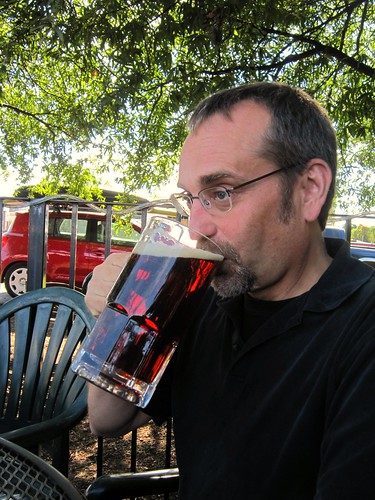
That's me (ungrammatical but colloquial) enjoying a
Maßkrug (High German for liter mug) of
Legend's Oktoberfest lager (redundant but didactic) outdoors at
Legend Brewing Company, at its brewery in Richmond, Virginia, seven years ago, on the 4th of September, 2010.
Americans use the synecdoche "
stein" to refer to a mug of beer. Germans do not. In German, "
stein" means "
stone." For a mug, a German would say "
Krug" or "
Seidel." A "Maßkrug" is a liter mug. A liter comprises 33.81 U.S. ounces or more than two U.S. pints; a
Maßkrug weighs about 5.5 U.S. pounds full. Despite my sober demeanor: giddy me!
The 'official' —and original
Oktoberfest— begins today in Munich, the capital of the state of Bavaria in Germany. The celebration traditionally runs for sixteen days counting backward from the first Sunday in October. Since the 1990s, however, if the sixteenth day falls before 3 October (which is
German Unity Day), the festival continues until and including the 3rd. Thus,
Oktoberfest this year —the festival's 184th iteration— comprises a full eighteen days: 16 September through 3 October.
Munich's name, by the way, is derived from the Old German term
Munichen, meaning "
by the monks," after Benedictine monks who founded a monastery in what would later become the city. Trappist monks —a later, stricter, offshoot of the Benedictine order— would become known in the 20th-century Belgium for their iconic eponymous ales.
-----more-----