Showing posts with label animal. Show all posts

Saturday, July 18, 2026

Pic(k) of the Week: Farewell, Charlie

Farewell, Charlie
  Click on the image for a larger, hi-res version (on Flickr).

We rescued Charlie in 2019. Even then, he had some gray in his muzzle. When we guessed he was about five years old, he didn't protest.

After many adventures and many years of unconditional companionship, Charlie has died. I will sorely miss my hiking/photography comrade.

10 July 2026.


***************

-----more-----

Saturday, July 13, 2024

Pic(k) of the Week: Master of his domain

Master of his domain

Waiting and watching,
The green frog sits atop the pond,
For the moment,
Master of his domain.

Postal Pond in Legacy Park: City of Decatur, Georgia, USA. 15 June 2024.
Lithobates clamitans —commonly known as the green frog— is a species of frog native to eastern North America. The two subspecies are the bronze frog and the northern green frog.

Green frogs usually have green heads while the body is brown, gray, or dark green. The green head can be more or less prominent on certain individuals. The belly is white with black mottling. Male green frogs in breeding condition have yellow throats. Green frogs are darker colored on colder days to help absorb heat. Adult green frogs range from 2 to 4 inches in body length (5–10 cm); the typical body weight is 1 to 3 ounces (28 to 85 g). The mating call of a green frog sounds like the single note of a plucked banjo.
Wikipedia.


***************

-----more-----

Saturday, June 01, 2024

Pic(k) of the Week: Stay in your lane, buddy!

Stay in your lane, buddy! An eastern box turtle on the trail (literally).

Three Creeks Trail in Ira B. Melton Park: DeKalb County, Georgia, USA. 21 May 2024.

Terrapene carolina carolina — commonly known as the the eastern box turtle— is native to the eastern United States. It is a subspecies within a group of hinge-shelled turtles normally called box turtles. While in the pond turtle family, Emydidae, and not a tortoise, the box turtle is largely terrestrial.

Eastern box turtles have a high, domelike carapace [upper body shell] which is normally brownish or black and accompanied by a yellowish or orangish radiating pattern of lines, spots, or blotches. Skin coloration, like that of the shell, is variable but is usually brown or black with some yellow, orange, red, or white spots or streaks. This coloration closely mimics that of the winter leaf of the tulip poplar tree.

Box turtles are slow crawlers, extremely long-lived, slow to mature, and have relatively few offspring per year. These characteristics, along with a propensity to get hit by cars and agricultural machinery, make all box turtle species particularly susceptible to anthropogenic, or human-induced, mortality. In 2011, citing 'a widespread persistent and ongoing gradual decline of Terrapene carolina that probably exceeds 32% over three generations,' the International Union for Conservation of Nature (IUCN) downgraded its conservation status from near threatened to vulnerable.
Wikipedia.


***************

-----more-----

Saturday, July 22, 2023

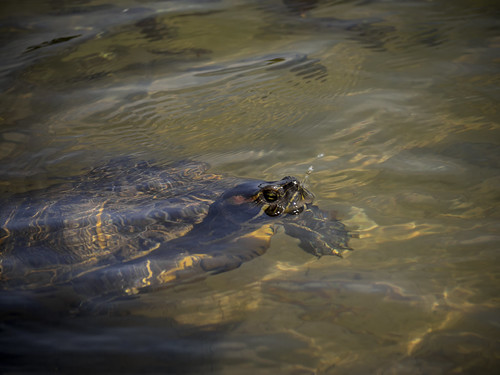
Pic(k) of the Week: Turtle, surfacing

Turtle, surfacing

A native red-eared slider turtle blows bubbles as she surfaces.

Seen at a wildlife sanctuary pond in St. Augustine Beach, Florida, USA. 3 July 2023.
The red-eared slider or red-eared terrapin (Trachemys scripta elegans) is a subspecies of the pond slider (Trachemys scripta), a semiaquatic turtle belonging to the family Emydidae. The red-eared slider is native from the Midwestern United States to northern Mexico, but has become established in other places because of pet releases, and has become invasive in many areas where it out-competes native species. The turtle gets its name from the small, red stripe around its ears, or where its ears would be, and from its ability to slide quickly off rocks and logs into the water.
Wikipedia.

-----more-----

Saturday, November 19, 2022

Pic(k) of the Week: Close encounters of the arachnid kind

Close encounters of the arachnid kind

A Jorō near-miss (in Legacy Park: Decatur, Georgia, USA, 12 November 2022).

It was a foggy early morning on the forest trail. I didn't see the expansive web —or its spinster— until I was about to run into it. I quickly ducked.

Backlit, the web might not have been visible in a photo and the spider, merely a silhouette. So, I popped up the in-camera flash. Not expecting this situation, I wasn't carrying a diffuser and the image might be a bit hot. Nonetheless, the arachnid appears well-limned in all her colorful glory.

As to the arachnid...
Trichonephila clavata —also known as the Jorō spider (ジョロウグモ)— is a member of the Trichonephila genus. The spider can be found throughout Japan (except Hokkaidō), Korea, Taiwan, and China. The spider is also an introduced species in North America —first spotted, in 2013, in northeast Georgia and northwest / upstate South Carolina. It is believed that the species will become naturalized over much of the eastern seaboard of the United States due to its relative imperviousness to the cold.

The adult female's body size is 2/3 to 1 inch (17–25 mm), while the male's is 1/4 to 2/5 inches (7–10 mm). The adult female individual has stripes of yellow and dark blue, with red toward the rear of the abdomen. The web of females may reach several meters in length. In sunlight, the yellow threads appear to be a rich gold color. In autumn, the smaller males may be seen in the webs for copulating. After mating, the female spins an egg sack on a tree, laying 400 to 1,500 eggs in one sack. Her lifecycle ends by late autumn or early winter with the death of the spider. The next generation emerges in spring.

Although the spider is not aggressive, it will bite to protect itself. The bite is considered painful, but not life-threatening.
Wikipedia.

-----more-----