Every year in September, an explosion of yellow flowers covers granite outcrops such as Arabia Mountain, Panola Mountain [and Stone Mountain]. These are yellow daisies (Helianthus porteri). Related to sunflowers, they are one of the fall wonders within the Arabia Mountain National Heritage Area.
Found in only 4 states — Georgia, Alabama, North Carolina, and South Carolina — the flowers are most common on the rocky outcrops of the Georgia Piedmont region, thriving in fragile solution pits — vernal pools that are often dry and sandy — found on bare rock faces.
On a guided morning hike, Preserve Manager 'Ranger Robbie' Astrove gave us some sad news. This autumn, he's seen fewer native autumnal yellow daisies than in any of his fifteen years as ranger at the park. The intense, sustained summer heat may have been to blame.
Astrove had a plan, however. He led us along a boardwalk at the base of the mountain. There, rains, flowing down the impervious granite-gneiss rockface, had irrigated the plants during summer, while towering trees at the base provided ample shade from harsh afternoon sun. So, despite an overall deficit, the autumnal daisies were in abundance here. “Nature's gonna nature,” Ranger Robbie told us.
Click on the image for a larger, hi-res version (on Flickr).
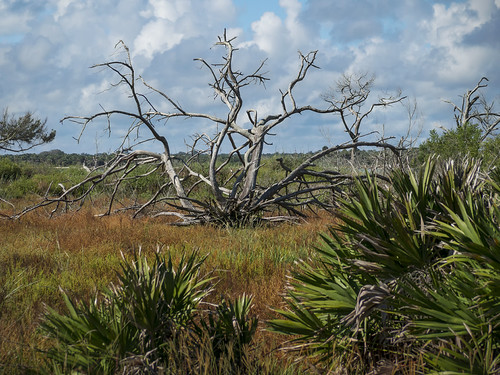
Framed by saw palmetto, a lone ghost tree stands, sered, in a salty tidal marsh of the Matanzas Inlet estuary.
St. Johns County (Palm Coast), Florida, USA.
9 September 2026.
***************
Matanzas Inlet
The Matanzas Inlet is a narrow, partially saltwater channel in the U.S. state of Florida — 14 miles (23 km) south of the city of St. Augustine — between two barrier islands and the mainland, connecting the Atlantic Ocean and the southern end of the Matanzas River estuary, comprising a coastal scrub environment and maritime forest. Part of the Atlantic Intracoastal Waterway, the Matanzas Inlet is the last remaining natural, or undredged, inlet on Florida's Atlantic coast.
A ghost forest is a coastal woodland characterized by widespread tree mortality as a result of saltwater intrusion and land submergence. Ghost forests commonly form when sea level rise, tectonic subsidence, or storm-driven coastal flooding increases soil salinity beyond the tolerance of freshwater tree species.The formation of ghost forests changes the surrounding ecology, often changing the deciduous forests into saltwater marshes or tidal wetlands.