Showing posts with label nature photography. Show all posts

Saturday, July 04, 2026

Pic(k) of the Week: Clover envy

Clover envy
  Click on the image for a larger, hi-res version (on Flickr).

Some call it a weed.
Feh!
That's clover envy.

A red clover wildflower (Trifolium pratense), blooming in spring.

East Decatur Greenway
DeKalb County, Georgia, USA.
18 May 2019.


***************
  • This is a close-up. The clover appears much larger in the image than it did in 'real' life. Somewhat paradoxically, photographers refer to this technique not as 'micro' but 'macro.'
  • To 'isolate' the blossom from the weedy background, I employed an off-camera flash. The light diminished quickly beyond the flower, producing a dark background.
  • Seven years ago, I submitted the photo to a YouTube photographer for critique. He dismissed it as too 'hot,' over-exposed by the flash. Looking at it now, I disagree...or, should I say, feh!

***************

-----more-----

Saturday, September 27, 2025

Pic(k) of the Week: Hawk on the PATH

Hawk on the PATH

Click on the image for a larger, hi-res version (on Flickr).

Perched only a few yards from a boardwalk over a wetland, a red-shouldered hawk (Buteo lineatus) was warily observing me from over its shoulder...but obligingly remained posed for the camera.

South Peachtree Creek PATH in Mason Mill Park: DeKalb County, Georgia, USA. 16 August 2025.


***************

Danny Gatton: Sky King
Album: Cruisin' Deuces (Label: Elektra, 1993)

-----more-----

Saturday, August 30, 2025

Pic(k) of the Week: River Oats on the Creek

River oats on the creek
Click on the image for a larger, hi-res version (on Flickr).

River oats in dappled morning light.

Cecilia Creek along the East Decatur Greenway: DeKalb County, Georgia, USA. 27 July 2025.

Chasmanthium latifolium — commonly known as river oats, inland sea oats, and wood oats — is a clump-forming, upright grass in the grass family (Poaceae), native to the central and eastern United States, growing in wooded areas and riparian zones.

River oats reach a height between 2 to 5 feet (⅔ - 1½ m) and a width of 1 to 2 feet (⅓ - ⅔ m). Their distinctive flat nodding seed heads resemble oats, emerging green in spring, turning tan in summer, and then purplish in fall. The bamboo-like leaves often turn yellow-gold in fall.

North Carolina Cooperative Extension.
Wikipedia.

***************

-----more-----

Saturday, September 28, 2024

Pic(k) of the Week: Tick clover, pondside

Tick clover, pondside

A small wildflower with a big name: panicled leaf tick trefoil.

Seen blooming on a bank of Postal Pond in Legacy Park: City of Decatur, Georgia, USA. 12 September 2024.

Is the trefoil a late-summer blossom or an early-autumn-er? You decide.
Hylodesmum is a genus of flowering plants in the family Fabaceae, sometimes called ticktrefoils or tick-trefoils. It is sometimes treated as part of Desmodium. It includes sixteen species native to eastern North America, sub-Saharan Africa, and southeast Asia.

Hylodesmum nudiflorum — previously known as Desmodium nudiflorum and commonly known as naked-flowered tick trefoil, panicled leaf tick trefoil, stemless tick trefoil, or naked-stemmed tick clover— is a species of perenial flowering plant in the legume family (Fabaceae), native to eastern North America. Hylodesmum nudiflorum is typically found in mature, open hardwood woodlands in moist, sandy, gravelly, or loamy soil with high organic content. It is a nitrogen-fixing species through symbiosis with soil-borne bacteria.

Hylodesmum nudiflorum's delicate pinkish blooms, ⅓-inch (0.8 cm), are sweetly fragrant, occurring mid to late summer, borne on leafless stems. Reminiscent of pea-like blooms, the flowers have a rounded upper petal and three narrower lower petals, longer than the upper.
North Carolina Cooperative Extension.
Wildflowers of the United States.
Wikipedia.


***************

Pink Martini: "Sympathique"

-----more-----

Saturday, June 01, 2024

Pic(k) of the Week: Stay in your lane, buddy!

Stay in your lane, buddy! An eastern box turtle on the trail (literally).

Three Creeks Trail in Ira B. Melton Park: DeKalb County, Georgia, USA. 21 May 2024.

Terrapene carolina carolina — commonly known as the the eastern box turtle— is native to the eastern United States. It is a subspecies within a group of hinge-shelled turtles normally called box turtles. While in the pond turtle family, Emydidae, and not a tortoise, the box turtle is largely terrestrial.

Eastern box turtles have a high, domelike carapace [upper body shell] which is normally brownish or black and accompanied by a yellowish or orangish radiating pattern of lines, spots, or blotches. Skin coloration, like that of the shell, is variable but is usually brown or black with some yellow, orange, red, or white spots or streaks. This coloration closely mimics that of the winter leaf of the tulip poplar tree.

Box turtles are slow crawlers, extremely long-lived, slow to mature, and have relatively few offspring per year. These characteristics, along with a propensity to get hit by cars and agricultural machinery, make all box turtle species particularly susceptible to anthropogenic, or human-induced, mortality. In 2011, citing 'a widespread persistent and ongoing gradual decline of Terrapene carolina that probably exceeds 32% over three generations,' the International Union for Conservation of Nature (IUCN) downgraded its conservation status from near threatened to vulnerable.
Wikipedia.


***************

-----more-----

Saturday, May 04, 2024

Pic(k) of the Week: Winter red bud

Winter red bud

A native 'Rising Sun' eastern redbud tree, blooming on a lazy day in late winter. Or was it early spring?

The Trailhead Community Park of the East Decatur Greenway in the City of Decatur, Georgia, USA. 7 March 2024.

Cercis canadensis —commonly known as the eastern redbud tree— is a large deciduous shrub or small tree in the legume family (Fabaceae), native to eastern North America from southern Michigan south to central Mexico, and as far west as New Mexico. It generally has a short, often twisted trunk and spreading branches.

The Rising Sun Redbud (Cercis canadensis ‘JN2’) is a smaller variety of the more common Eastern Redbud, growing only to about 8-12 feet in height (2.5-3.5 m). In early spring, the tree bursts into bloom before the leaves appear, with tiny, sweet pea-like flowers of lavender-pink hue. This spectacle is followed by the emergence of heart-shaped leaves, which start as a vibrant shade of apricot-orange. As the season progresses, the leaves transition through shades of yellow, gold, and finally, a rich, deep green.
Wikipedia.
Nature is a Blessing.


***************

-----more-----

Saturday, April 27, 2024

Pic(k) of the Week: Vernal honesty

Vernal honesty

Pastel delights
Singing aubade
In vernal chorus, assembled.

Wildflowers called honesty(!), blooming in mid-spring morning light.

Dearborn Park: City of Decatur, Georgia, USA. 20 April 2024.

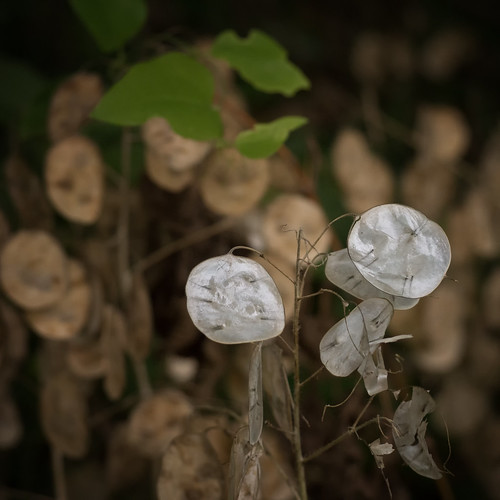
Lunaria annua —commonly known as annual honesty, dollar plant, honesty, lunaria, money plant, moneywort, moonwort, silver dollar— is a species of flowering plant in the cabbage and mustard family (Brassicaceae). It is native to southern Europe but is cultivated throughout the temperate world.

The plant grows up to 3 feet tall (90 cm). In spring and summer, it bears terminal racemes [short stalks] of white or violet flowers. The fruits appear in midsummer. They are paper-thin, flat, silver dollar-sized fruits, called siliques, that become white-translucent with age, resembling a full moon or coin, hence some of the common names of the plant. Another common name, 'honesty,' relates to the translucence of the plant's silique membranes, which 'truthfully' reveal their contents.
Wikipedia.
North Carolina Cooperative Extension.

Silver dollars


***************

-----more-----