Showing posts with label summer flora. Show all posts

Saturday, August 01, 2026

Pic(k) of the Week: Orange, then green

Orange, then green
Click on the image for a larger, hi-res version (on Flickr).

A native, wild trumpet creeper vine blooms in mid-summer, as seen from a vantage along the South Peachtree Creek Trail, on an elevated boardwalk over the wetlands of Burnt Fork Creek.

Mason Mill Park: DeKalb County, Georgia, USA.
21 July 2026.

Campsis radicans — commonly known as cow-itch, cow vine, devil's shoestring, foxglove vine, hellvine, hummingbird vine, trumpet creeper, trumpet vine — is a dense, vigorous, woody, deciduous, perennial vine in the trumpetvine family (Bignoniacea) that attaches itself to structures and climbs by aerial rootlets. It is native to the central and eastern United States, inhabiting woodlands and riverbanks (and growing on roadside telephone poles).

The trumpet creeper has clusters (terminal cymes) of orange to reddish-orange trumpet-shaped flowers, 3 inches long (8 cm), with a yellowish throat and 5 shallow lobes bending backward. They appear throughout the summer (June to September), and are very attractive to hummingbirds.

North Carolina Cooperative Extension.
Wikipedia.

***************

Freddie Hubbard: Open Sesame.

-----more-----

Saturday, July 25, 2026

Pic(k) of the Week: Under a twisting mulberry tree

Under a twisting mulberry tree
  Click on the image for a larger, hi-res version (on Flickr).

Thanks, thanks to thee, my worthy friend,
For the lesson thou hast taught. *

An old, gnarly red mulberry tree (Morus rubra) lives on.

Decatur Legacy Park
City of Decatur, Georgia, USA.
26 June 2026.


***************

-----more-----

Saturday, July 11, 2026

Pic(k) of the Week: Elegant zinnia

Elegant zinnia
  Click on the image for a larger, hi-res version (on Flickr).

A common zinnia flower blooms in a summer garden.

Briarlake Forest Park
DeKalb County, Georgia, USA.
6 July 2026.

Zinnia elegans — commonly known as common zinnia, elegant zinnia, and zinnia — is an annual flowering plant in the family Asteraceae. It is native to Mexico but naturalised in several places, including the United States.

The uncultivated plant grows to about 5½ inches in height (15 cm). It has solitary flower heads about 2 inches across (5 cm). The purple ray florets surround black and yellow discs. Flowering occurs during the summer months.

Zinnias are popular garden plants with hundreds of cultivars in many flower colours, sizes, and forms. The garden zinnia was bred via hybridisation from the wild form.

Wikipedia.
North Carolina Cooperative Extension.
Wikipedia.

***************

-----more-----

Saturday, September 06, 2025

Pic(k) of the Week: Jewelweed corolla

Jewelweed corolla

Click on the image for a larger, hi-res version (on Flickr).

Close-up blossom: just one in a riot of orange jewelweed wildflowers blooming on a woodland trail.

Mason Mill Park: DeKalb County, Georgia, USA. 21 August 2025.

Impatiens capensis — commonly known as jewelweed, orange jewelweed, touch-me-not — is an annual plant in the Balsaminaceae family, native to North America, growing in moist soil including forests, streambanks, and bogs.

Jewelweed is a herbaceous plant that grows 3 to 5 feet tall (0.9–1.5 m), branching extensively. The leaves are ovate, with shallow, rounded teeth on the margins. The plant blooms from late spring to early fall. The flowers are orange (sometimes yellow), ¾ to 1¼ inches long (2 to 3 cm), with a three-lobed corolla[collection of petals in a flower, sometimes in the form of a tube.]

The seed pods have five valves which coil back rapidly to eject the seeds in a process called explosive dehiscence, triggered by a light touch, hence the name 'touch-me-not.' Dew or rain beads on the leaves forming sparkling droplets that give rise to the common name of 'jewelweed.' "

North Carolina Cooperative Extension.
Wikipedia.

***************

-----more-----

Saturday, August 23, 2025

Pic(k) of the Week: Black-Eyed Susans on the PATH

Black-Eyed Susans on the PATH
Click on the image for a larger, hi-res version (on Flickr).

Native black-eyed Susan wildflowers bloom in a pollinator garden.

South Peachtree Creek Trail in Mason Mill Park: DeKalb County, Georgia, USA. 18 July 2025.

Rudbeckia hirta — commonly known as black-eyed Susan and yellow coneflower — is a flowering plant in the aster family (Asteraceae), native to eastern and central North America.

The plant grows to 3½ feet tall (1 m), blooming from late summer into early autumn. The flowers have daisy-like yellow heads, up to 4 inches in diameter (10 cm), with yellow ray florets circling a conspicuous brown or black dome-shaped cone, containing many small disc florets. The species epithet means 'hairy' and refers to short, stiff hairs on the leaves and stems. The genus name honors Olof Rudbeck, a 17th-century Swedish botanist.
Wikipedia.

***************

-----more-----

Saturday, August 09, 2025

Pic(k) of the Week: Woodland morning

Woodland morning
Click on the image for a larger, hi-res version (on Flickr).

Softly camouflaged,
Morning in the woodland
Fending the summer beast.

Melton Park: DeKalb County, Georgia, USA. 23 June 2025.


***************

-----more-----

Saturday, July 26, 2025

Pic(k) of the Week: Into the green

Into the green
Click on the image for a larger, hi-res version (on Flickr).

After the rain,
The urban duo
Goes into the green.

Trolley Trail in Gilliam Park: City of Atlanta (Kirkwood), Georgia, USA. 28 June 2025.


***************

Dexter Gordon: Cheesecake
Album: Go (Blue Note, 1962)

-----more-----

Saturday, November 30, 2024

Pic(k) of the Week: Turkeyfoot riffles

Turkeyfoot riffles

Riffles on Turkeyfoot Creek.
Serene, tranquil.
Urban cacophony, vanquished.

Cascade Springs Nature Preserve: City of Atlanta, Georgia, USA. 9 August 2024.


***************

-----more-----

Saturday, September 28, 2024

Pic(k) of the Week: Tick clover, pondside

Tick clover, pondside

A small wildflower with a big name: panicled leaf tick trefoil.

Seen blooming on a bank of Postal Pond in Legacy Park: City of Decatur, Georgia, USA. 12 September 2024.

Is the trefoil a late-summer blossom or an early-autumn-er? You decide.
Hylodesmum is a genus of flowering plants in the family Fabaceae, sometimes called ticktrefoils or tick-trefoils. It is sometimes treated as part of Desmodium. It includes sixteen species native to eastern North America, sub-Saharan Africa, and southeast Asia.

Hylodesmum nudiflorum — previously known as Desmodium nudiflorum and commonly known as naked-flowered tick trefoil, panicled leaf tick trefoil, stemless tick trefoil, or naked-stemmed tick clover— is a species of perenial flowering plant in the legume family (Fabaceae), native to eastern North America. Hylodesmum nudiflorum is typically found in mature, open hardwood woodlands in moist, sandy, gravelly, or loamy soil with high organic content. It is a nitrogen-fixing species through symbiosis with soil-borne bacteria.

Hylodesmum nudiflorum's delicate pinkish blooms, ⅓-inch (0.8 cm), are sweetly fragrant, occurring mid to late summer, borne on leafless stems. Reminiscent of pea-like blooms, the flowers have a rounded upper petal and three narrower lower petals, longer than the upper.
North Carolina Cooperative Extension.
Wildflowers of the United States.
Wikipedia.


***************

Pink Martini: "Sympathique"

-----more-----

Saturday, July 27, 2024

Pic(k) of the Week: Sputnik in the marsh

Sputnik in the marsh

Like nature's Sputnik,
A buttonbush blooms
Spike'd white
Standing on marshy ground.
Cephalanthus occidentalis —commonly known as buttonbush, common buttonbush, button-willow, buck brush, and honey-bells— is a species of flowering plant in the bedstraw family (Rubiaceae). Native to eastern and southern North America, it is a common shrub of many wetland habitats, including swamps, floodplains, mangroves, and moist forest understory.

Cephalanthus occidentalis is a deciduous shrub or small tree that averages 3 to 10 feet in height (1 to 3 m). Its flowers bloom in late spring and summer, arranged in a dense spherical inflorescence [cluster of flowers], ¾ to 1⅓ inches in diameter (2 to 3.5 cm), on a short peduncle [stalk supporting the inflorescence].
Wikipedia.

Photo taken in Constitution Lakes Park: DeKalb County, Georgia, USA. 12 July 2024.

***************

-----more-----

Saturday, September 03, 2022

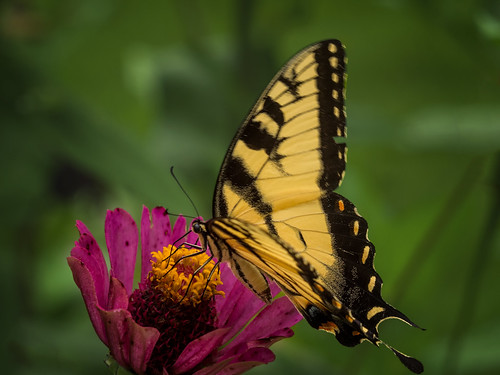
Pic(k) of the Week: Butterfly & zinnia

Butterfly & zinnia

In a summer garden, an eastern tiger swallowtail butterfly pollinates a zinnia flower.

DeKalb County, Georgia, USA. 11 August 2022.

-----more-----

Saturday, July 16, 2022

Pic(k) of the Week: Crocosmia in Georgia

Crocosmia in Georgia

South Africa invades the southeastern US!

Orange crocosmia, blooming wild and creek-side, on the East Decatur Greenway, in DeKalb County, Georgia, USA. 1 July 2022.
Crocosmia —also known as montbretia— is a small genus of flowering plants in the iris family, Iridaceae. It is native to the grasslands of southern and eastern Africa, ranging from South Africa to Sudan. The plants have colorful inflorescences of 4 to 20 vivid red and orange flowers on a horizontally branched stem, flowering from early summer well into fall.
Wikipedia.
-----more-----