Showing posts with label flower. Show all posts

Saturday, August 01, 2026

Pic(k) of the Week: Orange, then green

Orange, then green
Click on the image for a larger, hi-res version (on Flickr).

A native, wild trumpet creeper vine blooms in mid-summer, as seen from a vantage along the South Peachtree Creek Trail, on an elevated boardwalk over the wetlands of Burnt Fork Creek.

Mason Mill Park: DeKalb County, Georgia, USA.
21 July 2026.

Campsis radicans — commonly known as cow-itch, cow vine, devil's shoestring, foxglove vine, hellvine, hummingbird vine, trumpet creeper, trumpet vine — is a dense, vigorous, woody, deciduous, perennial vine in the trumpetvine family (Bignoniacea) that attaches itself to structures and climbs by aerial rootlets. It is native to the central and eastern United States, inhabiting woodlands and riverbanks (and growing on roadside telephone poles).

The trumpet creeper has clusters (terminal cymes) of orange to reddish-orange trumpet-shaped flowers, 3 inches long (8 cm), with a yellowish throat and 5 shallow lobes bending backward. They appear throughout the summer (June to September), and are very attractive to hummingbirds.

North Carolina Cooperative Extension.
Wikipedia.

***************

Freddie Hubbard: Open Sesame.

-----more-----

Saturday, July 11, 2026

Pic(k) of the Week: Elegant zinnia

Elegant zinnia
  Click on the image for a larger, hi-res version (on Flickr).

A common zinnia flower blooms in a summer garden.

Briarlake Forest Park
DeKalb County, Georgia, USA.
6 July 2026.

Zinnia elegans — commonly known as common zinnia, elegant zinnia, and zinnia — is an annual flowering plant in the family Asteraceae. It is native to Mexico but naturalised in several places, including the United States.

The uncultivated plant grows to about 5½ inches in height (15 cm). It has solitary flower heads about 2 inches across (5 cm). The purple ray florets surround black and yellow discs. Flowering occurs during the summer months.

Zinnias are popular garden plants with hundreds of cultivars in many flower colours, sizes, and forms. The garden zinnia was bred via hybridisation from the wild form.

Wikipedia.
North Carolina Cooperative Extension.
Wikipedia.

***************

-----more-----

Saturday, July 04, 2026

Pic(k) of the Week: Clover envy

Clover envy
  Click on the image for a larger, hi-res version (on Flickr).

Some call it a weed.
Feh!
That's clover envy.

A red clover wildflower (Trifolium pratense), blooming in spring.

East Decatur Greenway
DeKalb County, Georgia, USA.
18 May 2019.


***************
  • This is a close-up. The clover appears much larger in the image than it did in 'real' life. Somewhat paradoxically, photographers refer to this technique not as 'micro' but 'macro.'
  • To 'isolate' the blossom from the weedy background, I employed an off-camera flash. The light diminished quickly beyond the flower, producing a dark background.
  • Seven years ago, I submitted the photo to a YouTube photographer for critique. He dismissed it as too 'hot,' over-exposed by the flash. Looking at it now, I disagree...or, should I say, feh!

***************

-----more-----

Saturday, June 27, 2026

Pic(k) of the Week: Echinacea garden

Echinacea garden
  Click on the image for a larger, hi-res version (on Flickr).

Native purple coneflower wildflowers (aka echinacea) blooming in a pollinator garden.

City of Avondale Estates, Georgia, USA.
7 June 2026.

Echinacea is a genus of herbaceous flowering plants in the daisy family. It has ten species, which are commonly called coneflowers. They are native only in eastern and central North America, where they grow in wet to dry prairies and open wooded areas

Echinacea purpurea — commonly known as purple coneflower, eastern purple coneflower, purple coneflower, purple rudbeckia — is an herbaceous perennial in the Asteraceae (daisy) family that is native to the central and eastern United States. The Genus name is Greek for meaning 'spiny one' and the species name means reddish-purple.

It may grow 3 to 4 feet tall; attractive ray petals surround a center of dark purplish brown disc flowers in summer and are long-lasting through mid-fall. The plant prefers well-drained, moist loam but is adaptable to various soil types. It is drought tolerant once established and can grow in full sun to partial shade. It is also deer, heat, humidity, and salt resistant.

North Carolina Cooperative Extension.
Wikipedia.

***************

-----more-----

Saturday, June 20, 2026

Pic(k) of the Week: Hydrangea on creek

Hydrangea on creek
  Click on the image for a larger, hi-res version (on Flickr).

A wild bigleaf hydrangea shrub (Hydrangea macrophylla), illuminated by riparian morning light.

On Glenn Creek in Melton Park
DeKalb County, Georgia, USA.
23 May 2025.

Hydrangea macrophylla — commonly known as bigleaf hydrangea — is a species of flowering plant in the family Hydrangeaceae, native to Japan, that has become naturalised in the Americas. It is is a deciduous shrub growing to 10 feet tall (3 m) with large heads of pink or blue flowers in summer and autumn. The opposite, serrated leaves can grow to 6 inches (15 cm) in length.
Wikipedia.

***************

-----more-----

Saturday, June 13, 2026

Pic(k) of the Week: Jerusalem artichoke...in Georgia!

Jerusalem artichoke...in Georgia!
  Click on the image for a larger, hi-res version (on Flickr).

A native Jerusalem artichoke blooms in an urban meadow.

East Decatur Greenway
DeKalb County (Forrest Hills), Georgia, USA.
4 June 2026.

Helianthus tuberosus — commonly known as Jerusalem artichoke, sunchoke, sunroot, wild sunflower, or earth apple — is an herbaceous perennial edible root vegetable that is a species of sunflower in the Asteraceae family. It is native to the eastern and central United States and parts of Canada.

Helianthus tuberosus grows 5 to 10 feet tall (1.5–3 m). The leaves have a rough, hairy texture. The flowers are yellow, 2-4 inches in diameter ( 5–10 cm), with 10–20 ray florets and 60 or more small disc florets. The flowers are briefly fragrant, giving off a light, vanilla-chocolate perfume.

The plant's tubers are edible, similar in texture to water chestnuts, with a nutty flavor. They may be boiled, mashed, roasted like potatoes, or eaten raw. They do not contain starch like potatoes; instead contain inulin, which converts to fructose, and may be tolerated better by diabetics. The knobby tubers are harvested in the fall, approximately two weeks after the flowers fade (October-December).

Despite its common name, Jerusalem artichoke is not an artichoke and not associated with the city of Jerusalem. The 'artichoke' in its name comes from its similar taste. 'Jerusalem' is believed to be a corruption of the Italian word 'girasole,' meaning sunflower. Italian settlers in the United States likely referred to the plant as girasole because it resembled sunflowers.

North Carolina State Cooperative Extension.
Wikipedia.

***************

Freddie Hubbard: Little Sunflower

-----more-----

Saturday, June 06, 2026

Pic(k) of the Week: Coreopsis lanceolata

Coreopsis lanceolata
  Click on the image for a larger, hi-res version (on Flickr).

A field of native lanceleaf coreopsis (coreopsis lanceolata), initially planted along a city street, now blooming wild every spring season.

DeKalb County, Georgia, USA.
5 May 2026.

Seen along (and planted by) the East Decatur Greenway (part of a 342-mile network of off-road trails in and around the metro Atlanta, Georgia area, built and maintained by the non-profit PATH Foundation for walkers, runners, skaters, and cyclists).

Coreopsis lanceolata — commonly known as lanceleaf coreopsis, lanceleaf tickseed, lance-leaved coreopsis, or sand coreopsis — is a North American wildflower, a species of tickseed in the Asteraceae (daisy) family, native to the south-central US. It typically grows to 2 feet tall (60 cm) in prairies, glades, fields, and roadsides, thriving in sandy and rocky soils. The plant produces yellow flower heads singly at the top of a naked flowering stalk, each head containing both ray florets and disc florets. Each flower measures 2-3 inches across (5–8 cm).

The genus name comes from the Greek words koris meaning "bug" and opsis meaning "like" in reference to the shape of the seed which resembles a bug or tick. The specific epithet means lance-shaped referring to the leaves.

North Carolina State Cooperative Extension.
Wikipedia.

***************

Lee Morgan: Häschen

-----more-----

Saturday, May 09, 2026

Pic(k) of the Week: Poppy field

Poppy field
  Click on the image for a larger, hi-res version (on Flickr).

In early morning, wild red poppies (Papaver rhoeas) bloom in an urban meadow.

Seen along the 19-mile Stone Mountain Trail — here, located on the Eastern Continental Divide in the City of Clarkston, Georgia, USA.

13 April 2026.


***************

-----more-----

Saturday, March 28, 2026

Pic(k) of the Week: Hibernal narcissus

Hibernal narcissus
Click on the image for a larger, hi-res version (on Flickr).

An obligatory annual photo of a daffodil.
— or —
I can't resist taking a portrait of a narcissus in late winter!

The large daffodil — white with a central white 'trumpet'— is an Ice Follies cultivar; the smaller are Jetfire cultivars — yellow with orange 'trumpets' *. All, I admired and photographed in a private garden in DeKalb County, Georgia, USA, on 3 March 2026.


***************

Lee Morgan: Ceora
Album: Cornbread
Label: Bluenote (Recorded: 1965 | Released: 1967)

-----more-----

Saturday, March 21, 2026

Pic(k) of the Week: Trout lily ephemeral

Trout lily ephemeral
Click on the image for a larger, hi-res version (on Flickr).

Ephemeral beauty on a winter forest floor: a native wildflower, the trout lily, blooms on Arabia Mountain.

After a 13-kilometer hike on the mountain, I was less than half a kilometer from my parked car when I stumbled upon this cluster of trout lilies blooming on the side of the Mile Rock Trail. To say that I was delighted AND surprised would be an understatement.

This is a close-up. The blossom appears larger in the image than it did in 'real life.'

DeKalb County, Georgia, USA.
28 February 2026.


***************

About the Dimpled Trout Lily

Erythronium umbilicatum — commonly known as the dimpled trout lily — is a species of perennial flowering plant in the lily family (Liliaceae), native to the southeastern United States, primarily in the piedmont and southern Appalachian areas. It is a spring ephemeral [i.e., short-lived] and its preferred habitat is forests.

Erythronium umbilicatum has green, mottled leaves that are up to 8 inches long (20 cm). The scape [i.e., long, leafless flowering stem] is up to 8 inches long (20 cm), bearing a single, nodding, lily-like flower on a 5 to 8-inch stalk (12-20 cm) with 6 petals, yellow on the inside and streaked brownish-purple on the outside, that recurve backward. The conspicuous stamens are brownish-purple in color. The flower blooms in late winter/early spring before the surrounding trees leaf out and cast shade.

North Carolina Cooperative Extension.
Wikipedia.


***************

Clifford Brown: Sandu
Album: Study in Brown (Label: EmArcy, 1955)

-----more-----

Saturday, February 21, 2026

Pic(k) of the Week: Winter speedwell

Winter speedwell
Click on the image for a larger, hi-res version (on Flickr).

In deep winter, a tiny birdseye speedwell (Veronica persica) blooms during a 'false' (22 °C!) spring.

East Decatur Greenway
City of Decatur, Georgia, USA.
9 January 2026.

This is a close-up. The blossom — maybe 0.4 inches wide (1 cm) — appears much larger in the image than it did in 'real' life.


***************

Walter Piston:
The Incredible Flutist (Tango of the Merchant's Daughters)
Album:
Piston: Symphony No. 6, The Incredible Flutist, 3 New England Sketches
(Label: RCA Victor Red Seal, 1991)

-----more-----

Saturday, January 17, 2026

Pic(k) of the Week: Winter catkin

Winter catkin
Click on the image for a larger, hi-res version (on Flickr).

Yellow catkins hang,
Crimson buds portend,
Winter shrub un-slumber'd.

Male flowers of a hazel alder tree (Alnus serrulata).

Arabia Lake in Arabia Mountain Nature Preserve
DeKalb County, Georgia, USA.
8 February 2023.

A catkin is a slim, cylindrical flower cluster (a spike), with inconspicuous or no petals, usually wind-pollinated (anemophilous) but sometimes insect-pollinated. It contains many, usually unisexual flowers, arranged closely along a central stem that is often drooping. Catkin-bearing plants include many trees or shrubs such as birch, willow, aspen, hickory, sweet chestnut, and sweetfern. In many of these plants, only the male flowers form catkins, and the female flowers are single (hazel, oak), a cone (alder), or other types (mulberry). While the blooming months for catkins may vary due to factors such as climate change and latitude, the following are some general timeframes: hazel catkins bloom from January to March, alder catkins from February to March, silver birch catkins from March to May, oak catkins from April to May, and white willow catkins from April to May.
Wikipedia.

***************

Phineas Newborn Jr.: Celia (composition by Bud Powell)
Album: Here Is Phineas (Label: Atlantic (1956)

-----more-----

Saturday, September 06, 2025

Pic(k) of the Week: Jewelweed corolla

Jewelweed corolla

Click on the image for a larger, hi-res version (on Flickr).

Close-up blossom: just one in a riot of orange jewelweed wildflowers blooming on a woodland trail.

Mason Mill Park: DeKalb County, Georgia, USA. 21 August 2025.

Impatiens capensis — commonly known as jewelweed, orange jewelweed, touch-me-not — is an annual plant in the Balsaminaceae family, native to North America, growing in moist soil including forests, streambanks, and bogs.

Jewelweed is a herbaceous plant that grows 3 to 5 feet tall (0.9–1.5 m), branching extensively. The leaves are ovate, with shallow, rounded teeth on the margins. The plant blooms from late spring to early fall. The flowers are orange (sometimes yellow), ¾ to 1¼ inches long (2 to 3 cm), with a three-lobed corolla[collection of petals in a flower, sometimes in the form of a tube.]

The seed pods have five valves which coil back rapidly to eject the seeds in a process called explosive dehiscence, triggered by a light touch, hence the name 'touch-me-not.' Dew or rain beads on the leaves forming sparkling droplets that give rise to the common name of 'jewelweed.' "

North Carolina Cooperative Extension.
Wikipedia.

***************

-----more-----

Saturday, August 23, 2025

Pic(k) of the Week: Black-Eyed Susans on the PATH

Black-Eyed Susans on the PATH
Click on the image for a larger, hi-res version (on Flickr).

Native black-eyed Susan wildflowers bloom in a pollinator garden.

South Peachtree Creek Trail in Mason Mill Park: DeKalb County, Georgia, USA. 18 July 2025.

Rudbeckia hirta — commonly known as black-eyed Susan and yellow coneflower — is a flowering plant in the aster family (Asteraceae), native to eastern and central North America.

The plant grows to 3½ feet tall (1 m), blooming from late summer into early autumn. The flowers have daisy-like yellow heads, up to 4 inches in diameter (10 cm), with yellow ray florets circling a conspicuous brown or black dome-shaped cone, containing many small disc florets. The species epithet means 'hairy' and refers to short, stiff hairs on the leaves and stems. The genus name honors Olof Rudbeck, a 17th-century Swedish botanist.
Wikipedia.

***************

-----more-----

Saturday, May 31, 2025

Pic(k) of the Week: Dwarf crested iris

Dwarf crested iris
Click on the image for a larger, hi-res version (on Flickr).

A native dwarf crested iris (Iris cristata) wildflower, blooming creekside.

Trailhead Community Park of the East Decatur Greenway in the City of Decatur, Georgia, USA. 7 May 2025.

Iris cristata (also known as dwarf crested iris and crested iris) is a species in the genus Iris, and is part of the subgenus of Limniris (bearded iris). It is a rhizomatous perennial plant, endemic to the eastern United States. Purple blossoms arise on a stalk above the 4 to 8 inch tall leaves. There are 3 unmarked petals; the yellow, fluted crest is on each of three sepals. It is usually found in colonies of several to many plants, growing in chalky soil, in oak woodlands, on rocky hillsides, in ravines, and along streams.
Wildflowers of the United States
Wikipedia

***************

McCoy Tyner: Love Surrounds Us
Album: Uptown Downtown (Milestone, 1989)

-----more-----

Saturday, May 24, 2025

Pic(k) of the Week: Clarkston poppies

Clarkston poppies
Click on the image for a larger, hi-res version (on Flickr).

Brilliant red poppies (Papaver rhoeas) bloom in an urban wildflower meadow planted along a CSX railroad track.

Stone Mountain Trail: City of Clarkston, Georgia, USA. 13 May 2025.


***************

Hank Mobley: This I Dig Of You
Album: Soul Station (Blue Note, 1960)

-----more-----

Saturday, May 25, 2024

Pic(k) of the Week: Lanceleaf coreopsis (sepals & petals)

Lanceleaf coreopsis (sepals & petals)

A native lanceleaf coreopsis wildflower blooms in May in the Trailhead Community Park of the East Decatur Greenway.

City of Decatur, Georgia, USA. 5 May 2024.
Coreopsis lanceolata —commonly known as lanceleaf coreopsis and lanceleaf tickseed— is a species of tickseed in the aster family (Asteraceae). It is native to the eastern and central parts of the United States, growing in open woodlands, prairies, plains, glades, meadows, and savannas.

Coreopsis lanceolata is a perennial plant sometimes attaining a height of over 2 feet (60 cm). April through June, it produces yellow flower heads singly at the top of a naked flowering stalk, each head containing both ray florets and disc florets. Each flower measures 2 to 3 inches across (5–8 cm).

The genus name 'Coreopsis' means 'bug-like'; it —as well as the common name, 'tickseed'— comes from the fact that the seeds are small and resemble ticks. The specific epithet 'lanceolata' refers to the shape of the leaves: narrow and lance-shaped.
Wikipedia.


-----more-----

Saturday, May 11, 2024

Pic(k) of the Week: Small Venus' looking-glass

Small Venus' looking-glass

Look down! It's a tiny, native 'weed' with a sublime name:
"Small Venus' Looking-Glass."

Seen blooming alongside a sidewalk in the City of Avondale Estates, Georgia, USA. 6 May 2024.
Triodanis perfoliata — commonly known as Clasping bellflower, Clasping bellwort, or Small Venus' looking-glass — is a small, annual flowering plant belonging to the bellflower family (Campanulaceae), native to North and South America (from Canada to Argentina). It grows in prairies, along the edges of woods and rocky outcrops, and in disturbed soil, such as roadsides [and sidewalks!].

Triodanis perfoliata grows to a height of 4-18 inches (10–46 cm). On the upper part of the stem, the plant produces bell-shaped five-petaled flowers, approximately ½ inch or less across (1.3 cm), that range in color from blue-violet to pink-purple to lavender, with a white center. There are also flowers on the lower part of the stem but they do not open. These are cleistogamous — automatic self-pollinators that produce seeds.
Wikipedia
North Carolina Cooperative Extension


***************

-----more-----

Saturday, April 27, 2024

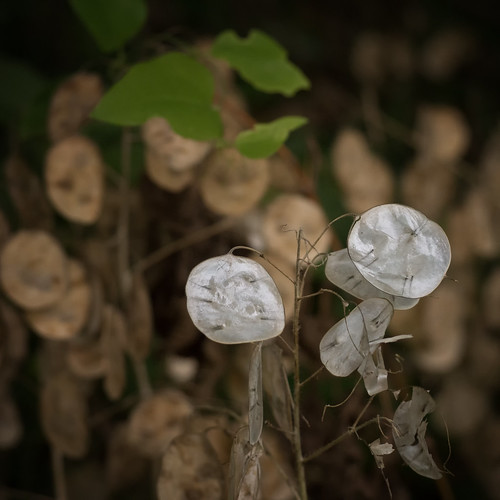
Pic(k) of the Week: Vernal honesty

Vernal honesty

Pastel delights
Singing aubade
In vernal chorus, assembled.

Wildflowers called honesty(!), blooming in mid-spring morning light.

Dearborn Park: City of Decatur, Georgia, USA. 20 April 2024.

Lunaria annua —commonly known as annual honesty, dollar plant, honesty, lunaria, money plant, moneywort, moonwort, silver dollar— is a species of flowering plant in the cabbage and mustard family (Brassicaceae). It is native to southern Europe but is cultivated throughout the temperate world.

The plant grows up to 3 feet tall (90 cm). In spring and summer, it bears terminal racemes [short stalks] of white or violet flowers. The fruits appear in midsummer. They are paper-thin, flat, silver dollar-sized fruits, called siliques, that become white-translucent with age, resembling a full moon or coin, hence some of the common names of the plant. Another common name, 'honesty,' relates to the translucence of the plant's silique membranes, which 'truthfully' reveal their contents.
Wikipedia.
North Carolina Cooperative Extension.

Silver dollars


***************

-----more-----

Saturday, March 16, 2024

Pic(k) of the Week: Winter speedwell

Winter speedwell

Look down! Tiny blue winter speedwell blossoms have popped up, low down, in large numbers, seemingly overnight. So small, so unassuming, and, yes, some might say, so weedy.

Lanier Gardens Park: Avondale Estates, Georgia, USA. 24 February 2022.

I've so often walked by over ubiquitous winter speedwell, paying no heed, until one winter afternoon, when I felt the need to get down on the ground and look at them on their level.

My clothes became muddied; I probably received bemused glances from motorists passing close by this tiny strip of streetside greenspace. But there I lay, taken aback by these blossoms' miniature elegance: flowers for a fairy's garden.
Veronica persica —commonly known as birdeye speedwell, common field-speedwell, Persian speedwell, large field speedwell, bird's-eye, or winter speedwell— is a flowering plant in the plantain family (Plantaginaceae). It is native to Eurasia and is widespread as an introduced species elsewhere, including North America. The short-stalked leaves are broadly ovate with coarsely serrated margins, and measure one to two centimeters (0.4 to 0.8 inches) long. The flowers are roughly one centimeter (0.4 inches) wide and are sky-blue in color with dark stripes and white centers.
Wikipedia.


***************

-----more-----