Showing posts with label poetry. Show all posts

Saturday, July 25, 2026

Pic(k) of the Week: Under a twisting mulberry tree

Under a twisting mulberry tree
  Click on the image for a larger, hi-res version (on Flickr).

Thanks, thanks to thee, my worthy friend,
For the lesson thou hast taught. *

An old, gnarly red mulberry tree (Morus rubra) lives on.

Decatur Legacy Park
City of Decatur, Georgia, USA.
26 June 2026.


***************

-----more-----

Saturday, January 10, 2026

Pic(k) of the Week: Gnarly tree in winter

Gnarly tree
Click on the image for a larger, hi-res version (on Flickr).

Nature as artist;
Tree as canvas.
A winter portrait.

A January pine tree on Stone Mountain.

Stone Mountain Park: DeKalb County, Georgia, USA.
16 January 2017.

Looking back through the portfolio can occasionally reveal a hidden gem, such as this painterly arboreal portrait. Well done, nine-year-younger Thomas!


***************

Freddie Hubbard: Karioka (composition by Kenny Dorham)
Album: Goin' Up (Label: Blue Note (recorded 1960; released 1961)

-----more-----

Saturday, April 19, 2025

Pic(k) of the Week: Tree over hill

Tree over hill

A tree comes into blossom
Over a dun hill.
A moment recursive
In Brigid's turn.

A municipal golf course, as seen from the Stone Mountain Trail in Candler Park of the city of Atlanta, Georgia, USA. 21 March 2025.


***************


Nina Simone: My Baby Just Cares for Me
Album: Little Girl Blue (Bethlehem Records, 1959)

-----more-----

Saturday, February 01, 2025

Pic(k)of the Week: Underfoot

Underfoot

Every time I walk down
into the hollow
through the winter woods
or up the mountain again,
I stop right here.
Standing on the packed earth
at an old logging road
where the creek slips quietly
through its rusty culvert
underfoot,
I'm not so much listening as feeling
a kind of tickling caress
through the soles of my shoes
and I recognize
a crossing of paths, a choice,
a way back,
if I could only turn
and follow.

Underfoot
Stephen Wing (Atlanta, Georgia)

There were no logging roads or mountains in the parkland of this cemetery...but there were a creek and a culvert, hilly inclines, winter woods, a crossing of paths...and, considering the solemnity of the surroundings, places, like this, where one could quietly contemplate the feel of the earth underfoot.

Decatur Cemetery: City of Decatur, Georgia, USA. 25 January 2025.

***************

Teddy Wilson: Sweet Lorraine

-----more-----

Saturday, September 07, 2024

Pic(k) of the Week: Umbrella in foliage

Umbrella in foliage

Umbrella in foliage,
Under summer rain.
Tableau at the park.

Mason Mill Park: DeKalb County, Georgia, USA. 25 July 2024.

On 12 August 2024, Flickr's editors selected the image (as one of five hundred) for inclusion in Flickr's daily Explore feature.

***************

-----more-----

Saturday, April 27, 2024

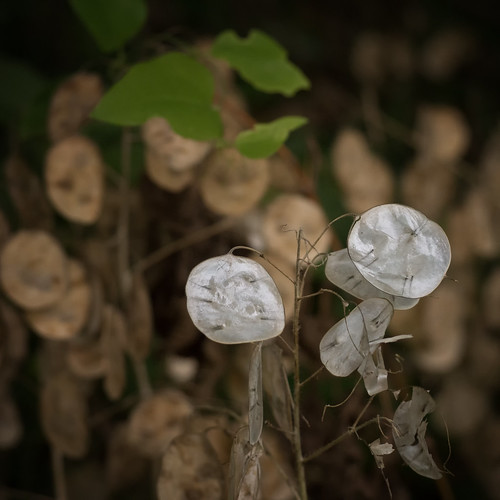
Pic(k) of the Week: Vernal honesty

Vernal honesty

Pastel delights
Singing aubade
In vernal chorus, assembled.

Wildflowers called honesty(!), blooming in mid-spring morning light.

Dearborn Park: City of Decatur, Georgia, USA. 20 April 2024.

Lunaria annua —commonly known as annual honesty, dollar plant, honesty, lunaria, money plant, moneywort, moonwort, silver dollar— is a species of flowering plant in the cabbage and mustard family (Brassicaceae). It is native to southern Europe but is cultivated throughout the temperate world.

The plant grows up to 3 feet tall (90 cm). In spring and summer, it bears terminal racemes [short stalks] of white or violet flowers. The fruits appear in midsummer. They are paper-thin, flat, silver dollar-sized fruits, called siliques, that become white-translucent with age, resembling a full moon or coin, hence some of the common names of the plant. Another common name, 'honesty,' relates to the translucence of the plant's silique membranes, which 'truthfully' reveal their contents.
Wikipedia.
North Carolina Cooperative Extension.

Silver dollars


***************

-----more-----

Saturday, March 23, 2024

Pic(k) of the Week: Double sonata

Double sonata

Framed in a window,
Boccherini, as the sun fell,
Dreaming a double sonata.

Seen in the upper windows of a violin shop in Avondale Estates, Georgia, USA, on the afternoon of 21 February 2024.


***************

-----more-----

Saturday, October 07, 2023

Pic(k) of the Week: The Final Out

The Final Out

Let me sit in the ball park
cap turned backwards and
praying for a rally. I need
the sun and sweat to remind
me how much I love the game,
how each year it comes down,
to the last inning, the final out.
 — Baseball
(Simon and Schuster, 2018)

Baseball's playoffs began this week; the World Series championship is to be played later in the month. It's autumn. The wait-for-tomorrows of spring and summer are no more. All that remains is the "final out."

No baseballs were harmed —or staged— during the shoot.

***************

-----more-----

Saturday, January 21, 2023

Pic(k) of the Week: Light as storm passes

Light as storm passes
i am afraid of what happens
when it stops storming this way round
when the clouds have blown,
and all that is left are me and my prayers for rain.
i'm trying to enjoy the thunder while it lasts,
but it's hard not to miss a storm before it leaves.
Ryan Jones
a bop for rayden

Poem seen in Georgia Poetry in the Parks. Sunset seen after a violent storm in Decatur, Georgia, USA, 12 January 2023.

-----more-----

Saturday, January 29, 2022

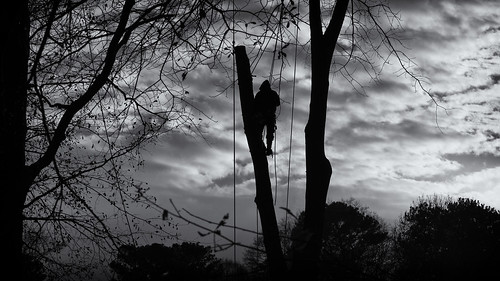
Pic(k) of the Week: To fell a tree

To fell a tree

To fell a tree.
Hooded,
An arborist in silhouette.


Decatur, Georgia, USA. 30 December 2020.

-----more-----

Saturday, December 12, 2020

Pic(k) of the Week: Poetry, in repose

Poetry, in repose

The gardens of our lives
Were our Family and the Arts.
We live on -
While our precious legacies
Continue to bloom and flourish.

This small bronze sculpture —of a young girl reading a book— sits atop a small stone pedestal in Cator Woolford Gardens, just east of Atlanta, Georgia, USA.

The poem above is carved into the open pages of the book. The sculpture itself is named Poetry. A plaque below reads: "Dedicated on June 12, 2002, in loving memory of [sisters] Isabelle Woolford Kennedy and Charlotte Woolford Crawley." The artist is Teena Marie Stern (of whom I've found little information).

A peaceful moment. 10 December 2020.

-----more-----

Saturday, October 10, 2020

Pic(k) of the Week: Life, what is it but a dream?

Ocoee River (at Big Creek) 02
In a Wonderland they lie,
Dreaming as the days go by,
Dreaming as the summers die;

Ever drifting down the stream
Lingering in the golden gleam
Life, what is it but a dream?

Lewis Carroll

Pictured: raft put-in on the Ocoee River near Archville, Tennessee, USA, in the Cherokee National Forest.

Photo taken 8 September 2018.
Poem excerpt from 1871.

-----more-----

Saturday, August 24, 2019

Pic(k) of the Week: Tiny tri-tone

Tiny tri-tone
So gradual in those summers was the going
of the age it seemed that the long days setting out
when the stars faded over the mountains were not
leaving us
even as the birds woke in full song and the dew
glittered in the webs it appeared then that the clear morning
opening into the sky was something of ours
to have and keep and that the brightness we could not touch
and the air we could not hold had come to be there all the time
for us and would never be gone and that the axle
we did not hear was not turning when the ancient car
coughed in the roofer’s barn and rolled out echoing
first thing into the lane and the only tractor
in the village rumbled and went into its rusty
mutterings before heading out of its lean-to
into the cow pats and the shadow of the lime tree
we did not see that the swallows flashing and the sparks
of their cries were fast in the spokes of the hollow
wheel that was turning and turning us taking us
all away as one with the tires of the baker’s van
where the wheels of bread were stacked like days in calendars
coming and going all at once we did not hear
the rim of the hour in whatever we were saying
or touching all day we thought it was there and would stay
it was only as the afternoon lengthened on its
dial and the shadows reached out farther and farther
from everything that we began to listen for what
might be escaping us and we heard high voices ringing
the village at sundown calling their animals home
and then the bats after dark and the silence on its road
W.S. Merwin: The Speed of Light.

A tiny tri-tone —maybe 1 centimeter wide— was nearly hidden in the underbrush. By the following day, it had withered.

DeKalb County, Georgia. 20 July 2019.

-----more-----

Saturday, February 16, 2019

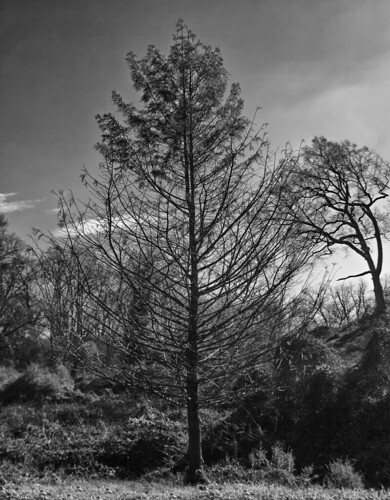
Pic(k) of the Week: Riparian tree in winter

Riparian tree in winter

Roots stretched down the bank;
Arms twisted up, some yet frocked. 
Calm tenacity. 

Winter of 2018/2019, on Sugar Creek, in the Kirkwood neighborhood of Atlanta, Georgia.

-----more-----

Saturday, February 02, 2019

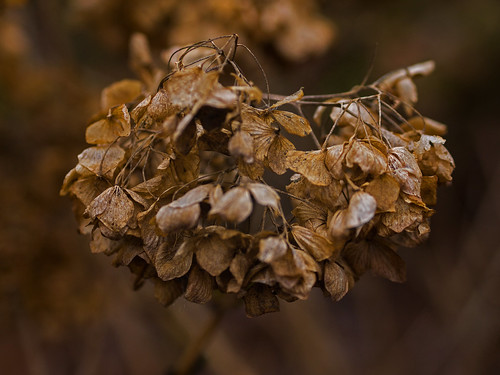
Pic(k) of the Week: Farewell, hydrangea

Farewell, hydrangea

Farewell, hydrangea,
Erstwhile companion.
Dead in winter,
Your corymbs tattered
Yet hanging on.

Atlanta (Edgewood), Georgia. 20 January 2019.

-----more-----

Saturday, December 01, 2018

Pic(k) of the Week: Mist on the Fen.

Mist on the fen

A veil draped on the fen.
Familiar became wunderlich.
The quiet ... loud.

And it was 'chilled.'

At seven, Sunday morning, 25 November 2018, in Atlanta, Georgia's Gilliam Park.

-----more-----

Wednesday, August 16, 2017

"And beer is all there is."


I don't know how many bottles of beer
I have consumed while waiting for things 
to get better
I dont know how much wine and whisky
and beer
mostly beer
I have consumed after 
splits with women-
waiting for the phone to ring
waiting for the sound of footsteps,
and the phone to ring
waiting for the sounds of footsteps,
and the phone never rings
until much later
and the footsteps never arrive
until much later
when my stomach is coming up
out of my mouth
they arrive as fresh as spring flowers:
"what the hell have you done to yourself?
it will be 3 days before you can fuck me!"

the female is durable
she lives seven and one half years longer
than the male, and she drinks very little beer
because she knows its bad for the figure.

while we are going mad
they are out
dancing and laughing
with horney cowboys.

well, there's beer
sacks and sacks of empty beer bottles
and when you pick one up
the bottle fall through the wet bottom
of the paper sack 
rolling
clanking
spilling gray wet ash
and stale beer,
or the sacks fall over at 4 a.m.
in the morning
making the only sound in your life.

beer
rivers and seas of beer
the radio singing love songs
as the phone remains silent
and the walls stand
straight up and down
and beer is all there is.

***************
Beer
Love is A Dog From Hell (published, 1977)

Charles Bukowski (16 August 1920 – 9 March 1994)
German-American poet and novelist

Charles Bukowski (1920-1994)

-----more-----

Tuesday, October 25, 2016

Shakespeare, Mom, and the World Series

In 1948, my Nana and my mother, then a young lady, were on their way, by train, from Brooklyn to visit relatives in Chicago. They stopped for a train change in Cleveland. A porter approached, offering to carry their bags. "What do you think of the Indians," he asked my mother. "You have Indians in Cleveland?" she innocently asked, surprised. In disgust, the porter put down their bags and walked away.

The Cleveland (baseball) Indians would go on to win the World Series that year, defeating the Boston Braves. It would be, in fact, the last season in which Cleveland would win the World Series (until?).

On whether they or their opponent, the Chicago Cubs —last winners of a World Series over a century ago, in 1908, long suffering under a caprine curse— win this October, I take no public stance. My beloved Washington Nationals were, after all, swatted away in the post-season (1924 being the last time they, in an earlier iteration, won the world championship).

And yet, I will watch and root against history. And I will take note that today, Game 1 of the 112th Fall Classic, falls on St. Crispin Day (outfielder Coco Crisp, notwithstanding), a feastday for which William Shakespeare —possibly with the ghost-writing assistance of Christopher Marlowe— penned what might be the ultimate pep talk ... if not originally for a baseball game.


This story shall the good man teach his son;
And Crispin Crispian shall ne'er go by,
From this day to the ending of the world,
But we in it shall be remembered-
We few, we happy few, we band of brothers;
For he to-day that sheds his blood with me
Shall be my brother; be he ne'er so vile,
This day shall gentle his condition;
And gentlemen in America [my apology, Mr. Shakespeare] now a-bed
Shall think themselves accurs'd they were not here,
And hold their manhoods cheap whiles any speaks
That fought with us upon Saint Crispin's day.

October can be the loveliest month. Angst and joy, but (hopefully) no bloodshed. Talk beer, tomorrow. Play ball, tonight.

-----more-----

Monday, September 22, 2014

Farewell, summer. Tonight at 10:29, it's the Autumnal Equinox.

I trod upon my carpet of gold,
While the reds, the browns, and the enduring greens
Bespeckle the pathway beneath my feet,
Casting autumn's prism in all its glory.
Verse by Genovaite Ambraziejus Cizauskas, my mother.

Autumn Leaves

Tonight, at 10:29 PM Eastern Daylight Time (2:29 Universal Time), it will be the exact moment at which the Autumnal (or September) Equinox will occur. And, at that moment, autumn will have begun (or spring, in the southern hemisphere).
At the instant of the September equinox, the midday sun will be shining straight overhead at the equator. As the September equinox sun crosses the equator, going from north to south, it’ll signal the beginning of autumn in the Northern Hemisphere and spring in the Southern Hemisphere. On the day of the equinox, the sun rises due east and sets due west all over the world, with everyone worldwide receiving the same amount of day and night. By October, however, that’ll change dramatically. By then, the sun will rise noticeably south of due east and will set noticeably south of due west. That’ll mean shorter days and longer nights for the Northern Hemisphere, yet longer days and shorter nights in the Southern Hemisphere.
EarthSky


Nuts (02)


Why do leaves change color in autumn?
As the autumn days grow shorter, the reduced light triggers chemical changes in deciduous plants causing a corky wall to form between the twig and the leaf stalk. This "abscission layer" eventually causes the leaf to drop off in the breeze. As the corky cells multiply, they seal off the vessels that supply the leaf with nutrients and water and also block the exit vessels, trapping simple sugars in the leaves. The combination of reduced light, lack of nutrients, and no water add up to the death of the pigment chlorophyll, the "green" in leaves.

Once the green is gone, two other pigments show their bright faces. These pigments, carotene (yellow) and anthocyanin (red), exist in the leaf all summer but are masked by the chlorophyll. (The browns in autumn leaves are the result of tannin, a chemical that exists in many leaves, especially oaks.)

Sugar trapped in autumn leaves by the abscission layer is largely responsible for the vivid color. Some additional anthocyanins are also manufactured by sunlight acting on the trapped sugar. This is why the foliage is so sparkling after several bright fall days and more pastel during rainy spells. In general, a set growing season followed by a dry autumn filled with sunny days and cool, frostless nights produces the most vibrant palette of fall colors.
The Farmer's Almanac


***************

The season for beer

How does this all apply to a blog about good fermentables? Maybe it doesn't. But I'd like to think that the colors of autumn —yellow, red, auburn, brown, black— are indeed the colors of beer.

I remember, unfondly, a late September day, several years ago, when I was flogging small brewery imports in Annapolis, Maryland. A manager of a certain 'high-end' wine-and-beer shop dismissed my sales call. She would not be interested in any more beer for the fall, she informed me, because she could only sell beer in the summer. That she said that to me while standing amidst a stack of Miller Lite.

Please don't tell her about the late summer hop harvest and its accompanying true autumn seasonal, deep golden 'fresh-hopped' beers. Don't tell her about amber-hued Oktoberfest and Märzens. Or about beers mashed with gourds and spiced with cinnamon. And, please, do not tell her about deep auburn German doppelbocks and Belgian dubbels, or copper English barleywines, or jet-black Russian Imperial Stouts. No! Please reserve more of those for the rest of us.

Ah, but, please! Don't tell her about football and beer.

Welcome, autumn. Welcome the season for beer.

India Ink has Mt Hoods!

Tuesday, December 03, 2013

"Beer": a poem by George Arnold.

"Beer", a poem for today, by George Arnold (1834–1865), with verse a good measure more florid than its unadorned title.

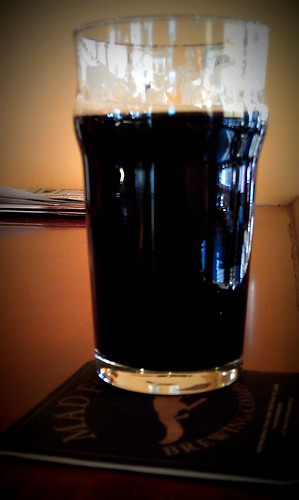
Mad Ordinary
Here,
With my beer 
I sit, 
While golden moments flit: 
Alas! 
They pass 
Unheeded by: 
And, as they fly, 
I, 
Being dry, 
Sit, idly sipping here 
My beer.

O, finer far 
Than fame, or riches, are 
The graceful smoke-wreathes of this cigar! 
Why 
Should I 
Weep, wail, or sigh? 
What if luck has passed me by? 
What if my hopes are dead,— 
My pleasures fled? 
Have I not still 
My fill 
Of right good cheer,— 
Cigars and beer

Go, whining youth, 
Forsooth! 
Go, weep and wail, 
Sigh and grow pale, 
  Weave melancholy rhymes 
  On the old times, 
Whose joys like shadowy ghosts appear, 
But leave me to my beer! 
  Gold is dross,— 
  Love is loss,— 
So, if I gulp my sorrows down, 
Or see them drown 
In foamy draughts of old nut-brown, 
Then do wear the crown, 
  Without the cross!

Life is good

From Poetry Foundation.org:
Born in 1834 in New York City, George Arnold once had aspirations of becoming an artist before deciding to devote his time to literature. A popular author, journalist, and poet of the mid-19th century, he wrote for various publications and periodicals, including the Saturday Press, Vanity Fair, and Weekly Review under the name “McArone,” which brought him recognition as a humorist.

In addition to humorous pieces, Arnold also wrote poetry and published books on children’s games. He was best known for his poem “The Jolly Old Pedagogue” as well as the McArone Papers, which he wrote under his pseudonym.

Arnold was also a patron of Pfaff’s Beer Cellar, a popular watering hole for a group of New York bohemian writers and artists, including Walt Whitman.