Sunday, June 12, 2016

Evil is strong, but good is resilient.


Lamb of God, who take away the sins of the world, have mercy upon us.
Lamb of God, who take away the sins of the world, grant us peace.


-----more-----

Saturday, June 11, 2016

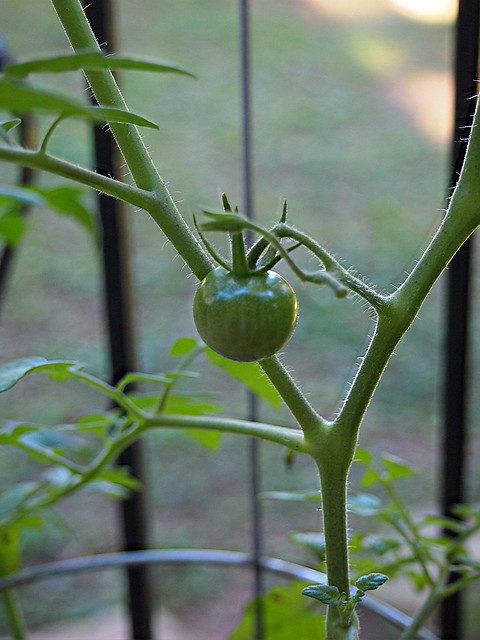
Pic(k) of the Week: Hang on, little tomato.

Hang on little tomato

A young tomato in the garden: on 8 June 2016, as yet green and, thus far, hanging on.


The sun has left and forgotten me
It's dark, I cannot see.
Why does this rain pour down?
I'm gonna drown,
In a sea
Of deep confusion.

Somebody told me, I don't know who,
Whenever you are sad and blue
And you're feelin' all alone and left behind,
Just take a look inside and you'll find,

You gotta hold on, hold on through the night.
Hang on, things will be all right.
Even when it's dark,
And not a bit of sparkling
Sing-song sunshine from above,
Spreading rays of sunny love,

Just hang on, hang on to the vine.
Stay on, soon you'll be divine.
If you start to cry, look up to the sky.
Something's coming up ahead
To turn your tears to dew instead.

And so I hold on to this advice,
When change is hard and not so nice.
You listen to your heart the whole night through.
Your sunny someday will come one day soon to you.

Pink Martini: 2004.


-----more-----

Tuesday, June 07, 2016

Baltimore's journey from Planet Beer 1995 to HomeBrew Con 2016.

There was a frantic knocking on my office door. "Tom, come quick. Big problem!"

It was May 1995 and I was the brewery manager for the Oxford Brewing Company, Maryland's first 'craft' brewery, now long closed, but then located southwest of the city of Baltimore, Maryland. In June of that year, Baltimore would be hosting its first-ever American Homebrewers Association national conference, and Oxford Brewing had been asked to brew the official beer.

The theme for the conference that year was Planet Beer. So, Oxford's beer was to be I.P.A., Inter-Planetary Ale, in style, of course, an IPA - an India Pale Ale. A bad pun, I know.

Knocking at the door was Alvaro Spencer, our laboratory technician. Mr. Spencer had worked in the beer business in South America for many years, albeit for large capacity industrial lager breweries. He had signed on to help us build a rudimentary laboratory and institute quality control measures. He ushered me to our production board, where he pointed at the specifications for the IPA: 6.5% alcohol by volume (abv), 55 International Bittering Units (IBU). He had never before seen or brewed beers of such high alcohol or hop content, and for such a small-capacity brewery.

In his charmingly accented English, he worriedly exclaimed, "What is this EEE-puh? Too big. Too much IBU. No good!"

American Homebrew Association

The American Homebrew Association was founded in 1978 by homebrew guru Charlie Papazian, even though homebrewing would not be legalized until the following year. Today, the AHA has a membership of 46,000, although the association estimates that as many as 1.2 million Americans brew at home.

HomeBrew Con 2016

HomeBrew Con 2016Now rebranded as HomeBrewCon 2016, the AHA's national convention returns to Baltimore this week for only the third time in its 38-year history. The Conference is also the site for the National Homebrew Competition.

In 2015, 7,663 entries were judged at twelve first round judge centers across the United States. First Round winners advance to the Final Round of the competition at the AHA National Homebrewers Conference. Final Round winners receive gold, silver or bronze medals in 28 style categories.

In 1979, 34 entries competed in the first AHA National Homebrew Competition held in Boulder, Colorado.

At that first Conference in 1979, there were 200 attendees. The AHA has no figures for conference attendance in Baltimore in 1995, but the year before, in Denver, there had been 428. In 2005, in Baltimore for the second time (with the not-snappy theme of "Beer By The Schooner, Ale By the Yard"), there were 857 attendees and 4,128 beers judged. This year, it estimates 3,200 attendees, up from the 2,800 last year in San Diego with 7,663 beers judged.

But HomeBrewCon 2016 is not only for homebrewers. In addition to the Conference itself (and the judging of the nations' best homebrew), which runs Thursday through Saturday, 9-11 June, there are events throughout the week —not just in Baltimore, but in Washington, D.C., 45 miles to the south —with many events open to non-homebrewing good-beer fans, as well. Of many, a few of note:
  • Tuesday, 7 June, 12-5pm.
    In Washington, D.C., beer author Stan Hieronymous co-brews an "American Primitive Beer" at Right Proper Brewing with head brewer Nathan Zeender during an open-house of the brewery's new production facility in Brookland.
    Details.

  • Wednesday, 8 June, 10am-1pm.
    Maryland beer historian Maureen O'Prey leads a beer-history walking tour of the Brewer's Hill neighborhood of Baltimore Maryland, with Baltimore Beer Week co-founder, Dominic Cantalupo.
    Details.

  • Wednesday, 8 June, 12-4pm.
    Hand-crafted tap handles. Mark Supik & Company woodturning shop makes tap handles for many Maryland breweries and nationally. See how, at its Highlandtown neighborhood workshop in Baltimore.
    Details.

  • Wednesday, 8 June, 7:30-11pm.
    A special screening of Brewmore Baltimore, a feature length documentary chronicling the history of the brewing industry in Baltimore, Maryland, narrated by two beer historians, Maureen O'Prey and Rob Kasper (past columnist and editor at The Baltimore Sun). At the Pratt Street Alehouse in downtown Baltimore, with beer served, of course, from host Oliver Brewing Company.
    Details.

  • Wednesday, 8 June, 12-3:15pm.
    The BJCP (Beer Judge Certification Program) is a certifying entity for American beer judges (for both homebrew and professional competitions). The organization is, of course, present in Baltimore this week, conducting exams for judges. But in addition to that, it's holding a series of seminars, open to both judges and civilians, with such topics as Understanding Sensory Perception of Beer, Pre-Prohibition Porter, Understanding and Judging Flavor Additives in Beer.
    Details.

  • Thursday-Saturday, 9-11 June.
    HomBrewCon itself begins in Baltimore on Thursday, 9 June and concludes on Saturday, 11 June, with a Grand Banquet at which the winners of the concurrent National Homebrew Competition are announced.
    Details.

IBUs & Postscript

IBUs - International Bitterness Units - are a measuring scale of bitterness in beer, literally the amount of dissolved alpha acids in a beer contributed by hops. One IBU equals one part per million of isohumulone, or 1 milligram of alpha acid dissolved in 1 liter of beer.

Most industrial lagers clock in at around a dozen or fewer IBUs. Thus, Mr. Spencer felt he had good cause for concern over the 55 IBUs of Oxford Brewing's Inter Planetary Ale. We decided, however, to brew it without any modifications.

Afterward, when Mr. Spencer tasted the finished result, he dropped all of his earlier objections. He had become a fan of 'too-big' beers. And Inter Planetary Ale was served to the attendees at the 1995 AHA "Planet Beer" Homebrewer Conference.

For me, to this day, IPA remains "EEE-puh." Even though, today, 55 IBUs would be considered quaint. Even though I do get puzzled looks when I pronounce it by name.


"Calling Occupants of Interplanetary Craft"
The Carpenters, 1977

-----more-----

Sunday, June 05, 2016

Sunday Facebook Check-out (June 2016)


Beer brings happiness; non-craft beer more so.

If the phrase 'industrial brewing' makes your lip curl like a wine drinker on first encountering a Belgian brown sour, I’m afraid you don’t really understand beer. Dismissing mass-market beers is like dismissing the Ford Focus and saying F1 racers are the only valid form of motor car. Some terrible crimes have been committed under the banner of industrial beer, that’s true. But overall, industrial beer has brought more happiness to the mass of humanity than craft beer ever will.

That was beer historian Martyn Cornell, at Zythophile, in a story otherwise about this ...
So, what was it like, the ancient lager Carlsberg spent two years and hundreds of thousands of kroner recreating, resurrecting yeast out of a bottle dating back to 1883, pulling out 130-year-old brewing records, growing an ancient barley variety, hiring a floor maltings, working out the most likely hop varieties to use, reproducing the original brewing water, having oak casks made in a Lithuanian cooperage, making moulds of vintage bottles so that new versions could be hand-blown, and then flying in dozens of journalists and beer writers to Copenhagen from as far away as Malaysia and California to drink the result.

It was … OK.


****************

Dry politics

Dissatisfied with the Presidential choices this year? There IS another candidate for President.

The Prohibition Party is the oldest independent third-party still active. Founded in 1869, it remains “opposed [to] the manufacture, distribution, and sale of alcoholic beverages.” Its presidential candidate this election is Jim Hedges of Pennsylvania.

Jay Brooks (a beer writer, not a candidate) has the rest of the story at the Brookston Beer Bulletin.


*****************

All About Beer gets lost in Richmond.

In "Explore Richmond: 48 Hours in Richmond, Virginia" (July 2016: Vol. 27, no.3) —a guide to the beer and brewery scene of the city— All About Beer magazine makes no mention of Legend Brewing, that city's (and Virginia's) oldest continuously operating 'craft' brewery (since 1994).

John Holl, editor of All About Beer, responded on Twitter:
Thanks for reading, Tom! Print constraints means that not everyone gets in. But hope folks spend more than a weekend in town.

A representative of Legend Brewing also responded:
We're just a big yellow building and probably the easiest brewery to find.

*****************

It isn't just about the hops.

The [U.S.] Brewers Association has joined the Brewing and Malting Barley Research Institute (BMBRI) as a corporate associate member. The BMBRI works to identify and evaluate barley varieties that are suitable for the production of high quality malt and beer.

Joining with the Brewing and Malting Barley Research Institute to work toward this is a good move for the [U.S.] Brewers Association, and for American 'craft' brewers. Macro brewers want neutrally flavored barley while 'craft' brewers prefer more highly flavored varieties, whether for base malt or specialty. And up to this point, barley has been developed and grown for the macros.
In late 2011 thru the first half of 2012, members of the Brewers Association Pipeline Committee participated in a survey to ascertain their preferred malt characteristics. Members were asked to describe the base malt characteristics best suited for their brands. [...] Respondents placed the most emphasis on flavor, calling it priority one. Respondents agreed that recent 10- to 25-year trend towards ever increasing flavor neutrality must be reversed. At the same time brewers recognize that this is the most difficult trait to communicate with specific granularity for reasons having to do with basic knowledge gaps of how and when flavor arises and minus a lexicon for describing malt flavors.
The BA identifies other traits of barley for malting for 'craft brewing:
  • Lower free amino nitrogen (“FAN”)
  • Lower total protein
  • Lower diastatic power (“DP”)
  • Lower Kolbach Index (ratio of soluble protein to total protein, or “S/T”)
All but the lower diastatic power are traits shared with macro-brewers. The macro-brewers use a high amount of adjuncts in their grists, usually corn and/or rice. A higher diastatic power is needed in their preferred barley to convert the starches of the adjuncts to fermentable sugar. 'Craft' brewers generally rely on all-malt grists; thus, diastatic power is not as important in the barley they use.
  • Read more at the [U.S.] Brewers Association.
  • And here's a related story about a University of Oregon program to develop malt varieties for 'craft' breweries.

***************

Unbeautiful swimmers

"This is a great IPA," the beer-store clerk told me. On his recommendation, I purchased a 6-pack of cans, took them home, and opened one in anticipation. Here is what I saw and tasted: A sinking mass of sludgy floaters in the bottom of a turbid mess, with only a hint of IPA flavor, tasting melony-fruity and not bitter, and, in fact, metallic-sweet. The date imprinted on the bottom the can, indicating a drink-by date or canning date, was indeterminate at best.

'Craft' breweries, with some exceptions, don't have the resources that macro-brewery conglomerates do to enforce the freshness of their bottles, cans, and kegs once they are shipped from the plants. But they —large breweries or small— are still responsible for informing their customers what is fresh and what isn't. Not doing so is a failure of 'craft.' It is not an unusual occurrence; it's far too common.

Not a great IPA; not great at all.

Unbeautiful swimmers

******************

The Unbearable Corniness of Craft

For years, the macro-breweries have been using unprocessed corn and rice, 'breakfast' grains, as adjuncts to barley malt in their beers. For years, 'craft' brewers have decried and derided the practice. But now some 'craft' breweries themselves are using these grains, not in pure form but with highly processed, chemical-laden breakfast cereals, such as Captain Crunch and Count Chocula, produced by far-from-small or independent mega-conglomerates. That's disingenuous and un-'craft.'

Read more at Beer & Brewing.


******************

The Prosody of Bitter

I’d forgotten about bitter, forgotten about that citrusy-slow build of sweetness, the words of toffee and hop spice, the crosstown traffic, the blistering bitterness, the dryness, the siren call of English hops, the warp and waft of the raw materials, the full body, its common touch (at which I have unforgivably sneered), the monstrosity, the leviathan, the well water hoisted, the sheer sheerness of it all. And as I delved further and further into my glass of Gadds No 3, I realised how much I’d forgotten about bitter and how much I had missed it.
— British beer writer Adrian Tierney-Jones, at Called to the Bar.

-----more-----

Saturday, June 04, 2016

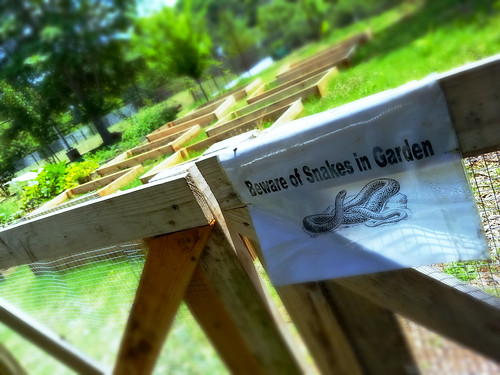
Pic(k) of the Week: Beware of Snakes in Garden

Not quite a biblical admonition ...

Beware of Snakes in Garden

A sign outside a community garden in a park in Atlanta, Georgia. 30 May 2016.

-----more-----