Showing posts with label nature. Show all posts

Saturday, October 03, 2026

Pic(k) of the Week: Salt Marsh Ghost

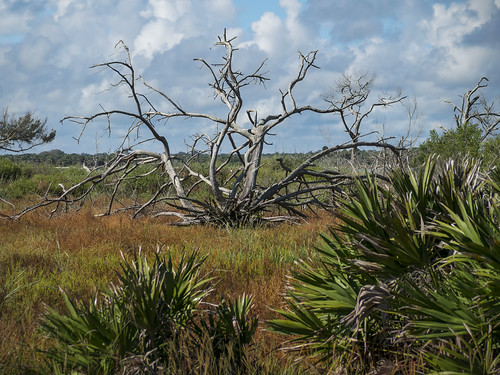
Salt marsh ghost
Click on the image for a larger, hi-res version (on Flickr).

Framed by saw palmetto, a lone ghost tree stands, sered, in a salty tidal marsh of the Matanzas Inlet estuary.

St. Johns County (Palm Coast), Florida, USA.
9 September 2026.


***************

Matanzas Inlet

The Matanzas Inlet is a narrow, partially saltwater channel in the U.S. state of Florida — 14 miles (23 km) south of the city of St. Augustine — between two barrier islands and the mainland, connecting the Atlantic Ocean and the southern end of the Matanzas River estuary, comprising a coastal scrub environment and maritime forest. Part of the Atlantic Intracoastal Waterway, the Matanzas Inlet is the last remaining natural, or undredged, inlet on Florida's Atlantic coast.
— Wikipedia.

Ghost Tree

A ghost forest is a coastal woodland characterized by widespread tree mortality as a result of saltwater intrusion and land submergence. Ghost forests commonly form when sea level rise, tectonic subsidence, or storm-driven coastal flooding increases soil salinity beyond the tolerance of freshwater tree species.The formation of ghost forests changes the surrounding ecology, often changing the deciduous forests into saltwater marshes or tidal wetlands.
— Wikipedia.

***************

Weather Report: Blackthorn Rose


-----more-----

Saturday, May 16, 2026

Pic(k) of the Week: Winter fiddleheads

Winter fiddleheads
  Click on the image for a larger, hi-res version (on Flickr).

Fiddleheads of Christmas ferns unfurl in late winter. Spring is nascent.

Glenn Creek Nature Preserve
City of Decatur, Georgia, USA.
12 March 2026.

***************

Christmas Fern

Polystichum acrostichoides, commonly denominated Christmas fern, is a perennial, evergreen fern native to eastern North America, from Nova Scotia west to Minnesota and south to Florida and eastern Texas. It is one of the most common ferns in eastern North America, being found in moist and shady habitats in woodlands, stream banks and rocky slopes. Christmas fern has a tufted, clumping habit, with its fronds arising from a central growth point. It can form colonies, but frequently grows singly or in twos or threes. The common name derives from the evergreen fronds, which are often still green in winter, at Christmas.
— Wikipedia

🔥 Unlike Ostrich ferns, whose cooked fiddleheads are edible, the fiddleheads of Christmas ferns are NOT EDIBLE and can be toxic if ingested. Observe; don't forage!
— Old Farmer's Almanac.


***************

-----more-----

Saturday, September 14, 2024

Pic(k) of the Week: Stretch!

Stretch!

Gather ye nuts while ye may...even when hanging by your hind legs!

Seminary Wood in Legacy Park: City of Decatur, Georgia, USA. 9 November 2023.

...with apologies to poet Robert Herrick.

***************

-----more-----

Saturday, May 25, 2024

Pic(k) of the Week: Lanceleaf coreopsis (sepals & petals)

Lanceleaf coreopsis (sepals & petals)

A native lanceleaf coreopsis wildflower blooms in May in the Trailhead Community Park of the East Decatur Greenway.

City of Decatur, Georgia, USA. 5 May 2024.
Coreopsis lanceolata —commonly known as lanceleaf coreopsis and lanceleaf tickseed— is a species of tickseed in the aster family (Asteraceae). It is native to the eastern and central parts of the United States, growing in open woodlands, prairies, plains, glades, meadows, and savannas.

Coreopsis lanceolata is a perennial plant sometimes attaining a height of over 2 feet (60 cm). April through June, it produces yellow flower heads singly at the top of a naked flowering stalk, each head containing both ray florets and disc florets. Each flower measures 2 to 3 inches across (5–8 cm).

The genus name 'Coreopsis' means 'bug-like'; it —as well as the common name, 'tickseed'— comes from the fact that the seeds are small and resemble ticks. The specific epithet 'lanceolata' refers to the shape of the leaves: narrow and lance-shaped.
— Wikipedia.


-----more-----

Saturday, April 20, 2024

Pic(k) of the Week: Riparian ragwort

Riparian ragwort

In early spring, tall, yellow ragwort wildflowers were growing abundantly in the wetlands of Glenn Creek.

Ira B. Melton Park, in DeKalb County, Georgia, USA. 22 March 2023.
Packera anonyma — commonly known as Small's Ragwort, Appalachian Ragwort, Southern Ragwort, Plain Ragwort — is a wildflower in the aster family (Asteraceae), native to much of the eastern United States, south of New England.

Small's Ragwort flourishes in habitats that are wet during the winter and dry in summer and is one of the first native flowers to bloom in abundance, beginning in March and continuing into June. The ray and disc flowers are bright yellow, 8-15 rays per flower. The plant grows up to 3 feet tall (1 m).
— North Carolina Cooperative Extension.

Seen alongside the Three Creeks Trail, a "labyrinth of soft-surfaced trails" in and around a 120-acre Piedmont forest in suburban Atlanta, Georgia. The trail connects Ira B. Melton Park to the larger Mason Mill Park. The three creeks of the trail's name are Glenn Creek, Burnt Fork Creek, and South Fork Peachtree Creek; the first two are tributaries of the much larger third.


***************

-----more-----

Saturday, February 03, 2024

Pic(k) of the Week: Winter Sky

Winter sky

A winter storm blows away in late afternoon.

Avondale Estates, Georgia, USA. 9 January 2024.

***************


-----more-----

Saturday, January 27, 2024

Pic(k) of the Week: Verdant fungus

Verdant fungus

"A rolling stone gathers no moss" ... but a polypore mushroom can!

Briarlake Forest Park: DeKalb County, Georgia, USA.
7 January 2024.
Trametes versicolor is a common polypore mushroom found throughout the world. Meaning 'of several colors', versicolor accurately describes this fungus that displays a unique blend of markings. Additionally, owing to its shape being similar to that of a wild turkey's tail feathers, T. versicolor is most commonly referred to as turkey tail. The top surface of the cap shows typical concentric zones of different colors, and the margin is always the lightest. Older specimens [such as the one pictured] can have zones with green algae [or moss] growing on them, thus appearing green. It commonly grows in rows on logs and stumps of deciduous trees, and is common in North America.
— Wikipedia.

This is a closeup. The polypore appears much larger in the image than it did in 'real' life.

***************


-----more-----

Saturday, November 04, 2023

Pic(k) of the Week: Tree in morning marsh

Tree in morning marsh

Morning light anoints a dead tree, yet standing on marshy ground.

Seminary Wood in Legacy Park: City of Decatur, Georgia, USA.
3 October 2023.

***************

-----more-----

Saturday, July 22, 2023

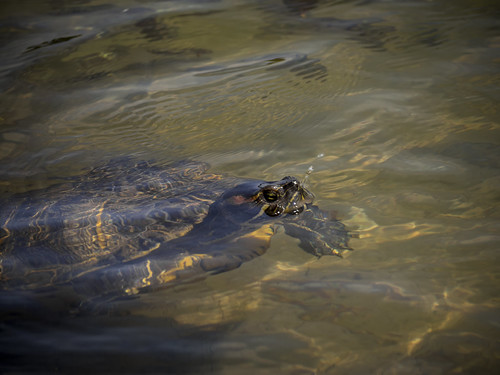
Pic(k) of the Week: Turtle, surfacing

Turtle, surfacing

A native red-eared slider turtle blows bubbles as she surfaces.

Seen at a wildlife sanctuary pond in St. Augustine Beach, Florida, USA. 3 July 2023.
The red-eared slider or red-eared terrapin (Trachemys scripta elegans) is a subspecies of the pond slider (Trachemys scripta), a semiaquatic turtle belonging to the family Emydidae. The red-eared slider is native from the Midwestern United States to northern Mexico, but has become established in other places because of pet releases, and has become invasive in many areas where it out-competes native species. The turtle gets its name from the small, red stripe around its ears, or where its ears would be, and from its ability to slide quickly off rocks and logs into the water.
— Wikipedia.

-----more-----

Saturday, July 08, 2023

Pic(k) of the Week: Wild garlic on the trail

Wild garlic on the trail

Pungent aroma and brilliant color, but...a weed?

Wild garlic, blooming, in Legacy Park, Decatur, Georgia, USA, on 27 May 2023.
Allium vineale —commonly known as wild garlic, onion grass, crow garlic, or stag's garlic— is a perennial, bulb-forming species of wild onion in the genus Allium and family Amaryllidaceae (amaryllis). It is native to Europe, northwestern Africa, and the Middle East. The species has been introduced in Australia and North America, where it has become a noxious weed.

All parts of the plant have a strong garlic odour. The underground bulb is 0.4 to 0.8 inches in diameter (1–2 cm). The main stem grows 1 to 4 feet tall (30–120 cm), comprising a number of small red bulbils [exterior bulbs] with a few pinkish-green flowers, 3⁄32 to 3⁄16 inches long (2.5 to 4.5 mm).
— Wikipedia.

-----more-----

Saturday, April 22, 2023

Pic(k) of the Week: Vernal rising

Vernal rising

Up, they jumped,
Winter sprites,
Vernal rising.


Happy Earth Day!

22 April 2023
Earth Day is an annual event on April 22 to demonstrate support for environmental protection. First held on April 22, 1970, it now includes a wide range of events coordinated globally by EarthDay.org, including 1 billion people in more than 193 countries.The official theme for 2023 is "Invest In Our Planet."
— Wikipedia.

-----more-----

Saturday, April 15, 2023

Pic(k) of the Week: Goose going Postal

Goose going Postal

A Canada goose (Branta canadensis) gracefully winters on Postal Pond, in Decatur Legacy Park, Decatur, Georgia, USA, on 4 March 2023.

I've always called this elegant waterfowl, a Canadian Goose. I've only just discovered its 'correct' appellation. Despite its name, the Canada goose's year-round habitat extends south into Georgia1, 2,300 miles (3,700 kilometers) from Canada.

Decatur, by the way, is a small city (population, 24,928) in —and the county seat of— DeKalb County, Georgia, part of the Atlanta metropolitan area.2 Legacy Park is a 77-acre oasis within it.

-----more-----

Saturday, March 25, 2023

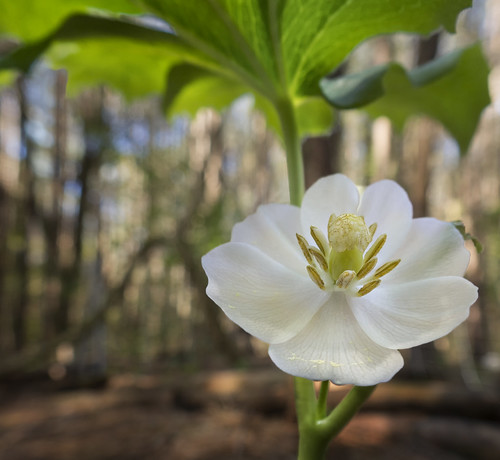
Pic(k) of the Week: Mayapple blooms in March

Mayapple blooms in March

It may have been 0 °C in DeKalb County, Georgia, USA, on 19 March 2023, but the native plant restoration was blossoming in the Clyde Shepherd Nature Preserve.

Podophyllum peltatum is an herbaceous woodland plant in the family Berberidaceae —with common names of mayapple, American mandrake, wild mandrake, and ground lemon— widespread across most of the eastern United States and southeastern Canada.

The mayapple grows only two leaves and one flower, which appears in the axil of the leaves (where the leaf joins the stem). The stems grow to 30–40 cm (12 in to 16 in) tall; the leaves grow up to eight inches in diameter (20–40 cm) with three to nine deeply cut lobes. The flowers are white, yellow or red, one to two inches in diameter (2–6 cm), with six to nine petals, maturing into a large, fleshy, lemon-shaped berry, one to two inches long (2–5 cm).

All the parts of the plant are poisonous, including the green fruit, but once the fruit has ripened and turned yellow, it can be safely eaten, as the ripe fruit does not produce toxicity.
— Wikipedia.


***************
Clyde Shepherd Nature Preserve is a citizen-run, 28-acre park, located in an urban area between the cities of Decatur and Atlanta, Georgia.

A few years ago, the preserve brought in sheep to eradicate (i.e., eat!) an infestation of invasive plants in the park. Species such as English ivy, Chinese privet, and kudzu were out-competing and ultimately destroying native plants that local pollinators and the native ecosystem depended upon.

As the invaders were vanquished, the natives began to return. Such as the mayapple.

Here's another view: top-down and pre-bloom.

March Mayapple

-----more-----

Saturday, March 18, 2023

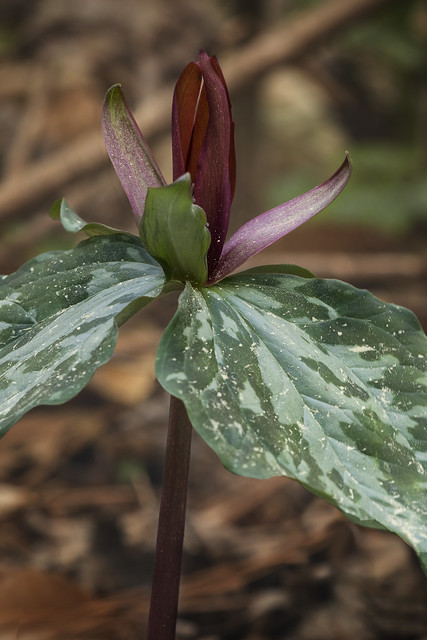
Pic(k) of the Week: Sweet Betsy in bloom!

Little Sweet Betsy in bloom!

Look down! There, on the forest floor! It's a native wildflower, a "Little Sweet Betsy" trillium, blooming in late winter. Notice the yellow specks of pollen. Spring is coming.

Seen on 9 March 2023, in the Glenn Creek Nature Preserve: a small community-maintained city park in Decatur, Georgia, USA.
Trillium cuneatum —commonly known as the little sweet betsy— is a species of flowering trillium, native to the southeastern United States. The plant has three broad, mottled leaves surrounding a banana-scented, sessile [blossom lacking a stalk] flower. The petals are erect and either maroon, bronze, green, or yellow in color, flowering from early March to late April. It is the largest of the eastern sessile-flowered trilliums.
— Wikipedia.

***************
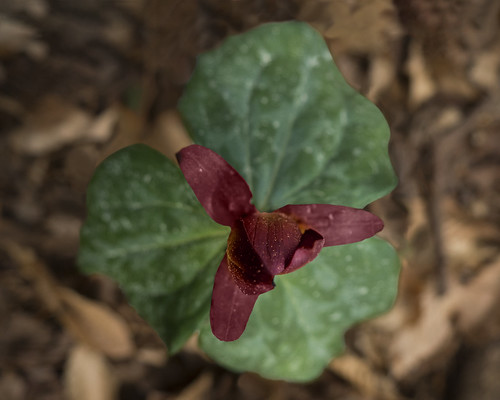
The preserve appears to be a haven for these native wildflowers. Here's another Little Sweet Betsy trillium, but snapped head-on.

Sweet Betsy in bloom! (02)

Trillium —also known as wake-robin, toadshade, tri-flower, birthroot, birthwort, or, sometimes, 'wood lily'— is a genus of about fifty flowering plant species in the Melanthiaceae family [also called the bunchflower family]. Trillium species are native to temperate regions of North America and Asia, with the greatest diversity of species found in the southern Appalachian Mountains of the southeastern United States.
— Wikipedia.

-----more-----

Saturday, March 04, 2023

Pic(k) of the Week: Nature contemplation

Nature contemplation
The lover of nature is he whose inward and outward senses are still truly adjusted to each other; who has retained the spirit of infancy even into the era of manhood.
― Ralph Waldo Emerson

On a spring-like winter's afternoon, a gentleman was sitting still on the banks of Glenn Creek, seemingly contemplating its simple beauty.

Glenlake Park: Decatur, Georgia, USA. 20 February 2023.

-----more-----

Saturday, February 18, 2023

Pic(k) of the Week: Thicket tunnel

Thicket tunnel

Thicket tunnel or allée over the trail?

Clyde Shepherd Nature Preserve: DeKalb County, Georgia, USA. 8 February 2023.

-----more-----

Saturday, February 04, 2023

Pic(k) of the Week: Arabia buzzards

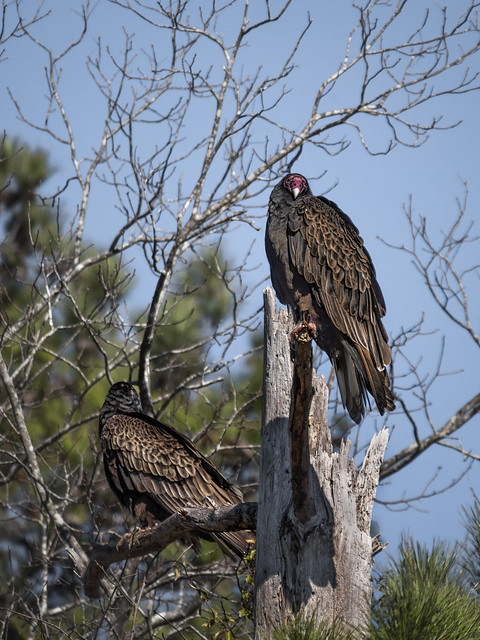
Arabia buzzards A pair of turkey vultures scope the carrion scene, atop a pine tree near the summit of Arabia Mountain.

The turkey vulture (Cathartes aura), also known as buzzard or turkey buzzard, is the most widespread of the New World vultures, ranging from southern Canada to the southernmost tip of South America. It inhabits a variety of open and semi-open areas, including subtropical forests, shrublands, pastures, and deserts. A large bird, the turkey vulture has a wingspan of 63-72 inches (160–183 cm) and a length of 24-32 inches (62–81 cm). The body feathers are mostly brownish-black, but the flight feathers on the wings appear to be silvery-gray beneath, contrasting with the darker wing linings. The adult's head is small in proportion to its body and is red in color with few to no feathers. It also has a relatively short, hooked, ivory-colored beak. The turkey vulture is a scavenger and feeds almost exclusively on carrion. It has very few natural predators.
— Wikipedia.

Arabia Mountain National Heritage Area: Stonecrest, Georgia, USA. 27 January 2023.

-----more-----

Saturday, November 19, 2022

Pic(k) of the Week: Close encounters of the arachnid kind

Close encounters of the arachnid kind

A Jorō near-miss (in Legacy Park: Decatur, Georgia, USA, 12 November 2022).

It was a foggy early morning on the forest trail. I didn't see the expansive web —or its spinster— until I was about to run into it. I quickly ducked.

Backlit, the web might not have been visible in a photo and the spider, merely a silhouette. So, I popped up the in-camera flash. Not expecting this situation, I wasn't carrying a diffuser and the image might be a bit hot. Nonetheless, the arachnid appears well-limned in all her colorful glory.

As to the arachnid...
Trichonephila clavata —also known as the Jorō spider (ジョロウグモ)— is a member of the Trichonephila genus. The spider can be found throughout Japan (except Hokkaidō), Korea, Taiwan, and China. The spider is also an introduced species in North America —first spotted, in 2013, in northeast Georgia and northwest / upstate South Carolina. It is believed that the species will become naturalized over much of the eastern seaboard of the United States due to its relative imperviousness to the cold.

The adult female's body size is 2/3 to 1 inch (17–25 mm), while the male's is 1/4 to 2/5 inches (7–10 mm). The adult female individual has stripes of yellow and dark blue, with red toward the rear of the abdomen. The web of females may reach several meters in length. In sunlight, the yellow threads appear to be a rich gold color. In autumn, the smaller males may be seen in the webs for copulating. After mating, the female spins an egg sack on a tree, laying 400 to 1,500 eggs in one sack. Her lifecycle ends by late autumn or early winter with the death of the spider. The next generation emerges in spring.

Although the spider is not aggressive, it will bite to protect itself. The bite is considered painful, but not life-threatening.
— Wikipedia.

-----more-----

Saturday, October 01, 2022

Pic(k) of the Week: Wood stork, perched

Wood stork, perched

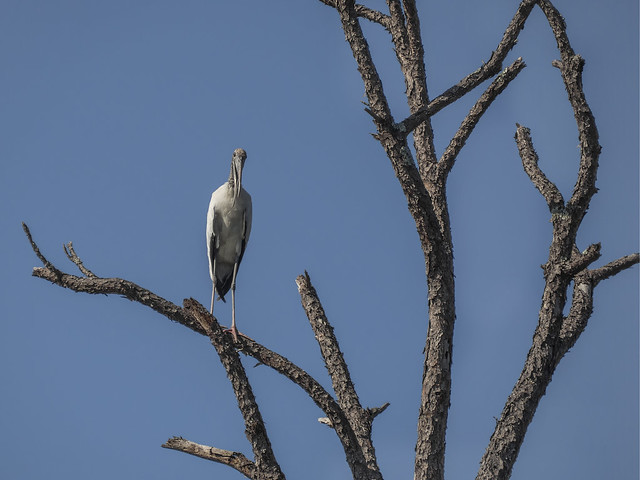
In Fort Mosé Historic State Park, in St. Augustine, Florida, USA, a wood stork (Mycteria americana) perches in a tree on a brackish marshland hammock. 5 September 2022.
To the north [of Fort Mosé], there is a rookery, a nesting colony of gregarious birds, such as wood storks, egrets, and herons. These birds showcase their breeding plumage from mid-March through July. One of the largest birds to nest in this area is the wood stork [a large American wading bird]. This area is ideal for nesting because the changing water level reveals higher concentrations of fish during lower tides. Females lay two to five eggs, which both parents incubate for about one month. A pair of nesting wood storks and their young need approximately 443 pounds of fish during the breeding season to survive.

In the 1930s, there were an estimated 20,000 breeding pairs of wood storks [in Florida]; today, the population is approximately 8,000. The numbers have declined drastically, mainly from loss of feeding grounds due to land development, logging, and draining.
— Fort Mosé placard

***************

Fort Mose

Fort Mose Historic State Park is a former Spanish fort in St. Augustine, Florida. In 1738, the governor of Spanish Florida, Manuel de Montiano, had the fort established as a free black settlement, the first to be legally sanctioned in what would become the territory of the United States.

The park is located on the edge of a salt marsh on the western side of the waterway separating the mainland from the coastal barrier islands. The original site of the 18th-century fort was uncovered in a 1986 archeological dig. The 24-acre (9.7 ha) site is now protected as a Florida State Park.It was designated a US National Historic Landmark on October 12, 1994.
— Wikipedia.

-----more-----

Saturday, September 24, 2022

Pic(k) of the Week: Live Oaks at night

Live Oaks at night

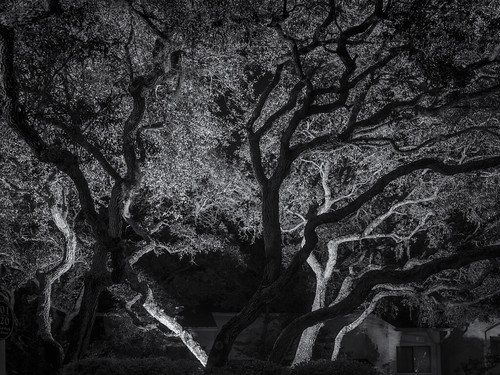
Even (especially?) at night, southern live oaks can be dramatically magnificent.

St. Augustine Beach, Florida, USA. 9 September 2022.
Quercus virginiana —also known as the southern live oak— is an evergreen oak tree native to the southeastern United States and the lower coastal plain of the Gulf of Mexico. Though many other species are loosely called live oak, the southern live oak is particularly iconic of the Old South.

Depending on the growing conditions, live oaks vary from a shrub-size to large and spreading tree-size: typical open-grown trees reach 66 feet in height (20 m), with a limb spread of nearly 89 feet (27 m). Their lower limbs often sweep down towards the ground before curving up again. The southern live oak has a deep taproot that anchors it when young and eventually develops into an extensive and widespread root system. This, along with its low center of gravity and other factors, makes the southern live oak extremely resistant to strong sustained winds, such as those seen in hurricanes.

The bark is dark, thick, and furrowed longitudinally. The leaves are stiff and leathery, with the tops shiny dark green and the bottoms pale gray. Although live oaks retain their leaves nearly year-round, they are not true evergreens. Live oaks drop their leaves immediately before new leaves emerge in the spring.
— Wikipedia.

-----more-----