Showing posts with label Florida. Show all posts

Saturday, October 25, 2025

Pic(k) of the Week: Sunrise tree

Sunrise tree
Click on the image for a larger, hi-res version (on Flickr).

Tree in morning sun.

Lakeside Park: St. Augustine Beach, Florida, USA. 4 September 2025 (7:38 am EDT)

I was leaving a sunrise photoshoot in the park's sculpture garden, and I paused in the parking lot to glance back at Lake Anhinga. I saw this: the morning sun backlighting the branches of a perimeter tree, reflected on the lake. An afterthought had become a highlight. (Photographic moral of the story: don't forget to look behind you!)


***************

-----more-----

Saturday, October 11, 2025

Pic(k) of the Week: Coquina rock in surf at sunrise

Coquina rock in surf at sunrise (02)
Click on the image for a larger, hi-res version (on Flickr).

A coquina rock is battered by the Atlantic Ocean surf, captured in a photograph at Washington Oaks Gardens State Park in Palm Coast, Florida, on September 6, 2025, at 8:21 a.m. EDT.

This boulder is part of a ¾-mile-long coquina rock formation, the second-largest of its kind along the east coast of North America. The largest formation is located further south on a barrier island in Jupiter, Florida, Blowing Rock Preserve.


***************

What is coquina?

Coquina rock is a type of sedimentary rock (specifically limestone), formed by the deposition and subsequent cementation of mineral and organic particles on the floor of bodies of water at the Earth's surface. The coquina rocks at Washington Oaks are part of the Anastasia formation —stretching from the city of St. Augustine to Palm Beach County — that was created during the Pleistocene era (12,000 - 2.5 million years ago). Lower sea levels allowed slightly acidic rainwater to dissolve calcium carbonate in millions of exposed shells. This process effectively bonded the shells to the sand, resulting in the creation of rocks that solidified over time.

One characteristic of coquina rocks is the regular, perfectly cylindrical holes in many sections of a formation, formed by erosion of rock by rainwater. These weathered formations create shallow tidal pools that support crabs, sea snails, anemones, and other small marine life The word 'coquina' is Spanish for 'cockle' and is the name given to Donax variabilis, a small, burrowing clam that lives in the sand just at the ocean’s edge, and is the main shell component of the rock.

Florida State Parks.

Sunrise took place at 7:04 a.m. EDT; I didn't capture this photo until 8:21, an hour and seventeen minutes later. Why the delay? When I arrived at the park entrance at 6:30, the gates were locked. Florida state parks don't open until 8 a.m. The moral of the story? Do your research.

And yet, a beautiful moment to experience.


***************

Thelonius Monk: Brilliant Corners
Album: Brilliant Corners (Label: Riverside)
Recorded 1956; released 1957.

-----more-----

Saturday, October 04, 2025

Pic(k) of the Week: Gulls & waxing moon over surf at dusk

Gulls & waxing moon over surf at dusk

Click on the image for a larger, hi-res version (on Flickr).

Gulls fly by, as a waxing gibbous moon, 89% illuminated, rises over an Atlantic Ocean beach at sundown

City of St. Augustine Beach, Florida, USA. 4 September 2025 (7:47 p.m. EDT).


***************

Herbie Hancock: Maiden Voyage
Album: Maiden Voyage (Label: Blue Note, 1965)

-----more-----

Saturday, September 20, 2025

Pic(k) of the Week: Cross & statue

Cross & statue

Click on the image for a larger, hi-res version (on Flickr).

A patinated bronze statue of a Catholic missionary appears to beseech heavenward, positioned before a nearly 200-foot-tall 'Great Cross,' whose silvery stainless steel gleams golden in late-afternoon sun.

Mission Nombre de Dios: St. Augustine, Florida, USA.
3 September 2025.

About the mission:

Mission Nombre de Dios (Name of God) is a Catholic mission founded in 1587 in St. Augustine, Florida, on the west side of Matanzas Bay. It is likely the oldest extant mission in the continental United States. The National Shrine of Our Lady of La Leche, the oldest shrine in the southeast U.S., is located on the mission grounds.

The mission traces its origins to September 8, 1565, when Spanish admiral Pedro Menéndez de Avilés landed with a band of settlers, including a Catholic chaplain, Father Francisco López de Mendoza Grajales. The mission would serve the colonists and nearby villages of the Mocama, a Native American tribe.

The 'Great Cross' was dedicated in October 1966 to celebrate the 400th anniversary of the mission's founding. It is made of stainless steel and towers 208 feet above the Matanzas marshes. An eleven-foot-tall bronze statue of Father López stands in front, created in 1958 by Ivan Meštrović (1883-1962), a Croatian sculptor (then dean of Art at Notre Dame University, in South Bend, Indiana, USA).

National Park Service (pdf)
Wikipedia.


***************

Donald Byrd: Cristo Redentor

Album: A New Perspective (Label: Blue Note)
Released 1964; recorded 1963.

-----more-----

Saturday, September 13, 2025

Pic(k) of the Week: Españolas de la alborada

Españolas de la alborada

Click on the image for a larger, hi-res version (on Flickr).

Españolas (2010)
painted concrete
Marianne Lerbs

St. Augustine Sculpture Garden:
City of St. Augustine Beach, Florida, USA.
12 September 2025.


****************

St. Augustine is the oldest continuously inhabited city in the continental United States, established by Spanish explorers in 1565. One can easily picture the female colonists, known as Españolas, leisurely promenading on Sundays with their parasols, reminiscent of the scene depicted by the sculptor.

The sculpture garden sits just beyond the city's southeastern border, in St. Augustine Beach, a suburban-esque town of mid-20th-century vintage.

I first made the acquaintance of these charming ladies on a visit to St. Augustine in 2018 and took their portraits. I wasn't overly pleased with the outcome, so I returned seven years later for another try. The park appeared a bit worn, in need of some care, and the sculpture's plaque had gone missing. Nevertheless, the ladies, with their fans and parasols, appeared resplendent at sunrise. Felicitaciones!


***************

About Marianne Lerbs

I grew up in Caracas, Venezuela during the sixties. Now, I am a multidisciplinary artist, painter, muralist and sculptress. I am a College level art instructor and recipient of Artist in Residence grants in Jacksonville, FL. I have participated several times in Jacksonville's Cultural Council Art in Public Programs, developing murals, banners and large art panels. I was pre-selected by the Police Athletic League with a proposal with large size colorful concrete pillows for their outdoor areas. I have designed and executed large mosaic murals for the Florida Museum of Natural History. I recently completed two commissions, a collection of paintings inspired on St. Augustine's female historic figures, and a series based on Floridian history. I completed three monumental sculptures for the St. Augustine Sculpture Garden in St. Augustine Beach, Florida.
Marianne Lerbs


***************

Return to Forever: Spain

Album: Light as a Feather (Label: Polydor)
Released 1973; recorded 1972.

-----more-----

Saturday, October 19, 2024

Pic(k) of the Week: Sunrise over St. Johns Pier

Sunrise over St. Johns Pier

End-of-summer sunrise over the Atlantic Ocean.

St. Johns Ocean & Fishing Pier: St. Augustine Beach, Florida, USA. 3 September 2024 (7:23 am EDT).

***************

-----more-----

Saturday, October 12, 2024

Pic(k) of the Week: Wind-swept beach (for Thelonius Monk)

Wind-swept beach

Beach dunes after a late afternoon storm.

St. Augustine Beach, Florida, USA. 1 September 2024 (18:39 EDT).

***************

-----more-----
  • Thelonious Sphere Monk was an American composer and pianist, born on 10 October 1917; he died on 17 February 1982.

    Monk's performance, here, of Pannonica — a tune he composed and named for Kathleen Annie Pannonica de Koenigswarter, an English-born patron of late 1940s and 1950s American bebop jazz ('Nica' to her friends) — displays a compositional ethos and keyboard virtuosity distilled to its essence. Utilizing null time, rhythmic surprise, dissonant harmonies, 'wrong notes,' and tones seemingly coaxed from 'between' the piano's keys, he transforms a deceptively simple melody into a miniature gem of severe beauty.

  • Pic(k) of the Week: one in a weekly series of images posted on Saturdays.
  • Photo 41 of 52, for year 2024. See a larger, hi-res version on Flickr: here.
  • Commercial reproduction requires explicit permission, as per Creative Commons.

  • Camera: Olympus OM-D E-M10 II.
    • Lens: Olympus M.40-150mm F4.0-5.6 R
    • Settings: 45 mm; 1/640 sec; ISO 200; ƒ/5.6

  • For more from YFGF:

Saturday, September 16, 2023

Pic(k) of the Week: Wary weather watcher

Wary weather watcher

A storm approaches;
Warily, the dog watches.
Beach life.

St. Augustine Beach, Florida, USA. 9 September 2022.

-----more-----

Saturday, August 12, 2023

Pic(k) of the Week: Castillo de San Marcos

Castillo de San Marcos

Looking north at daybreak, along the Matanzas River, at the Castillo de San Marcos.

In downtown (!) St. Augustine, Florida, USA. 7 September 2022.
The Castillo de San Marcos (Spanish for "St. Mark's Castle") is the oldest masonry fort in the continental United States; it is located on the western shore of Matanzas Bay in the city of St. Augustine, Florida, built by the Spanish to protect the city. The Castillo is a masonry star fort made of a stone called coquina (Spanish for "small shells"), which consists of ancient shells that have bonded together to form a sedimentary rock similar to limestone. Construction began in 1672 and was completed in 1695, though the structure would undergo many alterations and renovations over the centuries. Native Americans from Spain's nearby missions did most of the labor, with additional skilled workers brought in from Havana, Cuba.
Wikipedia.

In 1924, the Castillo (then named Fort Marion) was declared a U.S. National Monument. In 1933, the National Park Service assumed responsibility. In 1942, the original name, Castillo de San Marcos, was restored.
National Park Service pamphlet.

St. Augustine is a city on the Atlantic coast of northeastern Florida. Founded in 1565 by Spanish explorers, it is the oldest continuously inhabited European-established settlement in what is now the contiguous United States. The city served as the capital of Spanish Florida for over 200 years.
Wikipedia.

-----more-----

Saturday, August 05, 2023

Pic(k) of the Week: St. Augustine Lighthouse, at morning

St. Augustine Lighthouse, at morning

Missed it by thaat much! Only two days earlier, the 'Buck' moon had been a full 'supermoon.'

Here, on 5 July 2023, the now waning gibbous moon sets, at sunrise, near the St. Augustine Lighthouse, in St. Augustine, Florida, USA.
The St. Augustine Light Station is a privately maintained aid to navigation and an active, working lighthouse in St. Augustine, Florida. It stands at the north end of Anastasia Island and was built between 1871 and 1874. The current lighthouse tower, original first-order Fresnel lens and the Light Station grounds are owned by the St. Augustine Lighthouse & Maritime Museum, Inc., a not-for-profit maritime museum.

The St. Augustine Light Station consists of the 165-foot (50 m) 1874 tower, the 1876 Keepers' House, two summer kitchens added in 1886, a 1941 U.S. Coast Guard barracks, and a 1936 garage that was home to a jeep repair facility during World War II. The site is also a National Oceanic and Atmospheric Administration (NOAA) weather station. The lighthouse was placed on the National Register of Historic Places in 1981.

The tower, however is the second lighthouse tower in St. Augustine, the first being lit officially by the American territorial government in May 1824 as Florida's first lighthouse. However, both the Spanish and the British governments operated a major aid to navigation here including a series of wooden watch towers and beacons dating from 1565.
Wikipedia.

-----more-----

Saturday, July 22, 2023

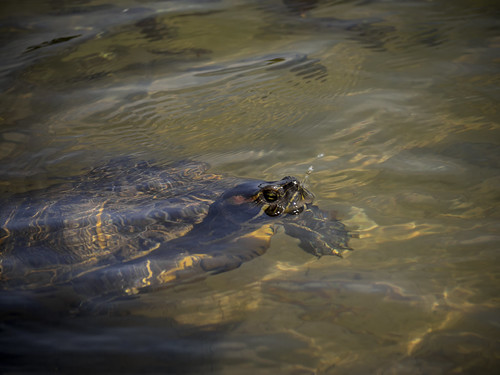
Pic(k) of the Week: Turtle, surfacing

Turtle, surfacing

A native red-eared slider turtle blows bubbles as she surfaces.

Seen at a wildlife sanctuary pond in St. Augustine Beach, Florida, USA. 3 July 2023.
The red-eared slider or red-eared terrapin (Trachemys scripta elegans) is a subspecies of the pond slider (Trachemys scripta), a semiaquatic turtle belonging to the family Emydidae. The red-eared slider is native from the Midwestern United States to northern Mexico, but has become established in other places because of pet releases, and has become invasive in many areas where it out-competes native species. The turtle gets its name from the small, red stripe around its ears, or where its ears would be, and from its ability to slide quickly off rocks and logs into the water.
Wikipedia.

-----more-----

Saturday, November 05, 2022

Pic(k) of the Week: Morning mist on the beach

Morning mist on the beach

On the beach,
It's a morning sun,
Through cloud and ocean spray,
A beacon in gloom.
At peace.

St. Augustine Beach, Florida, USA.
30 October 2022 (9:19 am EDT).

-----more-----

Saturday, October 15, 2022

Pic(k) of the Week: ¡Cuidado!

¡Cuidado!

I thought I'd sneak in a beach photo before the weather turns too cold. Here: a father and children at St. Augustine Beach, Florida, USA, on 7 September 2022.

Patience and chance choreographed this image. I noticed a man carefully introducing his newborn to the ocean. As I began snapping photos, his older son blithely ran by. It was a "decisive moment," as the French humanist photographer Henri Cartier-Bresson might have labelled it.

Of course, to paraphrase U.S. Senator Lloyd Bentsen, I am no Monsieur Cartier-Bresson.

-----more-----

Saturday, October 01, 2022

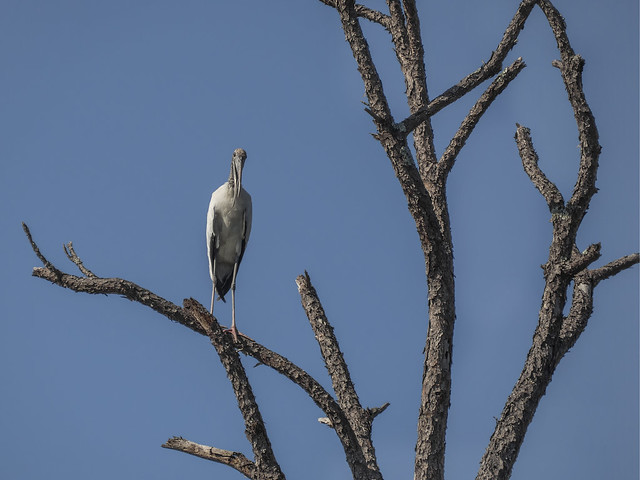
Pic(k) of the Week: Wood stork, perched

Wood stork, perched

In Fort Mosé Historic State Park, in St. Augustine, Florida, USA, a wood stork (Mycteria americana) perches in a tree on a brackish marshland hammock. 5 September 2022.
To the north [of Fort Mosé], there is a rookery, a nesting colony of gregarious birds, such as wood storks, egrets, and herons. These birds showcase their breeding plumage from mid-March through July. One of the largest birds to nest in this area is the wood stork [a large American wading bird]. This area is ideal for nesting because the changing water level reveals higher concentrations of fish during lower tides. Females lay two to five eggs, which both parents incubate for about one month. A pair of nesting wood storks and their young need approximately 443 pounds of fish during the breeding season to survive.

In the 1930s, there were an estimated 20,000 breeding pairs of wood storks [in Florida]; today, the population is approximately 8,000. The numbers have declined drastically, mainly from loss of feeding grounds due to land development, logging, and draining.
— Fort Mosé placard

***************

Fort Mose

Fort Mose Historic State Park is a former Spanish fort in St. Augustine, Florida. In 1738, the governor of Spanish Florida, Manuel de Montiano, had the fort established as a free black settlement, the first to be legally sanctioned in what would become the territory of the United States.

The park is located on the edge of a salt marsh on the western side of the waterway separating the mainland from the coastal barrier islands. The original site of the 18th-century fort was uncovered in a 1986 archeological dig. The 24-acre (9.7 ha) site is now protected as a Florida State Park.It was designated a US National Historic Landmark on October 12, 1994.
Wikipedia.

-----more-----

Saturday, September 24, 2022

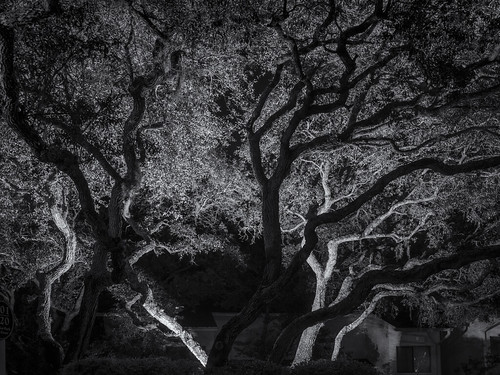
Pic(k) of the Week: Live Oaks at night

Live Oaks at night

Even (especially?) at night, southern live oaks can be dramatically magnificent.

St. Augustine Beach, Florida, USA. 9 September 2022.
Quercus virginiana —also known as the southern live oak— is an evergreen oak tree native to the southeastern United States and the lower coastal plain of the Gulf of Mexico. Though many other species are loosely called live oak, the southern live oak is particularly iconic of the Old South.

Depending on the growing conditions, live oaks vary from a shrub-size to large and spreading tree-size: typical open-grown trees reach 66 feet in height (20 m), with a limb spread of nearly 89 feet (27 m). Their lower limbs often sweep down towards the ground before curving up again. The southern live oak has a deep taproot that anchors it when young and eventually develops into an extensive and widespread root system. This, along with its low center of gravity and other factors, makes the southern live oak extremely resistant to strong sustained winds, such as those seen in hurricanes.

The bark is dark, thick, and furrowed longitudinally. The leaves are stiff and leathery, with the tops shiny dark green and the bottoms pale gray. Although live oaks retain their leaves nearly year-round, they are not true evergreens. Live oaks drop their leaves immediately before new leaves emerge in the spring.
Wikipedia.

-----more-----

Saturday, August 06, 2022

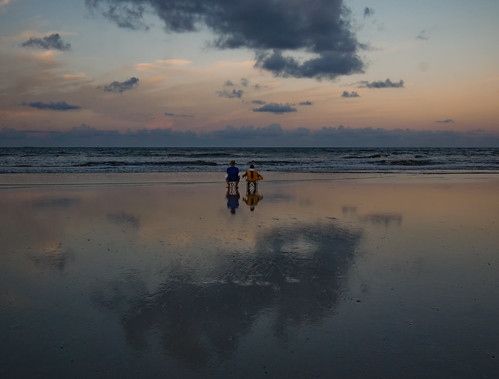
Pic(k) of the Week: Calm at crepuscule

Calm at crepuscule

Two contemplating sunset, looking east over the Atlantic Ocean.

St. Augustine Beach, Florida, USA. 4 August 2018 (9:08 pm)

And, yes, they knew that the sun sets in the west. But high clouds catch and reflect its light back to the east.

-----more-----

Saturday, July 31, 2021

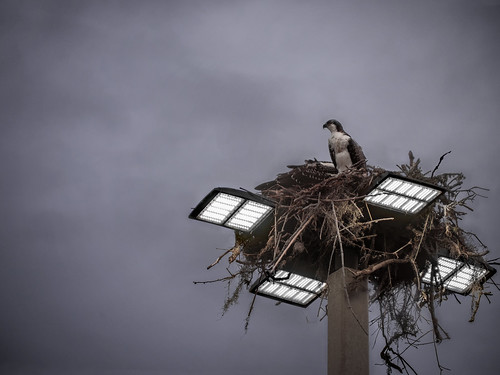
Pic(k) of the Week: Osprey in nest on light pole

Osprey in nest on light pole

The osprey tolerates a wide variety of habitats, nesting in any location near a body of water providing an adequate food supply. Ospreys construct their nests at the tops of dead trees, atop power poles, on manmade nesting platforms, and sometimes on buoys, chimneys, or other structures.
U.S. Fish and Wildlife Service (pdf)

Look up!

Call it "environmental irony" or (less humbly) "new topography": man-made elements intruding (?) in an image otherwise of natural beauty. But, if you do, you might see (and hear) ospreys in their nest, high overhead...on a light pole, in a supermarket parking lot, as I did in St. Augustine Beach, Florida, USA, on 3 July 2021.

The osprey —or, more specifically, the western osprey (Pandion haliaetus), also called sea hawk, river hawk, and fish hawk— is a diurnal, fish-eating bird of prey with a cosmopolitan range. It is a large raptor, reaching more than two feet in length (60 cm) and six feet across the wings (180 cm). It is brown on the upper parts and predominantly greyish on the head and underparts. It is found on all continents except Antarctica, although in South America it occurs only as a non-breeding migrant.
Wikipedia

-----more-----

Saturday, July 17, 2021

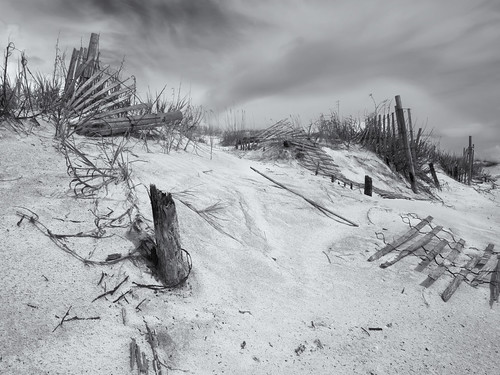
Pic(k) of the Week: Dune fence down.

Dune fence down

Dune fence down: desolation at/on St. Augustine Beach, Florida, USA.

Photo taken on 30 June 2021.

-----more-----

Saturday, July 10, 2021

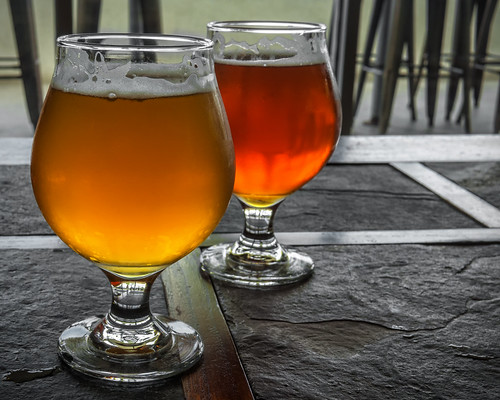
Pic(k) of the Week: OCA x2

OCA x 2

Old Coast Ales is a production brewery (with taproom) that opened in 2017. It's located in St. Augustine *, Florida, USA, a few blocks southeast of the Bridge of Lions, a 100-year-old drawbridge that connects Anastasia Island to downtown St. Augustine.

We visited on 1 July 2021. Here are two draught beers we ordered (and enjoyed) in the brewery's taproom.

Left to right:
  • Oh-8-Oh
    5.7% ABV
    (alcohol-by-volume)
    "Mildly bitter and balanced between malt and hop flavors, this pale ale features Sultana and Sabro Cryo hops."
    ---> Me: Yep. More like a classic pale ale's bitter and earthy than a latter day's fruity or cat-stinky. Had two.

  • Empirical
    American IPA
    6.6 % ABV
    "Old skool American IPA with a solid malt backbone and a heavy hop of Amarillo, Simcoe, and Centennial hops."
    ---> Me: Yep. Bonus points for beauty.
Old Coast Ales is a production brewery: meaning that it does not have a kitchen as would a brewpub. But, 'not to worry.' Innately connected to the brewery is a taco eatery that was busy when we visited. After purchasing some fare (which we ate while pairing drinking our beers in the brewery), we understood why.

***************

Hop geeky

Hops —the female (and non-seed bearing) flowers of herb bines— are used by brewsters in beer:
  • for their herbal/spicy/fruity flavors and aromas
  • to add drying bitterness as a counterbalance to malt sweetness
  • to lesser extents as beer-foam enhancers, beer shelf-life stabilizers, and anti-microbial agents.
There are many varieties of hops grown (such as Amarillo and Sultana, above), propagated for their flavor, aroma, bittering potential, farming yield, and resistance to agricultural disease.

-----more-----

Saturday, October 19, 2019

Pic(k) of the Week: Two Calusians: 'craft' beers in Sarasota, Florida

Two Calusians

I put out the word on the interwebs: where to go for good beer in Sarasota, Florida?

And the word came back from 'craft' beer professionals on Facebook. Go to Calusa Brewing.

So, I did (on 5 October 2019).

The brewery sits in unpretentious surroundings in a light-industrial/business park. Rusting cars and totaled light-engine planes sit in a junkyard just beside it. The brewery building itself is corrugated metal.

Inside, it's, again, corrugated industrial with high ceilings. A long bar with several draught-beer taps sits against one wall, communal stammtiche tables in front of it. Windows to the rear provide a peek into the brewhouse area. Bourbon barrels filled with maturing beers sit to the side.

And those beers...!

16 rotating draft lines of traditional favorites, hazy hop bombs and mixed-fermented/fruited sour beers.

I asked for help. Bartender Ed took the time to walk me through it. Here are two (neither a hop bomb or sour):
  • King's Creatures​ (left)
    • "English Export Stout​"
    • 6.9% alcohol
    • "Deeply roasty, with a hypnotic darkness and scary drinkability. Monsters covet and hoard the British malt notes of espresso, & light toffee."
    • Me: Lovely British Maris Otter malt for base; sapid but not overdone treacle from dark malts; alcoholic slap at end dries the finish.

  • Calusa Ringstrasse (right)​
    • "Vienna-style Lager"​
    • 5.5% alcohol
    • "A brilliant clarity of autumnal copper reveals the toasted, full character of the finest continental malt and crisp finish of noble hops.
    • Me: Not "brilliantly" clear, but a well-executed lager nonetheless, expressing lightly toasted crackers, an elegant (not fruity) sweet middle, and, indeed, a crisp finish.
Sometimes, the interwebs do deliver on their promise.

Calusa Brewing [kuh LOOSE uh] is located at 5701 Derek Avenue, in Sarasota, Florida. I don't know who Derek is, but the Calusa were the original Native American landlords of southwestern Florida. (Seminole was the catch-all name for the later refugees fleeing white-man encroachment further north.)

A series of occasional reviews of beer (and wine and spirits).
No scores; only descriptions.

-----more-----