Showing posts with label nature preserve. Show all posts

Saturday, May 16, 2026

Pic(k) of the Week: Winter fiddleheads

Winter fiddleheads
  Click on the image for a larger, hi-res version (on Flickr).

Fiddleheads of Christmas ferns unfurl in late winter. Spring is nascent.

Glenn Creek Nature Preserve
City of Decatur, Georgia, USA.
12 March 2026.

***************

Christmas Fern

Polystichum acrostichoides, commonly denominated Christmas fern, is a perennial, evergreen fern native to eastern North America, from Nova Scotia west to Minnesota and south to Florida and eastern Texas. It is one of the most common ferns in eastern North America, being found in moist and shady habitats in woodlands, stream banks and rocky slopes. Christmas fern has a tufted, clumping habit, with its fronds arising from a central growth point. It can form colonies, but frequently grows singly or in twos or threes. The common name derives from the evergreen fronds, which are often still green in winter, at Christmas.
Wikipedia

🔥 Unlike Ostrich ferns, whose cooked fiddleheads are edible, the fiddleheads of Christmas ferns are NOT EDIBLE and can be toxic if ingested. Observe; don't forage!
Old Farmer's Almanac.


***************

-----more-----

Saturday, April 12, 2025

Pic(k) of the Week: Spring comes to Beaver Pond

Spring comes to Beaver Pond

The trees were blooming on Beaver Pond.

Clyde Shepherd Nature Preserve: DeKalb County, Georgia, USA. 2 April 2025.

***************
As I was framing the shot, a bird photographer (aka 'birder') was standing nearby, wielding a 'bazooka-sized' lens. Unbeknownst to me, he had sidled very close.

"What did you spot?" he asked, catching me off guard. "A tree!" I replied. He smirked, saying, "There are many of those," and strolled off. Of course, that was the point.

Quam stulti isti mortales sunt. 


***************


Shirley Horn: A Lazy Afternoon

-----more-----

Saturday, March 09, 2024

Pic(k) of the Week: Laurel Creek waterfall

Laurel Creek waterfall

Evergreen mountain laurel trees ring small Laurel Creek as it cascades into the (slightly) larger Stephenson Creek.

Seen alongside (that is, clambered down from) the Flat Rock spur of the Arabia Mountain PATH trail in the Arabia Mountain Nature Preserve: DeKalb County, Georgia, USA. 27 February 2024.

Note to self: Return in spring, when the mountain laurel is blooming.

***************

-----more-----

Saturday, February 17, 2024

Pic(k) of the Week: Mirror'd Morning

Mirror'd morning

Mirror'd morning on Beaver Pond...but not a rodent in sight!

Clyde Shepherd Nature Preserve: DeKalb County, Georgia, USA. 6 February 2024.

***************

-----more-----

Saturday, July 22, 2023

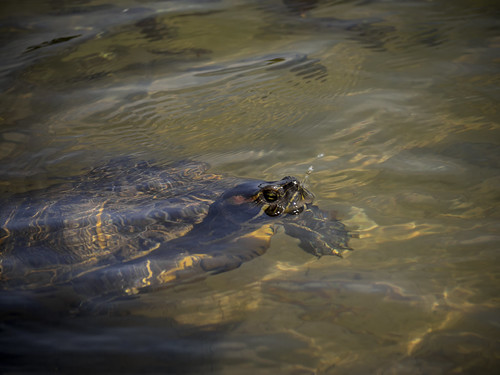
Pic(k) of the Week: Turtle, surfacing

Turtle, surfacing

A native red-eared slider turtle blows bubbles as she surfaces.

Seen at a wildlife sanctuary pond in St. Augustine Beach, Florida, USA. 3 July 2023.
The red-eared slider or red-eared terrapin (Trachemys scripta elegans) is a subspecies of the pond slider (Trachemys scripta), a semiaquatic turtle belonging to the family Emydidae. The red-eared slider is native from the Midwestern United States to northern Mexico, but has become established in other places because of pet releases, and has become invasive in many areas where it out-competes native species. The turtle gets its name from the small, red stripe around its ears, or where its ears would be, and from its ability to slide quickly off rocks and logs into the water.
Wikipedia.

-----more-----

Saturday, April 29, 2023

Pic(k) of the Week: Yellow-crowned Night Heron

Yellow-crowned Night Heron

North for mating season (from its winter habitat from southern Florida, through Mexico, into Central America), a yellow-crowned night heron perches in swampy marshland in DeKalb County, Georgia, USA, on 21 April 2023.

Unfortunately, I 'blew out' some of the highlights (such as the heron's yellow crown) and 'cut off' one of its feet. Nonetheless, I was excited to have photographed this fine fellow in the wild.

Thank you to a passing birder who identified this yellow-crowned night heron for me (and congratulated me on my new "lifer": birdwatching lingo for spotting a bird you’ve never seen before).

Fortunately, I did not forget to thank her (or, silently, the heron).

-----more-----

Saturday, April 08, 2023

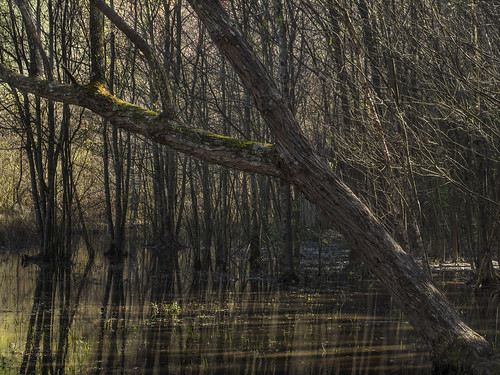
Pic(k) of the Week: Bayou morning

Bayou morning

Wetlands of South Fork Peachtree Creek: a 'bayou' morning on Beaver Pond.

Clyde Shepherd Nature Preserve: DeKalb County, Georgia, USA. 19 March 2023.
When rain falls into the beaver pond/wetlands at the preserve, the water goes into the south fork of Peachtree Creek. From Peachtree Creek, the water flows into the Chattahoochie River and then into the Gulf of Mexico. The areas that drain into the Chattahoochee River (including the preserve) make up the Chattahoochie Watershed.

-----more-----

Saturday, March 25, 2023

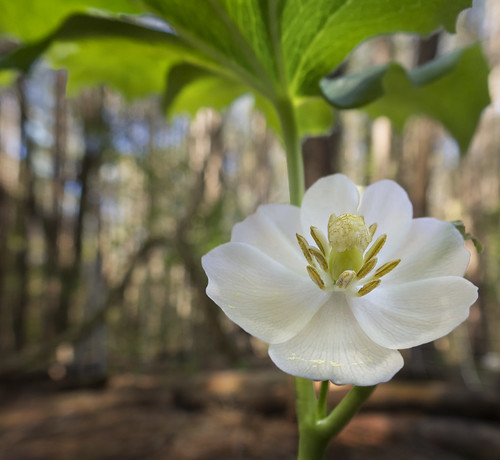
Pic(k) of the Week: Mayapple blooms in March

Mayapple blooms in March

It may have been 0 °C in DeKalb County, Georgia, USA, on 19 March 2023, but the native plant restoration was blossoming in the Clyde Shepherd Nature Preserve.

Podophyllum peltatum is an herbaceous woodland plant in the family Berberidaceae —with common names of mayapple, American mandrake, wild mandrake, and ground lemon— widespread across most of the eastern United States and southeastern Canada.

The mayapple grows only two leaves and one flower, which appears in the axil of the leaves (where the leaf joins the stem). The stems grow to 30–40 cm (12 in to 16 in) tall; the leaves grow up to eight inches in diameter (20–40 cm) with three to nine deeply cut lobes. The flowers are white, yellow or red, one to two inches in diameter (2–6 cm), with six to nine petals, maturing into a large, fleshy, lemon-shaped berry, one to two inches long (2–5 cm).

All the parts of the plant are poisonous, including the green fruit, but once the fruit has ripened and turned yellow, it can be safely eaten, as the ripe fruit does not produce toxicity.
Wikipedia.


***************
Clyde Shepherd Nature Preserve is a citizen-run, 28-acre park, located in an urban area between the cities of Decatur and Atlanta, Georgia.

A few years ago, the preserve brought in sheep to eradicate (i.e., eat!) an infestation of invasive plants in the park. Species such as English ivy, Chinese privet, and kudzu were out-competing and ultimately destroying native plants that local pollinators and the native ecosystem depended upon.

As the invaders were vanquished, the natives began to return. Such as the mayapple.

Here's another view: top-down and pre-bloom.

March Mayapple

-----more-----

Saturday, March 18, 2023

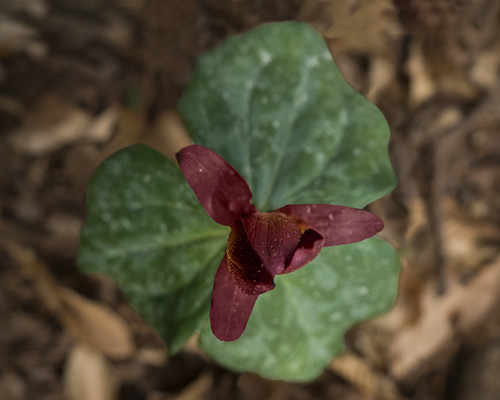
Pic(k) of the Week: Sweet Betsy in bloom!

Little Sweet Betsy in bloom!

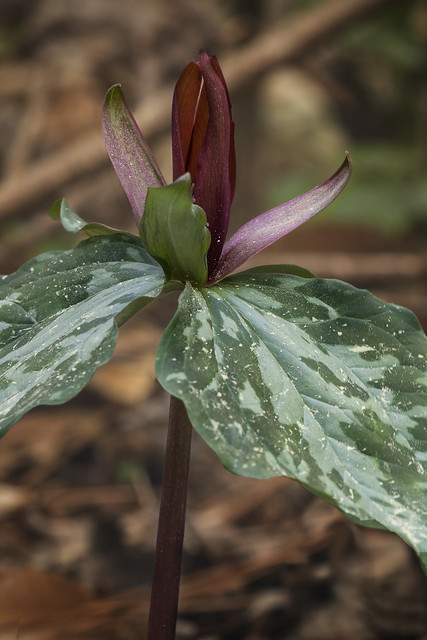
Look down! There, on the forest floor! It's a native wildflower, a "Little Sweet Betsy" trillium, blooming in late winter. Notice the yellow specks of pollen. Spring is coming.

Seen on 9 March 2023, in the Glenn Creek Nature Preserve: a small community-maintained city park in Decatur, Georgia, USA.
Trillium cuneatum —commonly known as the little sweet betsy— is a species of flowering trillium, native to the southeastern United States. The plant has three broad, mottled leaves surrounding a banana-scented, sessile [blossom lacking a stalk] flower. The petals are erect and either maroon, bronze, green, or yellow in color, flowering from early March to late April. It is the largest of the eastern sessile-flowered trilliums.
Wikipedia.

***************

The preserve appears to be a haven for these native wildflowers. Here's another Little Sweet Betsy trillium, but snapped head-on.

Sweet Betsy in bloom! (02)

Trillium —also known as wake-robin, toadshade, tri-flower, birthroot, birthwort, or, sometimes, 'wood lily'— is a genus of about fifty flowering plant species in the Melanthiaceae family [also called the bunchflower family]. Trillium species are native to temperate regions of North America and Asia, with the greatest diversity of species found in the southern Appalachian Mountains of the southeastern United States.
Wikipedia.

-----more-----