Showing posts with label Arabia Mountain. Show all posts

Saturday, May 02, 2026

Pic(k) of the Week: It's a hazy, hazy sunrise.

It's a hazy, hazy sunrise.
  Click on the image for a larger, hi-res version (on Flickr).

Looking southeast from the summit of monadnock Arabia Mountain, one could see a noticeable (yet lovely) haze just after sunrise, produced by a combination of high humidity, 50% cloud cover, and air rife with pollen.

DeKalb County, Georgia, USA.
3 April 2026 (8:06 am EDT).


***************

-----more-----

Saturday, April 25, 2026

Pic(k) of the Week: Diamorpha daybreak

Diamorpha daybreak
  Click on the image for a larger, hi-res version (on Flickr).

Tiny crimson diamorpha wildflowers, blooming at sunrise, near the summit of Arabia Mountain monadnock *.

DeKalb County, Georgia, USA.
3 April 2026 (7:37 am EDT).

Diamorpha smallii — commonly known as diamorpha, elf orpine, or Small's stonecrop — belongs to the stonecrop family (Crassulaceae), in the Sedum species of plants: succulents possessing thick, fleshy sections which retain water, allowing them to survive in drought conditions.

Diamorpha smalli is endemic to the southeastern United States, where the densest populations appear in Georgia, particularly in Panola Mountain State Park and the Davidson-Arabia Mountain Nature Preserve. Two to four inches in height, Diamorpha smallii grows in areas with granite surfaces, appearing in vernal pools (seasonal puddles of water contained by rock or dirt) and solution pits (thin patches of dirt isolated on rock outcrops), adapted to survive in harsh conditions, including high temperatures and limited soil.

Hidden most of the year, Diamorpha smallii emerge in late winter, producing dense rosettes of tiny red succulent leaves. Then, in late March, the plants produce small white flowers (~ ¼ inch). As temperatures rise, the plants lose their bright red color, taking on the appearance of little brown stems sticking up from the ground, holding on to their seeds to forestall dessication during the hottest months of the year. The seeds drop and germinate in autumn.

Arabia Mountain Heritage Area Alliance.
Scott Ranger's Nature Notes.
Wikipedia.

Fulsome blooming diamorpha


***************

-----more-----

Saturday, April 18, 2026

Pic(k) of the Week: Piedmont sandwort

Piedmont sandwort
  Click on the image for a larger, hi-res version (on Flickr).

Looking down at tiny Piedmont sandwort wildflowers, blooming in a sandy, dessicated solution pit.

This is a close-up. These tiny blossoms — about 3 millimeters wide, on stems about 4 centimeters long— appear much larger in the photograph than they did in 'real' life!

Geocarpon is a genus of flowering plants in the carnation family (Caryophyllaceae). It includes seven species native to North America, including Geocarpon uniflorum — commonly known as Piedmont sandwort (or one-flower stitchwort).

Geocarpon uniflorum is native to the southeastern United States, where it is primarily found in the Piedmont. Its preferred habitat is sandy or granitic rock outcrops. Prior to 2022, the plant was known botanically as Minuartia uniflora.

Wikipedia.
Flora of North America.

On the summit of Arabia Mountain
DeKalb County, Georgia, USA.
3 April 2026.


***************

-----more-----

Saturday, March 21, 2026

Pic(k) of the Week: Trout lily ephemeral

Trout lily ephemeral
Click on the image for a larger, hi-res version (on Flickr).

Ephemeral beauty on a winter forest floor: a native wildflower, the trout lily, blooms on Arabia Mountain.

After a 13-kilometer hike on the mountain, I was less than half a kilometer from my parked car when I stumbled upon this cluster of trout lilies blooming on the side of the Mile Rock Trail. To say that I was delighted AND surprised would be an understatement.

This is a close-up. The blossom appears larger in the image than it did in 'real life.'

DeKalb County, Georgia, USA.
28 February 2026.


***************

About the Dimpled Trout Lily

Erythronium umbilicatum — commonly known as the dimpled trout lily — is a species of perennial flowering plant in the lily family (Liliaceae), native to the southeastern United States, primarily in the piedmont and southern Appalachian areas. It is a spring ephemeral [i.e., short-lived] and its preferred habitat is forests.

Erythronium umbilicatum has green, mottled leaves that are up to 8 inches long (20 cm). The scape [i.e., long, leafless flowering stem] is up to 8 inches long (20 cm), bearing a single, nodding, lily-like flower on a 5 to 8-inch stalk (12-20 cm) with 6 petals, yellow on the inside and streaked brownish-purple on the outside, that recurve backward. The conspicuous stamens are brownish-purple in color. The flower blooms in late winter/early spring before the surrounding trees leaf out and cast shade.

North Carolina Cooperative Extension.
Wikipedia.


***************

Clifford Brown: Sandu
Album: Study in Brown (Label: EmArcy, 1955)

-----more-----

Saturday, January 17, 2026

Pic(k) of the Week: Winter catkin

Winter catkin
Click on the image for a larger, hi-res version (on Flickr).

Yellow catkins hang,
Crimson buds portend,
Winter shrub un-slumber'd.

Male flowers of a hazel alder tree (Alnus serrulata).

Arabia Lake in Arabia Mountain Nature Preserve
DeKalb County, Georgia, USA.
8 February 2023.

A catkin is a slim, cylindrical flower cluster (a spike), with inconspicuous or no petals, usually wind-pollinated (anemophilous) but sometimes insect-pollinated. It contains many, usually unisexual flowers, arranged closely along a central stem that is often drooping. Catkin-bearing plants include many trees or shrubs such as birch, willow, aspen, hickory, sweet chestnut, and sweetfern. In many of these plants, only the male flowers form catkins, and the female flowers are single (hazel, oak), a cone (alder), or other types (mulberry). While the blooming months for catkins may vary due to factors such as climate change and latitude, the following are some general timeframes: hazel catkins bloom from January to March, alder catkins from February to March, silver birch catkins from March to May, oak catkins from April to May, and white willow catkins from April to May.
Wikipedia.

***************

Phineas Newborn Jr.: Celia (composition by Bud Powell)
Album: Here Is Phineas (Label: Atlantic (1956)

-----more-----

Saturday, December 06, 2025

Pic(k) of the Week: Autumn morning on Arabia Lake

Autumn morning on Arabia Lake
Click on the image for a larger, hi-res version (on Flickr).

As I was setting up my tripod, a passing hiker greeted me.
"It's a beautiful day."
"Yes, indeed," I replied.

Arabia Lake: a man-made reservoir on Arabia Mountain, a granite monadnock near the town of Stonecrest in DeKalb County, Georgia, USA. 6 November 2025.


***************

Arabia Lake & Davidson-Arabia Mountain National Heritage Area

The former Davidson Quarry, which owned Arabia Mountain in the mid 20th-century, created the lake by damming small Stephenson Creek. In 1972, the Davidson family closed the quarry and donated the land to the county. Concrete and metal remains of a quarry bridge can still be seen on both banks of the lake (visible, in the photo, in the background)

The land is now part of the Davidson-Arabia Mountain National Heritage Area...

...that encompasses natural, cultural, and historical elements to form a cohesive, nationally significant landscape. The area is due east of Atlanta and spans 40,000 acres (16,000 ha) reaching from the historic commercial center of Lithonia to the Monastery of the Holy Spirit in Conyers, including several sites in between, including Arabia Mountain, Panola Mountain, and the historic Flat Rock Community. The National Heritage Area was established in 2006 and is coordinated by the Arabia Mountain National Heritage Area Alliance, which includes board members, representatives from the community and local organizations, and staff.


***************

Miles Davis: Boplicity.
Album: Birth of the Cool
Label: Capitol Records (recorded 1949; released 1957).

-----more-----

Saturday, November 16, 2024

Pic(k) of the Week: Hiking summit's edge

Hiking summit's edge

In morning, two hike the summit of Arabia Mountain: DeKalb County, Georgia, USA. 20 October 2024.

Composed primarily of granite-gneiss migmatite rock, Arabia Mountain is a monadnock —"an isolated small mountain that rises abruptly from a gently sloping or virtually level surrounding plain." Its almost barren summit sits 955 feet (290 m) above sea level but rises only 172 feet (52 m) above the surrounding countryside of pine and hardwood woodlands.


***************

-----more-----

Saturday, November 09, 2024

Pic(k) of the Week: Mountain Lake (from Arabia Mountain)

Mountain Lake (from Arabia Mountain)

The prosaically-named Mountain Lake is a reservoir created during 20th-century quarrying of granite, gneiss, and migmatite on Arabia Mountain, a monadnock in DeKalb County, Georgia, in the southeastern United States.

Here, the lake is seen in mid autumn on 19 October 2024, looking down from a southeastern slope of the mountain. (Some of the rocky outcrop can be seen in the foreground.)


***************

-----more-----
Saturday, April 06, 2024

Pic(k) of the Week: Diamorpha in bloom

Diamorpha in bloom

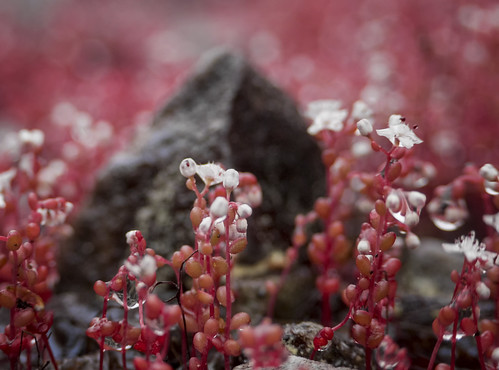
In late winter and early spring, tiny red diamorpha succulents grow white blossoms atop Arabia Mountain, a 955-foot high granitic monadnock in southeastern DeKalb County, Georgia, USA. 27 March 2024.

Also called elf orpine, diamorpha —a rare plant endemic to the southeast United States— appears, during during winter and spring, as a vibrant red covering patches of Arabia Mountain in shallow solution pit pools. In March and early April, the diamorpha flowers, growing delicate white blooms. The blooms do not last long – they will soon begin to fade as the diamorpha prepare for the hot summer months.

Diamorpha are dormant in the summer due to the extreme heat of the bare rock face. During the warmer parts of the year, these hardy plants look like little more than brown twigs sticking up out of patches of soil on the monadnock. This stage of the diamorphas’ life cycle is critical: during the summer, they hold their seeds above the ground, conserving energy until the fall (seeds that fall to the ground in summer burn and die in the hot sun). Then, in the autumn, the seeds drop to the ground and begin to germinate. The process starts again around December. Now, in April, this complicated life story is at its most vibrant stage.
Arabia Mountain National Heritage Area

This photo is a 'macro' closeup. The diamorpha, at most 2 inches tall, appear much larger in the image than they did in 'real' life.

***************

-----more-----

Saturday, March 09, 2024

Pic(k) of the Week: Laurel Creek waterfall

Laurel Creek waterfall

Evergreen mountain laurel trees ring small Laurel Creek as it cascades into the (slightly) larger Stephenson Creek.

Seen alongside (that is, clambered down from) the Flat Rock spur of the Arabia Mountain PATH trail in the Arabia Mountain Nature Preserve: DeKalb County, Georgia, USA. 27 February 2024.

Note to self: Return in spring, when the mountain laurel is blooming.

***************

-----more-----