Showing posts with label blossom. Show all posts

Saturday, January 17, 2026

Pic(k) of the Week: Winter catkin

Winter catkin
Click on the image for a larger, hi-res version (on Flickr).

Yellow catkins hang,
Crimson buds portend,
Winter shrub un-slumber'd.

Male flowers of a hazel alder tree (Alnus serrulata).

Arabia Lake in Arabia Mountain Nature Preserve
DeKalb County, Georgia, USA.
8 February 2023.

A catkin is a slim, cylindrical flower cluster (a spike), with inconspicuous or no petals, usually wind-pollinated (anemophilous) but sometimes insect-pollinated. It contains many, usually unisexual flowers, arranged closely along a central stem that is often drooping. Catkin-bearing plants include many trees or shrubs such as birch, willow, aspen, hickory, sweet chestnut, and sweetfern. In many of these plants, only the male flowers form catkins, and the female flowers are single (hazel, oak), a cone (alder), or other types (mulberry). While the blooming months for catkins may vary due to factors such as climate change and latitude, the following are some general timeframes: hazel catkins bloom from January to March, alder catkins from February to March, silver birch catkins from March to May, oak catkins from April to May, and white willow catkins from April to May.
Wikipedia.

***************

Phineas Newborn Jr.: Celia (composition by Bud Powell)
Album: Here Is Phineas (Label: Atlantic (1956)

-----more-----

Saturday, March 15, 2025

Pic(k) of the Week: Flowering Quince, flowering in winter

Flowering Quince, flowering in winter

Native to China, a flowering quince shrub (Chaenomeles speciosa) blooms in winter, far from home.

Briarlake Forest Park: DeKalb County, Georgia, USA. 25 February 2025.


***************


Scott Joplin: Solace (Joshua Rifkin, piano)

-----more-----

Saturday, February 10, 2024

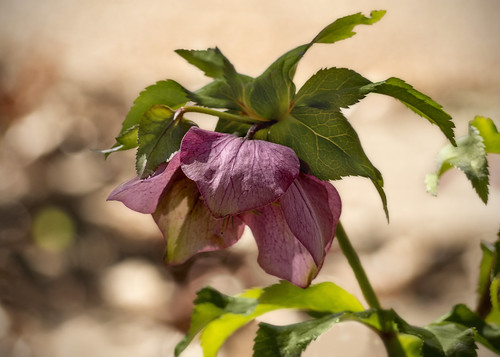
Pic(k) of the Week: Holy hellebore

Holy hellebore

"Listen with the ear of your heart.
— Prologue, Rule of St. Benedict (c. 530 CE).

A Lenten rose (hellebore) blooms in mid-winter.

A small garden on the grounds of Monastery of Our Lady of the Holy Spirit in Rockdale County, Georgia, USA. 3 February 2024.


***************

-----more-----

Saturday, June 03, 2023

Pic(k) of the Week: Hops? ... No!

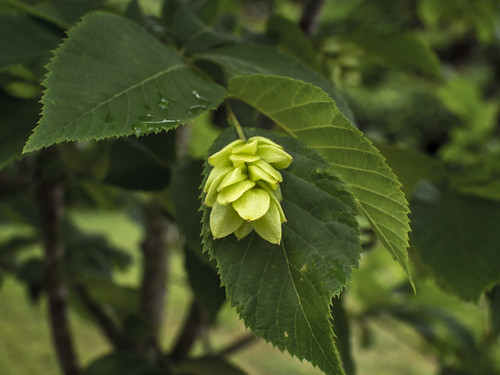
Hops? ... No!

Convergent evolution?

The fruits of American hophornbeam trees closely resemble the seed cones of hop plants (which are used to flavor beer). But hophornbeams, despite a similarity in appearance (and name), are NOT hops...and, indeed, would not be particularly pleasant in a beer!

Seen in Sycamore Park, in Decatur, Georgia, USA. 13 May 2023.
Ostrya virginiana —commonly known as the American hophornbeam, eastern hophornbeam, hardhack (in New England), ironwood, and leverwood— is a species of Ostrya (deciduous trees belonging to the birch family Betulaceae) native to eastern North America.

Ostrya virginiana is a small deciduous understory tree growing to 59 feet tall (18 m) with a trunk 8-20 inches in diameter (20–50 cm). The flowers are catkins (spikes) produced in early spring, at the same time as the new leaves appear. In early summer, pollinated female flowers develop into small hop-resembling fruits, 1⁄8–3⁄16 inches long (3–5 mm), changing from greenish-white to dull brown as the fruit matures.
Wikipedia.

-----more-----

Saturday, April 01, 2023

Pic(k) of the Week: Pear tree in winter

Pear tree in winter

Invasive but lovely, a Bradford pear tree blooms...in winter!
Bradford pear (Pyrus calleryana ‘Bradford’) is a spring-flowering tree that has been widely planted throughout the eastern U.S. in the last few decades. It is a popular tree that is frequently seen in nearly every city within its growing range. The species is a native of China, Taiwan, Japan, and Vietnam.

The Bradford pear grows 30 to 50 feet tall and 20 to 30 feet wide. It has a wider and more erect, branchier canopy than other species of Pyrus calleryana. A rapid grower, it has a short to moderate life span (15 to 25 years). The most attractive feature of this thornless tree is the showy white flowers that appear before the leaves in the spring. Early spring flowering may last two weeks. The flowers, unfortunately, have an unpleasant [rotting fish] fragrance. Small, round, brown fruit then appear but are hidden by the leaves. Fruits are about the size of a marble and are often eaten by birds. In the fall, the Bradford pear is one of the last trees to have colorful leaves, mahogany-red and sometimes bright orange-red.

Pyrus calleryana and cultivars are considered invasive in southeastern US. Although the ‘Bradford’ pear was originally bred as sterile and thornless, it readily cross-pollinate with other cultivars of callery pears and subsequently produces viable fruit. The ripened fruit is eaten and disseminated by birds, which results in very thorny thickets of wild pear trees. Callery pears also have thorns ranging from ¼-inch long to over 2-inches long that can cause extensive damage to equipment [and humans].

Seen alongside the East Decatur Greenway in DeKalb County, Georgia, USA, on 17 February 2023.

-----more-----

Saturday, March 12, 2022

Pic(k) of the Week: Winter white (but not snow white)

Winter white (but not snow!)

It's winter white...but it's not snow white. Lovely, but invasive, the Callery pear trees have begun to bloom.

Seminary Wood in Decatur, Georgia, USA. 25 February 2022.
The Callery pear (Pyrus calleryana)is one of the first trees to bloom in early March throughout north Georgia. The tree has been widely planted across the southeast for its white spring blossoms and red fall color. [...] Callery trees growing wild trees develop thick thorns along the branches,inches long. Many cultivars of the Callery pear can invade and destroy native ecosystems.
North Georgia Master Gardeners.

-----more-----

Saturday, June 15, 2019

Pic(k) of the Week: Geranium among the licorice

Geranium among the licorice

Red! A closeup of geraniums blooming in a bed of silver licorice.

Using flash under the directly overhead midday sun. As seen in a garden, in Atlanta, Georgia, on 11 June 2019.

-----more-----

Saturday, May 11, 2019

Pic(k) of the Week: Garden vine blossoms

Garden vine blossoms

Mom always loved weeding her flower beds 'best,' more so than planting them. She took delight, she would say, in "the creative destruction."

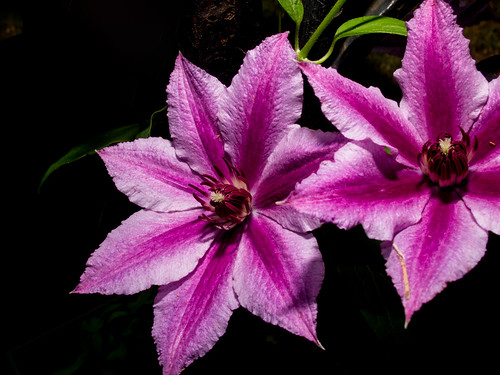
Here's a blossoming vine I saw climbing near a front door, in Decatur, Georgia, 10 May 2019. No creative destruction needed.

-----more-----

Saturday, May 04, 2019

Pic(k) of the Week: Rosebud glory

Rosebud glory

Georgia's May Day's rosebud's glory.
Rough winds do shake the darling buds of May,
And summer's lease hath all too short a date.
— William Shakespeare (Sonnet 18)

-----more-----

Saturday, April 13, 2019

Pic(k) of the Week: Doggin' Dogwood

Doggin' Dogwood

It's early April in Georgia, and many of the dogwood blossoms are already past peak. But not these guys.
The four showy flower petals of the flowering dogwood (Cornus florida) aren’t actually petals as botanists define them. The dogwood petals instead are modified leaves called bracts that surround a cluster of about 20 tiny yellow flowers. As the flowers bloom, the showy bracts expand to attract pollinating insects. Each bract has a dark red-brown indentation at its tip. Depending on location, dogwood trees may bloom in March, April or May for about two weeks. When pollinated, the flowers produce red berries relished by wildlife.
SFGate.

As seen in Sycamore Park, in Decatur, Georgia, on 11 April 2019.

-----more-----

Saturday, December 30, 2017

Pic(k) of the Week: New Year's Poinsettia

Christmas poinsettia

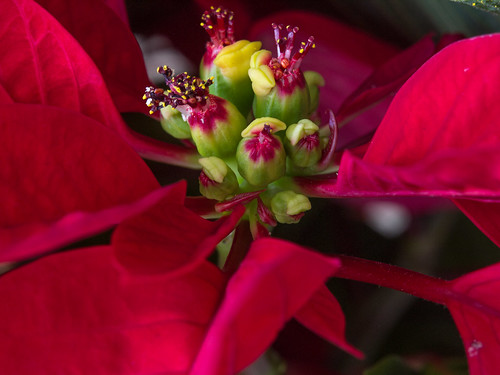
For the final Pic(k) of the Week of 2017, no beer. Instead, it's a 'macro' of a house-cut poinsettia, 'filmed' with a 16-millimeter extension tube.

I pronounce the plant as it is spelled: "poin SET tee uh." If you say it otherwise, ignoring that final 'i,' I say you're wrong.

Did you know that you can preserve a poinsettEEa well past the winter holidays? I guessed at that last year, and replanted it outdoors, under a tree, in the spring. Here are tips about that from Gardening Know How:
In spring, return the plant to a sunny area and water well. Cut back all canes (branches) to about 6 inches from the pot’s rim. It may also be a good idea to repot the poinsettia using the same type of soil. While poinsettias can be kept indoors throughout summer, many people choose to move them outdoors in a sunny, but protected, area of the flower garden by sinking the pot into the ground. Either way is fine. After new growth has reached between 6 to 10 inches, pinch out the tips to encourage branching. This can be done once a month until the middle of August. Once nights become longer in fall, bring the poinsettia indoors. From about September through November light becomes crucial in poinsettia plant care. In order to encourage blooming, poinsettia plants require long periods of darkness at night (about 12 hours). Therefore, move the poinsettia to a location where it will not receive any nighttime light or cover it with a box. Allow plenty of light during the day so the plant can absorb enough energy for flowering. Warmer days (65-70 F./18-21 C.) and cooler nights (55-60 F./13-16 C.) are also recommended. Provide semi-cool, humid locations in bright, indirect light with plenty of moisture once blooming occurs.

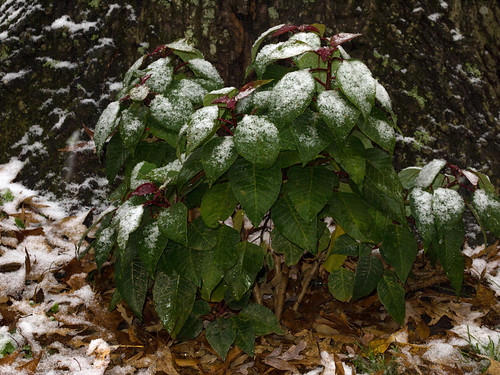
Mine fared well. But, did you notice that line about the fall? "Bring the poinsettia indoors." I ignored that advice. That's when this happened.

Snow on the Poinsettia

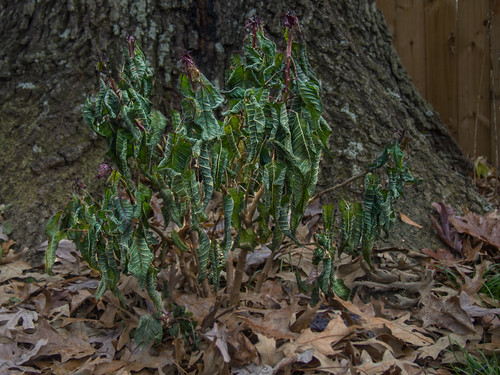
So pretty, but, then, a couple days after that, this happened.

After the freeze

Oh, well. Back to another store-cut poinsettia. Green (red?) thumbs are not my cups of beer.

-----more-----

Saturday, August 05, 2017

Pic(k) of the Week: Earth Goddess in summer

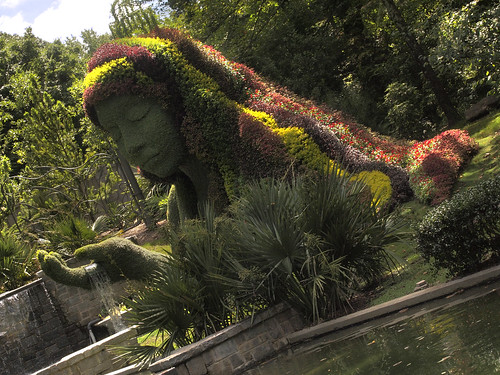
Earth Goddess in summer (04)

The Earth Goddess 'living' sculpture, as seen in the Cascades Garden, of the Atlanta Botanical Garden, in, naturally, Atlanta, Georgia, on 30 July 2017.
The immense Earth Goddess has become a signature exhibit at the Garden. The living sculpture, installed in 2013, was originally designed and fabricated by artisans from Mosaïcultures Internationales de Montréal. Mosaiculture is the centuries-old horticultural art of covering fabricated steel forms with a planting material and "plugging," or planting, it with tens of thousands of tiny plants.

At 30 feet wide by 25 feet tall, the sculpture weighs nearly 29 tons and holds more than 18,000 individual plants, which are trimmed weekly to maintain the flowing lines. Some of the plants used for a palette of color and texture include Pilea glauca, Lantan camara (Florida Red Mound), Alternanthera (Petites Feuilles Verts), Ipomoea batatas (Sweetheart Purple), Durante erecta (Lemon Lime), and Hypoestes sanguinolenta (Splash Select Pink).

-----more-----

Saturday, May 06, 2017

Pic(k) of the Week: Hydrangea begins to bloom.

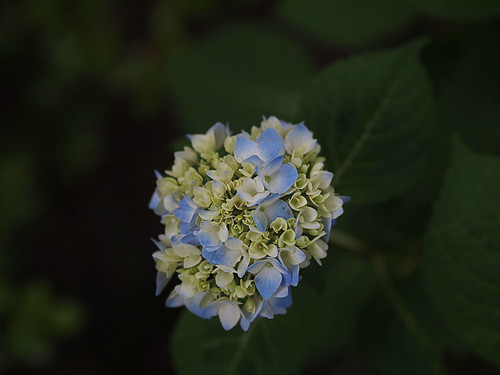
Hydrangea begins to bloom

Saturdays, here, it's usually a photo of a beer or a brewery (or wine, whiskey, but not song). Today, on the other hand, the Pic(k) of the Week is of a blooming hydrangea.

Hydrangea (or hortensia) is a genus of 70–75 species of flowering plants native to southern and eastern Asia (China, Japan, Korea, the Himalayas, and Indonesia) and the Americas. By far the greatest species diversity is in eastern Asia, notably China, Japan, and Korea. Most are shrubs 1 to 3 meters tall, but some are small trees, and others lianas reaching up to 30 m (98 ft) by climbing up trees. They can be either deciduous or evergreen, though the widely cultivated temperate species are all deciduous.
Wikipedia

And, here, from the website of the United States National Arboretum (that is, before budget cuts take it down):
While there are approximately 23 species of Hydrangea, only five are widely cultivated in the U.S. The most popular species is Hydrangea macrophylla, which is commonly known as bigleaf, French, garden or florist’s hydrangea. This Japanese native is rated as hardy to USDA cold-hardiness zone 6. It produces large inflorescences of white, pink or blue flowers in early summer. As with most other Hydrangea species, the inflorescence is composed of a combination of large, showy and small, inconspicuous flowers. In mophead, or Hortensia, (H. macrophylla var. macrophylla) cultivars, many showy flowers are arranged on the outside of the rounded inflorescence. On the interior of the inflorescence, a few small flowers are present; these are the flowers that produce seed.

And, finally, here, from The Farmer's Almanac:
With immense flower heads, hydrangeas flaunt an old-fashioned charm that is hard to resist. Colors also beguile with clear blues, vibrant pinks, frosty whites, lavender, and rose—sometimes all blooming on the same plant! The colors of some hydrangeas—especially mophead and lacecap—can change color based on the soil pH, which affects relative availability of aluminum ions. Acidic soils with a pH of less than 5.5 produce blue flowers; soils with a pH greater than 5.5 produce pink flowers. White flowers are not affected by pH. Unrivaled in the shrub world, these elegant ladies are easy to cultivate, tolerate almost any soil, and produce flowers in mid-summer through fall (when little else may be in bloom). Hydrangeas are excellent for a range of garden sites from group plantings to shrub borders to containers.

I took this image at 5:53 pm, on 30 April 2017, in the garden of a house in southeast Atlanta, Georgia, using a 'fast lens' on a Micro Four Thirds-format mirrorless digital camera.
  • Camera: Olympus Pen E-PL1
  • Lens: Olympus M.45mm F1.8
  • ISO: 200
  • Shutter speed: 1/400
  • Aperture: f/2.0
  • Focal length: 45 mm
    (equivalent to DSLR range of 90 mm)
-----more-----

Saturday, April 18, 2015

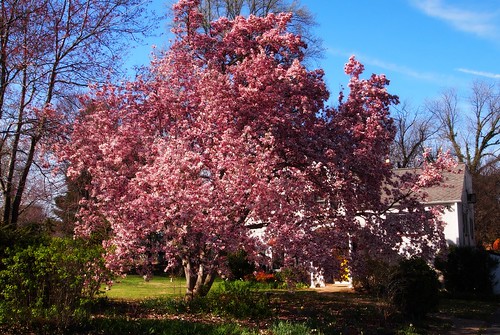
Pic(k) of the Week: Pink blossoms, yellow door.

'Tis the season for bloomin' pastels.

Pink blossoms, yellow door (01)

And the pink wasn't limited only to Washington D.C.'s Tidal Basin.

Here's a street scene, in suburban...
Fairfax, Virginia.
12 April 2015.

-----more-----

Saturday, March 29, 2014

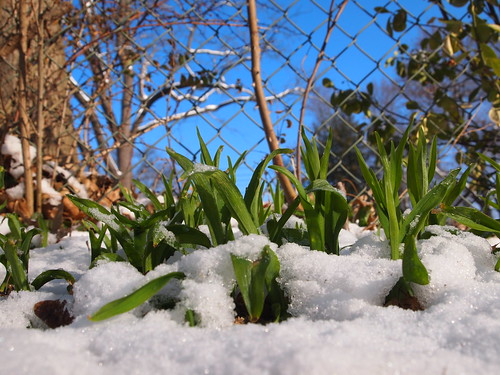
Pic(k) of the Week: Snow sprouts

Snow sprouts

Snow, snow, led astray,
Why, why, here today?
It's calendar sprin(g),
Or, so we thin(k).
Winter's nine months away.

A snowstorm hit the Washington, D.C.-area, on 25 March, five days after the start of spring. A premature April Fools' Day prank, perhaps?

*****************
P.S. Please excuse my doggerel.

-----more-----

Saturday, March 16, 2013

Pic(k) of the Week: Purple majesty's early spring

Purple majesty's early spring (04)

At the intersection of the Washington and Old Dominion Trail and the Four Mile Run Trail: purple blossoms in late winter.

Madison Manor Park
Arlington, Virginia.
10 March 2013.

********************
  • Pic(k) of the Week: one in a weekly series of personal photos, often posted on Saturdays, and often, but not always, with a good fermentable as a subject. Camera: Olympus Pen E-PL1.
  • Commercial reproduction requires explicit permission, as per Creative Commons.

  •