Showing posts with label spring. Show all posts

Saturday, May 10, 2025

Pic(k) of the Week: 3-2-1 Sketch!

3-2-1 Sketch!

Pens down! In a 'sketch-off,' participants had only a short time to draw a portrait of the person sitting across from them.

Atlanta Dogwood Festival in Piedmont Park: Atlanta, Georgia, USA. 13 April 2025.


***************

-----more-----

Saturday, May 13, 2023

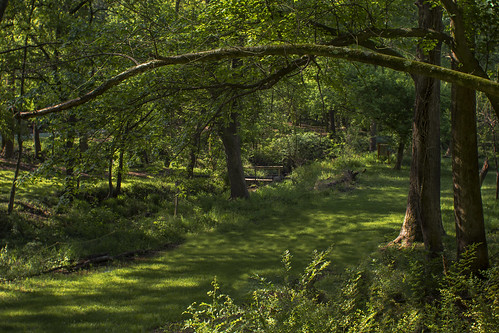
Pic(k) of the Week: How green was my valley

How green was my valley

Idyll beyond pavement,
How green was my valley
In vernal raiment.

Beyond its paved southern terminus, the East Decatur Greenway (DeKalb County, Georgia, USA) extends, unpaved, about one-third mile northeastward. Continuing through a wildflower garden, it crosses Cecilia Creek via a small pedestrian bridge (pictured here), and concludes alongside the eastern bank of the creek.

15 April 2023.


-----more-----

Saturday, May 28, 2022

Pic(k) of the Week: White violet, close up

White violet, close up

Tiny, early-spring flora.

In March, ruderal, white/purple-striated violets were bustin' out all over. Here, I photographed one (getting down low!), just off of a sidewalk, in Avondale Estates, Georgia, USA, on 22 March 2022.

This was a closeup. The Viola sororia (at most two centimeters in diameter) appears much larger in the image than it did in 'real' life.

-----more-----

Saturday, April 23, 2022

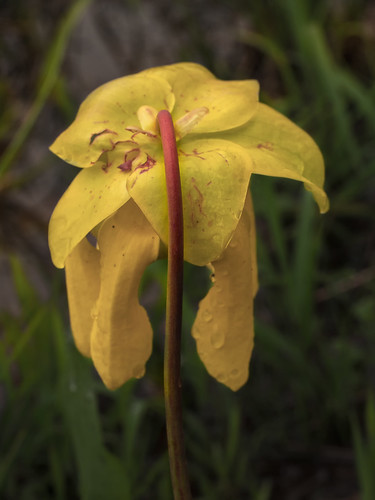
Pic(k) of the Week: Rare Sarracenia oreophila, blooming

Rare Sarracenia oreophila, blooming

The yellow blossom of an endangered, carnivous(!) green pitcher plant, growing in the wild, on the bank of a pond, in Legacy Park of the city of Decatur, Georgia, USA. 16 April 2022.

***************

The more you know...

Sarracenia oreophila, also known as the green pitcher plant, is a carnivorous plant in the genus Sarracenia [growing in wetland environments].

In early spring, the plant produces large, yellow flowers with 5-fold symmetry. The yellow petals are long and strap-like, and dangle over the umbrella-like style of the flower, which is held upside down at the end of a 20-inch long (50 cm) scape. The stigma of the flower are found at the tips of the 'spokes' of this umbrella.

In late spring, the plant devlops highly modified leaves in the form of pitchers that act as pitfall traps for prey, such as small insects. The narrow pitcher leaves are tapered tubes that rise up to 30 inches (75 cm) from the ground, with a mouth 2 to 4 inches (6-10 cm) in circumference.
Wikipedia.

***************

Now, the bad news

Native to the southeast U.S., the green pitcher plant is an extremely endangered species [due to human development and forest succession] and now only can be found in a handful of counties in northeast Georgia [including Decatur], southwest North Carolina, and northeast Alabama.
U.S. Fish and Wildlife Service.

Green pitcher plants, surviving

-----more-----

Saturday, February 26, 2022

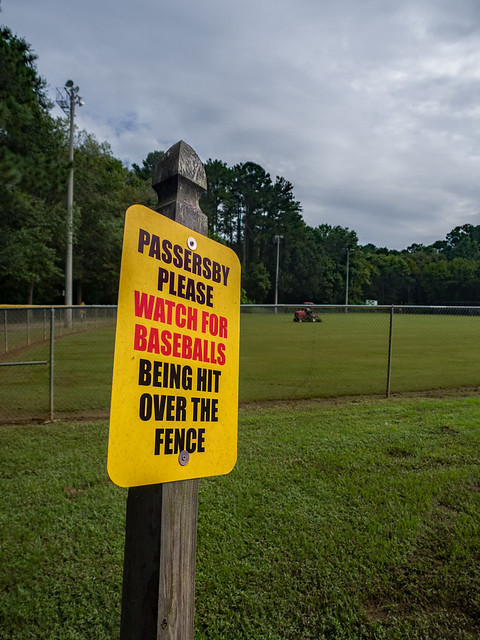
Pic(k) of the Week: Watch for baseballs!

Watch for baseballs!

Watch for baseballs! It's a sign of spring.

Pictured:
Eight (!) youth baseball fields abut the southern entrance of the South Peachtree Trail, in Medlock Park, DeKalb County, Georgia, USA.

***************

But there's no sign of 'adult' baseball yet in sight.

The labor agreement between baseball owners and players expired last year and Major League Baseball's owners are 'locking out' the players. In fact, spring training games were to have begun this week ... and none were played.

In their negotiations, baseball players are looking for a new agreement to:
  • enforce a commitment to winning on the part of all teams
  • to pay the younger players producing an increasing share of on-field value commensurate with that production,
  • to encourage more spending on players instead of discouraging it.
Team owners are either disagreeing with each demand or to the requirements for each.

If the two sides cannot reach agreement by Monday, 28 February 2022, baseball's Opening Day —originally set for 31 March— will need to be postponed (or worse).

First the virus, now this. Sigh.

***************

UPDATE

After the second-longest labor dispute in baseball history, the owners and players reached a deal on 10 March, clearing the way for baseball’s return. With, now, an abbreviated spring training schedule, Opening Day was set for 7 April, a week later than originally scheduled. More: below.


-----more-----

Saturday, July 24, 2021

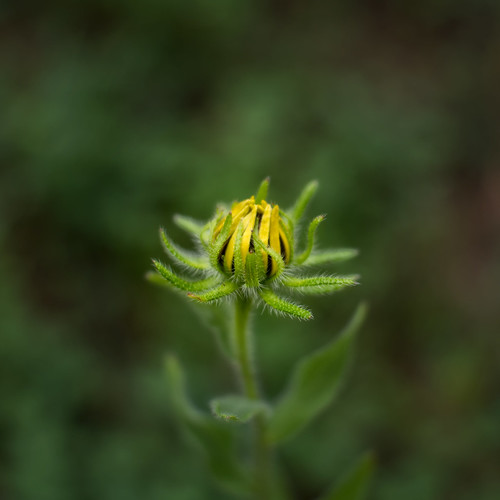
Pic(k) of the Week: Proto-aureate

Proto-aureate

Proto-aureate,
Yellow wildflower,
Half-fledged.

Trailhead Community Park, of the East Decatur Greenway, in Decatur, Georgia, USA, on 6 June 2021.

-----more-----

Sunday, May 09, 2021

Pic(k) of the Week: Tiny wood sorrel on the Greenway

Tiny wood sorrel on the Greenway

April showers bring May flowers. Like these.

Tiny violet wood sorrel flowers blossom on the East Decatur Greenway, in DeKalb County, Georgia, USA. 2 May 2021.
Violet wood-sorrel (Oxalis violacea) is a native plant in much of the United States, from the Rocky Mountains east to the Atlantic Ocean and Gulf of Mexico coasts, and through Eastern Canada. It has a tendency to cluster in open places in damp woods and on stream banks, and in moist prairies.
Wikipedia.

By the way, this is a closeup. The wood sorrel appears much larger in the image than it did in 'real' life.

-----more-----

Saturday, May 01, 2021

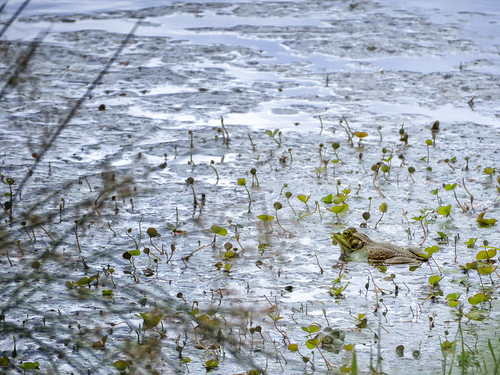
Pic(k) of the Week: Bullfrog in pond

Bullfrog in pond

The bullfrogs (Lithobates catesbeianus) have begun bellowing. It's mating season, in among the water clover, of Postal Pond, in Legacy Park of Decatur, Georgia, USA, on 27 April 2021.

I could hear this loud fellow well before I could see him, well camouflaged as he was. That is, until I used my camera's telephoto lens as a monocular to spot him.

Legacy Park is an in-the-city park. But at 77 acres, it can have an in-the-country feel. Just ignore the occasional bleat of a car horn in the distance.

-----more-----
  • On 29 April 2021, Flickr's editors chose this image as one for inclusion in their Flickr Explore feature.

  • Pic(k) of the Week: one in a weekly series of images posted on Saturdays, and occasionally, but not always (as is the case today), with a good fermentable as the subject.
  • Photo 18 of 52, for year 2021. See it on Flickr: here.
  • Camera: Olympus OM-D E-M10 II.
    • Lens: Olympus M.40-150mm F4.0-5.6 R
    • Settings: 150 mm | 1/160 | ISO 200 | f/5.6
  • Commercial reproduction requires explicit permission, as per Creative Commons.

  • For more from YFGF:

Saturday, March 20, 2021

Pic(k) of the Week: Cecilia's wetlands

Cecilia's wetlands

Marshlands of Cecilia Creek (or more prosaically, East Fork Middle Branch Shoal Creek), in Seminary Wood.

Photo taken in Legacy Park, within the boundaries of the City of Decatur, in the state of Georgia, USA.


-----more-----

Saturday, June 13, 2020

Pic(k) of the Week: Turtle and amberwings, down by the lakeside

Turtle and amberwings

Two dragonflies flit dangerously close to a turtle...or, from the turtle's perspective, deliciously close. Down by Avondale Lake, in the (small) city of Avondale Estates, Georgia, USA, on 5 June 2020.

-----more-----

Friday, May 01, 2020

Utepils for Frühjahrswanderung


Word of the day: “Utepils.”

Norwegian for “a beer that is enjoyed outside...particularly on the first hot day of the year.
— “The Positive Lexicography Project
(a catalog of foreign terms for happiness that have no direct English translation).

Used in a sentence:
An utepils would be a salubrious refreshment after a Frühjahrswanderung today.
— “Frühjahrswanderung”: German for “spring hike,”if not quite as mellifluous a locution as “utepils.”

Happy May Day!

-----more-----

Saturday, April 25, 2020

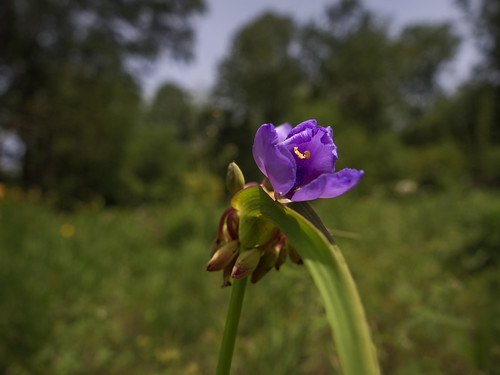
Pic(k) of the Week: Purple wildflower in field

Purple wildflower in field

Wildflowers have begun to bloom at the end of the trail (or is it the beginning?).

At the Trailhead Community Park of the East Decatur Greenway, in Decatur, Georgia, USA. 22 April 2020.

The shot is a closeup — getting in close at a wide angle— so the purple blossom appears larger in the image than it does in 'real' life (~ 1-inch or 2.5-centimeters).

-----more-----

Saturday, June 08, 2019

Pic(k) of the Week: Mimosa stamens

Mimosa stamens

Pink, perfumed...and invasive!

A mimosa tree blooms in June, as seen along the East Decatur Greenway, in Decatur, Georgia, on 1 June 2019.

****************

About the Mimosa

Albizia julibrissin is known by a wide variety of common names, such as Persian silk tree or pink siris. It is also called Lenkoran acacia or bastard tamarind, though it is not too closely related to either genus. The species is usually called 'silk tree' or 'mimosa' in the United States. The leaves of the tree slowly close during the night and during periods of rain, the leaflets bowing downward; thus its modern Persian name shabkhosb, means 'night sleeper.' In Japan, its common names are nemunoki, nemurinoki, and nenenoki which all mean 'sleeping tree.'
Wikipedia.

Originally brought to the U.S. as an ornamental tree, the mimosa tree has escaped gardens and pushed its way into natural areas that should be preserved for native plants. With its ability to reproduce vigorously and with only one natural enemy to keep it in check (Fusarium wilt), it has spread unchecked across the South. It is considered a non-native invasive weed.
Walter Reeves: Georgia Gardener.

-----more-----

Saturday, May 04, 2019

Pic(k) of the Week: Rosebud glory

Rosebud glory

Georgia's May Day's rosebud's glory.
Rough winds do shake the darling buds of May,
And summer's lease hath all too short a date.
— William Shakespeare (Sonnet 18)

-----more-----

Saturday, April 13, 2019

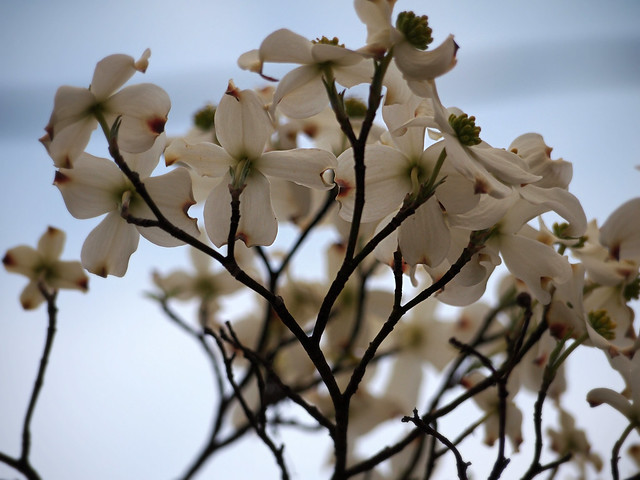
Pic(k) of the Week: Doggin' Dogwood

Doggin' Dogwood

It's early April in Georgia, and many of the dogwood blossoms are already past peak. But not these guys.
The four showy flower petals of the flowering dogwood (Cornus florida) aren’t actually petals as botanists define them. The dogwood petals instead are modified leaves called bracts that surround a cluster of about 20 tiny yellow flowers. As the flowers bloom, the showy bracts expand to attract pollinating insects. Each bract has a dark red-brown indentation at its tip. Depending on location, dogwood trees may bloom in March, April or May for about two weeks. When pollinated, the flowers produce red berries relished by wildlife.
SFGate.

As seen in Sycamore Park, in Decatur, Georgia, on 11 April 2019.

-----more-----

Saturday, March 23, 2019

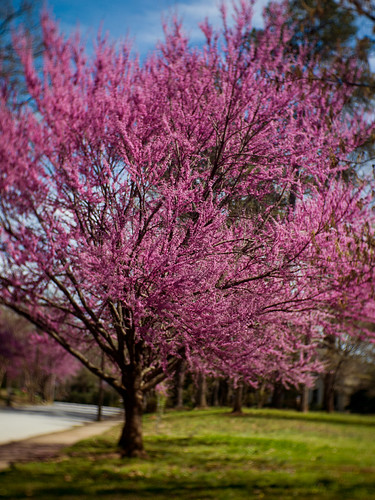
Pic(k) of the Week: Pink Spring!

Sycamore Pink (02)

On 17 March 2019, these magnificent dogwoods —in the Sycamore Street neighborhood of Decatur, Georgia— were in the pink, seemingly celebrating the start of spring. They were three days early.

***************

Vernal Equinox

The actual Vernal Equinox —when winter became spring, astronomically— occurred Wednesday at 5:58 pm Eastern Daylight Saving Time. (That's Atlanta, Georgia time. Your time may vary.) At that moment, the Sun crossed, from south to north, directly above the equator. In other words, at that moment there was no tilt of the Earth's axis in regard to the Sun. For our friends south of the equator, the March Equinox marks the end of summer and start of autumn.

Super Worm Full Moon

The moon also rose that evening of the Equinox, full (aka the Worm Moon) and 'super' (its closest approach to the Earth). That's a phenomenon that last occurred in spring 1905 and won’t occur again until 2144.

Not half and half

Year to year, due to the inexactness of the modern calendar and because Earth's elliptical orbit is continually changing its orientation relative to the Sun, the date varies from 19 through 21 March. And, it isn't true that on that day, there are equal amounts of daylight and dark. It's close, but not quite.

Vernal Equinox and Easter

In A.D. 325, the Roman Catholic Council of Nicaea set the date of Easter as the Sunday following the paschal full moon, which is the full moon that falls after the Vernal Equinox. (A full moon —the Worm Moon— did occur Wednesday night, but since it occurred on the same date, it's not technically the first full moon after the Equinox.)

In practice, that means that Easter is always the first Sunday after the first full moon that falls after March 21. Thus, Easter can occur as early as 22 March or as late as 25 April, depending on when the paschal full moon falls.

-----more-----

Saturday, May 12, 2018

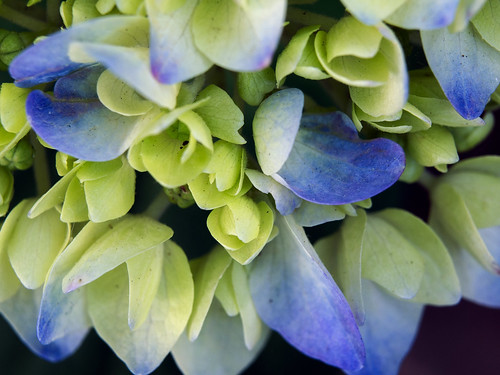
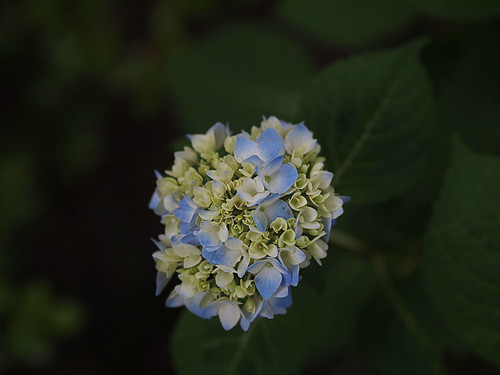
Pic(k) of the Week: Hydrangea blooms blue.

Hydrangea blooms blue

Hydrangea macrophylla —also called bigleaf hydrangeas and mophead hydrangeas and French hydrangeas— are a staple of the American South, such as this one in Atlanta, Georgia, the petals of its inflorescence only beginning to turn blue on 7 May 2018.

-----more-----

Tuesday, March 20, 2018

Sing Joy Spring

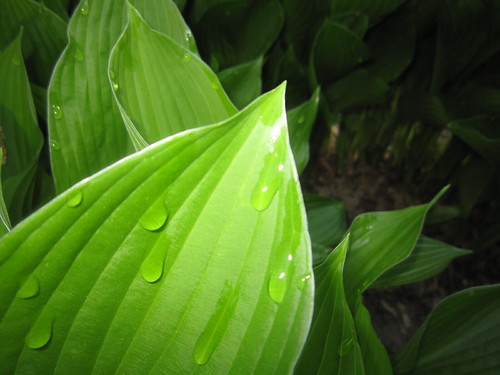
hosta 11 April (01)

Spring arrives today, Tuesday, 20 March 2018, at 12:15 p.m., east coast daylight time. The vernal equinox. In the Northern Hemisphere.

We sing a spring
Sing joy spring.
A rare and most mysterious spring,
This most occult thing
Is buried deep in the soul.
Its story never has been told.

The joy spring, the fountain of pleasure,
Is deep inside you whether you're diggin' it or not.
Once you're aware of this spring,
You'll know that it's the greatest
Treasure you've got.

And furthermore:
The joy spring, the bounteous treasure,
Cannot be bartered away and never can be sold.
Nothing can take it from you.
It's yours and yours alone to have and to hold.

And something more:
It never is lost to fire or theft.
It's always around. When trouble is gone,
The pleasure is left.
I've always found
It's burglar-proof same as the treasure
Man lays up in heaven, worth a
Price no one can measure.
That says a lot.

So joy spring,
this fountain of pleasure,
That's deep inside you, let me inform you in all truth,
Ponce de Leon sought this
When he was searchin'
For the fountain of youth.
I say in truth, he
Sought a magical thing,
For he was searchin'
For the joy spring.

JOYSPRING
Music: Clifford Brown
Lyrics: Jon Hendricks
Performance: Manhattan Transfer


-----more-----

Saturday, May 06, 2017

Pic(k) of the Week: Hydrangea begins to bloom.

Hydrangea begins to bloom

Saturdays, here, it's usually a photo of a beer or a brewery (or wine, whiskey, but not song). Today, on the other hand, the Pic(k) of the Week is of a blooming hydrangea.

Hydrangea (or hortensia) is a genus of 70–75 species of flowering plants native to southern and eastern Asia (China, Japan, Korea, the Himalayas, and Indonesia) and the Americas. By far the greatest species diversity is in eastern Asia, notably China, Japan, and Korea. Most are shrubs 1 to 3 meters tall, but some are small trees, and others lianas reaching up to 30 m (98 ft) by climbing up trees. They can be either deciduous or evergreen, though the widely cultivated temperate species are all deciduous.
Wikipedia

And, here, from the website of the United States National Arboretum (that is, before budget cuts take it down):
While there are approximately 23 species of Hydrangea, only five are widely cultivated in the U.S. The most popular species is Hydrangea macrophylla, which is commonly known as bigleaf, French, garden or florist’s hydrangea. This Japanese native is rated as hardy to USDA cold-hardiness zone 6. It produces large inflorescences of white, pink or blue flowers in early summer. As with most other Hydrangea species, the inflorescence is composed of a combination of large, showy and small, inconspicuous flowers. In mophead, or Hortensia, (H. macrophylla var. macrophylla) cultivars, many showy flowers are arranged on the outside of the rounded inflorescence. On the interior of the inflorescence, a few small flowers are present; these are the flowers that produce seed.

And, finally, here, from The Farmer's Almanac:
With immense flower heads, hydrangeas flaunt an old-fashioned charm that is hard to resist. Colors also beguile with clear blues, vibrant pinks, frosty whites, lavender, and rose—sometimes all blooming on the same plant! The colors of some hydrangeas—especially mophead and lacecap—can change color based on the soil pH, which affects relative availability of aluminum ions. Acidic soils with a pH of less than 5.5 produce blue flowers; soils with a pH greater than 5.5 produce pink flowers. White flowers are not affected by pH. Unrivaled in the shrub world, these elegant ladies are easy to cultivate, tolerate almost any soil, and produce flowers in mid-summer through fall (when little else may be in bloom). Hydrangeas are excellent for a range of garden sites from group plantings to shrub borders to containers.
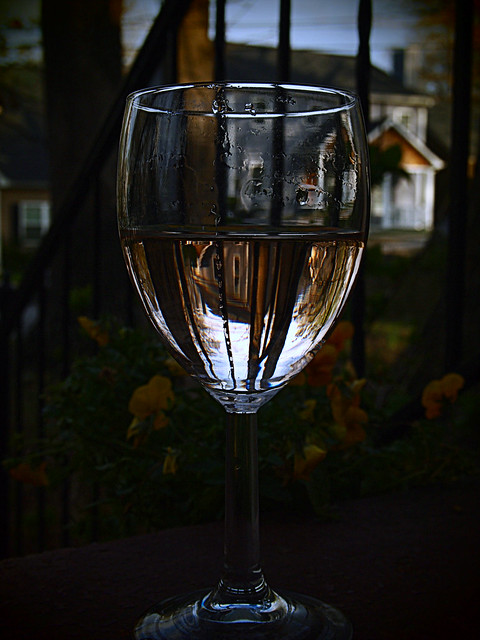
I took this image at 5:53 pm, on 30 April 2017, in the garden of a house in southeast Atlanta, Georgia, using a 'fast lens' on a Micro Four Thirds-format mirrorless digital camera.
  • Camera: Olympus Pen E-PL1
  • Lens: Olympus M.45mm F1.8
  • ISO: 200
  • Shutter speed: 1/400
  • Aperture: f/2.0
  • Focal length: 45 mm
    (equivalent to DSLR range of 90 mm)
-----more-----

Saturday, April 08, 2017

Pic(k) of the Week: 2nd rosé of spring

2nd rosé of spring

What:
A cornucopia cépage of Mendocino and Sonoma Coast fruit: Pinot Noir, Barbera, Grenache, Grenache Gris, Syrah.

Who:
Banshee Winery: its 2016 rosé.

How (did it taste):
Light touch of nectarines and raspberries. Dry finish with a nice smack of acidity.

Why
Rosé: so much a sign of spring.

Where:
Front porch: Atlanta, Georgia.
When:
The second rosé: The first glass, I had poured earlier in the evening. 24 March 2017.

Bloomin' Dogwood (03)

-----more-----