Showing posts with label Germany. Show all posts

Saturday, May 20, 2023

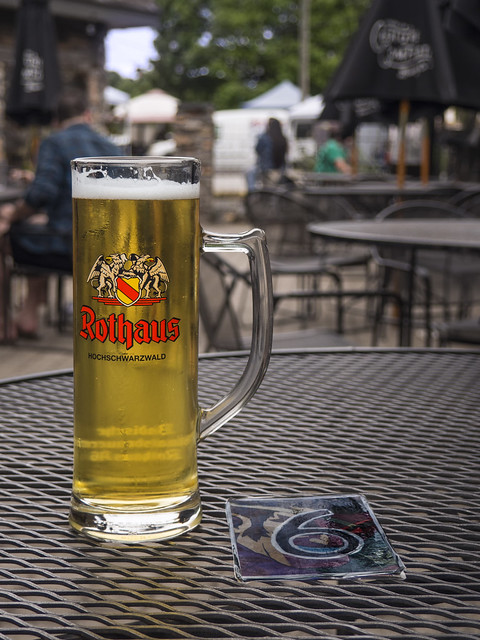
Pic(k) of the Week: Rothaus Tannenzäpfle Pils, on draught

Rothaus Tannenzäpfle Pils, on draught
The Rothaus Tannenzäpfle 1 is the absolute classic among our beers - and has been since 1956. That is why it is also the namesake and figurehead of the Gäpfle family. The best aromatic hops from Tettnang and the Hallertau as well as local malt made from summer barley and the purest spring water from the Black Forest give Rothaus Tannenzäpfle its uniquely spicy and fresh taste.
— Badische Staatsbrauerei Rothaus 2 (Baden State Brewery Rothaus)

Rothaus Tannenzäpfle Pils — served out-of-doors on a spring afternoon, on draught in a brewery serving glass, on the pub patio at My Parents Basement 3, in Avondale Estates, Georgia, USA. 7 May 2023.

***************

Yes, but how does the beer taste?

For having traveled so far, the beer was in good form. Brilliant clarity under a long-lasting white collar of foam. Slightly grassy nose; subtle cracker-wafer malt; hints of honey and green apple; subdued tree-sap and mowed-grass hops; dry, slightly sulfury finish. A glorious German pilsner. Delightful.

A series of occasional reviews of beer (and wine and spirits).
No scores; only descriptions.

-----more-----

Saturday, September 19, 2020

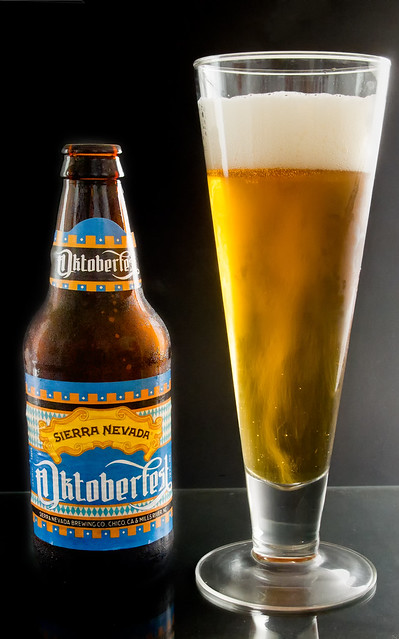
Pic(k) of the Week: Sierra Nevada Oktoberfest 2020, 'pro se'

Oktoberfest 2020
Since 1810, when Bavarian Crown Prince Ludwig I organized the first Oktoberfest in Munich —to celebrate his nuptials with Princess Therese— there only have been twenty-five occasions on which the festival has not been held. And that includes this year.

In April, Markus Söder (Minister-President of Bavaria, Germany) and Dieter Reiter (mayor of Munich) jointly, sadly, announced the official cancellation of the 2020 Oktoberfest, citing the ongoing coronavirus pandemic: “The risks are simply too high.” The last time Oktoberfest was canceled was seventy-two years ago, in 1948, due to post-war deprivation (temporarily replaced by a small-scale, small-beer celebration). And disease itself has canceled Oktoberfest twice before this year: in 1854 and 1874, in both years because of European cholera epidemics.

If the festival had occurred this year, it would have begun today, Saturday, 19 September, and concluded in sixteen days, on Sunday 4, October.

***************

Meanwhile, 5,700 miles west of Munich...

In 'normal' years, Sierra Nevada Brewing of Chico, California, USA (and Mills River, North Carolina) has partnered with a different German brewery each year to produce its seasonal Oktoberfest. But, in 2020, as with the Bavarian celebration, such a collaboration has proven pandemically unfeasible.

So, this year, Sierra Nevada brewed pro se.
Our Festbier is a refreshing ode to beer’s biggest party. Toasty malts and German hops yield notes of fresh bread and floral, fruity character for a balanced, crisp lager that makes any moment festive.
  • Malts: Two-row Pale, Munich, Vienna
  • Hops: Spalter, Spalter Select
  • Yeast: Lager Yeast
  • Original gravity: 13.9 °P
  • Alcohol-by-volume (abv): 6%
  • Bittering Units (IBU): 28
My impression?

Deep golden hue with a white head and good bead. Aromas of toasted malt, gently pungent flowers, and circus-peanut candy. Off-dry interior of sweet malt and light caramel. Spicy/medium-dry finish. Straightforward...and recommended. Going solo didn't hurt much.

Sierra Nevada Oktoberfest 2020
Note: I purchased my tasting 'samples' in Atlanta, Georgia, on 4 September. Per a bottle imprint, Sierra Nevada had packaged the beer on 23 July, but whether that had occurred at the California or North Carolina plant was not indicated.


***************

More Oktoberfests

Mr. Alistair Reece is a Scot ex-pat who makes his home in central Virginia, USA (arriving there after a detour to Prague, Czech Republic). And he loves his Oktoberfests. For the past several years, around this time of year, he has courageously consumed dozens of Oktoberfests, Fest-styles, Märzens, and American 'craft' interpretations in order to rank them by style fealty and quality, tangible and ineffable. This year, his top ten list goes thus:
  1. 1. New Realm (Georgia/Virginia, USA) - Bavarian Prince
  2. 2/3. (tie) Great Lakes (Ohio, USA) - Oktoberfest
  3. 2/3. (tie) Sierra Nevada - Oktoberfest
  4. 4/5/6. (tie) Left Hand (Colorado, USA) - Oktoberfest
  5. 4/5/6. (tie) Von Trapp (Vermont, USA) - Oktoberfest
  6. 4/5/6. (tie) Benediktiner (Bavaria, Germany) - Festbier
  7. 7/8. (tie) Ayinger (Bavaria, Germany) - Oktober Fest-Märzen
  8. 7/8. (tie) Samuel Adams (Massachusetts, USA, etc.) - Octoberfest
  9. 9/10. (tie) Devils Backbone (Virginia, USA) - O'Fest
  10. 9/10. (tie) Warsteiner (North-Rhine Westphalia, Germany) - Oktoberfest
Caveat: Your mileage may differ. Mr. Reece tasted/judged only those beers available in his neck of the central Virginia woods. For his full list, his scoring and criteria, and his tasting notes, go to his website, Fuggled (the name of which reveals his additional affinity for British-style bitters and milds).

-----more-----

Friday, May 01, 2020

Utepils for Frühjahrswanderung


Word of the day: “Utepils.”

Norwegian for “a beer that is enjoyed outside...particularly on the first hot day of the year.”
— “The Positive Lexicography Project”
(a catalog of foreign terms for happiness that have no direct English translation).

Used in a sentence:
An utepils would be a salubrious refreshment after a Frühjahrswanderung today.
— “Frühjahrswanderung”: German for “spring hike,”if not quite as mellifluous a locution as “utepils.”


Happy May Day!

-----more-----

Saturday, October 28, 2017

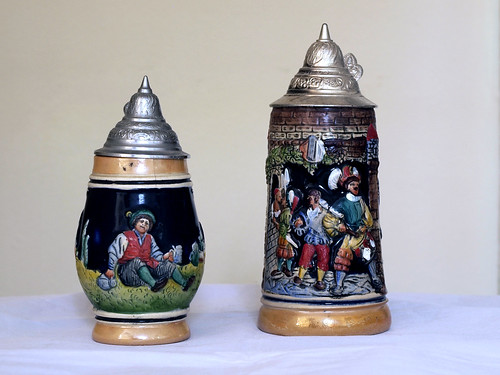
Pic(k) of the Week: Small ceramic beer steins

Small ceramic beer steins

Two illustrated, aluminum-handled, ceramic German beer steins, circa 1960 *. On the left is a 200-milliliter stein (6.75 ounces); on the right, a 300-milliliter stein (10.14 ounces).

There's some German doggerel on the larger of the two:

Stich und Hieb, und ein Lieb,
muß ein Landsknecht haben.


—Two lines from a German folksong, loosely translated as:

Sword and uniform, and love,
That's what a Landsknecht has.


A Landsknecht was a mercenary, of the 15th and 16th centuries, from the 'lower' German lands of, what was then, the Holy Roman Empire (in, what is now, the Rhineland, Alsace, etc.).

Some believe that drinking steins were originally designed, hundreds of years ago, with hinged lids to keep flying insects out of the beer. If so, a worthy innovation. Danke und Prost!

-----more-----

Thursday, April 28, 2016

Appreciating a master of malt: Wolfgang Kunze (1926-2016).

Want to be a brewster? Know this man.

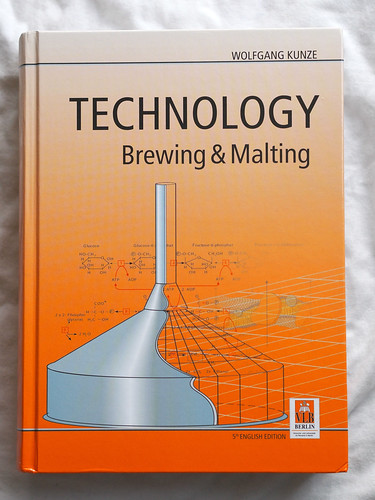
Wolfgang Kunze:  “Technology Brewing and Malting”

On January 17, 2016, Wolfgang Kunze died, at 89.

For decades, Mr. Kunze taught brewing, in Communist East Germany. His book, Technology Brewing and Malting, written in his native German — as well as translated into English, Spanish, Polish, Serbian, Hungarian, Chinese, and Russian— has long been a 'textbook' textbook for brewers throughout the world.

Wolfgang Kunze, born on 7 August 1926 in Dresden, made an apprenticeship as “Brewer and Maltster" at the Waldschlößchen Brewery in Dresden (Saxony) from 1947 to 1949. Following he moved to Berlin where he began to study brewing technology at the VLB Berlin and Humboldt University. Against all the odds of the divided postwar Berlin, he graduated as a Diploma Brewing Engineer in 1952. The newly married young father decided - for family reasons - to move back to his home city Dresden which was located in the GDR. There he took a job as a teacher at the Vocational School for brewers and maltsters. What was originally conceived as an interim solution became his professional passion that occupied him for 38 years. So in the course of nearly four decades countless brewers and maltsters from across the GDR went through his classes.

In 1959, he met a request to develop an official textbook for the training of brewers in the GDR. This project was realized in 1961 when the first edition of the book “Technology Brewing and Malting" was published. During the decades the textbook was published in the GDR in six editions, but also became very popular with the brewing trainees in West Germany. Wolfgang Kunzes credo “express complicated matters as simple as possible and in the language of the people” describes one of his key success factors both as a teacher and as an author.

Technology Brewing & Malting

Continuing his career as Director of the Vocational School Dresden, Wolfgang Kunze additionally took over the lessons for brewing technology at the Engineering School for the food industry in Dippoldiswalde (Saxony). However, he refused an offer of the Technical University of Dresden for an unscheduled promotion due to a lack of time. In 1990, Wolfgang Kunze had been replaced by its successor Herwig Bittner, who has been the head of the Vocational School Centre for Agriculture and Food in Dresden until today.

With his retirement in 1991, a new and very active period of his life began. He brought his extensive contacts and experience into the newly founded “VLB Office Dresden”. In this position, he was a respected unifying figure who has rendered great services in the convergence of East and West German brewing industry after the German reunification. In addition, the VLB took over the publishing rights of “Technology Brewing and Malting”, so that the future of this book was secured. In 1994, the 7th revised edition was published by the VLB, later followed by international editions in English, Polish, Chinese, Russian and Spanish as well as three additional German updates. Overall, his work with more than 60,000 printed copies in 7 languages has become one of the most successful textbooks for brewers worldwide.

Wolfgang Kunze was also the initiator of the “Dresdner Brewers’ Day” in 1992. As a joint project of VLB with the Brewers Association of Saxony this meeting devoted mainly to the technical and technological development of the breweries in the new federal states. In its 22nd edition the Dresdner Brewers’ Day takes place on 8 April this year - the first time that Wolfgang Kunze will not be there.

With great dedication, honesty and his Saxon humor, Wolfgang Kunze had accompanied the brewing industry up until old age. He was a regular and welcome guest at numerous trade events and on trade fairs at the stand of the VLB he was always available for an interview, a photo or even for an autograph.

His merits for the brewing industry are documented in numerous awards: He was an honorary member of the VLB Berlin (2001), an honorary member of the German Association of Brewmasters and Maltmasters (DBMB, 2001), an honorary member of the Brewers Association of Saxony (2006), holder of the Bavarian Beer Medal (2008) and awarded with the Golden Badge of Honor of the VLB Berlin (2015).

His withdrawal from public life began two years ago when a serious illness weakened him. Although he temporarily recovered somewhat again, he died on January 17, 2016. Wolfgang Kunze is survived by his wife Christa, with whom he was married since 1948, three children, eight grandchildren, seven great-grandchildren and a dog.
— VLB Berlin
17 January 2016.

-----more-----
  • Kunze's obituary was published by the Versuchs- und Lehranstalt für Brauerei (VLB), the organization he captained in Berlin, Germany. I defer to its translation.
    The VLB is a members association and was founded in Berlin in 1883 by German brewers and maltsters. For more than 125 years VLB has been working in the field of research, development and training for the brewing industry. Today, round about 120 people work at the VLB in the fields of research, teaching, information, consulting and service. As a "Registered Association" VLB is an independent institute, which co-operates with Berlin University of Technology in the field of brewing science and has a very close network into the brewing and related industry. Since 2002 VLB is the sole holder of Institut für Gärungsgewerbe und Biotechnologie zu Berlin (IfGB).

  • For more from YFGF:

Saturday, October 31, 2015

Pic(k) of the Week: Lunch!

Liquid bread? Bock. It's what's for lunch.

Ayinger Celebrator, on draft

Ayinger Doppelbock: pronounce it "EYE inger". Brewed by Ayinger Privatbrauerei in the town of Aying, fifteen miles southwest of Munich, in Bavaria, Germany.
Doppelbocks ("double bocks") were probably first brewed in the 17th century by monks in Bavaria - a stronger version of bock beers that originated in Einbeck, Germany. Doppelbocks are usually rich, malty lagers; usually dark-colored; the names often end with the suffix "-ator." Ayinger Celebrator is probably little changed from the doppelbock first brewed at Ayinger in 1878; Ayinger's doppelbock was once called "Fortunator" but this global classic is called "Celebrator" around the world now.
6.7% alcohol-by-volume (abv)
— Merchant du Vin

What I saw:
Dark brown (with crimson streaks).

What I tasted:
Toasted pumpernickel bread topped with a schmear of plum jam. Some baker's chocolate. Slightly sweet, nutty finish.

What you see:
The photographer, me, in his glee, had neglected to take a picture before drinking. The bartender kindly re-poured a partial for the camera. (Or was it just my scam to get some more bock, please?)

Where I 'lunched':
On draft at Lyon Hall, in Arlington (Clarendon), Virginia.

When:
30 October 2015.

-----more-----

Thursday, December 06, 2012

Church-bells & brewers

It was always the church-bells. A city filled with them.

My parents were in the U.S. Foreign Service. In the late 1950s and early 1960s, they were stationed in Bonn, the capital of the then West Germany. From our family's two-floor apartment, a field away from the Rhine River, I could hear the pealing of many church-bells.

It was the pealing of those bells on St. Nicholas Day morning that especially appealed to a young boy's anticipation. St. Nicholas (Nikolaos of Myra 270 A.D. – 6 December 343) is the Catholic, Anglican, and Orthodox Christian patron saint of brewsters and brewers. And the predecessor to the modern Santa Claus.

Happy St. Nicholas Day! (01)

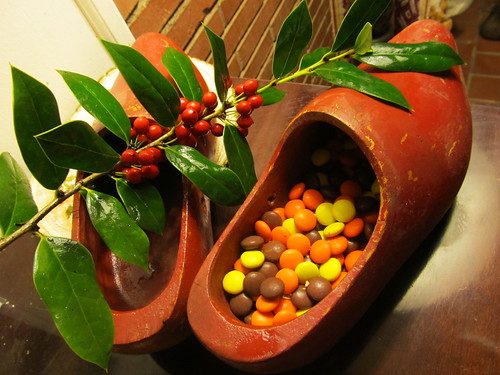
Every 6 December morning, those bells meant ... chocolates! Chocolates that St. Nicholas had stuffed in the wooden shoes we had placed out the night before, to welcome him to our house. In the interest of full disclosure, I must admit that, upon a few occasions, St. Nicholas filled my shoe with lumps of coal, for purported bad behavior.

Today, in honor of St. Nicholas, why not thank a brewer for their beers (or a confectioner for their chocolates)? But NOT with a lump of coal!


***************

***************
Digitally transferred from an out-of-print German record album of the early 1960s. That record was played often during the Christmas season in the Cizauskas household. The scratches can attest to that.

Saturday, September 22, 2012

Pic(k) of the Week: Willkommen Oktoberfest!

In the northern hemisphere, today is the first day of autumn, and the daylight hours already are noticeably fewer. In Munich, Germany, it's the first day of Oktoberfest, putatively the largest party in the world.

Jumping the gun by nine days, Gordon-Biersch brewpub in Tysons Corner, Virginia, celebrated the annual release of its Oktoberfest lager, on Thursday, 13 September, Brewer Grant Carson, bedecked in Bavarian garb, presided. The pub, plunked in a suburban mall, was filled that night. A traditional German band played beer tunes (Ein Prosit), and a 2-liter boot of Oktoberfest was passed around, folk sipping communally.

Willkommen Oktoberfest!


Carson told me that, six weeks earlier, he had brewed the 5.9% alcohol-by-volume, amber-colored lager with imported-from-Germany Wyermann malts (pilsner, Munich, Caramel, Melanoidin) and German hops (Hersbrucker). After fermentation, he lagered the beer (matured it at cool temperatures) in horizontal tanks during the intervening 35 or so days.

I found the beer to have a firm toasted-biscuit malt flavor, with a finishing touch —just a touch— of caramel sweetness. And, if you searched for it —I did— you noticed some floral Hersbrucker hop spiciness. Delicious! I invite 'hop heads' to join in the fun and become re-introduced to the intoxicating (pun intended) flavors of malted barley.

0.5 liters of Oktoberfest (01)


About.com Washington, D.C. posts a list of Oktoberfest-themed festivals in the greater Washington, D.C. area, some of which, such as Gordon-Biersch, have occurred already, and many of which will take place well into October (not quite following the time-line of the Munich festival).

Two long-standing area establishments deserve special mention. Blob's Park in Jessup, Maryland —a Bavarian beer hall, beer garden, dance hall, and restaurant— has been open since 1933. It was closed in 2007/8, before being re-opened by the great-nephew of the original owner, German immigrant Max Blob. The Selinger family opened the Old Stein Inn in Edgewater, Maryland in 1983. Last year, son Michael and his wife Beth rebuilt and re-opened the restaurant and beer garden after a devastating fire.

See other round-ups of D.C. area Oktoberfests at: DCBeer.com, Washington Post's Going Out Gurus, and Mid-Atlantic Brewing News' Hop Tips.

***************
As to the world's largest party, here's what's happening in Munich, Germany, today through Sunday, 7 October.
Oktoberfest is a 16-day festival held annually in Munich, Bavaria, Germany, running from late September to the first weekend in October. It is one of the most famous events in Germany and is the world's largest fair, with more than 5 million people attending every year. The Oktoberfest is an important part of Bavarian culture, having been held since 1810. Other cities across the world also hold Oktoberfest celebrations, modeled after the Munich event.

The Munich Oktoberfest originally took place during the sixteen days up to and including the first Sunday in October. In 1994, the schedule was modified in response to German reunification so that if the first Sunday in October falls on the 1st or 2nd, then the festival would go on until October 3 (German Unity Day). Thus, the festival is now 17 days when the first Sunday is October 2 and 18 days when it is October 1.

—Wikipedia

Official 2012 Oktoberfest Poster

From the official Oktoberfest website:
On Saturday, September 22nd, the Schottenhamel tent is the place to be, if you want to catch the official opening ceremonies. At noontime, 12pm, the lord mayor of Munich will have the honor of tapping the first keg of Oktoberfest beer. Once the barrel has been tapped, all visitors will then be allowed to quench their thirst. It pays to arrive early in order to experience the festivities up close and personal and it's quite common for visitors to come around 9am to secure good seats. The festival will last until October 7th.


**************
  • More photos from the Gordon-Biersch tapping: here.
  • Related story on the Munich Oktoberfest: Einstein's Oktoberfest.
  • My 'local,' Mad Fox Brewing Company, in Falls Church, Virginia, is blocking off the courtyard in front of the brewpub on Sunday, 22 September, for a day-long festival including a traditional German band, a German-inspired food menu, the tapping of the brewpub's Oktoberfest lager —Hitzig Frau, and, very un-traditionally, 22 IPAs (very hoppy ales) from other mid-Atlantic breweries.
  • Via TimeAnd Date.com, the autumnal equinox occurs on the U.S. east coast at exactly 10:49am today, Saturday, 22 September 2012. The autumnal and vernal equinoxes are the only two times during the year when the sun rises due east and sets due west.
  • Pic(k) of the Week: one in a weekly series of personal photos, often posted on Saturdays, and often, but not always, with a good fermentable as subject. Commercial use requires explicit permission, as per Creative Commons.