Showing posts with label bird. Show all posts

Saturday, February 14, 2026

Pic(k) of the Week: A Sunday kind of hawk

A Sunday kind of hawk
Click on the image for a larger, hi-res version (on Flickr).

A red-shouldered hawk (Buteo lineatus) perched in a tree: a wonderful find for a winter's Sunday stroll.

When I first noticed this handsome fellow, he was sitting in a marsh, far from my position and partially hidden from sight. I found a fallen bough to sit on and waited, hoping he might move closer for a 'cleaner' shot. Forty-five minutes later, he obliged.

And, for a moment, I felt like a 'birder.'

Decatur Legacy Park
City of Decatur, Georgia, USA.
11 January 2026.


***************

Barry Harris: Ornithology
Album: Breakin' It Up (Label: Argo, 1959)

-----more-----

Saturday, November 01, 2025

Pic(k) of the Week: Afternoon of an owl

Afternoon of an owl
Click on the image for a larger, hi-res version (on Flickr).

"Chiefly nocturnal, a barred owl does not generally tolerate close approach." Yet there he was, in late afternoon, perched only a few meters in front of us.

Seminary Wood in Decatur Legacy Park: City of Decatur, Georgia, USA, 24 September 2025.

The barred owl (Strix varia) is a chunky owl with dark eyes, dark barring on its upper breast, and dark streaking below. It is a common resident in dense coniferous or mixed woods of river bottoms or swamps, and upland woods. Its distinctive call is a rhythmic series of loud hoots: 'who-cooks-for-you, who-cooks-for-you-all.'
National Geographic Field Guide to the Birds of Eastern North America.

***************

Gonzalo Rubalcaba: A Quiet Place
Album: Skyline (Label: 5 Passion, 2021)

-----more-----

Saturday, October 04, 2025

Pic(k) of the Week: Gulls & waxing moon over surf at dusk

Gulls & waxing moon over surf at dusk

Click on the image for a larger, hi-res version (on Flickr).

Gulls fly by, as a waxing gibbous moon, 89% illuminated, rises over an Atlantic Ocean beach at sundown

City of St. Augustine Beach, Florida, USA. 4 September 2025 (7:47 p.m. EDT).


***************

Herbie Hancock: Maiden Voyage
Album: Maiden Voyage (Label: Blue Note, 1965)

-----more-----

Saturday, September 27, 2025

Pic(k) of the Week: Hawk on the PATH

Hawk on the PATH

Click on the image for a larger, hi-res version (on Flickr).

Perched only a few yards from a boardwalk over a wetland, a red-shouldered hawk (Buteo lineatus) was warily observing me from over its shoulder...but obligingly remained posed for the camera.

South Peachtree Creek PATH in Mason Mill Park: DeKalb County, Georgia, USA. 16 August 2025.


***************

Danny Gatton: Sky King
Album: Cruisin' Deuces (Label: Elektra, 1993)

-----more-----

Saturday, May 17, 2025

Pic(k) of the Week: Sextuplet brood

Sextuplet brood
Click on the image for a larger, hi-res version (on Flickr).

A mallard hen (Anas platyrhynchos) was swimming in a bog, right in front of me, just below the camera's angle. She noticed me and, not pleased, let out a stream of loud, agitated quacks. Her six ducklings, alerted to danger, quickly scattered for safety. I couldn't help but apologize to them all as I exited...but not before capturing a photo!

Frog Bog in Legacy Park: City of Decatur, Georgia, USA. 24 April 2025.


***************

Maurice Ravel: String Quartet (II. Assez vif – très rythmé)
Musicians: Auryn Quartet
Album: French String Quartets (Tacet 2003; Naxos 2020)

-----more-----

Saturday, March 29, 2025

Pic(k) of the Week: Morning bird in winter forsythia

Morning bird in winter forsythia

And smale foweles maken melodye

A peripatetic ruby-crowned kinglet (Corthylio calendula) momentarily stops to sing in a forsythia bush, its red crown shining in winter morning light.

Ruby-crowned kinglets typically inhabit northern North America. I spotted this male, however, much farther south (in DeKalb County, Georgia, USA), where it was probably preparing for its imminent migration back north.

26 February 2025.


***************


Ralph Vaughan-Williams: The Lark Ascending

-----more-----

Saturday, June 29, 2024

Pic(k) of the Week: Feed the Ducks

Feed the ducks

Come feed the little birds,
Show them you care.
And you'll be glad if you do.
Their young ones are hungry
Their nests are so bare.
All it takes is tuppence from you.
Feed the birds, tuppence a bag,
Tuppence, tuppence, tuppence a bag.

The birds in the water are a mother mallard (Anas platyrhynchos) and her ducklings. On land, the larger, braver bird (feeding to the right) is a Moscovy duck (Cairina moschata), native to Mexico, Central America, and northern South America. Small wild breeding populations have established themselves in the United States.

The photo is unposed. None of the participants knew they were being photographed.

Avondale Lake: City of Avondale Estates, Georgia, USA. 6 June 2024.

***************

-----more-----

Saturday, September 02, 2023

Pic(k) of the Week: Heron in morning pond

Heron in morning pond

In early morning, a juvenile great blue heron (Ardea herodias) was fishing in in a large city-park pond. I tried not to disturb her.

Postal Pond in Decatur Legacy Park: Decatur, Georgia, USA. 1 August 2023 (8:12 am EDT).

-----more-----

Saturday, June 24, 2023

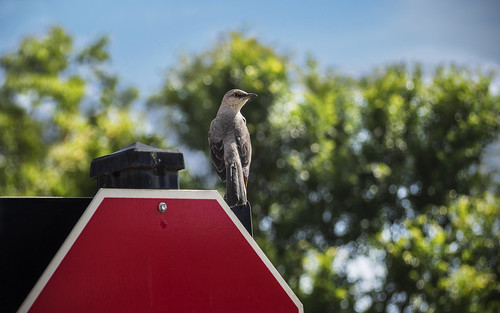
Pic(k) of the Week: Mockingbird on stop sign

Mockingbird on stop sign

A northern mockingbird stopped on a stop sign. And, then, she sang...and sang...and sang!

Mockingbirds are highly intelligent (although not on the level of crows) and have an extensive vocal repertoire and mimicry ability (although not to the extent of brown thrashers). But don't be misled. They have a nasty temperament!

East Decatur Greenway: Decatur, Georgia, USA. 14 May 2023.

-----more-----

Saturday, June 17, 2023

Pic(k) of the Week: Winking Hawk

Winking hawk

A juvenile red-shouldered hawk (Buteo lineatus) winked at me. Or, maybe, she was covering her left eye with a nictitating membrane.

Decatur Legacy Park: Decatur, Georgia, USA. 6 June 2023.

-----more-----

Saturday, April 29, 2023

Pic(k) of the Week: Yellow-crowned Night Heron

Yellow-crowned Night Heron

North for mating season (from its winter habitat from southern Florida, through Mexico, into Central America), a yellow-crowned night heron perches in swampy marshland in DeKalb County, Georgia, USA, on 21 April 2023.

Unfortunately, I 'blew out' some of the highlights (such as the heron's yellow crown) and 'cut off' one of its feet. Nonetheless, I was excited to have photographed this fine fellow in the wild.

Thank you to a passing birder who identified this yellow-crowned night heron for me (and congratulated me on my new "lifer": birdwatching lingo for spotting a bird you’ve never seen before).

Fortunately, I did not forget to thank her (or, silently, the heron).

-----more-----

Saturday, April 15, 2023

Pic(k) of the Week: Goose going Postal

Goose going Postal

A Canada goose (Branta canadensis) gracefully winters on Postal Pond, in Decatur Legacy Park, Decatur, Georgia, USA, on 4 March 2023.

I've always called this elegant waterfowl, a Canadian Goose. I've only just discovered its 'correct' appellation. Despite its name, the Canada goose's year-round habitat extends south into Georgia1, 2,300 miles (3,700 kilometers) from Canada.

Decatur, by the way, is a small city (population, 24,928) in —and the county seat of— DeKalb County, Georgia, part of the Atlanta metropolitan area.2 Legacy Park is a 77-acre oasis within it.

-----more-----

Saturday, February 04, 2023

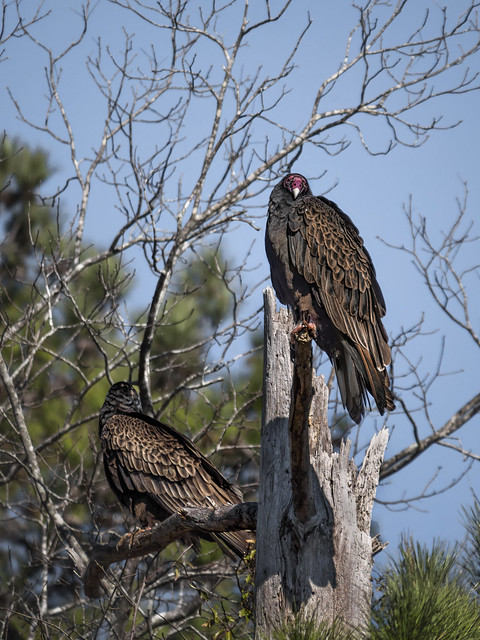
Pic(k) of the Week: Arabia buzzards

Arabia buzzards A pair of turkey vultures scope the carrion scene, atop a pine tree near the summit of Arabia Mountain.

The turkey vulture (Cathartes aura), also known as buzzard or turkey buzzard, is the most widespread of the New World vultures, ranging from southern Canada to the southernmost tip of South America. It inhabits a variety of open and semi-open areas, including subtropical forests, shrublands, pastures, and deserts. A large bird, the turkey vulture has a wingspan of 63-72 inches (160–183 cm) and a length of 24-32 inches (62–81 cm). The body feathers are mostly brownish-black, but the flight feathers on the wings appear to be silvery-gray beneath, contrasting with the darker wing linings. The adult's head is small in proportion to its body and is red in color with few to no feathers. It also has a relatively short, hooked, ivory-colored beak. The turkey vulture is a scavenger and feeds almost exclusively on carrion. It has very few natural predators.
Wikipedia.

Arabia Mountain National Heritage Area: Stonecrest, Georgia, USA. 27 January 2023.

-----more-----

Saturday, December 17, 2022

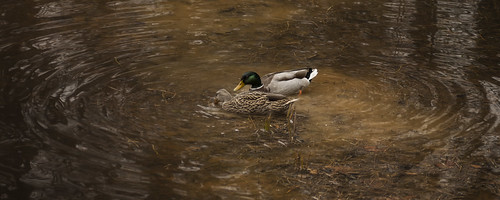
Pic(k) of the Week: Mallard whirlpool

Mallard whirlpool

An autumn breeding pair of mallards dabbling in a wetland pond.

South Peachtree Trail: DeKalb County, Georgia, USA. 6 December 2022.

-----more-----

Saturday, October 01, 2022

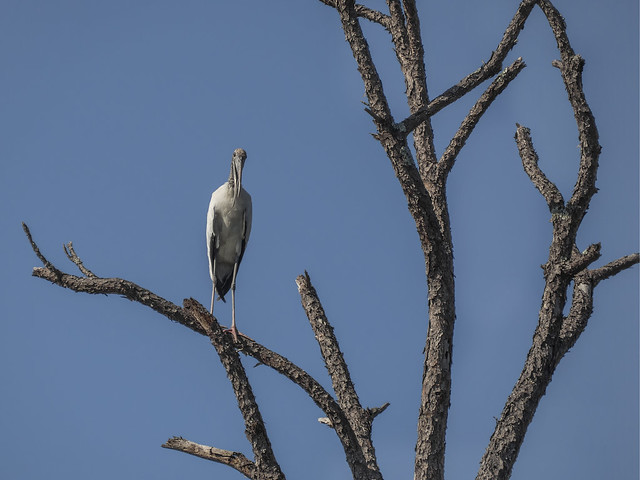
Pic(k) of the Week: Wood stork, perched

Wood stork, perched

In Fort Mosé Historic State Park, in St. Augustine, Florida, USA, a wood stork (Mycteria americana) perches in a tree on a brackish marshland hammock. 5 September 2022.
To the north [of Fort Mosé], there is a rookery, a nesting colony of gregarious birds, such as wood storks, egrets, and herons. These birds showcase their breeding plumage from mid-March through July. One of the largest birds to nest in this area is the wood stork [a large American wading bird]. This area is ideal for nesting because the changing water level reveals higher concentrations of fish during lower tides. Females lay two to five eggs, which both parents incubate for about one month. A pair of nesting wood storks and their young need approximately 443 pounds of fish during the breeding season to survive.

In the 1930s, there were an estimated 20,000 breeding pairs of wood storks [in Florida]; today, the population is approximately 8,000. The numbers have declined drastically, mainly from loss of feeding grounds due to land development, logging, and draining.
— Fort Mosé placard

***************

Fort Mose

Fort Mose Historic State Park is a former Spanish fort in St. Augustine, Florida. In 1738, the governor of Spanish Florida, Manuel de Montiano, had the fort established as a free black settlement, the first to be legally sanctioned in what would become the territory of the United States.

The park is located on the edge of a salt marsh on the western side of the waterway separating the mainland from the coastal barrier islands. The original site of the 18th-century fort was uncovered in a 1986 archeological dig. The 24-acre (9.7 ha) site is now protected as a Florida State Park.It was designated a US National Historic Landmark on October 12, 1994.
Wikipedia.

-----more-----

Saturday, July 30, 2022

Pic(k) of the Week: Flamboyance of flamingos

Flamboyance of flamingos

A flock of flamingos = a "flamboyance." Indeed!
The American flamingo (Phoenicopterus ruber) is a large species of flamingo closely related to the greater flamingo and Chilean flamingo, native to the Neotropics. It is also known as the Caribbean flamingo, although it is also present in the Galápagos Islands. It is the only flamingo that naturally inhabits North America (Florida and the Florida Keys).
Wikipedia

Seen at Zoo Atlanta: Atlanta, Georgia, USA.

-----more-----

Saturday, July 23, 2022

Pic(k) of the Week: Brown thrasher, foraging

Brown thrasher, foraging

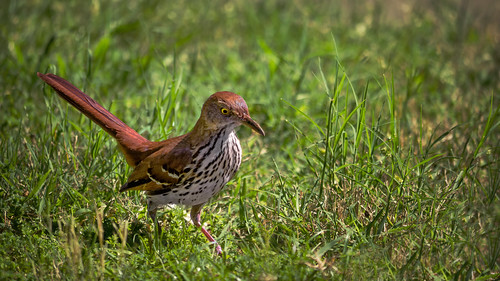
With 3,000 (!) distinct songs in its repertoire, the brown thrasher (Toxostoma rufum) has a right to be loquacious: it's the official bird of the state of Georgia, USA. Here, seen ground-foraging, in DeKalb County, Georgia. 18 April 2021.

The brown thrasher is a large bird (almost a foot in length) with a long, curved bill and a very long tail. It has two prominent white wing bars, a rich brown color on its top side, and a creamy white breast heavily streaked with brown. ¶ In 1935, Eugene Talmadge, then governor of the state of Georgia, proclaimed the brown thrasher as the state bird, but it would not be until 1970 that the Georgia legislature would officially designate it as such.
State Symbols USA.

-----more-----

Saturday, May 07, 2022

Pic(k) of the Week: Morning moon (and avian astronaut)

Morning moon (and avian astronaut)

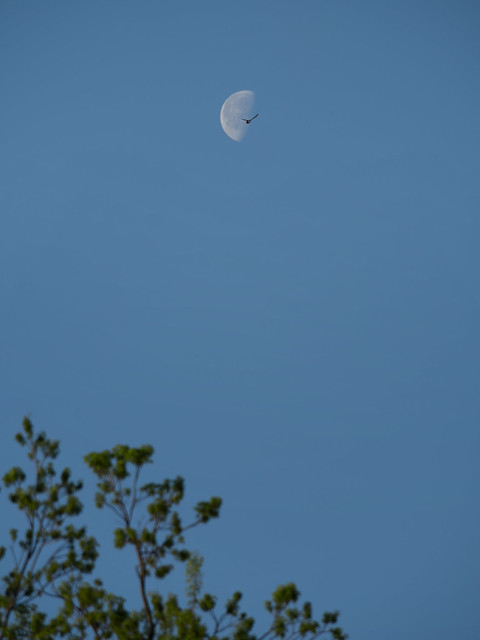
Look up!

A waning gibbous moon (and an avian astronaut), at morning, over Decatur, Georgia, USA.

22 April 2022.

-----more-----

Saturday, April 09, 2022

Pic(k) of the Week: Bird on a vine

Bird on a vine

This northern mockingbird (Mimus polyglottos) may have posed for me; but, boy, did he give me a death stare.

He (and I) were hanging out at the Wheland Foundry Trailhead of the Tennessee Riverwalk, in Chattanooga, Tennessee, USA, on 20 March 2022.

-----more-----

Saturday, July 31, 2021

Pic(k) of the Week: Osprey in nest on light pole

Osprey in nest on light pole

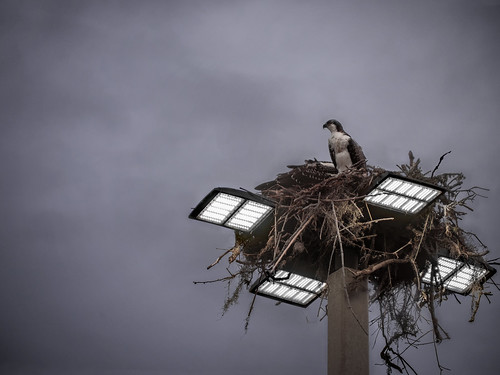
The osprey tolerates a wide variety of habitats, nesting in any location near a body of water providing an adequate food supply. Ospreys construct their nests at the tops of dead trees, atop power poles, on manmade nesting platforms, and sometimes on buoys, chimneys, or other structures.
U.S. Fish and Wildlife Service (pdf)

Look up!

Call it "environmental irony" or (less humbly) "new topography": man-made elements intruding (?) in an image otherwise of natural beauty. But, if you do, you might see (and hear) ospreys in their nest, high overhead...on a light pole, in a supermarket parking lot, as I did in St. Augustine Beach, Florida, USA, on 3 July 2021.

The osprey —or, more specifically, the western osprey (Pandion haliaetus), also called sea hawk, river hawk, and fish hawk— is a diurnal, fish-eating bird of prey with a cosmopolitan range. It is a large raptor, reaching more than two feet in length (60 cm) and six feet across the wings (180 cm). It is brown on the upper parts and predominantly greyish on the head and underparts. It is found on all continents except Antarctica, although in South America it occurs only as a non-breeding migrant.
Wikipedia

-----more-----