Ah, the beauty of cask-conditioned 'real ale.'
Real ale is a natural product brewed using traditional ingredients and left to mature in the cask (container) from which it is served [without extraneous gas pressure] through a process called secondary fermentation [and served at what is called 'cellar' temperature —in the low to mid 50 degrees Fahrenheit.] It is this process which makes real ale unique amongst beers, and develops the wonderful tastes and aromas which processed beers can never provide.— CAMRA [with edits].
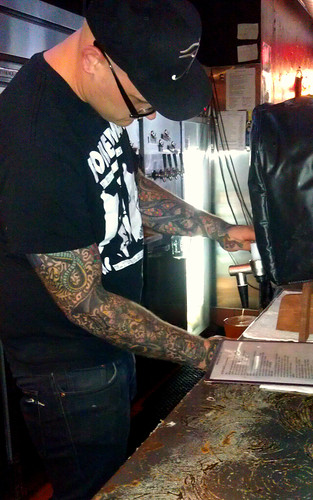
A bartender pours real ale directly from a firkin (10.8-US gallon cask). At Spacebar in Falls Church, Virginia, USA, on 8 September 2012.
Think of real ale as uber-fresh, as if it were being poured directly from a brewery fermenter. It is a deliberate process, involving both a brewery and pub.
What cask-conditioning is NOT is tossing beer into a cask; that's just tossing a beer into a cask. In fact, cask-conditioning does not imply or require the infusion of artificial or extraneous ingredients. That's just —as a friend describes it— tossing in "cocoa-puffs and dingleberries."
What real ale IS —as Jeff Alworth described it on p.84 of The Beer Bible— is "living beer."
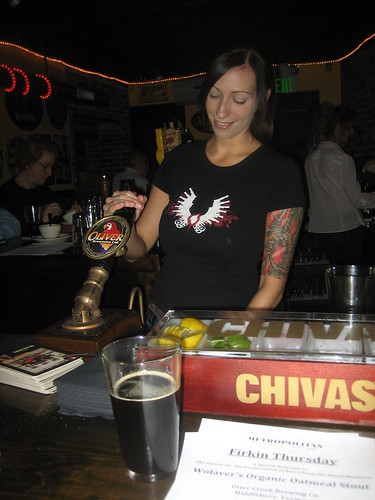
A bartender pulls real ale from a firkin via a beer engine (hand-pump). At Metropolitan, in Baltimore, Maryland, USA, on 13 November 2008.
***************
Cask Marque USA
If your U.S. pub, brewpub, or brewery taproom serves cask ale on a regular basis, you can receive accreditation from Cask Marque, now also available in the United States. Consultation is also offered. Information: here.Cask Marque, begun in the U.K. in 1997, is a voluntary accreditation scheme that allows publicans to display a special symbol indicating that their cask ale is of good quality, as judged by a series of surprise inspections.
-----more-----