Sunday, December 30, 2012

Thoughts on DC's Winter Holidaze Extravaganzee

In 1988, Washington, D.C.'s venerable beer pub, the Brickskeller, held its first ever Christmas Beer Tasting. Back then, there were only four 'local' breweries in Virginia and Maryland (and none in D.C.): G. Heileman Brewing Company, in Halethorpe, Maryland, Anheuser-Busch, in Williamsburg, Virginia, and upstart 'micro-breweries' Chesbay, in Virginia Beach, Virginia, and British Brewing Company, in Glen Burnie, Maryland. Schoolteacher and beer raconteur Bob Tupper, the host, would have to round out the evening's tasting with beers from breweries elsewhere.

The final winter beer tasting at the Brickskeller was held in December of 2010. Proprietors Dave and Diane Alexander would sell the restaurant/pub/hotel later that month. But the tradition of the Winter Holidaze Extravaganzee has continued at their other restaurant: D.A.'s R.F.D. (The "DA" stands for Dave (and Diane) Alexander; the "RFD" for "regional food and drink").

Introduction and interruption

It was held this year on 19 December 2012, for the 25th time, and, this time, with 16 local breweries represented. Many, many more local breweries could have been invited: there are five breweries in Washington, D.C. proper, forty from Virginia, and twenty in Maryland. Four in 1988; sixty-five in 2012. What a difference a quarter century has made.

I did find the list of the missing to be somewhat peculiar. There was no Capitol City Brewing, Washington D.C.'s first brewpub since Prohibition (although now brewing in northern Virginia). There was a reason for this, however, which I learned of a few days later. Although D.C.'s 3 Stars Brewing was present, where was DC Brau, the first production brewery in the the District of Columbia since 1956? And, where was Flying Dog, Maryland's largest brewery, and the 23rd largest regional brewery in the U.S.?

As it stood, however, even sixteen were too many for the evening, which began around 7 pm and continued past 11:30 pm. Inviting four more breweries but splitting the event over two nights would have been logistically better. Here's the evening's roster:

Christmas beer tasting 2012


Here are some other 'takeaways' from the evening ...


  • Most humorous moment #1:
    Host Bob Tupper —he, in his 60s, looking like Santa Claus— says of the smooth alcohol-masked flavor of 3 Stars Brewing's (Washington, D.C.) Winter Madness: "I wish they had had beers like this when I was dating in college." (Rest of thought left unsaid!) Brewer/owner Dave Coleman holds up his hand, showing wedding band. "I wouldn't know, Bob. I'm 5 years happily married." Tupper retorts: "I've got 30 years on you, Dave."

    10.6% alcohol-by-volume 'Winter Warmer,' brewed with Vienna, 2 Row, Crystal, Special Roast, Biscuit, & Chocolate malts, and rolled oats, and hopped with Centennial and Cascade.
    3 Stars @RFD

  • Best beard trio:
    See above! Left to right: 3 Stars brewer/co-owner Mike McGarvey; brewer/co-owner Dave Coleman; RFD host Bob Tupper.

  • Most humorous moment #2:
    Host Bob Tupper lets out a guffaw at something Jason Oliver, brewer for Devils Backbone (of Roseland, Virginia), has said. Unfortunately, my notes don't indicate what was said.

    For the evening, Oliver brought his 16 Point Ale, the newest entrant in his line of 'buck beers:' a 9.1% alcohol-by-volume 'Imperial' India Pale Ale, hopped with Columbus, Centennial, and Simcoe.

    A Devil of a laugh!

  • Best fail:
    A couple of minutes into talking with George Humbert —owner of DOG Brewing (of Westminster, Maryland— about his Chocolate Porter 6.9% abv), host Bob Tupper —in his best school teacher manner, which is, after all what he does when not talking about beer— picked up his plastic glass, and asked the staff: "Is THIS the Chocolate Porter?" It wasn't. The crew had inadvertently served the spiced Longest Night Solstice Ale (7.4% abv) from Vintage 50 (of Leesburg, Virginia). After a few minutes, Humbert's beer was served, and both Kristi Griner —brewer at Vintage 50— and Humbert were seated on the dais. "I knew immediately it wasn't mine, but I didn't want to embarrass anyone, and it was good," said Humbert.

    Mixed up, then fixed up.

  • Most embarrassing moment:
    Lost Rhino Brewing (of Ashburn, Virginia) 'collaborated' with Westover Market (an independent supermarket in Arlington, Virginia, with a year-round outdoor beer garden) to produce HopStar Triple IPA. The recipe was created, and small-batch tested, by Steve Marler (in the center of the photo), an award-winning home-brewer and a long-time member and officer of Brewers United for Real Potables (BURP), the Washington, D.C.'s area's largest and longest-running homebrew club. And the result, brewed by John Peters (on the right) at Lost Rhino Brewing —HopStar Triple IPA— was indeed a marvelously hoppy and bitter beer. The recipe included mango puree, which may have added to a citrus fruit aroma and flavor.

    The embarrassing moment occurred when Devin Hicks, the General Manager of Westover (on the left in the photo) —who was the impetus for making the beer— told the audience that the beer was just like Bells Brewing HopSlam but hoppier, and "everyone likes HopSlam, don't they?" The response from the audience was silence.

    Lost Rhino @RFD


  • Best posse:
    Mad Fox Brewing (Falls Church, Virginia) brought four brewers to the dais. There weren't enough chairs. In the photo, left to right: assistant brewers Brad Hulewicz (standing) and Brian Murphy; head brewer Charlie Buettner; brewmaster/owner Bill Madden; host Bob Tupper (wearing Santa hat).

    The beer they brought was one of the stars of the evening: Crazy Ivan, a 10% alcohol-by-volume 'Russian Imperial Stout,' aged 8 months in Evan Williams whiskey oak barrels.
    Mad Fox gang


  • Best personal moment:
    As I was writing down my tasting notes, an attractive brewer patted my back: "You're so organized," she said. Little did she (or I) know, that I would misplace my notebook, and have to recreate those notes from memory. So much for organization!

  • Best beers:
    Purely subjective, and purely my choices. The audience was not polled.

    Kevin Blodger —brewer and co-owner of Union Craft Brewery (Baltimore, Maryland)— brought Pregame, an 'English-style' Dark Mild: Deep brown/black, with some red highlights, with a strong coffee and baker's chocolate aroma and flavor. Only 4.4% alcohol-by-volume, yet packed with character. In fact, Pregame tasted fresher and more flavor-defined than a couple of the other beers (of much higher alcohol) that evening (to remain nameless).

    Union Craft @RFD


    Dave Warwick, brewer at Rock Bottom (Ballston, Arlington, VA), brought Fallen Angel,a blended Belgian-style Tripel: 50% of the mix was from a batch brewed in 2008 by then-brewer Chris Rafferty, and aged since then in a Woodford Reserve bourbon oak barrel; the other half was freshly fermented Tripel, brewed by Warwick, to provide carbonation and soften the wood and bourbon character. It didn't taste like a Tripel, but rather a strong golden ale with spicy notes, high-toned fruity aromatics, and a depth of bourbon heat and finish.

    Rock Bottom @RFD


  • And, finally: What is a winter beer?:
    That evening, we were served a saison —a Belgian-style spiced wheat beer. Is that a Christmas/winter beer? I believe the answer to be a simple one. A winter beer is a beer brewed, or drunk, or both, during the winter months. A merry Christmas to all, and to all, a good beer.

    ***************
  • The Brewers Association —a trade association for U.S. breweries of annual output of fewer than 6 million barrels— defines regional brewery as "A brewery with an annual beer production of between 15,000 and 6,000,000 barrels." A microbrewery, it defines as producing less than that.
  • By 11:15 pm, concerned about missing the Metro from downtown back to northern Virginia,  I left without tasting the 11.5% alcohol-by-volume Pumpkin Retribution from Jim Wagner and his crew at DuClaw. Thus, their beer didn't make my 'Best of' list, possibly undeservedly.
  • Photos of the brewers and descriptions of their beers can be seen on Flickr: here.
  • Saturday, December 29, 2012

    Pic(k) of the Week: Boxing Day dusting

    Boxing Day dusting

    A white Christmas, even if a day late, even if just a dusting. Some gusty winds too.

    northern Virginia.
    26 December 2012.

    ********************
  • Pic(k) of the Week: one in a weekly series of personal photos, posted on Saturdays, and often, but not always, with a good fermentable as a subject. Commercial use requires explicit permission,as per Creative Commons.

  • Monday, December 24, 2012

    The Things that Matter

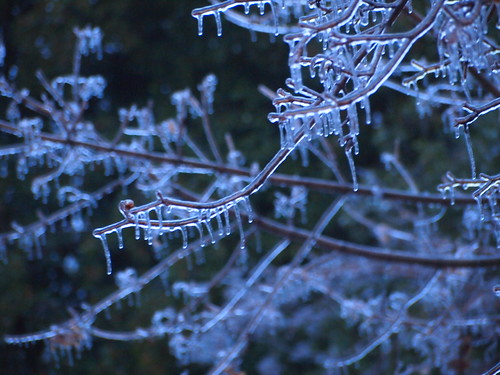
    December ice (02)

    When my siblings and I were growing up, Christmas Eve was the special night of Kūčios, the family meal in vigil of the commemoration of Christ's birth. There were the rituals (communal sharing of apple and Communion wafer); the foods (kugelis); the desserts (ausuakai); the licit sip(s!) of strong honey liqueur (vititus); the discussions (the was-Adam-or-Eve-to-blame argument, always won by mother and sister).

    And there were the Christmas tales. One my father would tell was that of a Kūčios of his childhood in the 1920s, the story of The Empty Chair. These are his words.

    Kucios

    Christmas Eve at my childhood home in Brooklyn, New York was a time of joyous fulfillment, when the four weeks of preparation during Advent culminated in the ceremony of Kūčios, the traditional Lithuanian Christmas Eve meal. It was the most important family event of the year, when all its members, even those who had married and left home to live in faraway places, felt drawn to join in the ritual.

    My wife and I try to carry on the Kūčios tradition in our own family. When the bright star of Christmas Eve becomes visible in the winter sky, we gather around our table for family prayers. Then we kiss the family crucifix, and share our Christmas wafers (plotkeles) and one large apple.

    As years pass, I repeat those stories that accompany these old customs, just as my father used to do: of Adam and Eve eating the forbidden fruit, an act whose disobedience involved us all and required the birth of the Savior to redeem, and of the sharing the wafer and the apple, which symbolized the family's unity and its spiritual kinship with the rest of mankind through Adam.

    One year not too long ago, a chair at our Kūčios table was empty for the first time. Our daughter, who was then studying at the University of Innsbruck, planned to visit St. Peter's in Rome on Christmas Eve for the midnight mass. She had asked that we keep open a place at the table for her. Since the family Kūčios began at 6 PM, it would coincide with the ceremonial opening of the Christmas Eve mass at St. Peter's celebrated by the Pope himself.

    Looking at my daughter's empty chair, I was reminded of another empty seat, many year's ago, in my parents' home on a Christmas Eve.

    It was the depth of the Great Depression, jobs were scarce in Brooklyn, and my parents could not even afford to buy a Christmas tree. The empty chair belonged to my grandfather. My family was celebrating Kūčios and grandfather was missing.


    Tevukas

    Grandfather was our favorite. We called him Tevukas (Little Father) and (always) spoke with him in Lithuanian, as we did with our parents. He was tall and thin, and had a large gray mustache which curled up the side of his mouth.

    Tevukas had the irrepressible spirit of a young child deep within him. He would often come to our flat on Hope Street in Brooklyn to play radutai, a kind of 'horsing around' that Tevukas had indulged in as a youngster himself in Lithuania.

    It wasn't that he did so much with us — besides lifting us high into the air and catching us before we could hit the ground — but his infectious spirit of fun filled us with childish delight. By contrast, the other grown up folk would treat us as if somehow we were adults who, through our own fault, hadn't grown up.

    Tevukas would regale us with happy tales of the peasant life he had lived as a boy a long time ago in old Lithuania. He told us of how he had watched over the sheep as a little boy, and of the fearsome wolves who prowled nearby. He told us about the deep forest he would walk through late at night to get home.

    Once, along the way, he thought he heard voices through the trees warning him, "Vincai, Vincai, take the other way home". Frightened, Tevukas did so. When he finally reached home, his mother embraced him, filled with relief. She told him that one of the workers on a neighboring estate had gone berserk and had been hiding in that very forest.

    He would tell us of the proud lord on whose land his family lived and worked, of the lord's beautiful manor house, and of his beautiful daughter who spoke only Polish and would taunt Tevukas for being poor.

    Tevukas would enchant us with stories of amber castles perched below the waves of the Baltic Sea, or frighten us with tales of haunted houses and evil spirits. He would tell us of the olden times, when the people worshipped the tall oak trees and the stones in the forests.

    Every Saturday night, so that he would be clean for church the next day, Tevukas would wash his feet in a tin bucket. Sunday morning, he would put on his old, shiny but well-pressed suit and top it off with a black derby, looking like a dapper ponas (gentleman), twenty years younger than he was. He always sat in the same pew, at the aisle-end, and attended what was called the suma, the solemn high mass at 11:00 AM when the choir filled the old church with its beautiful singing in Lithuanian and Latin.

    Tevukas loved to dance. At his granddaughter's wedding, when he was already 80 years old, Tevukas was determined to see if the young girls in America were as pretty and graceful as those in Lithuania. So, risking Grandmother's's stern disapproval, he danced with all of the bridesmaids at least half a dozen times.

    Yes, they were as pretty and graceful, he eventually admitted, but there was none that could compare with his little Katuke (kitten), his affectionate name for Grandma.

    The Empty Chair

    That cold Christmas Eve, in Brooklyn, many years ago, we were all worried about our missing Tevukas. Grandmother couldn't be consoled, frightened that some tragic accident had befallen her husband. "Kur mano Vincas? Kur mano Vincas?" ("Where is my Vincas?"), she wailed over and over again throughout the Kucios meal.

    We youngsters stole anxious glances at one another and prayed all the harder in our hearts that nothing bad had happened to Tevukas. We knew presents would be few, but at that point, we wanted nothing more than to see our Tevukas safely home again.

    What made his mysterious disappearance even worse was that snow had started to fall the night before and had continued all during the day. Normally we would have been delighted with snow for Christmas. Now we were worried that Tevukas was lost in the blizzard.

    Father gave thanks for God's gift of food for us. He inserted a quick prayer for Tevukas' safety. Our Kucious meal came to a melancholy conclusion.

    A Christmas Gift

    Suddenly, we heard a strange noise on the stairs leading to our flat. It had a peculiar, swishing sound which grew louder and louder as it approached our door. Then it stopped, and a loud banging ensued.

    Father opened the door.

    There stood a huge Christmas tree, full of snow. Behind it was Tevukas, all white too, like a living snow man, his mustache frozen stiff.

    "Tevukai, Tevukai!", we all shouted at once. "Where were you? What happened?"

    Tevukas smiled thinly through cracked lips and walked over to the stove in the kitchen to thaw out. Great globs of melting snow fell to the ground and Mother rushed to wipe them up.

    Tevukas drank a warming shot of veritos (a strong, spiced honey liqueur), and began to tell his story.

    When he had awakened that morning, he had seen the big flakes of snow. He knew that meant that the trolley car bosses would be hiring men to keep the tracks free of the falling snow. So, while it was still dark, he dressed quietly as not to wake Grandmother and trudged out to the car barns, where the trolleys began and ended their journeys.

    Tevukas had worked all day in the cold and snow. With the money he earned, he bought us the biggest Christmas tree he could find. He told us that he had no money left to buy us anything else and hoped that we would like the tree. Well, even as young as we were, we kids understood what a sacrifice Tevukas had made for us. We jumped all over him, thanking him again and again, kissing him and wiping the melting snow that was still dripping from him.

    Father stood the evergreen in a bucket in the parlor. And we marveled at what a wonderful Christmas present Tevukas had given us. It was the largest and best Christmas tree we had ever had.

    Tevukas, finally thawed and warmed, sat, weary but contented, down on his waiting chair. Grandmother, though still scolding him, smiled as she brought him his Kucios meal.

    Gifts would be few that evening, but our hearts were glad. Beloved Tevukas was safe and home with us on Christmas Eve.

    The chair no longer sat empty.

    —Albert C. Cizauskas

    ***************
    Now, at Kūčios, I keep an empty chair for Albert, my father.

    -----more-----

    Mike McCarthy, long-time executive brewer for Cap City, departs.

    I thought it peculiar that the nation's capital's first operating brewpub since Prohibition was not present at the local brewery winter beer tasting at RFD last week. There was neither beer nor representative from Capitol City Brewing Company. Now, I know why.

    I can confirm, sadly, that Mike McCarthy —10 year-long brewer for Cap City, 8 years its executive brewer— has resigned his position, and, in his words, is "exploring other options." McCarthy began at Capitol City in 2002, and became executive brewer in 2004. Under his stewardship, the brewpub won numerous awards. The outdoor Oktoberfest celebration he would organize annually grew to become the area's largest.

    The Brewer with the Golden Boots


    When Capitol City opened its doors in 1992, it was the first brewery to operate (even if a brewpub) in the city since 1956. Martin Virga, now with Gunpowder Falls Brewing in Pennsylvania was the first brewer, brewing at the original location on 11th and H St., NW. That location is still open, but no longer brewing. (Several of the original fermenting tanks are in use now at Vintage 50 in Leesburg, Virginia).

    Cap City throws a party!


    Under Bill Madden —who succeeded Virga and would be executive brewer for over 9 years (and is now president/brewmaster of Mad Fox Brewing)— Capitol City would open three more locations: one in the Shirlington neighborhood of Arlington, Virginia, one in the National Post Office Building on Capitol Hill in Washington, D.C., and one in Baltimore, Maryland, at the Inner Harbor. The last two would eventually be closed. The Shirlington location remains open; McCarthy oversaw a major expansion of its production size.

    I stopped into the pub on Sunday for a pint and a growler. The pint was a cask-conditioned ESB: brilliant in clarity, firm in malt, with an earthy nose and finish. Delicious.

    Cask ESB @Cap City


    The growler was filled with a newly-released German-style Pilsner, which I'll serve with Christmas Eve dinner. Both beers would have been two of the last brewed under McCarthy's supervision.

    -----more-----

    Saturday, December 22, 2012

    Pic(k) of the Week: Don't tell Mrs.Claus!

    Don't tell Mrs. Claus!

    Don't tell Mrs. Claus!

    Adjusting Santa's hat was Kristi Mathews Griner, brewster for Vintage 50, a brewpub in Leesburg, Virginia.

    Santa Claus was Bob Tupper, host of the Winter Holidaze Extravaganzee. Brewers from sixteen breweries in Washington, D.C., Maryland, and Virginia brought their winter seasonal beers, and talked about them.

    Held on 19 December 2012, at RFD, in Washington, D.C., the evening was the 25th annual occurrence of this winter beer tasting. For many years prior, the venue had been the Brickskeller; it was sold in 2010.

    ********************
  • More photos from the tasting: here.
  • Pic(k) of the Week: one in a weekly series of personal photos, posted on Saturdays, and often, but not always, with a good fermentable as a subject. Commercial use requires explicit permission,as per Creative Commons.

  •