Showing posts with label brewpub. Show all posts

Saturday, January 07, 2023

Pic(k) of the Week: Vernal Dreaming

Vernal dreaming

This unnamed mural is painted on an outside side wall of Twain's Brewpub & Billiards, in Decatur, Georgia, USA. Often obscured by employee vehicles, it was in full view this winter morning (11 December 2022).

For its title, Vernal Dreaming, befitting the dank day, would be my conceit.

-----more-----

Saturday, November 07, 2020

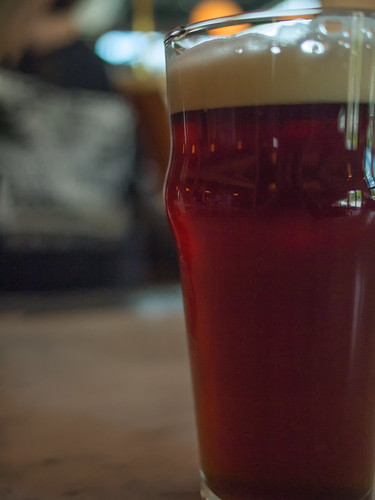
Pic(k) of the Week: Beau Geste

Beau Geste

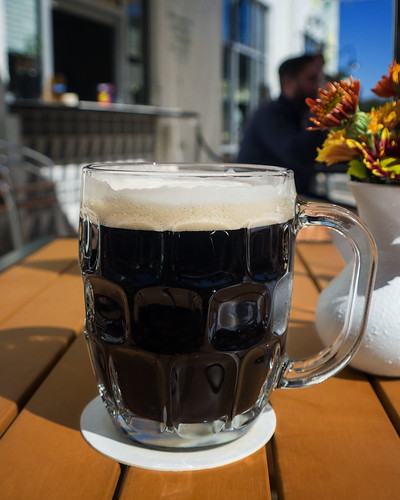
A mug of Geste, in the beer garden, at Elsewhere Brewing, in Atlanta (Grant Park), Georgia, USA. 31 October 2020.

Brewery description:
Dark Czech [style] Lager
ABV: 4.7%
IBU: 18
A tale of adventure! Stories from Prague praise a dark lager that delights the palate year-round. [Tastes of] rye bread, dried dates, and chocolate.

In style, Geste might be this new brewery's nod to a Czech-style tmavé pivo. Now, I don't know whether or not Elsewhere decocts Geste, as would be de regueur for tmavé pivo brewed in the Czech Republic. Nonetheless, the lager pours with a long-lived, creamy off-white head (via a side-pull tap); spicy hop and, yes, toasted rye-bread aromas; an off-dry body, alchemically full in such a small beer; flavors of toasted rye bread, chocolate, licorice, and dried dark fruit; and a spicy, Czech-style hop finish.

Elswhere pronounces Geste as "jest." I've added the adjective beau to my caption. The phrase "beau geste" is from the French, meaning "a graceful or magnanimous gesture." Fitting.

The brewpub is new. Its grand opening occurred over the previous weekend, on 24 October. That its brewer Josh Watterson has already produced such a sublime beer is tasty testament and auspicious augur.

Elsewhere Brewing

-----more-----

Saturday, March 28, 2020

Pic(k) of the Week: Bruegel in the brewpub

Bruegel in the brewpub

While recently searching among older images, I discovered this photograph from a time not long ago (yet seeming far gone) when social distancing was not a thing.

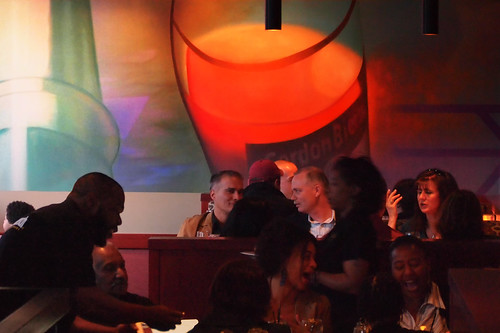
It's a portrait of a bustling brewpub, its patrons and servers all gesturing this way and that, all enjoying the moment —some perhaps already lubricated by the in-house-brewed libations— all watched over by a large mural of a tilting beer glass, and all washed with a warm indoor tint. If you can forgive me, I think it a bit 'Pieter Bruegel goes to the city.'

I took the photo in March 2013. [See that: here.] For today, I've done a bit of touch-up: straightening the mural, adjusting shadows and brights, and cropping extranea.

In this time of coronavirus, most breweries and brewpubs have been closed to drinking on-the-premises. Some face extinction. Some are hanging on, still brewing and selling via a stretched supply chain, some are offering packaged beer takeout on-site, and some even providing home delivery.

The point of today's post is not of any particular brewpub but of the multitude of breweries and brewpubs nationwide...and a photo expressing the experiential joy they brought us, now missing.

So, please! Buy their beer. Drink their beer (not much of a hardship, there). Support them now so that they may survive later: zymur-agents of our great good places.

-----more-----

Saturday, July 27, 2019

Pic(k) of the Week: Double Refreshment

Double Refreshment

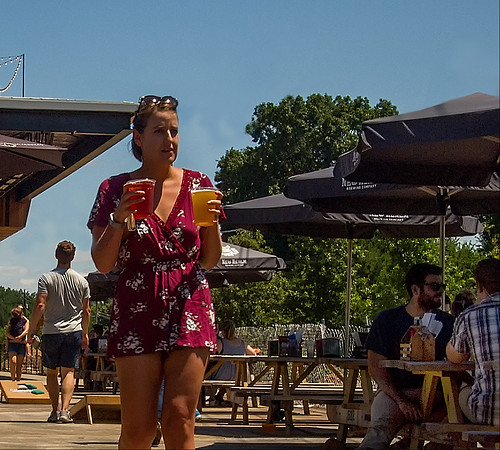
Beat the heat, twice!

In the beer garden, at New Realm Brewing, in Atlanta (Poncey-Highland), Georgia, on 7 July 2018.

-----more-----

Wednesday, July 10, 2019

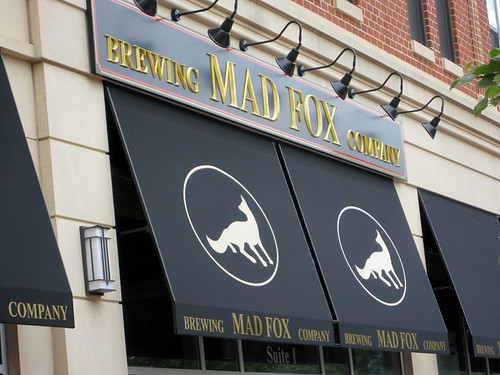
After 9 years, Mad Fox closes.

Mad Oak Bill

There's sad news from YFGF's former bailiwick. Mad Fox Brewing Company, a brewpub in Falls Church, Virginia —a suburb of Washington, D.C.— is closing its doors and spigots later this month, after a nine-year run.
Friends of Mad Fox Brewing Company
July 9, 2019

Friends, Patrons, and Supporters,

It is with great sadness and a heavy heart that I inform you of the closure of Mad Fox Brewing Company. Our last day of business will be Sunday, July 21st.

The decision to close has been an extremely difficult one to make. We have witnessed restaurant competition in the 2.2 square mile Falls Church City become fierce since our opening in 2010 with multiple businesses opening in the last year alone. As much as we tried to compete, there is an overwhelming number of choices for the local population. Sales have been on a slow decline over the last several years and, unfortunately, staying open is no longer sustainable.

On the brewing side of our business, we continue to see more breweries opening in Virginia with two new Taprooms setting up shop within a mile of Mad Fox in the last year. When we opened in 2010, there were 40 breweries in Virginia. Now there are close to 250. The Brewpub business model is a tough one to maintain compared to a Brewery Taproom with little overhead, lower rents, and outsourced food trucks. Our draw from the surrounding areas has dwindled in what has become an extremely competitive craft beer market, which has resulted in this final decision.

We attempted to work with our Bank and our Landlord for more favorable terms and while both were willing, we ultimately could not come to an agreement that would allow Mad Fox to be break even or better.

We plan a closure date of Sunday, July 21st; however, we plan to continue with our 9-year Anniversary Party on Saturday, 13 July to honor you, our investors, our staff, and the Falls Church Community. Words cannot express how proud I am of the Mad Fox legacy and the opportunity to be a member of such a wonderful community, if even for a short while. We opened the first brewpub in the City of Falls Church and have won numerous medals at the Great American Beer Festival as well as the Virginia Beer Cup. We have celebrated christenings, birthdays, weddings, retirements and many holiday gatherings. You, our guests, along with our spectacular Mad Fox team have enabled us to build tremendous notoriety over 9 years in business. I thank you for allowing Mad Fox to be a part of your lives. Thank you for your years of support and I hope to see you at the Pub in the coming weeks.

Sincerely,
Bill Madden
CEO and Executive Brewer, Mad Fox Brewing Company

Mad Fox awning

Mad Fox has never been known for "notoriety." To the contrary, it has achieved renown for its good beer, often, award-winning —Kölsch, Orange Whip IPA, Mason's Mild, Wee Heavy, to name only four. I —and many more— thank CEO/executive brewer Bill Madden​ for all of those beers. And for his magnificent real ales.

There are lessons to be learned, unintended consequences, as alcohol laws evolve. Mr. Madden's succinct letter points that out. Closing a business can be a visceral pang; one can read 'between the lines' of his letter.

That being said, Mr. Madden is a successful doyen of the area's 'craft' beer scene, both with Mad Fox and for a quarter-century before that. Beyond his own personal successes, he has mentored area brewers, he has organized beer festivals for brewers (beginning back when that concept was foreign), he has long advocated (and practiced) cask ale cellarmanship, and, last, but not least, he was co-instrumental in bringing good beer to Washington baseball.

His influence is beyond doubt. If past is prologue, good things await him (and beer lovers of the Washington, D.C.-area).

Real ale quintessence (02)
Unfiltered cask-conditioned pale ale, served via handpump

-----more-----

Friday, May 10, 2019

A Rocksteady American Mild Month

Rock Steady Mild at the brewery

As far as I can determine, Rocksteady 'English Mild' is the only Georgia, USA-brewed Mild Ale * currently available during American Mild Month in May.

And it's a good one, on draught at its creator, Good Word Brewing, a brewpub in Duluth, Georgia.
This Mild clocks in at 3.4% and has hints of leather, chocolate, and slight menthol from the E.K.G. and Fuggles hops we used in this beer.

Rocksteady is a year-round mainstay, there. But there's a bonus. During American Mild Month in May, the brewpub is also serving the mild cask-conditioned via beer engine. But that's only on Thursdays (or until the cask runs out) and only after 5 pm.

A series of occasional reviews of beer (and wine and spirits).
No scores; only descriptions.

-----more-----

Saturday, February 23, 2019

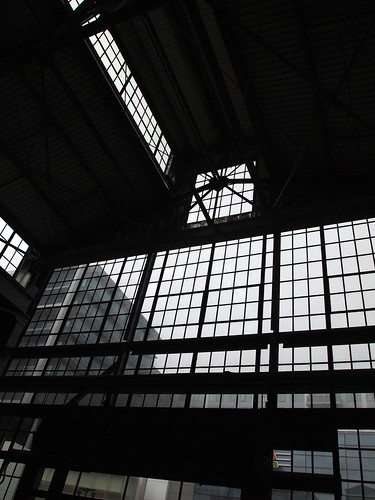
Pic(k) of the Week: High ceilings at Bluejacket

High ceilings at Bluejacket

The photo almost appears as if I had shot it in black-and-white, but not.

High ceilings and tall windows dramatically frame a re-purposed factory that, a century ago, produced boilers for Naval ships. In 2013, this historic Washington, D.C. boilermaker building was re-purposed ... as brewery/restaurant Bluejacket.

It's a beery blast-from-my-past: I last visited Bluejacket in 2014.

-----more-----

Saturday, May 26, 2018

Pic(k) of the Week: Rocksteady Mild

Rocksteady Mild

For American Mild Month in May, I visited Good Word Brewing, a brewpub in downtown Duluth, Georgia (about twenty miles north of Atlanta). One of its draft mainstays is Rocksteady, which it describes as an
English Mild.
This English bad guy ale has hints of tobacco, toffee, and a touch of leather.

Co-owner Todd Dimattio told me that he rotates one of his yeast strains between this mild ale and another of his IPAs. "Is that to keep the mild ale yeast viable?" I asked. "No," Dimattio replied. Between in-house and off-the-premises sales, Rocksteady is one of his top sellers.

REquired for this day and age, the brewpub does indeed brew hoppy beers, high 'gravity' beers, and 'sours,' as well. In fact, a patron at the bar said that one of the sours on tap tasted like a fruity, puckering lemonade. But Rocksteady Mild —ruby red, not hazy, tasting like a suggestion of toasted bread with a schmear of Nutella, more-ish at only 3.4% alcohol-by-volume (abv)— was (is) a rare thing of 'sessionable' beauty.

Rock on, Mild!

-----more-----

Saturday, April 28, 2018

Pic(k) of the Week: Beer patio bijou

Beer patio bijou

On encountering a brewpub in Atlanta, Georgia, an Instagrammer, tagging a friend, commented, "this is the brewery I was talking about ... that also has food!" In this new generation of brewery taprooms, a brewpub had become a pleasant anomaly to her. Les temps ont changé!

Pictured above, this was not that brewpub, but another, elsewhere in the same city on the same day. On a spring afternoon, its intimate outdoor beer patio was a bijou.

Wrecking Bar Brewpub, in Atlanta (Little 5 Points), Georgia, on 27 April 2018.

-----more-----

Saturday, February 03, 2018

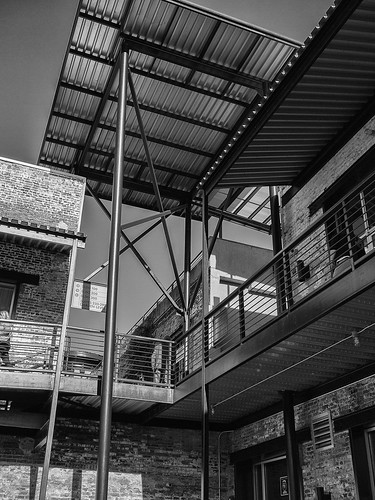
Pic(k) of the Week: Shadows and light, angles and straight lines

Shadows and light, angles and straight lines.

Sometimes, you should look up from your beer.

I did. Once.

As seen above the courtyard at 5 Seasons Brewing Westside, in Atlanta, Georgia. 20 January 2018.

-----more-----

Saturday, October 07, 2017

Pic(k) of the Week: Priming casks (cellarman couture)

Priming casks

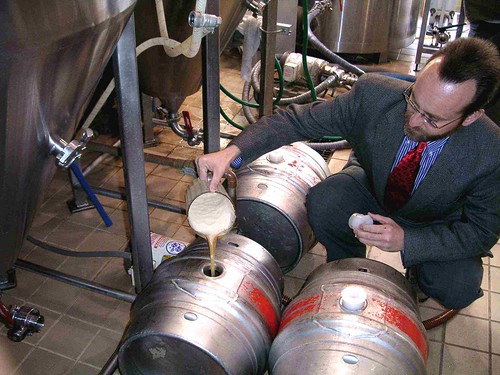
Brewer's Alley is a brewpub in Frederick, Maryland, USA. In February 2004, Tom Flores, brewmaster there invited YFGF's Thomas Cizauskas to the brewery to add priming gyle* to freshly-racked firkins.

Four observations:
  • Now, that's a blast from the past.
  • Now, that's some high hair.
  • Now, that's some cellarman couture.
  • That's a photo of me, from back in the day. I'm Thomas Cizauskas.
-----more-----

Saturday, May 20, 2017

Pic(k) of the week: Brewers Walt Dickinson & Nathan Zeender (and ...)

Brewers Walt Dickinson & Nathan Zeender

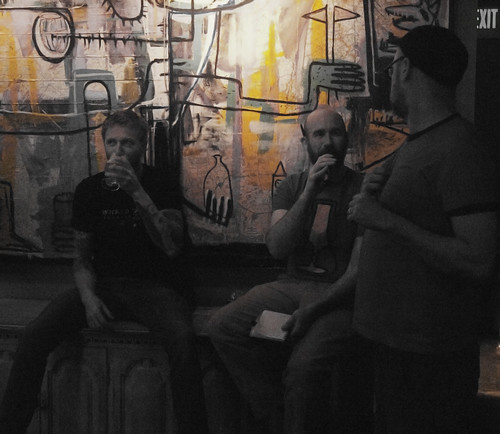
Mixed fermentation of wild and sour beers was the topic of a discussion "between two [three] powerhouses of funk": * Brewpub Right Proper hosted the seminar on 11 April 2017, during the week that the [U.S.] Brewers Association had travelled to Washington, D.C, to host its Craft Brewers Conference in Washington, D.C.

Almost one month later, to the day, Wicked Weed was purchased by Anheuser-Busch InBev. And many 'craft' drinkers (and brewers) cried foul. Did they believe that all that had been discussed that evening now had been transmuted into "alternative facts"?

A more thoughtful reaction was this from a brewer, said recently to me over beers: "It makes me sad."

-----more-----

Saturday, December 17, 2016

Pic(k) of the Week: Friday night brews

Brewer at work

We play; a brewer works. Yeast never sleeps, even on a Friday night.

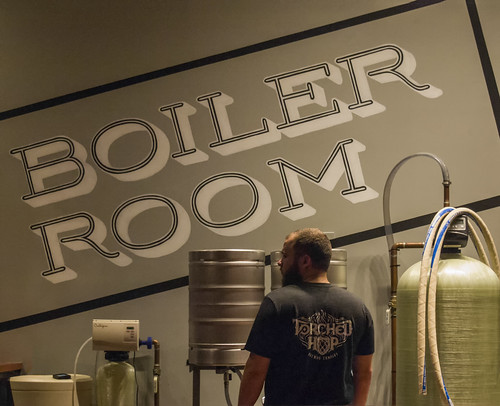
A brewer in the boiler room, at Torched Hop Brewing Company, a brewpub in the Old Fourth Ward neighborhood of Atlanta, Georgia. 18 November 2016.

-----more-----

Saturday, December 10, 2016

Pic(k) of the Week: Polished copper

Max Lager fermenters

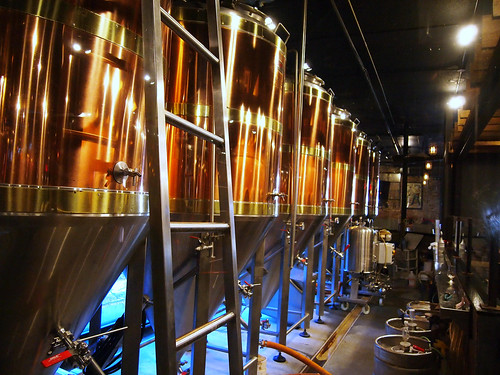
Copper was a metal long valuable in the construction of breweries, but is now laregely replaced by stainless steel. Copper is malleable and can be formed into sheets, which allowed the engineering of large brewing vessels. The sheets were easily joined to produce leak-proof seals. Copper is an excellent conductor of heat, which made it the metal of choice in the days when direct firing of kettles was common. In Britain, brewing kettles are still sometimes referred to as "coppers."
The Oxford Companion to Beer: Oxford University Press, 2012.

In a brewery, copper gleams mighty pretty but it can discolor mighty ugly. It oxidizes.

Fortuitously, brewers long have had a cleaning product readily at hand. They polished their copper kettles with spent yeast and a mild abrasive (such as the ash from the fire under the kettles).

Today's kettles are fabricated from stainless steel and heated by steam in wrap-around stainless-steel 'jackets'. But, for good looks, many 'craft' brewery kettles are gift-wrapped with sheets of copper on their exteriors. Today's brewers polish them not with yeast, but with chemical cleaners, most of which are acid-based.

Today's fermentation tanks are also constructed of stainless steel; many fashion-wise 'craft' breweries copper-clad those as well. Such as Max Lager's Wood-Fired Grill & Brewery in midtown Atlanta, Georgia, whose tanks, pictured above, were each beautifully polished.

I didn't ask the brewers how they cleaned their tanks and kettle. I simply admired the sheen, and enjoyed lunch and a beer(s).

-----more-----

Saturday, November 26, 2016

Pic(k) of the week: Torched Pils & Pie

Torched Pils & Pie

Beer and food pairing? If it tastes good: eat it. If it tastes good: drink it. Q.E.D. (That's Latin for quod erat demonstrandum, aka: done!, boom!, snap!, mic drop.)

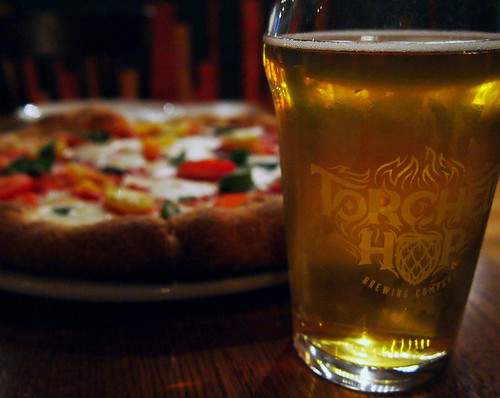
In the photo, it's a Citra-hopped lager and a Caprese pie, made and served at Torched Hop Brewing Company, a brewpub in the Old Fourth Ward neighborhood of Atlanta, Georgia, on 18 November 2016.

It describes the beer as:
a 100% Citra hopped German Pilsner. Citra hops are now one with lager yeast. This 100% Citra hopped lager is an American twist on a traditional German Pilsner.

Hey, now! That's not a Pilsner and, of course, not a German Pilsner. It is, however, a dank, melony American (Georgian?) lager with a bright, dry finish. A tasty hoppy lager, but not a Pilsner. No need to grab foreign laurels. The folk at RateBeer go even further off-kilter, listing the lager as an India Pale ALE [emphasis mine].

*************
Several years ago, the now-departed SABMiller put out an unintentionally humorous pamphlet on pairing beer and cheese. In it, the international beer conglomerate provided descriptions of various cheeses, each illustrated with beautiful photographs. For each cheese, the company suggested one beer pairing. But for each, it was always the same beer: Pilsner Urquell, a venerable Czechian beer which the conglomerate had acquired. And a true, if not German, Pilsner. (One could argue that the "original" Pilsner was from Czechian Plzeň, or Pilsen, after which an "er" was appended, registering Bohemian provenance.)

I wish I had saved the pamphlet.

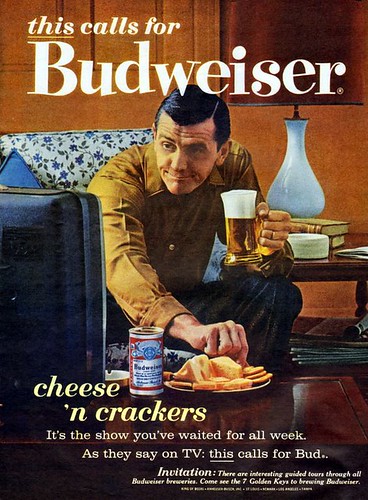
From four decades earlier, here's a 1963 print advertisement from another beer behemoth, Anheuser-Busch, one in a series of 1960s ads entitled “This calls for …”

Cheese 'n crackers, and Bud.

In this case, the this —Budweiser lager— “calls for cheese 'n crackers.” Although I might would opt for a different beer, the overarching idea stands: beer and cheese are natural 'partners.'
To prove that life's greatest pleasures are simple, set a really ripe farmhouse cheese —a well-mannered fruity Cheddar or blue Stilton for preference— alongside freshly baked wholemeal bread, a spoonful of home-made chutney, and a foaming pint of well-hopped, CASK-CONDITIONED [emphasis mine] English ale. Cheese, bread, and beer — the holy trinity or epicurean ecstasy. In other words, the perfect ploughman's, the definitive pub grub from time immemorial.
—Susan Nowak
The Beer Cookbook

And a pizza pie would do just fine.

-----more-----

Monday, October 17, 2016

Happy 20th, Manayunk Brewing!

Twenty years ago today, on 17 October 1996, in the lower level of the Manayunk Farmers' Market, on the banks of the Schuylkill River in Philadephia, Pennsylvania, the brewpub Manayunk Brewing Company first opened its doors to the public.

Manayunk Brewing (logo)

There were beer dinners and real ales; "exploding yeast" (well, not really) and Schuylkill River floods.

There were helping hands from uphill neighbors, Tom Kehoe and Jon Bovit, then producing open-fermenter beer at their just-over-one-year-old Yards Brewing; Bill Moore of Independence Brewing loaning supplies; Brandon Greenwood of all-over fame providing technical advice; and assistant brewers Jim Brennan and Ted Briggs supplying much-needed help.

There was Jim Anderson of Beer Philadelphia and spirited debates; free-lancer Rich Pawluk and beer-with-food pairings; bikes and beer engines at Dawson Street Pub.

There was the temerity to brew with corn; the dry-hopping with dark-fruit-forward New Zealand hops (like grandaddies of today's American IPA hops); and the pleading of why-don't-you-try-the British-Bitter-styled Renner's Red when raspberry-fermented (but not sweetened) Schuylkill Punch became all the rage.

And there was a beer-swilling pig (well, almost).

I should know, because I was there; I was Manayunk Brewing Company's original brewer. I'm not there now, but twenty years later, the brewpub lives on and thrives.

Congratulations, Manayunk, and cheers for twenty (at least) more.

Assessing the gravity

-----more-----

Saturday, August 13, 2016

Pic(k) of the Week: In front of Ale Asylum

In front of Ale Asylum

Now, that's a home for a brewpub: Ale Asylum, of Madison, Wisconsin, in panoramic view, on 24 July 2016, as an early evening sun brought a warm glow to it all.

Successful enough of a brewpub, Ale Asylum, in 2012, would move out of its original digs into this much larger space —complete with three grain silos— and begin packaging its beer for sale off-site.
Ale Asylum. Brewed and bottled in Madison. Fermented in sanity.

-----more-----
Saturday, June 18, 2016

Pic(k) of the Week: Weizen al fresco

A patron enjoys his hefeweizen, while sitting outside on the patio at Gordon Biersch Restaurant Brewery.

Weizen alfresco

A 'blast from the past,' this photo was taken on 30 March 2013, during a 'friends and family' pre-opening open house at the brewpub, located in the Navy Yard neighborhood of Washington, D.C.

-----more-----
Saturday, May 07, 2016

Pic(k) of the Week. A silo for 5 Seasons.

5 Seasons' silo

Many 'craft' beer drinkers tend to pay hops a lot of attention, yet barley malt not so much. Incorrectly. Hops are herbs, spice in beer. It is malt that is beer's fermentable foundation —its quiet soul.
Woe to the malster, brewer, or distiller who simply treats malt as a commodity ingredient. Understanding the relationships between hydration, food reserves, and enzymes within the cereal grain can make the difference between a good tasting product and a great tasting product. The role of maltsters, brewers, and distillers [is] one of "fashioning into a scientifically controlled industry, the noble art of converting barley malt into a wort upon which yeast may feast and ultimately fatten into a beverage with character."
The Craft Maltster's' Handbook.
Dave Thomas. White Mule Press (August 2014).

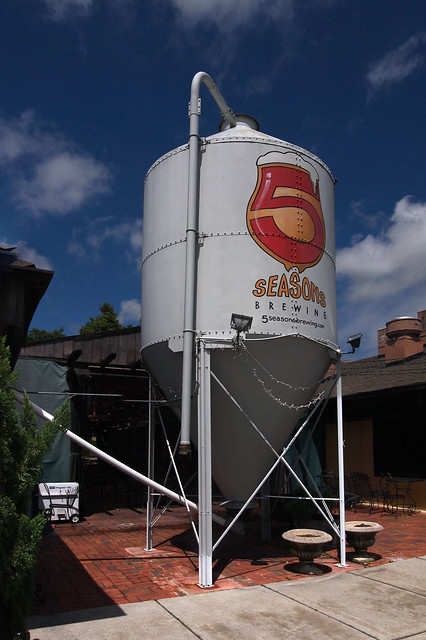
Pictured above is a grain silo holding barley malt for a later brew at the 5 Seasons Brewpub, as seen on 22 April 2016, under a deep blue sky in Sandy Springs, Georgia.

But what is barley and what is barley malt? The National Barley Growers Association has a pithy answer:

No Barley, No Beer

The The Oxford Companion to Beer (Oxford University Press, 2012) provides more depth:
Barley is the primary cereal grain used as the source of carbohydrates for brewing beer. It is designated Hordeum vulgare, and originates in the fertile Crescent of the Middle East (formerly Mesopotamia and its surroundings, now Syria, Iraq and surrounding lands). [...]

Malting is the process in which raw barley or another grain is made ready to become the main ingredient in the brewing process. It is essentially the first step in beer making. The grain is steeped in water, then rested under precise conditions to encourage germination, and finally dried in a kiln and/or a roaster. One of the key functions of malting is to degrade the grain's proteins and to create the enzymes and modify the starches needed for the brewing process. Professionally, the person responsible for this process is known as a maltster.

Returning to the silo above and referring to its brewpub, a question might arise: What is the fifth season?

The answer is ... beer-drinking season, of course. You can thank a barleycorn for that. And a farmer. And a maltster.

-----more-----

Saturday, October 24, 2015

Pic(k) of the Week: Sisson's Grundys

Sisson's Grundys (02)
Grundy tank is a term adopted by the North American craft brewing industry for UK-built pub cellar tanks. These inexpensive, mass-produced tanks were fabricated in the 1950s and 1960s, and have been utilized at almost every stage of the brewing process. The 8.5 [U.S.] barrel (10.1 hectoliters) tanks were originally produced for directly dispensing carbonated beer from pub cellars but have been utilized for fermentation, conditioning, and bright beer storage.
The Oxford Companion to Beer: Oxford University Press, 2012.

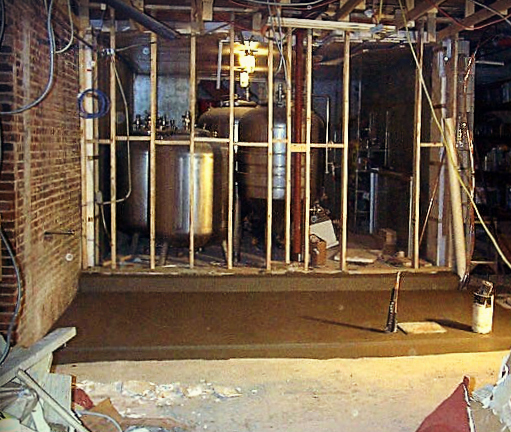
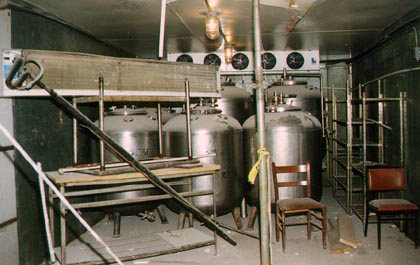
Pictured above are 'Grundy' tanks which were used as beer serving tanks at Sisson's Brewpub, in the Federal Hill neighborhood of Baltimore, Maryland. The photo was taken in December 2000, when the brewpub was undergoing renovations.

Sisson's had been the long-time pub of the Sisson family of Baltimore, when in 1989, son Hugh Sisson —after successfully lobbying the Maryland legislature to allow brewpubs to operate in the state— installed brewing equipment, and the pub became Maryland's first-ever brewpub (and, in fact, the first brewpub in the entire Virginia, Maryland, Washington, D.C. area). In 1995, he would sell his share of the brewpub, and open Clipper City Brewing, now known as Heavy Seas Beer, just outside the city and still in operation today. But Sisson's? The other family members sold it in 2000; brewing operations ceased in 2002.

Another view:

Sisson's Grundys

From this brewer's perspective, Grundy tanks were a pain in the arse. Leaky; never quite holding pressure; difficult to repair or find spare parts. But we still loved them. They were part of our American 'craft' beer beginnings.

What's old is new. From British beer historian, Martyn Cornell, at his blog, Zythophile (21 October 2015):
Tank beer – “tankova” – may be a hot new trend in London, with Meantime in Greenwich and Pilsner Urquell delivering fresh unpasteurised beer to pubs in beautiful shiny big containers, but the idea of putting beer in cellar tanks to deliver better quality is, even in London, more than a century old. [...]

The first “tank” beer system in the capital appears to have been introduced by Hugh Abbot, a brewer at Watney’s original Stag brewery in Pimlico, London, just around the corner from Buckingham Palace. In 1913 he had three standing butts fixed up in the cellar of a Watney’s pub, and beer delivered in an old horse-drawn tank wagon of the sort that brewers used to transport beer to their bottling stores. The experiment was successful enough that by 1920 Watney’s had electric-powered tanker lorries, fitted with copper tanks, taking beer around to its pubs. It was still using electric vehicles in 1949, though by then tank deliveries to pubs were done using trailers mounted behind standard tractor units.

In the early 1970s a brewery such as Mansfield was putting nearly two thirds of its beer into tanks. But by 1994, changes in tastes had cut that to less than 20 per cent, and tanks were coming out of cellars. Ironically, the demise of tank beer in Britain in the 1980s and early 1990s proved a boon to the growing craft beer movement, both here and, especially, in the United States. Redundant pub and club cellar tanks, cheap and easily available, some of them 50 years old, were converted into fermenting vessels and conditioning tanks in their thousands for new small breweries, and “Grundy tank” became the general term in the United States for imported UK-built pub cellar tanks, even though many were not actually built by Grundy.
— Read more: here.

-----more-----