Showing posts with label Craft Brewers Conference. Show all posts

Thursday, April 23, 2020

A virtual Craft Brewers Conference

Floor of BrewExpo America®

The [U.S.] Brewers Association —the national non-profit association on behalf of small and independent (and 'traditional') U.S. breweries— had originally scheduled its annual Craft Brewers Conference for this week in San Antonio, Texas. Then, there was this thing called a pandemic and the confab was scrubbed.

So, in lieu of an actual conference, the BA has been live-streaming seminars this week and will continue to so through 15 May.

There are almost 70 webinars in total. Topics include such as:
  • Chemical Safety in Brewing: Do You Really Know What You're Doing?
  • State of the Craft Brewing Industry
  • Draught Beer Quality Workshop: Addressing Draught Beer Dispense Issues
  • Don’t Get Gotcha’d: Regulatory and Compliance Best Practices for Growing Craft Breweries.
Downloadable pdfs and audio links are provided afterward for perusal. The full schedule: here.

More Brewers Association links:

-----more-----

Friday, March 13, 2020

Craft Brewers Conference 2020 canceled due to coronavirus concerns

Craft Brewers Conference 2020 canceled due to coronavirus concerns

The [U.S.] Brewers Association has been closely monitoring the situation around COVID-19 [coronavirus] as it relates to the Craft Brewers Conference® & BrewExpo America®and World Beer Cup™. We have been following updates and recommendations from the Centers for Disease Control and Prevention and the World Health Organization, as well as state and local governments.

Given the developments over the past 24 hours, we have made the difficult decision to cancel the 2020 Craft Brewers Conference & BrewExpo America and World Beer Cup [all three originally scheduled for 17-24 April 2020, in San Antonio, Texas].

The Brewers Association will provide full refunds of conference registration and booth fees, sponsor payments, and World Beer Cup competition entries.

We are grateful to all of you who made plans to attend this year’s events. It is heartbreaking to miss the annual gathering of our craft brewing community, but the safety and health of attendees, exhibitors, sponsors, staff, volunteers, and the craft brewing community at large [are] paramount to the Brewers Association. We look forward to seeing many of you September 24-26 at Great American Beer Festival® and again March 29-April 1, 2021 for the Craft Brewers Conference in San Diego, Calif. Until then, we will continue to work diligently on your behalf to provide you with relevant and timely resources to help you advance your business goals.

— [U.S.] Brewers Association
12 March 2020.

Presented annually for the past three decades by the [U.S.] Brewers Association (BA) —and its predecessor, the Association of Brewers— the Craft Brewers Conference (CBC) is the largest 'craft' brewing industry event in the U.S., serving breweries, brewpubs, and packaging breweries.
CBC joins brewers from across the country for seminars focusing on topics including sustainability, sales, packaging and export development, along with daily receptions, brewery tours, and hospitalities. The concurrent BrewExpo America is a trade show for brewers, with hundreds of vendors showcasing products and services.

The Brewers Association itself is a trade and lobbying organization for "small and independent" brewing companies in the United States and its territories. Among other things, the BA defines a 'craft' brewery as an American brewery producing fewer than six million barrels of beer per year.

Before canceling the April conference, the association had expected over 13,000 attendees. Breweries across the U.S. are canceling previously scheduled festivals and events. Some have begun to temporarily close their taprooms. Is there a 'craft' brewery viability crisis on the horizon? One hopes not.

Wild! Full room!

-----more-----

Wednesday, April 10, 2019

What's 'craft' beer worth? Try $27.6 Billion.

This week, a plenitude of American 'craft' brewers are in Denver, Colorado, attending the Craft Brewers Conference/BrewExpo, the industry's annual confabulation, hosted and organized by the [U.S.] Brewers Association in different U.S. cities each year.

In conjunction with that, the BA has released its annual compilation of annual growth data for the U.S. 'craft' brewing industry. Such as:

Craft Beer Production, 2018
In 2018, small and independent brewers collectively produced 25.9 million barrels and realized 4 percent total growth, increasing craft’s overall beer market share by volume to 13.2 percent.

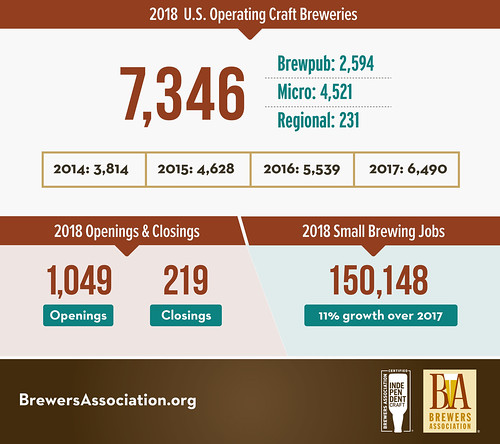
Retail dollar value was estimated at $27.6 billion, representing 24.1 percent market share and 7 percent growth over 2017. Growth for small and independent brewers occurred in an overall down beer market, which dropped 1 percent by volume in 2018. The 50 fastest growing breweries delivered 10 percent of craft brewer growth. Craft brewers provided more than 150,000 jobs, an increase of 11 percent over 2017.
[...]

There were 7,346 craft breweries operating in 2018, including 4,521 microbreweries, 2,594 brewpubs, and 231 regional craft breweries. Throughout the year, there were 1,049 new brewery openings and 219 closings—a closing rate of 3 percent.
[...]

Craft Breweries, 2018

[These] numbers are preliminary. [...] A more extensive analysis will be released during the Craft Brewers Conference & BrewExpo America® in Denver, Colorado from April 8 – 11, 2019. The full 2018 industry analysis will be published in the May/June 2019 issue of The New Brewer, highlighting regional trends and production by individual breweries.

— [U.S.] Brewers Association
2 April 2019

And while I'm at it, here's the BA's super-duper definition of its member breweries, that is, its definition of what a 'craft' brewery is. Note, however, that the BA does not define what a 'craft' beer is.
An American craft brewer is a small and independent brewer.
  • Small:
    Annual production of 6 million barrels of beer or less (approximately 3 percent of U.S. annual sales). Beer production is attributed to the rules of alternating proprietorships.
  • Independent:
    Less than 25 percent of the craft brewery is owned or controlled (or equivalent economic interest) by an alcoholic beverage industry member that is not itself a craft brewer.
  • Brewer:
    Has a TTB Brewer’s Notice [Federal license to brew beer commercially] and makes beer.


Trailer for the short, "For the Love of Craft," produced by [U.S.] Brewers Association founder Charlie Papaziaan. The film is to be premiered at the CBC.

-----more-----

Friday, June 09, 2017

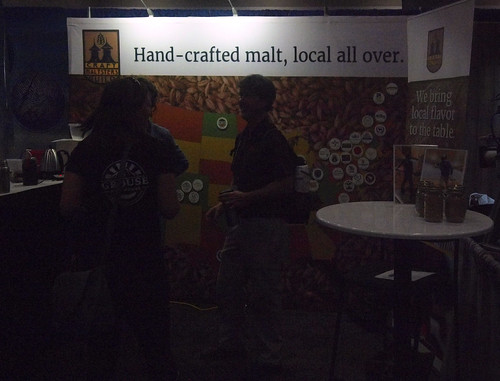
Hand-crafted malt, local all over.

Craft Maltsters Guild @CBC17

"What is the Craft Maltsters Guild?"

Here's how Brent Manning —a Craft Maltsters Guild board member and a representative of Riverbend Malt House of North Carolina— answered that question, and others I had, at the recent Craft Brewers Conference in Washington, D.C.
Manning:
The Guild is an association of North American craft maltsters with similar values and ideals maltsters even though we have had inquiries from Central and South America and small operations in Europe.

All of these people are making malt using different varieties of grain, using different equipment, some of it is homespun, a lot of it is homespun. And it's pretty exciting, because this is searching for new flavors. The tie-in for all of it is regional sourcing, support for your farmers, and transparency of quality commitment.

  • YFGF:
    Why has the traditional malt industry been concentrated in the upper Midwest, but the craft' malting industry elsewhere?

    Manning:
    The northeast used to be America's grain basket until we headed west due to consolidation, land costs, and economies of scale. The upper Midwest has fantastic growing conditions: the soil is rich, the topsoil is deep, the yield per acre is much higher than in other areas. You're looking at 125 bushels an acre in America's heartland; 75 in the South.

    In the Pacific Northwest, and Idaho and Montana, it's more traditional grain-growing areas. Elsewhere, there was some disease pressure early on before we had a robust plant breeding program at public universities. The schools and a couple of private individuals are bringing in some really exciting new varieties to the market. Just giving that sense of place as you move region to region; everybody's choosing their own way of doing business.

    And in the Southeast we did not have that food-grade supply chain in place. We've been really working to try and suss that out and support it, so that we can make this industry grow.

  • YFGF:
    I see a lot of 'craft' maltsters in the Northeast. Why is 'craft'malting developing so robustly there?

    Manning:
    There other things you're seeing. Brewery density is one reason you don't see craft malthouses in certain regions. Another is laws. New York State has a very expansive farm-brewery law that is tying a set of legal benchmarks to brewing and ingredients. They're great. They're fantastic, but that explains the density in New York state relative to anywhere else.

  • YFGF:
    And elsewhere?

    Manning:
    Yes. For instance, I'm the salesman for Riverbend Malt, in North Carolina. North Carolina has nothing that helps the craft malt industry. So, I'm just a crazy man right now. Whenever I walk the halls, they say, "So tell me about the hops business." I'm not talking about hops; I'm talking about barley. And North Carolina grew twenty-thousand acres of it, but it all goes into the feed market. So, it's a complicated conversation to help bridge that gap.

  • YFGF:
    Anyone from Georgia using 'craft' malt [home territory to YFGF]?

    Manning:
    Well, Riverbend has a couple of folks: Wrecking Bar Pub, a little bit with Sweetwater. Pretty much anybody who's doing the farmhouse-focused stuff. The malt really carries a lot of flavor, so it tends not to work well with IPAs. Because you want a neutral flavor or preferably nothing!

  • YFGF:
    How do craft maltsters incentivize farmers to grow brewing barley?

    Manning:
    In the South, we grow winter grains: plant in October and harvest in June. So, I'm not disrupting their normal cash-crop schedule. That makes my job easier. Up north, they are competing with some of the higher price per bushel cash crops. So the price per bushel in the northeast is higher than it is in the south because of that competitive landscape.

    But, yes, cash is king. If we want someone to take a risk, we have much more stringent specs than the feed-grade industry. So, yes, we use cash as a way to incentivize.

    The other thing, too, is that we want to pull them out of the commodity loop, as well. We try to agree on a variety, agree on specs, agree on a price before the grain is even planted. So, we don't really care what sort of geopolitical events might take place during the growing season that might negatively or positively affect that price point. Because it's set.

    It helps everybody involved. Farmers thought we were kind of crazy at first because we were shunning these global markets that they had gotten up and checked every day for ten, twenty years. We said, no, we don't want to do business like that. We want to do business with a handshake and, hopefully, as little paperwork as possible to get these projects in motion.

  • YFGF:
    How do craft maltsters get their product to brewers?

    Manning:
    Everyone is wearing a lot of hats right now. An owner might also be the accountant, might also be the floor grain raker, might be everything in between. The industry is still in that early stage right now. Only one of our member maltsters uses a distributor. That's Pilot Malthouse in Michigan; they use BSG. Everyone else self-distributes. For most of us, it's door-to-door sales.

  • YFGF:
    Do craft maltsters emphasize base malts or specialty malts?

    Manning:
    It totally depends. At Riverbend, we do heirloom and specialty malts. The South, for example, has a long history of growing some pretty tasty raw materials that could be used in the brewing industry. It's pretty exciting to bring those into production.

  • YFGF:
    I'd assume sourcing equipment had been a difficult thing at first, most of it sized for much larger malting houses.

    Manning:
    It still is. We have people with a lot of different backgrounds. I was a stream wetland biologist before so I don't really understand the mechanics of the machinery, but understand what's going on in the kernels. But other malt houses have engineers, fabricators that they've worked with on other projects on their farm, or whatever, so they will work together, and noodle through some ideas and come up with equipment design.

    That's part of why we [at Riverbend] did floor malting, obviously. It took out one of the big mechanical problems, which is how do you turn it? A guy pulling a rake, a guy with a shovel full of malt. It may not work perfectly day one, but you continue to refine it and improve upon it.

  • YFGF:
    Some in the 'craft' hop industry are forming cooperatives. Is 'craft' malt doing that?

    Manning:
    We're not so much working in that space. Geography is challenging; everybody wants to make their own products. There's not the same need for centralized equipment processing and product testing. Everyone is getting grain from different farmers.

  • YFGF:
    Does the Guild advocate best practices?

    Manning:
    We are about to release a quality and safety manual for start-up malt houses, not pushing them into 'hassip' [HACCP: Hazard Analysis and Critical Control Point] but a series of following the process from planting, the growing season, the harvest, the testing phase. That is one thing about growing grain in these non-traditional areas. Those quality specs are absolutely essential. Some farmers will get it done; some of them will not. We're trying to educate.
  • Craft Maltsters Guild logo
  • YFGF:
    You're here at the Craft Brewers Conference. Does the Guild work with the Brewers Association?

    Manning:
    Right now we have a really beautiful relationship with the BA. One of their technical guys is on our board as well. There's a really nice exchange of information between quality, flavor, quantities. Really looking at the supply chain issues, it's not just the farmer and the malt house and the brewer. There's seed cleaning, trucking, and storage, and all those pieces of the puzzle that all have to be lock-step if this is going to work.

  • YFGF:
    Does the Guild have meetings?

    Manning:
    Yes. In fact, we're about to have our annual meeting, here at the Conference. Usually, between 60 to 80 people show up. We have a few tiers of membership, everything from our regular members —which are ou our producers— to the associate level which could be a malthouse in planning to allied trade. We're pretty well formalized. We have some great information on our website. We do a pretty exciting webinar series for members, which is part of our quality management and training. It's pretty specific: for instance, smoking the malt.

  • YFGF:
    Smoking the malt? I hear that's legal in some states now.

    Manning:
    It is! [Laughs]

  • YFGF:
    Good luck at your meetings. Thanks for answering my questions.


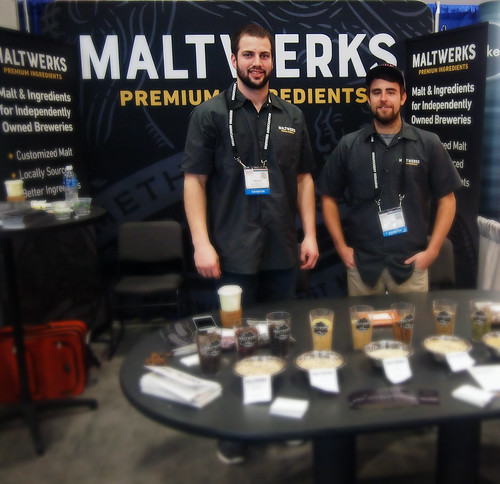
There were, in fact, a few other booths at the 2017 Craft Brewers Conference devoted to 'craft' malting, such as this 'craft' maltster, from Minnesota. And there was a seminar on field trials of barley and malt for the 'craft' brewing industry.

For a heretofore hop-centered industry, that's a welcome pivot.

Maltwerks @CBC17

-----more-----

Saturday, May 27, 2017

Pic(k) of the Week: ASBC Hot Steep Malt Sensory Method

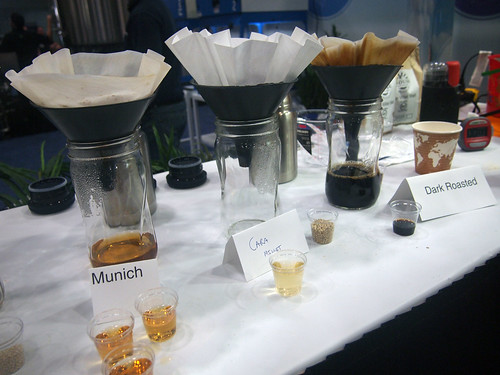
ASBC Hot Steep Malt Sensory Method (demonstrated by Craft Maltsters Guild)

The Craft Maltsters Guild was there at the recent Craft Brewers Conference in Washington, D.C., demonstrating the new Hot Steep Malt Sensory Method of the American Society of Brewing Chemists (ASBC).

At the Guild's booth, Jessica Johnstone of Grouse Malting (of Colorado) was kind enough to explain the process to me.
This is a demo of the ASBC Hot Steep Malt Sensory Method. It was published about a year ago. A lot of our malthouses have found it very beneficial for a multitude of purposes including brand development or quality control. Essentially, it's a hot steeped malt tea, filtered. Maltsters use it to identify aromas, tastes, flavors, and mouthfeel. Brewers can as well. We're looking for each batch of malt to taste the same, so we can market it as the same product. If there's an outlier, it's something we have to address.

A valuable test —developed by scientists Cassie Liscomb of Briess Malt & Ingredients and Lindsay Barr of New Belgium Brewing, it's a surprisingly uncomplicated procedure, using a coffee grinder and Thermos bottle, filter paper and jars. No expensive equipment needed, 'craft' brewers and maltsters.

"May I taste the samples," I asked Johnstone. "They're grainy and malty," she forewarned me.

"I've known only one brewer only who didn't like the taste of wort," I replied. "These samples are delicious."

-----more-----

Saturday, May 20, 2017

Pic(k) of the week: Brewers Walt Dickinson & Nathan Zeender (and ...)

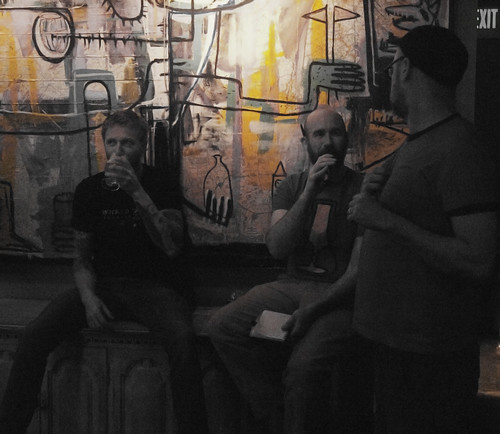
Brewers Walt Dickinson & Nathan Zeender

Mixed fermentation of wild and sour beers was the topic of a discussion "between two [three] powerhouses of funk": * Brewpub Right Proper hosted the seminar on 11 April 2017, during the week that the [U.S.] Brewers Association had travelled to Washington, D.C, to host its Craft Brewers Conference in Washington, D.C.

Almost one month later, to the day, Wicked Weed was purchased by Anheuser-Busch InBev. And many 'craft' drinkers (and brewers) cried foul. Did they believe that all that had been discussed that evening now had been transmuted into "alternative facts"?

A more thoughtful reaction was this from a brewer, said recently to me over beers: "It makes me sad."

-----more-----

Saturday, April 29, 2017

Pic(k) of the Week: Barreling at the CBC

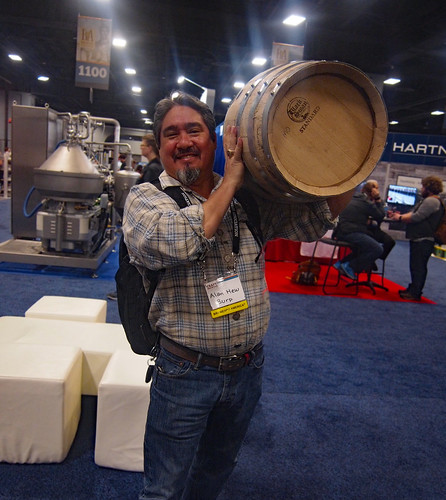
Barrelling

Alan Hew —longtime member of Washington, D,C.-based homebrewer club, B.U.R.P. (founded in 1981)— proudly carries an oak barrel he had secured at BrewExpo America®, during the 2017 Craft Brewers Conference, which ran 10-13 April in Washington, D.C. —only the second time for the conference in that city.
The Brewers Association (BA)—the not-for-profit trade group representing America’s small and independent craft brewers—has concluded the 34th edition of the Craft Brewers Conference & BrewExpo America (CBC) in Washington, D.C.

As the largest industry gathering, CBC brought together some 13,300 brewing professionals and more than 900 exhibitors for discussion and dialogue around America’s craft brewing business and culture. CBC was last in the nation’s capital in 2013, with 6,400 attendees and 440 exhibiting companies.
-----more-----

Saturday, April 22, 2017

Pic(k) of the Week: Brewers queue for Welcome Reception.

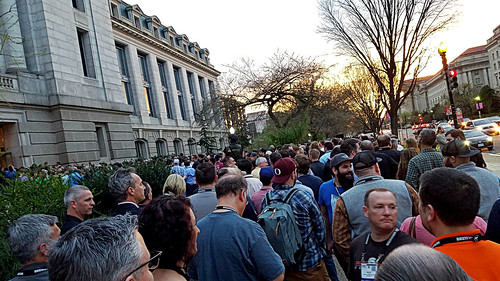
Brewers queue for Welcome Reception (02)
On 10 April 2017, a long line of brewers (a very long line, snaking a couple of city blocks) waited for the Smithsonian National Museum of Natural History to open its doors for the 2017 Craft Brewers Conference Welcome Reception.

The conference ran 10-13 April in Washington, D.C. It was only the second time the conference had been in that city.
The Brewers Association (BA)—the not-for-profit trade group representing America’s small and independent craft brewers—has concluded the 34th edition of the Craft Brewers Conference & BrewExpo America (CBC) in Washington, D.C.

As the largest industry gathering, CBC brought together some 13,300 brewing professionals and more than 900 exhibitors for discussion and dialogue around America’s craft brewing business and culture. CBC was last in the nation’s capital in 2013, with 6,400 attendees and 440 exhibiting companies.


There were so many attendees that the Brewers Association simultaneously staged a second reception at the National Museum of American History, a couple of blocks to the west, although less well-attended.

-----more-----

Saturday, April 15, 2017

The skinny on the 2017 Craft Brewers Conference

Welcome to the 2017 Craft Brewers Conference

The 2017 Craft Brewers Conference only just concluded on Thursday. And I've only begun to look through photos, transcribe recordings, write up my thoughts, and recount stories. It's time to get to work, in other words, but that'll be tomorrow. Today, there's a ballgame to listen to and yard work to do.

The [U.S.] Brewers Association —the host and organizer— is, however, behaving in a more professional manner than I. It already has released a post-mortem, possibly one of several to come. Here is its official press release.

Craft Beer in the Capital

13,300 Brewing Professionals, Exhibitors Convene in Washington, D.C. for the 2017 Craft Brewers Conference & BrewExpo America®

Boulder, CO • April 13, 2017—The Brewers Association (BA)—the not-for-profit trade group representing America’s small and independent craft brewers—has concluded the 34th edition of the Craft Brewers Conference & BrewExpo America (CBC) in Washington, D.C.

As the largest industry gathering, CBC brought together some 13,300 brewing professionals and more than 900 exhibitors for discussion and dialogue around America’s craft brewing business and culture. CBC was last in the nation’s capital in 2013, with 6,400 attendees and 440 exhibiting companies.

Highlights from the 2017 conference include:
  • 2017 Achievement Awards
    Three members of the brewing community were recognized and awarded for their dedication and service.
    • Brewers Association Recognition Award:
      Vinnie & Natalie Cilurzo, Co-Owners, Russian River Brewing Company

    • Russell Schehrer Award for Innovation in Brewing:
      Will Meyers, Brewmaster, Cambridge Brewing Company

    • F.X. Matt Defense of the Industry Award:
      Matthew McLaughlin, Executive Director, Mississippi Brewers Guild

  • Other notable takeaways from this year’s CBC include:
    • Keynotes:
      Leadership expert Alison Levine drew parallels from her experience climbing the highest peak on every continent to discuss how craft brewers can compete in a challenging and changing environment. Revered brewer Dick Cantwell provided his industry colleagues with his insights from his long career in the craft brewing community, offering a message of unity among small and independent brewers and reinforcing the importance of producing and maintaining high-quality beer.

    • Diversity Committee:
      The BA announced the formation of a Diversity Committee, with a goal of bringing a more diverse group of brewers and beer lovers into the craft brewing community. Helmed by BA Board member Scott Metzger (Free Tail Brewing Company), the committee is made up of a cross section of industry members of varied backgrounds and regions.

    • Marketing and Advertising Code:
      The BA updated its Marketing and Advertising Code to help brewers maintain high standards and act as responsible corporate citizens. New language has been included to address that beer advertising and marketing materials should not use sexually explicit, lewd, or demeaning brand names, language, text, graphics, photos, video, or other images that reasonable adult consumers would find inappropriate for consumer products offered to the public. Any name that does not meet the Marketing and Advertising Code that wins a BA produced competition including the Great American Beer Festival® (GABF) or World Beer CupSM will not be read on stage or promoted in BA materials, and will not be permitted to use the GABF or World Beer Cup intellectual properties in their marketing.

      Additionally, the BA has convened an Advertising Complaint Review Board should an issue arise that warrants further review and action.

    • CBC Symposium Beer:
      Each year the BA works closely with the local state guild to create the CBC Symposium Beer. Washington, D.C., presented an exciting opportunity to collaborate with the D.C., Virginia and Maryland guilds and involve area craft breweries. CBC attendees received a can of Family Tree, a Belgian pale ale whose recipe highlights the comradery among five D.C.-area brewers—Manor Hill Brewing, Vanish Farmwoods Brewery, Waredaca Brewing Company, and DC Brau Brewing Company—who got their start at Flying Dog Brewery.

    • Government Affairs:
      More than 230 brewers, brewery owners, and state guild representatives participated in the CBC Hill Climb, talking with Congressional staff about legislation important to the brewing community including the Craft Beverage Modernization and Tax Reform Act. Introduced at the beginning of the 115th Congress, this legislation would lower the federal excise tax paid by craft brewers. Brewers explained that a recalibration of the tax rate would allow them to reinvest in their companies, creating the opportunity for more local manufacturing jobs.


Not one to dawdle, the BA has already begun promoting the 2018 CBC, which it has scheduled for 30 April through 3 May of next year, concurrent with the World Beer Cup, in Nashville, Tennessee. That'll be a hootenanny.

-----more-----

Wednesday, April 05, 2017

CBC Road Trip!

Projects underway but not yet completed:

Road trip!

CBC13 Keynote Ballroom

-----more-----

Saturday, May 07, 2016

The 2016 World Beer Cup.

Since 1982, the [U.S.] Brewers Association has hosted an annual championship of American beer: the Great American Beer Festival (GABF). Since, 1996, it has also organised an international beer championship, the World Beer Cup (WBC).

The GABF is held every year in September or October, in Denver, Colorado. The World Beer Cup, in contrast, travels around the United States, and is held concurrently with the Craft Brewers Conference, but in alternating years. The 2016 edition has just concluded in Philadelphia, Pennsylvania.


There is a whiff of American exceptionalism to the World Beer Cup: the bias of an international event held in the U.S., categories based upon American interpretations of world beer 'styles,' the cost of international shipping and transportation to the U.S., the deleterious effects upon beer from that travel. Be that as it may, at this year's competition, there were 6,596 beers —from 1,907 breweries in 55 countries— judged in 96 'style' categories.
  • The average number of beers entered per category was 69, up from 50 in 2014.
  • The category with the most entries was American-Style India Pale Ale with 275 entries.
  • The second most-entered category was Imperial India Pale Ale with 181 entries.
  • The third most-entered category was American-Style Pale Ale with 167 entries.
Judges (75% of whom were from outside of the United States) awarded bronze, silver, and gold medals in each category (other than the "Fresh or Wet Hop Ale" category, in which no gold recipient was selected). Out of 287 medals awarded, American breweries received 231, or 80% of the total; breweries from other nations, 56, or 20%. (Germany had the second highest total after the U.S., at 17 medals, or 6%.)
  • Gold
    A world-class beer that accurately exemplifies the specified style, displaying the proper balance of taste, aroma and appearance.
  • Silver
    An excellent beer that may vary slightly from style parameters while maintaining close adherence to the style and displaying excellent taste, aroma, and appearance.
  • Bronze
    A fine example of the style that may vary slightly from style parameters and/or have minor defects in taste, aroma, or appearance.
Additionally, 6 overall brewery champions were selected (all from the U.S.), based upon their size and a complex algorithm.
Breweries are awarded points based on medals won, and these points are tabulated to arrive at the results. Here are the criteria used for awarding points, and the tie-breaking system used to rank breweries.
  • Most Total Points – breweries are awarded points based on the number of gold (3 points), silver (2 points) and bronze (1 point) medals won in the competition.
  • Most Gold Medals
  • Most Medals
  • Most Total Entries in all Medalled Categories
  • Number of Entries in Gold Medalled Categories
The second and third criteria have the effect of making a gold and two bronzes worth more than a gold and silver, while two golds would be worth more than a gold, silver and a bronze. The fourth and fifth criteria recognize overall competitiveness by achieving medals in categories with more entries than others.

Depending upon the audacity of their marketing departments, each of these six breweries ...
  • Very Small Brewing Company Category: Arch Rock Brewing Company
    brewer: James Smith
    Fewer than 1,001 barrels per year (1,190 hectoliters)
  • Small Brewing Company Category: Noble Ale Works (Anaheim, California)
    brewers: Evan and The Giants
    1,001-15,000 bbl (1,191–17,600 hl)
  • Mid-Size Brewing Company Category: Brewery Ommegang (Cooperstown, New York)
    brewers: Brewery Ommegang
    15,001–6,000,000 bbl (17,601–7,040,000 hl)
  • Large Brewing Company Category: Miller Brewing Company (Milwaukee, Wisconsin)
    brewers: Miller Brewing Co. Brewing Team
    Greater than 6,000,000 bbl (7,040,000 hl)
  • Brewpub (A restaurant-brewery that sells 25% or more of its beer onsite):
    • Small Brewpub Category: 12 Degree Brewing (Louisville, Colorado)
      brewers: Jon Howland and Tor O'Brien
      Fewer than 1,201 bbl (1,408 hl)
    • Large Brewpub Category: Beachwood BBQ & Brewing (Long Beach, California)
      brewer: Julian Shrago, Ian McCall, and Gene Wagoner Greater than 1,201 bbl (greater than 1,409 hl)
... could claim the mantle of Best Brewery In The World, and, more so, Noble Ale Works, which not only brewed the gold-medal winning IPA —'craft' beer's most popular 'style— but the bronze for its Imperial IPA. I'd lay a wager that Miller Brewing —before it's subsumed into the Anheuser-Busch InBev hegemon— will claim the "World's Best" title.

That is, until May 2018.

-----more-----

Tuesday, March 15, 2016

The State of the 'Craft' Beer Nation 2015.

NBWA logo The NBWA (National Beer Wholesalers Association) has released its initial analysis of the state of the United States beer industry in 2015, as prepared by its chief economist, Lester Jones.

By the numbers, here's a short summary:

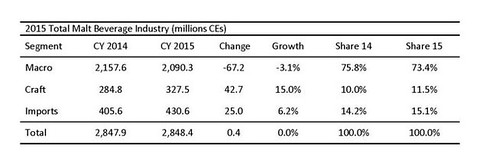
  • In 2015, total beer sales in the U.S. saw no appreciable increase over 2014, remaining at approximately 2.9 billion CEs (case equivalents). *
  • 2.5% of all beer sales shifted from the 'macro' segment to 'craft' and imports.
  • 'Craft' beer sales were up 15% in the U.S. in 2015 (over 2014), increasing from 284.8 CEs to 327.5 million CEs, an increase from 10% of the market to 11.5%.
  • 'Macro' beer sales decreased 3.1% (share decreasing from 75.8% to 73.4%).
  • Imports increased 6.2% (their share increasing from 14.2% to 15.1% of all beer sold).
  • Beer packaged in cans has increased its market share, versus bottles and kegs, every year since 2010, from 52.8% then to 55.5% in 2015. Draft beer has remained steady (or flat, depending on your point-of-view) at approximately 10%.
Pint of Draft Punk (02)

Here are a few more fun facts on the U.S. beer industry, as compiled by the NBWA:
  • In 2014, the U.S. beer industry shipped (sold) 206 million barrels of beer – equivalent to more than 2.8 billion cases.
  • In 2014, 86 percent of all beer was domestically produced, and 14 percent was imported from more than 100 different countries around the world.
  • Based on beer shipment data and U.S. Census population statistics, U.S. consumers 21 years and older consumed 27.5 gallons of beer per person during 2014.
  • The U.S. beer industry sells more than $100 billion in beer and malt-based beverages to U.S. consumers each year.
Total Malt Beverage Sales in U.S. in 2015

Things might not be 100% rosy, however. Jones notes that there are indications that the rate of 'craft' beer growth for January/February of this year was not as robust as it had been during those two months last year. But we're yet to hear from the [U.S.] Brewers Association, which, for several years now, has released its annual data concurrent with the Craft Brewers Conference. This year, that is scheduled for 3-6 May, in Philadephia, Pennsylvania.

Hang on, stay tuned, and brew forth.

-----more-----

Sunday, April 19, 2015

The Craft Brewers Conference: State of the 'Craft' Beer Industry 2015.

The 2015 Craft Brewers Conference is now history. And, if only for the number of attendees, a three-fold leap over only a few years ago, it made history.

Boulder, CO • April 17, 2015—The Brewers Association (BA)—the not-for-profit trade group representing America’s small and independent craft brewers—has concluded the 32th edition of the Craft Brewers Conference & BrewExpo America® (CBC) in Portland, Oregon.

As the largest industry gathering, CBC brought together more than 11,500 brewing industry professionals and some 600 exhibitors in one of the biggest beer cities for discussion and dialogue surrounding America’s craft beer culture. Themes included unity, quality and safety.

Craft Brewers Reach Record Volume Share of Marketplace

CBC also saw the BA release a full, extensive analysis of 2014 data on U.S. craft brewing growth. For the first time ever, craft brewers reached double-digit (11 percent) volume share of the marketplace. The state of the industry presentation is available in the CBC Media Kit.

The 2016 CBC will be held in Philadelphia, Pennsylvania, from May 3-6, in conjunction with the 2016 World Beer Cup®.
— Full BA press release: here.

Every year at the conference, the (U.S.) Brewers Association presents its annual State of the 'Craft' Industry report.* This year was no exception. And, for the most part, the BA reported a good state of affairs. In May, it will provide more extensive analyses and statistics in the The New Brewer, its trade publication. Much of that, however, will be considered proprietary, and thus accessible only to Association members.

Here are a few of the bullet points, made public.

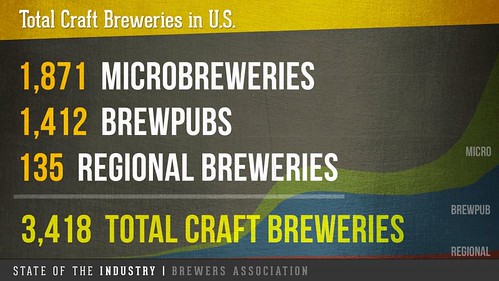
Total Craft Breweries 2014

There were 3,418 breweries in the U.S. at the close of 2014. Extrapolating from figures on other slides, there was a net total of 1.5 breweries opening every day during 2014, with an additional 2,051 breweries in planning by the end of the year. Considering that, that total of 'craft' breweries, a this point in 2015, may be well under-represented.

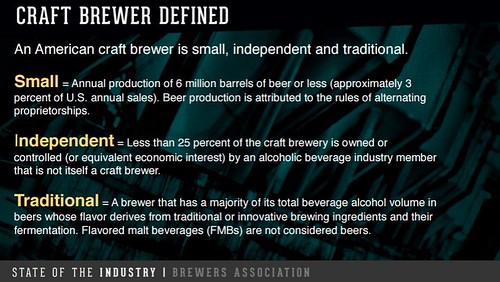
What's the difference between a brewpub, a microbrewery, and a regional brewery? There's a slide for that.

Definition of Craft Brewery 2015 (Brewers Association)


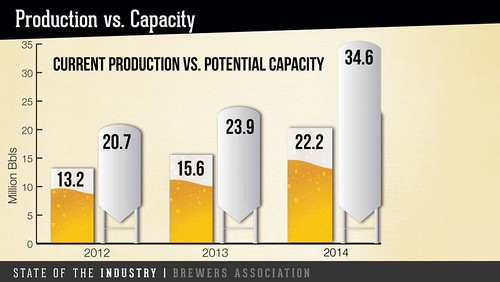
'Craft' beer volumes grew 18% in 2014 (vs. 0.5% for all U.S. beer), reaching an 11% share of all beer in the U.S.. Here's a slide showing the inherent potential for 'craft' beer growth in 2015, just with the breweries that existed in 2014.

U.S. Craft Brewery Production vs. Capacity 2014


There are a lot of people employed to make, sell, and deliver all that beer. The 'craft' beer industry has become a non-trivial part of national economic vitality.
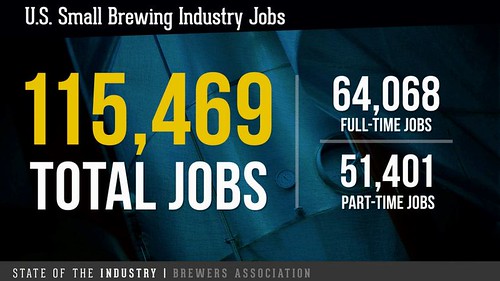
US Small Brewing Industry Jobs 2014


Quo vadis, 'craft'?

But ... all that new 'craft' beer will have to be sold somewhere to someone. Will demand continue to push supply? And where? In off-premises shops, whose shelves are already bursting with choices, where, on average, prices increased $1.01 per case, a 3% jump? Will consumers continue to open their wallets? Will demand continue in pubs and restaurants, where there are already signs of diminishing growth?

In 2015, will we see a more agitated tug-of-war between big 'craft' —which, although it grew 17% in 2014, saw a drop in its growth rate from 2013— and small 'craft' —brewpubs, which showed 20% growth, and microbreweries, which grew by 33%?

Will non-'craft' mega-breweries continue to purchase 'craft' breweries? Will more 'craft' breweries be themselves purchased other 'craft' breweries? (Here and here.) Interesting times. Stay tuned.

Finally, just a chuckle. Is the U.S. in danger of losing its brewers, as this slide headlines, allowing them to be exported to overseas competitors?
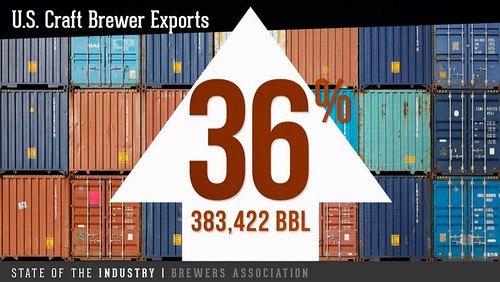
U.S. Craft Beer Exports 2014


-----more-----
Thursday, April 16, 2015

Dave and Diane Alexander honored by Brewers Association at Craft Brewers Conference.

Every year since 1987, the Brewers Association (and its predecessor, the Association of Brewers) presents the Brewers Association Recognition Award "to an individual or company whose inspiration, enthusiasm, and support have contributed to the brewpub and microbrewery movement" in the United States. The selection is announced during the Craft Brewers Conference.


In 1987, influential beer writer Michael Jackson received the first Brewers Association Recognition Award. Last year, in 2014, the award went to pioneering brewer Teri Fahrendorf, founder of the Pink Boots Society, "empowering women beer professionals to advance their careers in the beer industry through education."

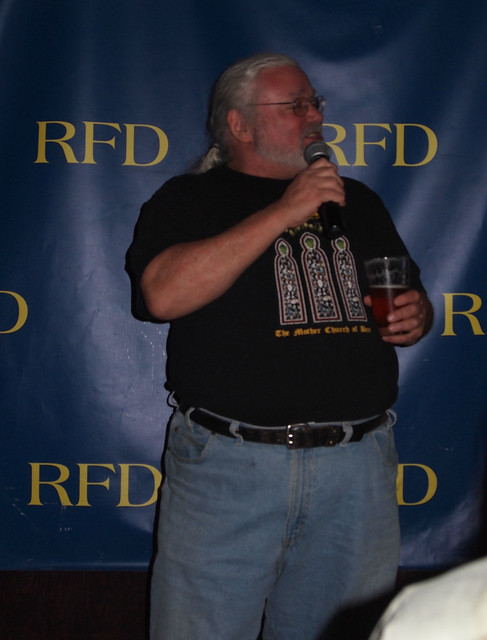
Yesterday, at the 2015 CBC, in Portland, Oregon,, the BA recognized 'DA': Dave and Diane Alexander, the husband wife team that for many years brought good beer to the Washington, D.C. area, as co-owners of the venerable beer tavern, the Brickskeller, and later, R.F.D.

Dave Alexander welcomes Beer Hunter fans

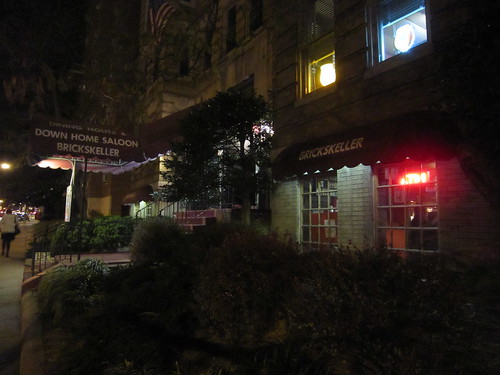
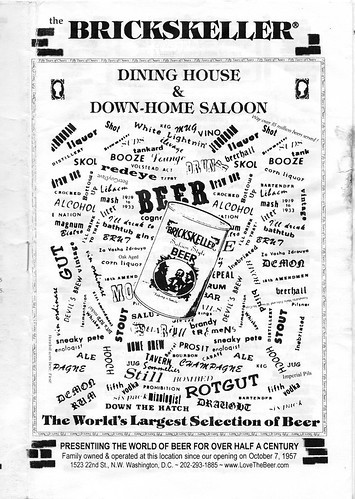
At the Brickskeller, the Alexanders organized tastings and appearances, bringing in brewers from across the United States, and Europe. (Some of the evenings quite infamous!) The couple was doing this years before such things became commonplace and accepted as the norm, as they are now. A dive bar appear in appearance, the Brickskeller Down Home Saloon would achieve national and international renown. Its beer list boasted over one-thousand choices (on paper, if not always in the cupboard).

Brickskeller exterior (03)


After over fifty years of operation, the Brickskeller was sold in 2010. (R.F.D. remains open.) But the Brick's legacy lives on: many of the attendees at the Brickskeller's events, and many of the drinkers who poured over the beer menus, were inspired enough to become some of the next generation(s) of good-beer brewers.

Congratulations to Diane and Dave. Well-deserved!

The final Brickskeller menu (01)

-----more-----

Saturday, April 12, 2014

A beer style riot broke out at the 2014 World Beer Cup!

There was a riot at the 2014 World Beer Cup. That's "riot" as in profligate behavior, not public tumult. A riot of beer styles.

The recently concluded 2014 World Beer Cup awarded medals in 94 officially recognized beer styles. If all the sub-styles were added in, the total style count would come to 174. One-hundred-and-seventy-four. Indeed?

The drinker doesn't need 133 beer styles. Or 70. Or even 30.

Most people who cook have only seven recipes in their repertoire. Even if they have shelves full of Jamie Oliver and Nigella Lawson, when it comes to planning what the family meal is going to be that night, research shows they revert to a list of no more than seven or eight choices. If they learn a new favourite dish, they forget one of the regulars they used to rely on. <...>

Keep it simple. Keep it relevant. Think about it from the point of view of the time-pressed, information overloaded consumer. This is one of those occasions when I realise the marketing guys have something to contribute. Sometimes, the reason they simplify stuff and reduce it down is because they understand that most people give a fraction of a second to each purchasing decision they make, and things have to be simple in order to register.

Beer styles help inspire some people to better brews. I'm very happy about that. But that's ultimately meaningless if it doesn't help - or in some cases even prevents - turning more people onto great craft beer.

Thus wrote Pete Brown in 2010. I agreed then; today, I concur 174%. It's style formalization run amok.

Be that it as it may, we can still take the time to celebrate the acumen and triumph of brewers across those 94 categories at the World Beer Cup. So, here ya go ...

World Beer Cup 2014

WORLD BEER CUP 2014

Boulder, CO • April 11, 2014—The Brewers Association (BA)—the not-for-profit trade group dedicated to promoting and protecting America's small and independent craft brewers—announced the results of one of the largest commercial beer competitions to date, the 2014 World Beer Cup Awards. The awards were presented at the conclusion of Craft Brewers Conference & BrewExpo America® in Denver, Colorado.

Drawing the highest number of entries to date, this edition of the World Beer Cup saw 4,754 beers from 1,403 breweries representing 58 countries—a 21 percent increase in the number of entries from the 2012 World Beer Cup, which had 3,921 entries.

Brewers from five continents earned awards from an elite international panel of judges at this tenth biennial competition, with brewers from 22 countries—ranging from Australia and Brazil to Taiwan and the United Kingdom—honored. Judges awarded 281 out of 282 total possible awards, reflecting the chance for one gold, one silver and one bronze award in each of 94 beer style categories.

This year’s event was particularly competitive; the proportion of winning breweries winning one or more awards was 18 percent, compared to 27 percent in 2012. There was a 75.6 percent increase in breweries competing this year versus 2012, which had 799 breweries that entered beers in the competition. A total of 253 breweries took home awards in 2014, a 16.6 percent increase over 2012.

A detailed analysis of the entries and awards can be found in the 2014 World Beer Cup Fact Sheet [a pdf file].

“Brewers from around the globe participate in the World Beer Cup to win recognition for their creativity and brewing skills,” said Charlie Papazian, president of the Brewers Association. “For a brewer, a World Beer Cup gold award allows them to say that their winning beer represents the best of that beer style in the world.”

Judges
A panel of 219 judges from 31 countries participated in this year’s competition, working in teams to conduct blind tasting evaluations of the beers and determine the awards. Drawn from the ranks of professional brewers and brewing industry experts, 76 percent of the judges came from outside the United States.

Category Trends
  • The average number of beers entered per category was 50, up from 41 in 2012.
  • The category with the most entries was American-Style India Pale Ale, with 223 entries.
  • The second most-entered category was American-Style Pale Ale, with 121 entries.
  • The third most-entered category was Wood- and Barrel-Aged Strong Beer, with 111 entries.

Award Highlights
  • The 281 awards were won by 253 breweries, with very few breweries earning more than one award.
  • 226 breweries won one award.
  • 26 breweries won two awards.
  • One brewery won three awards.

Competition Manager Chris Swersey commented, “This is the most diverse set of winning breweries in any World Beer Cup.”

The non-U.S. entry rate and winning rate tracked very closely in the 2014 competition, with 28 percent of beers entered coming from outside the U.S., and 27 percent of awards going to beers entered from outside the U.S. <...>


AFTER-THOUGHTS

To be clear, the BA hosts a beer festival and competition solely of American breweries —the Great American Beer Festival— every year in Denver, Colorado. Likewise, it organizes an annual convention concerned with the business of U.S. 'craft' beer —the Craft Beer Conference— hosted by a different American city every year. The BA's World Beer Cup, however, is a biennial international competition (first begun in 1996), held in the U.S., whose judging and awards ceremony are held concurrently with that year's Craft Beer Conference.

For this year's World Beer Cup in Denver, there were 4,754 beers entered; of those, 3,402 (or 71%) came from American breweries. So, by pure shock-and-awe preponderance of numbers, the U.S. took 205 medals of the 281 awarded (or 72%). In second, but well behind, was Germany, with 249 entries and 27 medals.

To make the contest fairer and more truly 'worldly,' maybe the BA could consider a percentage-based quota on entries from any one nation. This would, of course, disproportionately affect the U.S., necessitating a weighted lottery system of some sort to determine participation.

As to defeating style inflation, it's probably a battle lost several years ago. So, joining the riot, one could ask: why is there no cask ale category out of all of those ninety-four styles? If there's kellerbier, why not cask? Make it 95.


DMV VICTORS

Since YFGF is 'published' in the mid-Atlantic, we'll give shouts-out to those victorious breweries here in Maryland (which garnered 2 medals) and Virginia (5 medals, including 2 gold). Washington, D.C. would be included, but none of its breweries won a medal. There's always next year two years from now! 1
  • MARYLAND
    • Category 24: Aged Beer (14 entries)
      Silver: Vintage Horn Dog
      Flying Dog Brewery: Frederick, MD. (brewer: Matt Brophy)

    • Category 48: German-Style Brown Ale/Düsseldorf-Style Altbier (36)
      Bronze: Balt Altbier
      Union Craft Brewing, Baltimore, MD. (brewer: Kevin Blodger)

  • VIRGINIA
    • Category 17: American-Belgo-Style Ale (56)
      Gold: Whiter Shade of Pale Ale
      Starr Hill Brewery: Crozet, VA. (brewer: Mark Thompson)

    • Category 26: Smoke Beer (54)
      Bronze: Brewers Select Rauch Märzen
      Gordon-Biersch Brewery Restaurant:
      Rockville, MD Tysons Corner, VA. (brewer: Grant Carson) 2

    • Category 35: Vienna-Style Lager (39)
      Silver: Vienna Lager
      Devils Backbone Brewing Company (Outpost): Lexington.
      (brewer: Nate Olewine)

    • Category 45: American-Style Dark Lager (18)
      Gold: Old Virginia Dark
      Devils Backbone Brewing Company (Basecamp): Roseland, VA.
      (brewer: Jason Oliver)

    • Category 77: Scotch Ale (47)
      Silver: Heavy Red Horseman Scottish Style Ale
      Apocalypse Ale Works: Forest, VA. (brewer: Lee John)

Congratulations to them, and congratulations to all the winners worldwide. To paraphrase Mr. Shakespeare: A blessing on your hearts, you brew good beers.

-----more-----
Saturday, April 20, 2013

Pic(k) of the Week: Nitrogen fob

Nitrogen fob

Jets of liquid nitrogen vaporize out of beer bottles necks, during a demonstration of nitrogen bottle-fobbing, arranged at the 2013 Craft Brewers Conference.
Fobbing during bottling is important in forcing oxygen from the bottle before capping. As the bottle leaves the filler, foam rises to the top of the bottle, due to the drop in pressure, displaying the oxygen in the bottle's headspace. This is known as "capping on foam." Bottling lines will often employ liquid nitrogen or sterile water "jetters" [to create fobbing].
The Oxford Companion to Beer

The 2013 Craft Brewers Conference —presented by the Brewers Association— was held the last week in March, in Washington, D.C. (for the first time in its 30 year history).

Walter E. Washington Convention Center.
28 March 2013.

***************
  • More photos from the conference: here.
  • More coverage by YFGF: here.
  • Pic(k) of the Week: one in a weekly series of personal photos, often posted on Saturdays, and often, but not always, with a good fermentable as a subject. Camera: Olympus Pen E-PL1.
  • Commercial reproduction requires explicit permission, as per Creative Commons.

  • Saturday, April 13, 2013

    Pic(k) of the Week: CBC13 Keynote Ballroom

    CBC13 Keynote Ballroom

    A panoramic view of the main ballroom at the Walter E. Washington Convention Center, in Washington, D.C.

    On the morning of 27 March 2013, the room would fill with nearly 6,400 professionals of the U.S. 'craft' beer business for the opening presentations, and keynote address, of the Craft Brewers Conference.
    From March 26-29, 2013, America’s small and independent craft brewers will gather in Washington, D.C. for the 30th edition of the Craft Brewers Conference (CBC) & BrewExpo America. Presented by the Brewers Association, CBC is the largest industry event, serving both brewpubs and packaging breweries. CBC joins brewers from across the country for over 80 seminars focusing on topics including sustainability, sales, packaging and export development, along with daily receptions, brewery tours and hospitalities. BrewExpo America is the premier trade show for brewers, with hundreds of vendors showcasing the latest and best products and services.

    This was the first time the conference, in its thirty year history, held been held in Washington, D.C. It also was its largest gathering ever; ten years earlier, a tad less than one thousand had attended. The business of small and independent U.S. brewers is booming.

    ***************
  • More photos from the conference: here.
  • More coverage by YFGF: here.
  • Pic(k) of the Week: one in a weekly series of personal photos, often posted on Saturdays, and often, but not always, with a good fermentable as a subject. Camera: Olympus Pen E-PL1.
  • Commercial reproduction requires explicit permission, as per Creative Commons.

  • Thursday, April 11, 2013

    The top 50 breweries (and 'craft' breweries) in the US

    At the recent Craft Brewers Conference, I noticed something different in the welcome speech from Charlie Papazian, President of the Brewers Association (BA). I whispered to a friend sitting next to me: "He's never once said 'craft' brewery. He's using the term: 'small and independent brewery.'" A small detail, perhaps, but potentially a paradigm shift.

    Papazian addresses CBC13

    Papazian and the Brewers Association define 'craft' breweries using three criteria. Notice the third.
    An American craft brewer is small, independent, and traditional.
    • Small: Annual production of beer less than 6 million barrels. Beer production is attributed to a brewer according to the rules of alternating proprietorships. Flavored malt beverages are not considered beer for purposes of this definition.
    • Independent: Less than 25% of the craft brewery is owned or controlled (or equivalent economic interest) by an alcoholic beverage industry member who is not themselves a craft brewer.
    • Traditional: A brewer who has either an all malt flagship (the beer which represents the greatest volume among that brewer's brands) or has at least 50% of its volume in either all malt beers or in beers which use adjuncts to enhance rather than lighten flavor.
    Yesterday, the BA published new statistics on the state of the industry of 'craft' breweries.

    In 2011, 'craft' breweries accounted for 5.7% of the beer produced in the United States; in 2012, 6.5%, a 14% increase. In 2011, there were approximately 2,036 'craft' breweries in the U.S.; in 2012, there were 2,403, an increase of 18%. And, possibly most significantly, 'craft' beer's dollar share of the total U.S. beer market was $8.7 billion in 2011; in 2012, it reached $10.2 billion, a 17% increase. That marked a crossing of a beer Rubicon of a sort: craft beer sales in 2012 accounted for a 10.2% dollar share.

    U.S. Small & Independent Breweries in 2012

    Note the use of "Small and Independent" in the above graphic from the BA. Of course, they also use the term "craft." Yet, still, it does seem a shift in tone and message.

    Here, from the BA's press release is the list of the top 10 'small and independent' breweries (or 'craft', if you will), based on sales volume in 2012:
    • 1. Boston Beer Company: Boston, Massachusetts 
    • 2. Sierra Nevada Brewing Company:  Chico, California 
    • 4. New Belgium Brewing Company:  Fort Collins, Colorado
    • 4. The Gambrinus Company:  San Antonio, Texas
    • 5. Deschutes Brewery:  Bend, Oregon
    • 6. Lagunitas Brewing Company:  Petaluma, California
    • 7. Bell's Brewery, Inc.: Galesburg, Michigan
    • 8. Matt Brewing Company: Utica, New York
    • 9. Harpoon Brewery: Boston, Massachusetts
    • 10. Stone Brewing Company:  Escondido, California

    Flying Dog Brewery —of Frederick, Maryland, n the Washington, D.C. / Maryland / Virginia region (in which this blog resides)— took the 29th spot. Rounding out the top fifty was Troegs Brewing, of Hershey, Pennsylvania. See the rest of the list of the Top 50 'small and independent' breweries: here.

    Again, according to the Brewers Association, the top 10 breweries in 2012 in the United States, solely by volume, regardless of affiliation, were:
    • 1. Anheuser-Busch Inc.: St. Louis, Missouri
    • 2. MillerCoors: Chicago, Illinois
    • 3. Pabst Brewing Company: Los Angeles, California.
    • 4. D. G. Yuengling and Son Inc.: Pottsville, Pennsylvania
    • 5. Boston Beer Company: Boston, Massachusetts
    • 6. North American Breweries: Rochester, New York
    • 7. Sierra Nevada Brewing Company: Chico, California
    • 8. New Belgium Brewing Company: Fort Collins, Colorado
    • 9. Craft Brew Alliance, Inc.: Portland, Oregon
    • 10. The Gambrinus Company: San Antonio, Texas

    Anheuser-Busch and MillerCoors are not American-owned. Pabst owns no breweries; it is, in effect, a marketing company. Thus, the largest American-owned brewery is Yuengling, family owned and the oldest brewing company in the United States. Boston Beer —maker of the Sam Adams beers— is the second-largest. Yuengling Lager —Yuengling's flagship beer— is brewed with a hefty proportion of corn. As the BA does not consider corn to be 'traditional' —a stipulation that is historically fallacious— it refuses to recognize Yuengling as a small and independent brewery.

    North American Breweries is a conglomerate comprising Dundee, Genesee, Labatt Lime, Magic Hat, and Pyramid brands. The Craft Brew Alliance comprises Kona, Omission, Red Hook, and Widmer Brothers brands.

    Rounding out the top 50 overall breweries is Karl Strauss Brewing Company, of San Diego, California (which is also 39th on the list of 'craft' breweries). Maryland's Flying Dog Brewery comes in at #40. See the rest of the list here. Of those fifty, thirty-nine are defined by the BA as small and independent.

    ********************
  • Read the Brewers Association press releases: here and here.
  • UPDATE: The Brewers Association's full 2012 industry analysis was published in the May/June issue of The New Brewer, the trade journal of the Association.

  • Saturday, March 30, 2013

    Pic(k) of the Week: Beer Phones

    Beer-phones

    It was a full house at Meridian Pint in Washington, D.C. The largest ever Craft Brewers Conference had just concluded and many of its attendees had traveled uptown to this good beer pub in the Columbia Heights neighborhood of Washington, D.C. All 23 taps, as well as 23 casks, were pouring beers from 20 local breweries in Washington, D.C., Maryland, and Virginia.

    It was loud. It was boisterous. It was a celebration. Surrounded, this gentleman was able to tune it all out, and simply enjoy his beer.

    Washington, D.C.
    29 March 2013.

    **************
  • See the list of beers he was perusing: here.
  • This was but one of many events throughout the city (and nearby suburbs) during the week of CBC. See more photos from the Craft Brewers Conference: here
  • Pic(k) of the Week: one in a weekly series of personal photos, often posted on Saturdays, and often, but not always, with a good fermentable as a subject. Camera: Olympus Pen E-PL1.
  • Commercial reproduction requires explicit permission, as per Creative Commons.

  • Tuesday, March 26, 2013

    Destination: Washington DC. 2013 Craft Brewers Conference

    The annual Craft Brewers Conference has arrived in Washington, D.C., running today through Friday. Rather than a consumer beer tasting and brewery competition, this is a confab of and for brewers: the technology and science of beer, the business of beer, the selling of beer, the regulations of beer. And, of face-to-face networking. The peers of beer, if you will.

    From March 26-29, America’s small and independent craft brewers will gather in Washington, D.C. for the 30th edition of the Craft Brewers Conference (CBC) & BrewExpo America. Presented by the Brewers Association, CBC is the largest industry event, serving both brewpubs and packaging breweries. CBC joins brewers from across the country for over 80 seminars focusing on topics including sustainability, sales, packaging and export development, along with daily receptions, brewery tours, and hospitalities. BrewExpo America is the premier trade show for brewers, with hundreds of vendors showcasing the latest and best products and services.

    It's important to understand what is meant by 'craft' brewery. This is not a legal, governmental, term. It is a definition of and by the breweries themselves, through their trade group, the Brewers Association, organizer of the event.
    An American craft brewer is small, independent and traditional.

    Small: Annual production of 6 million barrels of beer or less. Beer production is attributed to a brewer according to the rules of alternating proprietorships. Flavored malt beverages are not considered beer for purposes of this definition.

    Independent: Less than 25% of the craft brewery is owned or controlled (or equivalent economic interest) by an alcoholic beverage industry member who is not themselves a craft brewer.

    Traditional: A brewer who has either an all malt flagship (the beer which represents the greatest volume among that brewers brands) or has at least 50% of its volume in either all malt beers or in beers which use adjuncts to enhance rather than lighten flavor.

    There is some controversy about that definition, which many have addressed (including me). This week, that's a discussion deferred.

    This is the first time in its history that the Conference has 'been' to Washington, D.C. I myself have been to two Craft Brewers Conferences: one in Austin, Texas, in the early 1990s, the other in Seattle, Washington in the late 1990s. In the 'craft' beer world, that's a virtual lifetime ago: much has changed, the number of breweries ballooning to over 2,000, the most ever in the history of brewing in the United States.

    Working for a wholesaler, I sell beer for a living; so I'll be at the CBC to drum up brewery business. But, as I wrote in this blog's masthead, I'm a lover of beer: not simply with its flavors —as delicious, complex, and varied as they may be— but with its history, science, lore, and evolving creation. Those are the reasons why this week will be, for me, a privilege and a treat.

    The new breweries of Washington, D.C., and those of neighboring Virginia and Maryland, will proudly be playing host. The 'craft' beer bars and restaurants of the area will be pulling out all the stops with a multitude of events, most open to the public.

    There will be telling of tall tales. There will be drinking of beer. Much.