Showing posts with label health. Show all posts

Friday, March 13, 2020

Craft Brewers Conference 2020 canceled due to coronavirus concerns

Craft Brewers Conference 2020 canceled due to coronavirus concerns

The [U.S.] Brewers Association has been closely monitoring the situation around COVID-19 [coronavirus] as it relates to the Craft Brewers Conference® & BrewExpo America®and World Beer Cup™. We have been following updates and recommendations from the Centers for Disease Control and Prevention and the World Health Organization, as well as state and local governments.

Given the developments over the past 24 hours, we have made the difficult decision to cancel the 2020 Craft Brewers Conference & BrewExpo America and World Beer Cup [all three originally scheduled for 17-24 April 2020, in San Antonio, Texas].

The Brewers Association will provide full refunds of conference registration and booth fees, sponsor payments, and World Beer Cup competition entries.

We are grateful to all of you who made plans to attend this year’s events. It is heartbreaking to miss the annual gathering of our craft brewing community, but the safety and health of attendees, exhibitors, sponsors, staff, volunteers, and the craft brewing community at large [are] paramount to the Brewers Association. We look forward to seeing many of you September 24-26 at Great American Beer Festival® and again March 29-April 1, 2021 for the Craft Brewers Conference in San Diego, Calif. Until then, we will continue to work diligently on your behalf to provide you with relevant and timely resources to help you advance your business goals.

— [U.S.] Brewers Association
12 March 2020.

Presented annually for the past three decades by the [U.S.] Brewers Association (BA) —and its predecessor, the Association of Brewers— the Craft Brewers Conference (CBC) is the largest 'craft' brewing industry event in the U.S., serving breweries, brewpubs, and packaging breweries.
CBC joins brewers from across the country for seminars focusing on topics including sustainability, sales, packaging and export development, along with daily receptions, brewery tours, and hospitalities. The concurrent BrewExpo America is a trade show for brewers, with hundreds of vendors showcasing products and services.

The Brewers Association itself is a trade and lobbying organization for "small and independent" brewing companies in the United States and its territories. Among other things, the BA defines a 'craft' brewery as an American brewery producing fewer than six million barrels of beer per year.

Before canceling the April conference, the association had expected over 13,000 attendees. Breweries across the U.S. are canceling previously scheduled festivals and events. Some have begun to temporarily close their taprooms. Is there a 'craft' brewery viability crisis on the horizon? One hopes not.

Wild! Full room!

-----more-----

Sunday, May 25, 2014

A #MemorialDay Sunday grilling edition of #VeggieDag Thursday

Port City's "One" Stout

Here's how the Beer Judge Certification Program (BJCP) describes a Russian Imperial Stout:
Rich, deep, complex and frequently quite intense, with variable amounts of roasted malt/grains, maltiness, fruity esters, hop bitterness and flavor, and alcohol. High roasted malt/grain flavors can suggest bittersweet or unsweetened chocolate, cocoa, and/or strong coffee. A slightly burnt grain, burnt currant or tarry character may be evident. Fruity esters can take on a dark fruit character (raisins, plums, or prunes). Malt backbone can show some supporting caramel, bready, or toasty flavors. Alcohol strength should be evident, but not hot, sharp, or solventy. No diacetyl. The balance and intensity of flavors can be affected by aging, with some flavors becoming more subdued over time and some aged, vinous or port-like qualities developing.

And, here's why scientists say that, for your Memorial Day picnic, you should switch from fizzy yellow beer to dark, roasty, full-bodied stout.
  • According to the National Cancer Institute, HCAs (heterocyclic amines) and polycyclic aromatic hydrocarbons (PAHs) are chemicals formed when muscle meat from beef, pork, poultry and fish is cooked using high-temperature methods, such as pan frying or grilling directly over an open flame. The American Institute of Cancer Research adds there is "limited, but suggestive evidence that compounds produced in meat through the grilling process factor in human cancer." Studies have suggested that marinating meat and fish before grilling can decrease the formation of HCAs; scientists point to antioxidants in marinades as possible HCA blockers.
    —More via Chicago Daily Herald
    .

  • Researchers at the University of Porto, in Portugal, tested the effect of marinating meat with a Pilsner, a non-alcohol beer, and a dark beer, against a control sampling of raw meat. Dark beer showed the strongest "inhibitory effect," reducing the formation of carcinogenic PAHs by 53 percent. Pilsners and non-alcoholic beers showed less significant results: 13 percent and 25 percent respectively. The scientists aren't entirely sure why a beer marinade has this effect; they speculate that it might be the antioxidant compounds in beer, especially darker varieties, which inhibit the movement of free radicals necessary for the formation of PAHs.
    —More via Mother Jones.

Be careful, here. The research isn't stating that (dark) beer is good for you, but rather that the anthocyanins in beer may reduce the amount of potentially dangerous HCAs and PAHs in grilled foods. On the other hand, there is indeed plenty of evidence to support the supposition that beer, in and of itself, is a health-promoting foodstuff.

So, now that you know how to be prophylactic while grilling, it's on to the recipes, with a few appetizers to begin with.

************

RECIPES

  • Mango-avocado salad with cilantro-lime-serrano-pepper dressing. Via Cooking Stoned.

  • Chilled radish soup. Via The Beekman 1802 Heirloom Vegetable Cookbook, by Josh Kilmer-Purcell and Brent Ridge. As their recipe uses buttermilk, here's a simple process for making vegan 'buttermilk', via Southern Vegan Food: "Add 1 tbsp vinegar to 1 cup of non-dairy milk. Let stand for 5 minutes. The milk curdles immediately."

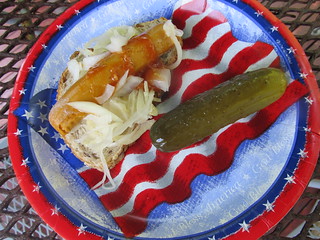
  • Veggie Hot Dogs in beer (04)

  • Steam soy 'hot dogs' in beer. Do not grill them; they blister unattractively. Via YFGF.

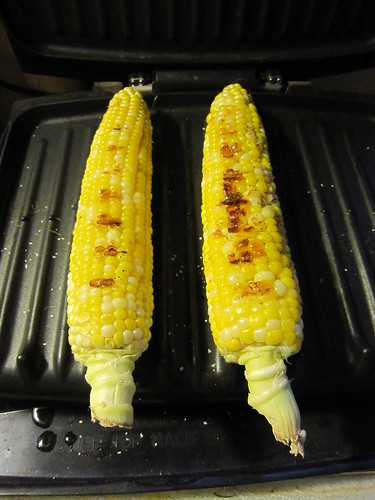
  • 'Grilling' corn on a George Foreman Grill. Via YFGF.

  • Grilling Corn with George Foreman (03)

  • "Oh She Glows" blogger Angela Liddon has seven requirements for "Perfect" Veggie-Burgers:
    • Can’t be mushy in the middle.
    • Crispy outer shell.
    • Lots of flavor from fresh herbs & spices.
    • No tofu.
    • Crunchy, chewy texture is a must.
    • No cracking or falling apart.
    • Must cook well 3 ways: frying pan, oven, and BBQ.
    A video tutorial on how to prep and freeze the 'burgers.'

  • Grilling spiced olives. Via Primal Palate.

  • A trio of grilled vegetables:

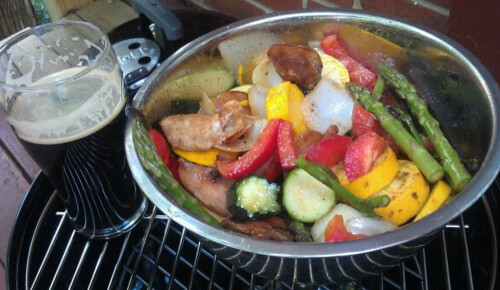
  • Stout-marinaded Grilled Veggies (02)

  • Salad of Grilled Vegetables. "A marinade can add flavor in as little as 20 to 30 minutes, and can be used on vegetables, as well as meats, seafood, and poultry," * says cookbook author Lucy Saunders, who wrote this year's Dinner in the Beer Garden [a —mostly— vegetarian beer-with-food cookbook], and 2006's "Grilling with Beer."

    For a basic marinade, use olive oil, vinegar, juice of lemon or lime, fresh herbs, and soy sauce ... for umami. Toss the cut vegetables and marinade into a locking plastic bag, and press out as much air as possible. Refrigerate for at least a couple hours.

    Saunders is partial to beer in marinades and adds this advice: "If adding a malty amber ale or stout to a marinade, the malts will add to the caramel color of the food, turning white onions or pale lobes of endive into gilded and browned beauties. I prefer milder kölsch or weissbiers for grilled fruits and tender vegetables, and brown ales or stouts for richer flavored grilled onions, eggplant, or sweet potatoes," she says. "I use fresh beer, but not the most expensive or rare beer. Very hoppy beers can make food too bitter."

  • And, for dessert:
    • Grilled peaches with ginger-coconut vegan 'ice cream.' Via Isa Chandra Moskowitz of Post Punk Kitchen.
    • "Grilled, strawberries become pockets of warm jam, bursting in your mouth." Via Forks in the Road.

Veterans' Commons

Tomorrow, on Memorial Day, please remember those who gave the "last full measure of devotion" toward protecting the ideals of America.

And, maybe, in their honor, enjoy good grilling and good eating. But don't forget the stout. For health purposes, of course.

VeggieDag Thursday
VeggieDag Thursday is an occasional Thursday post
on an animal-free diet and ecological issues.

-----Read more-----

Thursday, July 25, 2013

Beer Wars: The Calumny of The Food Babe.

I'm angry. If you're a drinker of good beer, or a brewer of such, you should be too.

A food blogger, who demurely refers to herself as the Food Babe, recently posted a piece —which she breathlessly called The Shocking Ingredients in Beer— about what she believed to be the unhealthy, unlisted, and unpalatable ingredients in beer. It was a typical attack piece, half-right and misleading, and researched just enough to prove a point, rather than to find fact.

In reading it, I was reminded of the South Beach Diet, which once famously declared beer a horrible food product because it contained maltose. Well, yes, unfermented beer contains maltose, the sugar in barley. But there is no, zero, maltose in finished beer. Maltose is exactly what yeast ferments (consumes) to produce beer. Called out on that inconvenient truth, the authors still refused to correct the record.

This Food Babe seems to have read from that same playbook of pernicious misinformation. Called out on her half-truths, she refuses to backtrack. On her website, she can be seen posing, holding a glass of wine. Should we tell her that wine is a terrible beverage choice? All that concentrated fructose? Should we tell her that the U.S. government allows over 60 additives in wine, including dimethyl dicarbonate, a rather nasty chemical, that is used to forestall spoilage? By her own logic (?), if such additives are allowed, they are, ipso facto, therefore always used. Well, then: drink up, Babe!

Even those farmers who employ organic methods, themselves spray their crops with chemicals, such as sulfur and copper. These are not pesticides, but they do take a toll on the environment. Should we tar these farmers as well, Babe? Et tu Brute?

What I found almost as appalling as the Food Babe's beer-McCarthyisms were the actions of several national 'craft beer' advocates, who, non-disapprovingly, linked to this tomfoolery via Twitter, Facebook, and other social media. Had they actually read this manure or had they merely re-posted it simply in a rush to gain readership? Had they assumed that the Babe could not possibly be referring to 'craft' beer? And, if so, did they really believe that 'craft' beer has complete control over its ingredient chain, that it uses no chemicals or additives, and that it flows virginally from the fountains of Ninkasi? In making this falderol viral, they lent horribly unfortunate credence to it.

As was put to me, in a more measured tone, by Maureen Ogle, author of Ambitious Brew: The Story of American Beer: "I'd hate to see a 'your beer is more pure than mine' war start over this."

In my ire, I turned to one of America's premier brewers and brewing instructors for a rebuttal. Steve Parkes possesses a brilliant zymurgical curriculum vitae, and is the owner of the American Brewers Guild, one of the three major U.S. brewing academies training our current and future 'craft' brewers. It would be safe to say that Mr. Parkes knows beer.

Here's what he had to say:

In order to write this piece, I have had to endure repeated readings of The Shocking Ingredients in Beer written by an internet character who calls herself The Food Babe. Trawling through the bad grammar and typos was painful enough, but putting that aside, and dealing with the innuendo, misrepresentation, and blatant falsehoods made it doubly so.

The Food Babe doesn’t drink beer, but she’s concerned for those of us who do. She’s right about the effects alcohol has on weight gain and on our general health but she didn’t leave it there. Armed with a list supplied by the Center For Science in the Public Interest, a group whose stated aim is to prevent people from drinking, and a quote from an anti alcohol campaigner, she sets about listing all of the ‘shocking” ingredients brewers are allowed to make beer with, and to not disclose on their labels.

The main thrust appears to be that beer can be made using corn, corn syrup, high fructose corn syrup, and dextrose, and that the brewers cannot provide proof that they are GMO [genetically modified organism] free. The problem with that is that no supplier of any food made from corn can prove no GMOs are present because no effort has been made to segregate GMO corn from the food supply. It’s unlikely to contain GMO material, but it’s impossible to say for certain it doesn’t.

And, if it were brewed with GMO corn —as Pabst Blue Ribbon might be according to the author’s wild speculation— the brewer is forbidden to put "contains GMO ingredients" on the label, thanks to the lobbying efforts of the food industry.

Anheuser-Busch is cited for being “caught using experimental food made in a laboratory,” referring to traces of an experimental rice found in the beer. Plots of experimental crops are planted right next to regular crops all the time and in this case the rice was simply contamination from rice in the field.

She moves on to talk about isinglass, which is solubilized swim bladders of subtropical fish, that has been used as a traditional clarification aid in beer for two centuries. It is widely used in the manufacture of English cask ales and many North American brewpubs use it to avoid the expense of a filter.

The author describes the use of isinglass by Guinness like this: “The sneaky thing this beer company does like many of the companies mentioned here today is create an illusion of using the best ingredients when in actuality what they tell you publicly on their websites is a complete farce.” (I didn’t leave out the punctuation … there wasn’t any).

Guinness does in fact use the best isinglass it can buy; the reason it’s not listed as an ingredient is because it’s not in the finished product. It is added to cause the yeast to clump together and sink more quickly to the bottom of the tank. The isinglass stays behind in the tank with the yeast.

The rest of the article lists, in unflattering and vague terms, a whole group of items that brewers are allowed to use if they want to, along with suggestions as to the illnesses they may or may not cause in some cases. The natural flavoring that may be derived from beaver anal glands is my favorite.

Many ingredients on that list date back generations, and while I can’t say for certain that they may have been added to a brewery product at some point in the past, I’m pretty sure that none are regular ingredients in beers today. Remember that brewers make a lot of flavored malt beverages today, so a lot of the flavorings, colorings, and preservatives end up in those. (I don’t advocate drinking those either.)

The writer has written an article filled with innuendo, is startlingly ignorant of the laws governing labeling, and is naïve about food science and brewing science in particular. She assumes the worst motives from beer manufacturers and makes wild unsubstantiated claims against some well-known brands. In her world, only foods derived from plants are to be trusted, and animal derived ingredients and process aids are forbidden, as are chemically derived ones. These are made against a backdrop of drinking beer for good health. I’m glad she didn’t research further and discover all of the unhealthy plant life that can creep into our beers if the brewers in this country weren’t so committed to making a safe and healthy product.


Beers: drunk and undrunk


Postscript
After this post was written, Steve Parkes submitted a few more things. Here:
The article is misleading at best. Her main sources other than brewers are organizations that want to ban alcohol. The brewers are naturally a little defensive when questioned about their processes from the public. Presumably those brewery PR departments checked out the Food Babe...perhaps even read her article on microwaves where she claims water exposed to microwaves resembles water that has been exposed to the words "satan" and "Hitler". So they were understandably reticent to engage her knowing what was coming.

Among brewers, the companies listed are quite open about their ingredients and processes. I've read long papers in technical journals describing how Guinness optimize their use of use isinglass. I've met with Anheuser Busch and Miller brewers and talked about their processes at length. There's no scandal there.... The process at Anheuser Busch is quite natural and traditional in fact, and AB have a line of gluten free and organic beers made in the same facilities as their other products.


In Conclusion
In the interest of transparency, I should stipulate that I do indeed drink beer ... as a wholesome food. I've been in the beer business for twenty years, as a brewer, brewpub owner, and a beer salesman. I'm also a vegetarian, but I do not, and, now, will not, read the Food Babe's blog.

In posting this rebuttal, I, of course, have added additional viewers for her site. That's unfortunate, but, to correct the record, necessary. It's sad that someone who professes a search for the truth about food would feel the need to distort the record to fit her perceived truth. As Daniel Patrick Moynihan once wrote: “Everyone is entitled to his own opinion, but not to his own facts.”

I'm on the same bandwagon as 'The Babe' about health and food (and somewhat about GMOs), but I reject outright her phony fellowship. I denounce her calumny.

-----more-----

Saturday, November 14, 2009

Pic(k) of the Week: A sign on the door

VA smoking ban (2)

The long-time symbolic heart of the tobacco industry skips a beat. On December 1st 2009, the State of Virginia will ban the smoking of tobacco in restaurants. There are, however, many exemptions and exceptions to the ban.

Photo taken at Dogwood Tavern in Falls Church, Virginia.

Tuesday, March 24, 2009

Beer boosts bones

This just in from the it's bad for you, it's good for you department: a study indicates that the moderate intake of beer (and to a lesser extent, wine) improves bone density.

The bad news comes from another recent study which reports that even moderate consumption may increase the risk of breast cancer in women.

The effect of alcohol on bone mineral density (BMD) that [Dr. Katherine Tucker of Boston's Tufts University] and her colleagues saw was "larger that what we see for any single nutrient, even for calcium. It's not ambiguous. It's very clear."

Dr. Tucker continues:
"It is very confusing for because alcohol has such diverse effects on different things." For example, while drinking may prevent heart disease, it increases breast cancer risk.

Moderate drinking may help build bone density

Ann Harding
Reuters
Mar 20, 2009

The researchers believe a causative factor to be the high silicon content of beer, more so in beer than in wine. Necessary for good bone health, silicon has become less prevalent in modern diets than it once was.

Distilled spirits were found to provide the least gain.

More on beer and health here.

Saturday, January 31, 2009

Moderation, not Deprivation: book review

Pick up a candy bar, a bag of potato chips, or even your kid’s favorite sugar-coated breakfast cereals and you can refer to a Nutrition Facts label.

But pick up a bottle of your favorite beer, and unless it’s a low-calorie or low-carbohydrate brew with a federally-required Nutrition Facts label emblazoned on it, you have no idea what, if any, nutritional components are in a regular-brewed stout, porter, bock, wheat beer or even a simple American-style pilsner beer.

I couldn't have said it better, and in fact, I didn't.

Bob Skilnik did.

The author of Beer and Food: An American History, Bob has a new book — Does My Butt Look Big In This Beer?

Does My Butt Look Big in this Beer?
For each of over 2,000 beers, Does My Butt Look Big lists calories, carbohydrates, alcohol by volume, and Weight Watchers points.  Skilnik collected public information and contacted breweries directly.

The US Treasury's Alcohol and Tobacco Tax and Trade Bureau (TTB) has proposed requirements for listing various nutritional measurements. Skilnik has some interesting things to say about that in the preface to the book: it's a reason in itself for reading the book.

Another beer writer —Lew Bryson— has chronicled how he, while continuing to enjoy good food and good beer, lost weight. Moderation and using Weight Watcher's point system were the keys. Read his account here.

The publication of Does My Butt Look Big In This Beer? could be considered timely. Sunday is the Super Bowl. That event, last year, was the 8th biggest of beer sales in the US. Beer drinkers perusing this book beforehand would be able to forecast —or regret— the amount of calories and carbohydrates they might consume watching the game.

For instance, Victory Brewing's Storm King Stout contains 286 calories, whereas Turbo Dog, a brown ale from Abita Brewing, is measured at 168. For comparison purposes only —and not as an endorsement to drink it— Coors Light contains 104, shall I say, empty, calories. Keep in mind that the nutritional analyses are based on 12 ounces, the size of a standard US beer bottle. Most US pubs serve pints, which should be [read below]16 US fluid ounces. That's 1/3 more. Thus a pint of Storm King would be 381 calories (not 286).

If, even after all this, you're still worried about beer calories and carbs, but don't want to skimp on flavor, then try this: Place two beer glasses in front of you. Fill only one. That's 100% of the flavor, but 50% of the calories and carbs.

*******************************
  • There is a companion blog at Drink Healthy, Drink Smart.
  • Caveat: My mention of Victory, a PENNSYLVANIA brewery, does not imply a Super bowl pick.
  • Caveat: I did receive a complimentary review e-copy of Does My Butt Look Big in This Beer? That being said, I purchased my copy of Beer & Food: An American History.
  • Caveat: I work for a northern Virginia wholesaler which distributes Abita beers.

Thursday, January 22, 2009

Beer prostate health

Beer Examiner has a nice summary of recent studies on the health benefits of moderate beer consumption and of alcohol in general. The blog is written by Charlie Papazian, the founder of the American Homebrew Association, who celebrates his birthday on Friday.

Men ages 40 to 64 who drank four or more glasses of red wine a week halved their risk for prostate cancer, say scientists from Fred Hutchinson Cancer Research Center in Seattle.

Thursday, January 01, 2009

The 1st "Beer is good for you" post of 2009

Here's the first "Beer is good for you" story of 2009.

Well, truth be told, the following piece about research at the University of Porto in Portugal actually was released on 31 December 2008 (and was based on a report issued in October), but then again, it may have already been 1 January 2009 somewhere else in the world.

New research reveals that steak when marinated in beer or wine is less likely to contribute to cancer.

Hot temperatures in the process of frying and grilling cause sugar and amino acids to convert into cancer-causing compounds leading to high levels of hetrocyclic amines (HAs).


And, for a third 'flavor' of hetrocyclic amine
beer works more efficiently in reducing levels in just 4 hours as compared to wine which requires a longer time. <...> Tasters also preferred the smell, taste and appearance of beer marinated steak [over a red wine marinade].

[The article draws on a report published in the October issue of the Journal of Agricultural and Food Chemistry.]


But before you go out and buy all that marinade, er, beer, here's a different study released only four days earlier on 27 December 2008:
The risk of getting inflicted with liver and bowel cancer increases by up to 20 percent in people who drink one pint of beer everyday, as per scientists at the World Cancer Research Fund (WCRF).

The story is not clear in how that statistic was derived.

Alan McLeod (A Good Beer Blog), in verifying the researchers' bona fides, has an interesting take on such studies in general. As a bonus, he mentions George Carlin, who remains funny and witty even after his passing in 2008.

Cask E.S.B.

A citizen journalist at NowPublic recently emailed me, requesting:
We at NowPublic are working on coverage of new study showing that one pint of beer a day increases liver and bowel cancer risk by 20 percent, and we are putting together a collection of photos. We came across your amazing photo on Flickr and it would be a great addition to our story. We would very much appreciate its use, with proper credit to you of course.

I demurred, and instead, published a link at NowPublic to the first story.

In related news, the Federal Drug Administration has banned life. Seems it leads to death.

More on beer and health here.

Wednesday, December 17, 2008

Beer, as WE age

There's yet another report that alcohol may be good in small or moderate amounts, but bad in greater amounts.

Jane Brody in the New York Times summarized this new report at her Personal Health column. What differentiates it from other similar reports is that it is specifically directed at Baby Boomers, as they pass 65. Much of her article draws on a study published in the October issue of The Journal of the American Dietetic Association.

The bad:

Doctors may also fail to recognize the symptoms of alcohol abuse, a problem that is expected to become increasingly common as baby boomers, who have been found to drink more than previous generations [emphasis mine], reach age 65 and beyond.

Personal Health
Query for Aging Patients: How Much Do You Drink?
By JANE BRODY
December 15, 2008

The good:
At the same time, older people who are in good health should know that moderate drinking under the right conditions may improve their health in several important ways.

The study's authors note that "moderate" alcohol consumption may ward off:
  • Heart disease and mortality
  • Diabetes
  • Dementia
  • Osteoporosis
and that it may have salubrious psychosocial and nutritional effects.

The risks of excessive alcohol consumption that Ms. Brody mentions are common sense:
Immoderate consumption of alcohol — more than three drinks a day — can be hazardous for people of all ages, but it is especially so for the elderly, who reach higher levels of blood alcohol faster and maintain them longer than younger people.

Potential hazards include an increased risk of falls and vehicular accidents, a decline in short-term memory, a worsening of existing health problems, and interactions with medications that may diminish the effectiveness of some drugs and increase the toxic effects of others.

I have a (very) short list of links to articles on beer and health at my website: Good Beer & Good Health?

Saturday, April 26, 2008

Papazian attacks the beer belly

Charlie Papazian is a founder of the American Homebrew Association and a powerful force behind the Brewers Association. As such, he has had a profound impact upon homebrewing and craft brewing since the legalization of homebrewing by Jimmy Carter in 1979.

He recently began blogging, and one of his posts addressed the lazy myth of the beer belly:

According to the U.S. government a 12 oz. serving of “regular” beer has less calories than 12 oz. of apple juice, orange juice, 2% milk and cola. If you are really serious about losing weight and don’t want to drink beer, then drink water.


Where the report refers to "regular" beer, keep in mind that beer of 7% alcohol by volume (abv), which is small by today's 'extreme-beer' standards, is itself 30% stronger than "regular" beer of 5% abv. Alcohol provides the greater share of calories in beer.

Be that as it may, long die the frumious slander of the beer belly!

Kudos! Mr. Papazian practices proper English usage and indents the first line of his paragraphs, a modern grammatical rarity. YFGF commends him and abashedly admits its own typographical sloth.

    Kudos! Mr. Papazian practices proper English usage and indents the first line of his paragraphs, a modern grammatical rarity. YFGF commends him and abashedly admits its own typographical sloth. (As an excuse, I note that Blogger.com, the host of the service I use to blog, does not make indenting easy.)Kudos! Mr. Papazian practices proper English usage and indents the first line of his paragraphs, a modern grammatical rarity. YFGF commends him and abashedly admits its own typographical sloth. (As an excuse, I note that Blogger.com, the host of the service I use to blog, does not make indenting easy.)

Alerted to Papazian's Beer Examiner blog at Stan Hieronymous' blog Appellation Beer.

Sunday, March 09, 2008

Beer is bad for you ... no, wait, it's good for you

LONDON (Reuters) - Drinking alcohol, even moderate amounts, may boost blood pressure more than previously thought, British researchers said on Tuesday.
Tuesday, March 4, 2008

But then, three days later:

WASHINGTON (Reuters) - People who started drinking in middle age were 38 percent less likely to have a heart attack or other serious heart event than abstainers -- even if they were overweight, had diabetes, high blood pressure or other heart risks, Dr. Dana King of the Medical University of South Carolina in Charleston and colleagues found.
Friday Mar 7, 2008

Who you gonna call?

Thursday, February 21, 2008

Caffeine, cigarettes, and beer

During my college days, a 'one-eyed' cheeseburger was my 3-in-the-morning antidote for too much partying. That's an egg on a burger, if you didn't know.

These days, an alternate method might be caffeinated alcohol and energy drinks.

Attorneys general from several states have issued demands for documents from Anheuser-Busch Cos. and Miller Brewing Co. as part of investigations into their marketing of caffeinated alcoholic drinks, the companies said. <...>

Drinks that combine alcohol with caffeine have become increasingly popular with young drinkers, including those under the legal drinking age. State attorneys general claim that beverage makers are irresponsibly taking advantage of this popularity by selling the drinks with misleading claims that they help users stay up late for partying. <...>

However,
"It is important to realize that the attorneys general are investigating products whose formulation and labeling already have been approved by the federal authorities, as well as by those states" requiring state approvals, Francine Katz, Anheuser's vice president for communications and consumer affairs, said in a statement. "Caffeinated alcohol beverages are nothing new," she added, noting that adults long have combined drinks such as rum and Coca-Cola.

And,
In August, attorneys general from roughly 30 states sent a letter to the federal Alcohol and Tobacco Tax and Trade Bureau, asking officials to examine what they claimed to be misleading marketing of the drinks. The Tax and Trade Bureau took no action after the request by the attorneys general and told them it had reviewed and approved the labeling of the drinks.

More from the Wall Street Journal, 21 February 2008: Anheuser, Miller Face Marketing Probes

Yesterday evening, outside a 'non-smoking' beer pub in Charlottesville, Virginia, I chatted briefly in the bitter cold with a a gentleman who was puffing on his cigarette. I asked him what his opinion was on potential government-mandated smoking bans, especially there in tobacco-friendly Virginia. He replied, "I hope it happens here. It might help me kick the habit."

I hadn't heard that argument before.

Sunday, December 23, 2007

Remember - to drink more beer

Moderate beer intake may cut Alzheimer's risk

December 17, 2007 - The silicon content of beer may protect against the deleterious effects of aluminum on brain health, suggests a new study with mice from Spain.

The research taps into beer's silicon content, and reports that moderate consumption cut the uptake in the digestive tract of aluminum, a neurotoxin and recently linked as a possible causal factor for Alzheimer's.

The study, published in the journal Food and Chemical Toxicology, reports that "moderate beer consumption… could perhaps be taken into account as a component of the dietary habits of the population."

The researchers from the University of Alcala in Madrid state however that "alcoholic beverage consumption needs to be kept within certain limits depending both on gender and on age and should never be promoted as a means of increasing certain nutrients, which can be obtained from other foodstuffs in the diet."

<...>

Previously, the potential health benefits of beer have focused on the flavonoid xanthohumol found in hops. Research has suggested that the compound could help prevent prostate cancer, but the scientists suggest supplements rather than beer for exploiting the potential benefits.

NutraIngredients.com


A reader of the piece, Thomas Fungwe, Ph.D. — a Nutrition Policy Analyst at the USDA's Center for Nutrition Policy and Promotion — had this to say in response:

Alzheimer disease is a progressive neurodegenerative disease characterized clinically by progressive cognitive impairment. Pathological hallmarks of Alzheimer disease in the brain include intracellular neurofibrillary tangles and deposits of aggregated amyloid-Beta protein (A-Beta) in neuritic plaques and cerebral vessels. The authors in this study did not measure any of the biological markers that one can truly show that Alzheimer disease is influenced by aluminum.

While we agree that the pathogenic mechanisms that lead to the development of Alzheimer, however, are not fully understood, it is for this reason that the Beverage industry should not seek to bring about publicity to studies that do not substantially tell us anything novel or compelling.

The question as to how much beer to consume in order to get the desired amount of silicon comparable to the amount fed to mice, weight for weight remains in the back of our minds.

Not understanding these issues — other than that of caregiver — I can't speak to Dr. Fungwe's assertions, except to agree that concentrating on only one pathway or marker may indeed be insufficient.

As well, it's always good to take such studies with a degree of skepticism; and it appears that this one may have been sponsored in some part by the alcoholic beverage industry. However that supposition does not, ipso facto, negate any or all of the study's conclusions.

The reticence (sometimes hostile) of a non-trivial portion of the medical and scientific establishments to accept the inescapable conclusion, taken from a preponderance of evidence over many studies, that alcoholic consumption in moderation can be part of a health-promoting diet, is a likewise fallacious stance.

On my website, I have collected a (very) limited amount of articles dealing with those healthful aspects, particularly as they relate to beer. Link here.

In October, I co-hosted a fundraiser for NARSAD, an organization that exists as a clearinghouse for mental health research. Jump to its website here.

Or, consider linking your computer in a Stanford University distributed computing effort, called Folding at Home, that hopes to understand the "mis-folding" of proteins, which is considered to be a cause of many neurodegenerative diseases.

In the meantime, remember ... to drink more beer ... in moderation!

Wednesday, November 14, 2007

Omega-3, IQ, and women

From a study done at the Department of Epidemiology, Graduate School of Public Health, University of Pittsburgh:

Upper-body fat has negative effects and lower-body fat has positive effects on the supply of long-chain polyunsaturated fatty acids that are essential for neurodevelopment. Thus, waist-hip ratio (WHR), a useful proxy for the ratio of upper-body fat to lower-body fat, should predict cognitive ability in women and their offspring.

Non-Politically Correct Translation:
Due to greater store of omega3 fatty acids, curvy women and their children have higher IQs than do skinny women and their children.

Many of us men and women did not need a study to know this already. But has a similar beer research study been funded?

Sunday, November 04, 2007

Beer after exercise

A Spanish research paper suggests that one beer, after a workout, is a better rehydrator than simple water.

Here's a (very) limited list of other articles on beer and health.

Thursday, November 01, 2007

Wine causes headaches; beer doesn't

Test created for wine headache chemicals
By MARCUS WOHLSEN, Associated Press Writer

The article begins like this:

a device developed by University of California, Berkeley, researchers could help avoid the dreaded "red wine headache."
<...>
The chemicals, called biogenic amines, occur naturally in a wide variety of aged, pickled and fermented foods prized by gourmet palates, including wine, chocolate, cheese, olives, nuts and cured meats.

"The food you eat is so unbelievably coupled with your body's chemistry," said Richard Mathies, who described his new technology in an article published Thursday in the journal Analytical Chemistry.

Scientists have nominated several culprits for "red wine headache," including amines like tyramine and histamine, though no conclusions have been reached.

But later in the piece, there's this:
The researchers found the highest amine levels in red wine and sake and the lowest in beer.

Beer is, of course, no headache!

In all fairness, the research did not look at the effect of aldehydes. Higher fermentation temperatures, such as those used when brewing some Belgian beers, cause elevated levels of these substances which are also thought to cause headaches. Congeners, found in fermented and most distilled beverages, also are believed to be a cause.