Showing posts with label beer history. Show all posts

Saturday, April 13, 2024

Pic(k) of the Week: Nitrogenated abbey

Nitrogenated abbey

Abt 12 is a 'quadrupel' abbey ale, brewed by Brouwerij St. Bernardus in Watou, West Flanders, Belgium.

Seen here, served, on draught in appropriate glassware, at My Parents' Basement —a combination pub and graphic novel/arcade game emporium— in Avondale Estates, Georgia, USA, on 6 March 2024.

Monks making beer? Why not? Beer —brewed from water, hops, yeast, and barley malt— is, after all, liquid bread. So, please give us this day our daily bread!

But, like any good story, there's more to it than meets the glass.


***************

St. Benedict and the Trappists

In 529 CE, an ascetic Christian monk, St. Benedict of Nursia, founded a monastery in Italy wholly centered on prayer, sacred contemplation, and manual labor (“ora et labora”). With the founding of several other monasteries, his group of followers became known as the Order of Saint Benedict or Benedictines.

In 1098, Saint Bernard of Clairvaux (co-founder of the Knights Templar) believed that the original purpose of the Benedictines had become diluted. Desiring to more closely follow the Rule of St. Benedict, he founded a new 'reformed' order at Citeaux Abbey near Dijon, France. His followers became known as Cistercians.

So, we come to 1664, when yet another splinter goup of monks wished to further reform the Cistercians. Led by Armand Jean le Bouthillier de Rancé, the abbot of La Trappe Abbey in Normandy, France, they created the Order of Cistercians of the Strict Observance, or, more commonly, the Trappists (officially becoming a religious order in 1892).

To this day, Trappist monasteries self-support themselves by producing and selling goods such as cheese, bread, fruit preserves — and beer (!)— in order not to make a profit but to simply sustain the necessities for life and prayer.
Let them not be discontented;
for then are they truly monastics
when they live by the labor of their hands,
as did our Fathers and the Apostles
Rule of St. Benedict (c. 530 CE).

***************

Trappist breweries

By the mid 20th-century, six Trappist monasteries were producing beer:
  1. Scourmont Abbey (producing Chimay)
  2. Abbaye Notre-Dame d'Orval (Orval)
  3. Abbey of Notre-Dame de Saint-Rémy (Rochefort)
  4. Brouwerij der Trappisten van Westmalle (Westmalle)
  5. Saint Sixtus (Westvleteren)
  6. Koningshoeven Abbey (La Trappe).
And, not really world-wide, but Beneluxian: the first five were established in Belgium, the last in the Netherlands.

Fast-forward to now, in 2024. There are three more added to the register:
  1. Brouwerij Abdij Maria Toevlucht (brewing Zundert) in the Netherlands
  2. Abbey of Saints Vincent and Anastasius (Tre Fontane) in Italy
  3. Mount St. Bernard Abbey (Tynt Meadow) in the UK.
Since the 1990s, a few other Trappist monasteries also have opened breweries, only to close them for various reasons —including one in the United States.

***************

Trappist trademark

Even before Word War II, Trappist monasteries had begun to take legal action against non-monastic businesses which made use of the name “Trappist” for their products. In 1985, the Commercial Court (now, Commerical Tribunal) in Brussels made this protection even more explicit:
It is now common knowledge that customers attribute special standards of quality to products made by monastic communities, and this is especially true of Trappist monasteries.

And, in 1997, the International Trappist Association (ITA) was established, creating standards and a trademark of “Authentic Trappist Products.”
Our label guarantees the monastic origin of the products as well as the fact that they measure up to the quality and traditional standards rooted in the monastic life of a real Trappist community. Even though this label can be used on other products, at present it is only used on beer, liqueur, cheese, bread, biscuits and chocolates.
Imagine receiving a cease-and-desist letter from a legal agent for God!

***************

Abbey beers and St. Bernardus

Per Wikipedia:
In 1945, the Belgian Trappist monastery, St. Sixtus essentially stopped selling its Westvleteren beer, brewing only for themselves...and limited sales at the monastery and local taverns. The monks gave a license to a local cheese factory to brew Saint Sixtus beers for outside sales and Brewery St. Bernard was founded. The brew master from Westvleteren, Mathieu Szafranski, became a partner in the brewery and brought along the recipes, the know-how, and the St. Sixtus yeast strain. Since 1992, these beers brewed in Watou, West Flanders, Belgium, have been sold under the brand name St. Bernardus.


So, St. Bernardus, although not brewed in Trappist monastery and not ITA-approved, does have an easily traceable Trappist provenance. Beers such as these — and others brewed to resemble the taste and appearance of Trappist beers or simply pay homage to them— are commonly refered to as “Abbey” or “Abbey-style” beers, without any strict legal standard.


***************

St. Bernardus Abt 12

As an old brewmaster once growled: “That's all well and good, but how does the beer taste?”

Generally speaking, the Trappist monks (and their imitators) brew their ales with distinctive yeasts (producing spicy, fruity, and estery/phenolic character), with extra ingredients, such as candi sugar (disdained by the Reinheitsgebot, the German Beer Purity Law), and often high in alcohol (even though that's not always the case).

The ales often are given the appellations of Singel, Dubbel, Tripel, and Quadrupel. These designations are ordinal numbers, indicating a ranking (1,2,3,4) of the brewery's beers in order of alcohol content, from less than 6% to more than 10% (by volume). They are NOT cardinal numbers; they do NOT imply double, triple, or quadruple anything.

So, St. Bernardus Abt 12 —a 'strong' Abbey-style ale of 10% alcohol— is designated a 'quadrupel.' It pours a dark reddish-brown but, unlike today's 'hazy' beers, if you hold the beer up to the light, you can see through it. The body is lush and somewhat unctious. After aromas of raisins, caramel apples and sweet cooking spice, the flavors are bittersweet chocolate, dark stone fruit, coconut, and malted milk balls. And finally, the finish is warming, with a smooth burn.


***************

Conclusion and the trouble with quibbles

One more thing, though. And, it's a quibble.

All Trappist ales and most Abbey ales — including St. Bernardus — traditionally have been carboanated. However, the kegged Abt 12 I drank at the pub pictured above had been nitrogenated — that is, infused with nitrogen gas— at the brewery.

The bubbles of beer come from carbon dioxide (CO2), a gas naturally produced by yeast during fermentation. Yes, many, if not most, beers today are fermented flat — that is, the carbon dioxide is allowed to escape during fermentation and, then, when the beer is packaged (be that in keg, bottle, or can), carbon dioxide is reinjected, under pressure, to create beloved beer bubbles.

But, the fact remains, those bubbles produced by carbon dioxide are part of the natural character of beer. They add, shall we say, 'life' to a beer, a satiating texture (as opposed to a 'flat,' uncarbonated beer).

The bubbles literally transport volatile beer aromatics to the human nose; simply put, without those bubbles, there's less aroma in your beer. Furthermore, the bubbles impart a tactile sharp yang to the yin of beer's residual malt sweetness. And, in the human mouth, some of those CO2 bubbles are even converted enzymatically into carbonic acid, adding more balancing 'bite.'

As to nitrogen gas in beer: it's artificially added. It's produced nowhere in the beer fermentation process. Nitrogen does not waft aromas to your nose; it adds no balancing bite to the finished beer. It doesn't even dissolve into the beer well; in fact, the beer under that creamy nitro-head is essentially flat! Nitrogen bubbles just sit there and look pretty. And, I guess that's the point. Creaminess, gentleness, and dimunition of aroma.

So, even though I prefer the get-at-you carbonated, cellar-ageable, and traditional bottled version...how did the nitrogenated draught St. Bernardus Abt 12 taste? Like a comfortable, boozy, pretty, malted milkshake. And that's not a bad thing!


A series of occasional reviews of beer (and wine and spirits).
No scores; only descriptions.

-----more-----

Friday, April 07, 2023

Happy National Beer Day, 2023!

Happy National Beer Day 2023!

7 April 2023: It's National Beer Day ... in the U.S., that is.

Then, again, is not every day, "beer day"? Ah, but there's more to the 90-year-old story. Read more at: YFGF.

***************

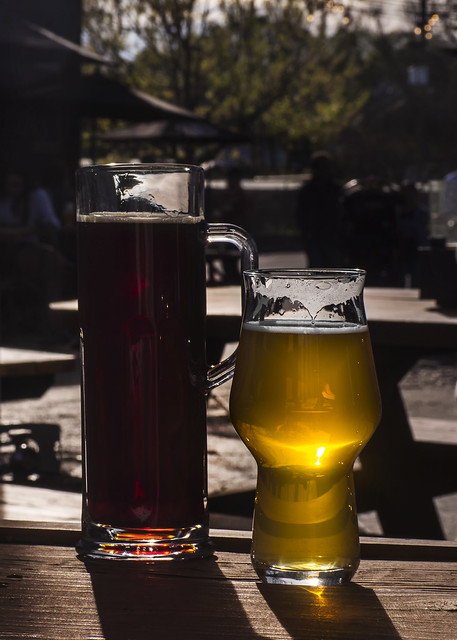
Now, as to those two lovelies...

  • Deathstill (left)
    • "German Style dopplebock." 8% alcohol-by-volume (abv).
    • In Dune —a series of science fiction novels (and films) by writer Frank Herbert and his estate— a deathstill is a "device used to extract all moisture from a living or dead human or creature. This is traditionally done to reclaim precious water from the dead, who no longer require it; but in Children of Dune the device is used as a method of execution."
  • A Night on Ponce (right)
    • "American IPA with Citra, Palisade, and Magnum hops." 7.5% alcohol-by-volume (abv).
    • Ponce de Leon Avenue is a major thoroughfare in Atlanta, named for the eponymous 16th-century Spanish conquistador, who searched for the legendary fountain of youth in Florida. Atlanta natives simply refer to the street as "Ponce."
Both beers brewed by Three Taverns Brewery, in Decatur, Georgia, USA. Both beers enjoyed, al fresco, on the brewery's beer patio, 11 March 2023.

A series of occasional reviews of beer (and wine and spirits).
No scores; only descriptions.

-----more-----

Saturday, September 17, 2022

Pic(k) of the Week: O'zapft is!


O'zapft is! *

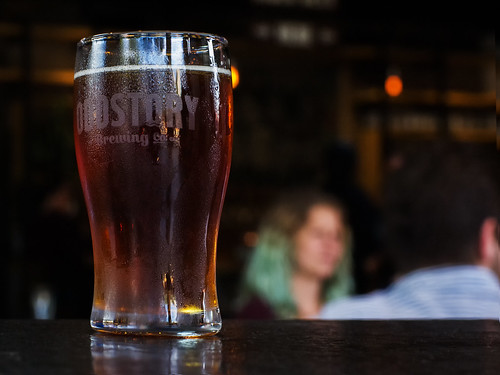
A refreshing draught pint of Oktoberfest lager is served in the beer patio at Odd Story Brewing, in Chattanooga, Tennessee, USA.
Oktoberfest/Marzen lager is a beer rich in malt with a balance of clean, hop bitterness, similar to the Vienna lager. Toasted bread or biscuit-like malt aroma and flavor is to be expected. Originating in Germany, this style was traditionally brewed in the spring (“Marzen” meaning “March”) and aged, or lagered, throughout the summer. A stronger version was served at early Oktoberfest celebrations and became known as Oktoberfest. Today, the festival’s version of an Oktoberfest is quite a bit lighter than what American craft brewers consider an Oktoberfest. 5.1-6% alcohol-by-volume (abv)
Craft Beer.com

***************

Oktoberfest in Munich

After a dry, two-year absence, the 'official' —and original— Oktoberfest returns today to Munich, the capital of the state of Bavaria in Germany. Since 1810 —when Bavarian Crown Prince Ludwig I organized the first Oktoberfest in Munich to celebrate his nuptials with Princess Teresa of the duchy of Saxe-Hildburghausen (now subsumed in the German state of Thuringia)— there only have been only twenty-six occasions on which the Oktoberfest festival has not been held. Of those, the most recent were last year and 2020, both cancellations due to the COVID-19 pandemic. Twice before that, disease also aborted Oktoberfest —in 1854 and 1874— but then because of cholera epidemics.

Munich's Oktoberfest —often referred to as the word's biggest party, with in excess of six million vistors expected— usually runs for sixteen days, counting backward from the first Sunday in October. Since the 1990s, however, if the sixteenth day falls before 3 October (which is the German Unity Day national holiday), the festival continues until and including the 3rd. Thus, this year, Oktoberfest comprises seventeen days: 17 September through 3 October.

Munich's name, by the way, is derived from the Old German term "Munichen," meaning "by the monks," referring to Benedictine monks who founded a monastery in what would later become the city. Trappist monks —a stricter, offshoot of the order— became known in 20th-century Belgium (and, in the 21st-century, elsewhere as well) for their eponymous wine-like ales.

-----more-----

Sunday, December 05, 2021

Ignominy repealed

"Pretty good. Not bad at all!"

Happy Repeal Day!

Eight-eight years ago, today, on 5 December 1933, Utah became the 36th (of 48 states) to ratify the 21st Amendment (3/4 of all states are required by the Constitution to ratify an Amendment) thus nullifying the 18th Amendment and ending America's 13-year ignominious experiment with the Prohibition of alcohol.

Take a moment today to honor the sagacity of those Americans of eighty-eight years ago. Hoist a beer, sip a whisky, or drink a glass of wine. Legally.

Read more at YFGF: here.

-----more-----
Saturday, September 18, 2021

Pic(k) of the Week: Fallen Oktoberfest

Autumn carpet

On 12 October 1810, Ludwig, crown prince of Bavaria, celebrated his wedding to Therese, princess of Saxe-Hildburghausen, with a big party in the capital city of Munich. He celebrated again the following year and each thereafter continuing to do so after even ascending to the Bavarian throne in 1825. Social unrest —including the Bavarian Beer Riots of 1844— ended his reign in 1848 but the beer-drinking and feasting endured. Bavarians and visitors continue to celebrate the annual bacchanal, from mid-September into early October, calling it Oktoberfest.

***************

Fallen Oktoberfest

Since 1810, there have been only twenty-six occasions on which Oktoberfest has not been held. The COVID-19 pandemic accounts for two of those: last year and again this. Only twice before has disease caused the celebrations to be canceled —in 1854 and 1874— on both occasions because of a cholera epidemic.

If Oktoberfest had occurred in Munich this year, it would have begun today, Saturday, 18 September, and concluded sixteen days from now, on Sunday, 3 October, German Unity Day.

***************

Pic(k) of the Week

Someone (maybe even I) once said, "The colors of autumn are the colors of beer."

So, here, to remember a fallen Oktoberfest: an autumn leaves tableau...but taken last year. Autumn here in the Northern Hemisphere won't begin until 22 September, so things haven't quite yet reached THAT point of fallen color!

-----more-----
Saturday, December 05, 2020

Pic(k) of the Week: Delirium trashed!

Delirium trashed!

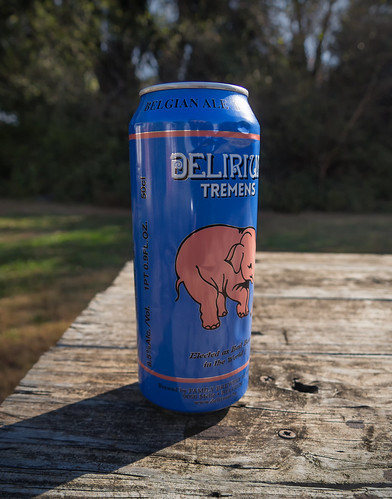
Just as Pabst Brewing continues to milk a blue ribbon it once received for its beer at a long-ago competition, the Huyge Brewery —located near Ghent, Belgium— touts its Delirium Tremens as the "best beer in the world" for one accolade it received in one competition in 2008.

The beer, named for symptoms brought on by alcohol withdrawal, is, fittingly, a strong beer, containing 9% alcohol. More importantly, how does the beer taste?

In his 2005 book, The Great Beers of Belgium, the late, great beer sage Michael Jackson described Delerium Tremens as:
Very bright [golden]. It has a dense head; a very fruity (greengage? gooseberry?) bouquet; a sweetish palate; and a lot of warming alcohol in an abrupt finish.

I didn't pose that empty beer can, by the way. It was already there, emptied of its contents, sitting on the picnic table, as I and the dog walked by on our morning constitutional. There must have been quite the beer party the day before.

-----more-----
Saturday, November 28, 2020

Pic(k) of the Week: Cannons on Tunnel Hill

Cannons on Tunnel Hill

On November 25, 1863, more than 50,000 Union soldiers stormed the Confederate defenses along Missionary Ridge east of Chattanooga. The attack stretched from the Rossville Gap at the Georgia border all the way up to Tunnel Hill at the northern end of Missionary Ridge. By the end of the day the Confederate Army of Tennessee was retreating towards Dalton, Georgia, and Chattanooga was firmly in Union hands. It was, as one Confederate officer later described it, 'The death knell of the Confederacy.'
National Park Service.

Three decades later, in 1890, the Federal government 'reserved' the battle site of the Battle of Missionary Ridge as the nation's first national battlefield park (along with the Battle of Chickamauga, also in Tennessee). It named the Tunnel Hill site the Sherman Reservation Civil War National Military Park after William Tecumseh Sherman, the victorious Union general.

A century and a half later, at sunset, Confederate cannons, now quiescent and inert, still face west, down Tunnel Hill, aimed at downtown Chattanooga, Tennessee, USA.

**************

A beery aside

Beginning soon after the cessation of hostilities of the Civil War in 1865, and accelerating apace during the latter 19th-century, re-industrialization of the re-united nation would be fueled and refreshed (pun intended), in no small measure, by the development of large-scale breweries (particularly of lager beer). Many of these had begun as small-scale provisioners to the armies. Industrial innovation, including refrigeration, would both spur the growth of the breweries and result from it. But that's another story.

-----more-----
Tuesday, May 05, 2020

Cinco de Mild!

It may be Cinco de Mayo —if one less beery and margarita-y than in years past— but it's also día cinco of American Mild Month —if less mildly than in years past.

American Mild Month

Today's tender sensibilities should favor a style called mild, and perhaps they will. the designation refers to mildness of hop character. A mild is gentle, sweetish, certainly not bitter. Some milds are pale in color, but more are tawny or dark.

Mild is an ale intended to be consumed in quantity, more as a restorative than a refresher. It was once a harvest-time drink, a reward for farmworkers.

The style was also popular in areas of thirst-making industry, and [has] retained its strongest loyalties in West Midlands towns.

Mild came to be seen as an old-fashioned style, with a 'cloth cap' image. The darker examples also suffered from the mistaken belief that brews with a full color are necessarily heavier in body or stronger in alcohol. Only when the style had become almost forgotten could a new generation of drinkers rediscover it.
— Michael Jackson
Michael Jackson's Beer Companion
1993

Before the 20th century (and even into it), Mild Ale, in Britain, referred to a non-aged ale, often quite alcoholically strong. But, then, the privations (and the tax privations) of World War I —and the decades thereafter— stood Mild on its head. They transmogrified it into a low alcohol, not bitter, often darker ale...but still a fresh, non-aged one. The decades of the 1960s, 70s, and 80s did further injustice to the drink. Sales and production plummeted. To give it a kick in the pints, the UK's Campaign for Real Ale (CAMRA) began a "Mild May" campaign which continues to this day.

Hampden Mild Ale

***************

American Mild Ale

Alistair Reece is an ex-pat Scotsman and past Prague resident, who lives in Virginia in the U.S., where he blogs at Fuggled. Why, Reece thought, do we not celebrate mild in the U.S.? And so, American Mild Month was born in May 2015.

But, what is an American Mild Ale?

Start with the concept of 'session' beer. Lew Bryson, a long-time fighter for 'session' beer, defines American Session Ale as:
  • 4.5% alcohol by volume or less
  • flavorful enough to be interesting
  • balanced enough for multiple pints
  • conducive to conversation
  • reasonably priced

Now mix in Mild. British beer historians Jessica Bloak and Ray Bailey describe modern British Mild as:
First, it has to put sweet malt and flavours from sugar at the forefront, but that doesn’t have to mean that it has to be sickly or lacking in character. Bitterness can work, but excessive perfume just seems wrong. Roastiness also jars, suggesting that some brewers remain in thrall to out-of-date history that declares mild to be a degeneration of porter, which it isn’t.

And finish it off with an American twist. Mr. Reece limns American Mild as:
A restrained, darkish ale, with gentle hopping and brewed with a clean American yeast strain so that the malt and what American hops are present shine through in the finish, without fruity flavors.
  • Alcohol-content-by-volume (abv) between 3.5% and 4.5%.
  • Color greater than 17 SRM (i.e., darker than a golden ale).
  • Bitterness level of 30 International Bittering Units (IBU) or fewer. Thus, more bitter than an English Mild, but less hoppy than an American pale ale.
  • Neutral American ale yeast strain.

A null definition might help. What American Mild Ale is NOT is a 'session' IPA: it is NOT a hoppy ale. What it is NOT is a beer of greater than 4.5% alcohol. Doing either of those things, and you're playing with 'session' semantics.

But do things right, and Mild Ale — 'more-ish' in flavor while eminently 'drinkable'— becomes a quintessential 'session' beer. Again, Mr. Jackson:
Milds are not bitter beers, but can nevertheless be full of flavor...They are generally low in alcohol...and make good lunchtime drinks. Perhaps this explains their new-found popularity?

Yes, please!

Covidentially, American Mild Month might be more wistfully aspirational this May, rather than actually sloshing in our pints. Nonetheless, it's still 'strongly' Mild Ale. Look for it; plan for it; drink it! And, brew it when you can.

Dark Mild for the win

-----more-----
  • American Mild Month webpage.
  • American Mild Ale defined.
  • Twitter: @MildMonthUS (Use hashtag: #MildMonthUS.)
  • Facebook: AmericanMildMonth.

  • An in-depth examination of modern British Mild Ale, from Jessica Boak and Ray Bailey, at All About Beer: here.
  • Irony notwithstanding, these are the specifications for English Mild Ale, as defined by the [U.S.] Brewers Association.
    A. Subcategory: English-Style Pale Mild Ale
    English Pale Milds are light amber to medium amber. Chill haze is allowable at cold temperatures. Fruity-ester aroma is very low to medium-low. Hop aroma is very low or low. Malt flavor dominates the flavor profile. Hop flavor is very low to low. Hop bitterness is very low to low. Very low diacetyl flavors may be appropriate in this low-alcohol beer. Fruity-ester flavor is very low to medium-low. Body is low to low-medium.
    • Original Gravity (°Plato) 1.030-1.036 (7.6-9.0 °Plato)
    • Apparent Extract/Final Gravity (°Plato) 1.004-1.008 (1.0-2.1 °Plato)
    • Alcohol by Weight (Volume) 2.7%-3.4% (3.4%-4.4%)
    • Bitterness (IBU) 10-20
    • Color SRM 6-9 (12-18 EBC)

    B. Subcategory: English-Style Dark Mild Ale
    English Dark Milds are reddish-brown to very dark. Fruity-ester aroma is very low to medium-low. Malt and caramel are part of the aroma while licorice and roast malt tones may sometimes contribute to aroma profile. Hop aroma is very low. Malt flavor and caramel are part of the flavor profile while licorice and roast malt tones may also contribute. Hop flavor is very low. Hop bitterness is very low to low. Very low diacetyl flavors may be appropriate in this low-alcohol beer. Fruity-ester flavor is very low to medium-low. Body is low-medium to medium.
    • Original Gravity (°Plato) 1.030-1.036 (7.6-9.0 °Plato)
    • Apparent Extract/Final Gravity (°Plato) 1.004-1.008 (1.0-2.1 °Plato)
    • Alcohol by Weight (Volume) 2.7%-3.4% (3.4%-4.4%)
    • Bitterness (IBU) 10-24
    • Color SRM 17-34 (34-68 EBC)

Friday, January 17, 2020

The shameful occurrence one hundred years ago today, 17 January 1920.


One hundred years ago, today, the 18th Amendment to the United States Constitution took effect, on 17 January 1920.

Its issue, National Prohibition, would remain in effect for thirteen years. Beer, wine, and distilled spirits had become unconstitutional.

18th Amendment to the Constitution of the United States of America

Section 1. After one year from the ratification of this article the manufacture, sale, or transportation of intoxicating liquors within, the importation thereof into, or the exportation thereof from the United States and all the territory subject to the jurisdiction thereof for beverage purposes is hereby prohibited.

Section 2. The Congress and the several States shall have concurrent power to enforce this article by appropriate legislation.

Section 3.This article shall be inoperative unless it shall have been ratified as an amendment to the Constitution by the legislatures of the several States, as provided in the Constitution, within seven years from the date of the submission hereof to the States by the Congress.

Prohibition actually had passed a year earlier, on 16 January 1919, when the Nebraska legislature became the 36th state to approve the amendment, satisfying the Constitution's 2/3-of-the-states requirement. The amendment's wording mandated a year's delay until implementation. Praise be to the enlightened citizens of Connecticut and Rhode Island: their states were the only to vote nay.

To this day, the 18th Amendment remains the only amendment to the Constitution that eliminates rights. It did not, however, prohibit the drinking of "intoxicating beverages," 'merely' their manufacture, inter-state distribution, and sale. In its collective wisdom, Congress, authorized by section 2, defined an intoxicating beverage as anything containing in excess of one half of one percent alcohol by volume. That was, of course, just enough.

Prohibition would not be repealed until 5 December 1933, with the adoption of the superseding 21st Amendment.

Who or what was responsible? Distilling an answer might be reductive sociology, but four movers stand above the others: the alcohol industry itself, the Women's Christian Temperance Union, The Anti-Saloon League, and the 16th Amendment.

About the last, first. Since the Civil War, the federal government had been growing hand-in-hand with a bourgeoning population. Revenue from excise taxes and other fees had become insufficient. The 16th Amendment, ratified in 1916, constitutionalized the income tax, which up to that time, the Supreme Court had repeatedly disallowed. Its passage made excise taxes less integral. (Were that viewpoint as sanguine today!)

The temperance movement had been growing in strength for a hundred years, especially so in the early 20th-century. Its proponents laid crime, health problems, spousal abuse, and other social ills at the feet of the alcohol industry, which —with such as 'gin joints'— was far from blameless. And the beer industry, seeing beer as indeed the beverage of temperance —that is, not of prohibition but of moderation— did little, and too late, to stem the tide.

But maybe the arch-villain of the story is Wayne Wheeler, president of the Anti-Saloon League. Single-minded in his crusade against alcoholic beverages, Wheeler became, at one point, powerful enough to influence national elections. He was to alcohol as the virulently racist Harry Anslinger later was to marijuana.

The Woman's Christian Temperance Union continues today, albeit in more quiescent form. The Anti-Saloon League also survives, but now known more politely as the American Council on Alcohol Problems. And income tax? Well, you know that story.

-----more-----

Thursday, December 05, 2019

On this date in American history, it once again became legal to sell intoxicating beverages.

Prohibition Repealed!

A prohibitionist is the sort of man one couldn't care to drink with,
even if he drank.
— Henry Louis (H.L.) Mencken

Eighty-six years ago, today —on 5 December 1933 (at 5:32 pm ET)— the state of Utah voted to approve the 21st Amendment to the Constitution of the United States of America, its decision fulfilling the requisite number of states and thus terminating the ignoble, nearly 14-year reign, of the 18th Amendment, Prohibition.

Some might find it ironic that Utah of all states —with its widespread latter-day teetotalling— would vote to ALLOW alcohol. On closer examination, it may have been logically sagacious of that state to repudiate the 18th amendment, the ONLY amendment to eradicate constitutional rights rather than creating, affirming, or clarifying them.

After Utah's vote, two more states would vote to ratify. Six states (excluding Alaska and Hawaii, which were not states at that time) would never bother to vote on the amendment. But alone among all the states of the nation, only South Carolina, deserving of ignominy, voted against repeal.

-----more-----

Friday, February 01, 2019

Happy Brewsters' Day!

Happy Brewsters' Day! (1 February)
I should like a great lake of ale, for the King of the Kings. I should like the family of Heaven to be drinking it through time eternal.
— Opening line of a poem attributed to Saint Brigid of Kildare

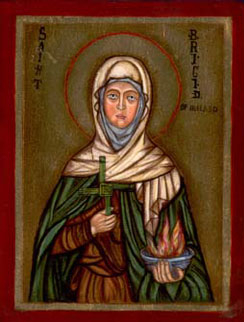
On 1 February, the Catholic Church celebrates the feast day of Saint Brigid of Kildare (c. 451 – 525 AD): a patron saint of brewers and one of three patron saints of Ireland (in league with Saints Patrick and Columba). Brigid herself was a brewer: one miracle attributed to her was turning (bath) water into beer, a gift she has since bequeathed to many brewsters and brewers alike (if without that spritz of sitz).
"Probably the best known Irish saint after Patrick is Saint Brigid (b. 457, d. 525). Known as 'the Mary of the Gael,' Brigid founded the monastery of Kildare, in Ireland. She was a generous, beer-loving woman, known for her spirituality, charity, and compassion.

Brigid worked in a leper colony which once found itself without beer. "For when the lepers she nursed implored her for beer, and there was none to be had, she changed the water, which was used for the bath, into an excellent beer, by the sheer strength of her blessing and dealt it out to the thirsty in plenty."

She also is reputed to have supplied beer out of one barrel to eighteen churches, which sufficed from Maundy Thursday [Holy Thursday] to the end of paschal time [52 days]. Obviously, this trait would endear her to many a beer-lover.
— Via the Brews Brothers: "Saints of Suds (When The Saints Go Malting In)."

-----more-----

Friday, November 09, 2018

The first autobiography in English was written by a brewster.

14th century brewer Margery Kempe: the English language's first autobiographer

On this day (9 November) the Anglican Community honors Margery Kempe (c. 1373 – 1438): a brewster *, grain-miller, Christian mystic, and the English language's first autobiographer.

Kempe wrote the "The Book of Margery Kempe," chronicling her domestic tribulations, her extensive pilgrimages to holy sites in Europe and the Holy Land, and her mystical conversations with God. The book is generally considered to be the first autobiography written in the English language.

Although the Church of England honors Margery Kempe today, the U.S. Episcopal Church does so earlier in the year, on 28 September. And the Catholic Church has never designated her a saint.

-----more-----

Sunday, December 24, 2017

Merry Christmas, with beer.

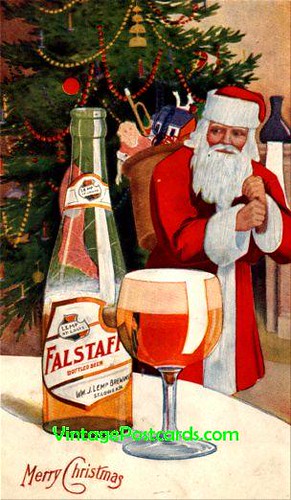
Merry Christmas from Falstaff

Leave a beer out tonight for ol' Saint Nick!

Šventų Kalėdų to all!

-----more-----

Friday, December 22, 2017

Porter: the drink that launched thousands of ships.

And if [the pint of Plain] is all drawn properly, the way it should be done, then the [contented] cream is borne majestically above to form the clerical collar that proves the goodness in its heart. And the true porter drinker would look upon such a glass with great reverence, indeed.


A brewer in Virginia, USA, recently posted a dark lament to Facebook.
"IPA, IPA, IPA! I think it's time that 'real beer' drinkers and brewers (not the Instagrammers and Untappd abusers) take beer back. When was the last time anyone saw a brown ale or a porter or stout that wasn't flavored or imperial? There is nothing quite like a nice, unflavored porter. DARK BEERS MATTER!"

A few days later, it just so happened, British beer authors Jessica Boak and Ray Bailey —in their eponymous blog's year-end list of top beer tweets— linked to a tweet from the archives of the British Broadcasting Corporation.

At the end of April 1973, then-Irish brewing company Guinness ceased production of all its porter. A few days later, on 11 May 1973, BBC presenter Larry McCoubrey drank one of the last draught pints to be had. As the BBC tweeted on 11 May 2017, the forty-fourth anniversary of that Belfast broadcast:
Larry McCoubrey's panegyric to porter was pure pub poetry. Pint of plain, please, publican.

Yes, brew (more) Porters again. Yes, make (more) beers dark again! Malted serendipity, indeed.


[A grandfather clock can be heard ticking.]

Porter, an old established tradition in Irish drinking history. Why, we've even got songs about it.

[Folk-singer sings.]
If you want your child to grow,
Your child to grow,
Your child to grow,
If you want your child to grow,
Give him a jar of porter.
Sing Toora loora loora lay,
Toora loora loora lay.
Sing Toora loora loora lay,
Give him a jar of porter.


It's an acquired taste, of course. But, at least, it comes easier than the bitter thickness of stout. But just as England produced beer that was mild and bitter, so we developed porter and stout. This is the 'mild.' "Plain" they call it. You would always call for a pint of Plain. That was just part of the mystique that grew up around this drink.

The more essential part of it was the way in which it was drawn. Barmen could rise and fall on their ability to draw a pint of Plain.

You see, it's drawn from two barrels. A high one, first, to give it a bit of life. A good glass full of gushing good cheer that settles slowly towards the bottom of the glass into a thick, contented cream.

It takes several minutes for that cream to substantiate towards the bottom of the glass, when it's ready for the muscle and the sinew, the real body of the drink itself. And that comes from the other barrel...of flat.

And if it's all drawn properly, the way it should be done, then the cream is borne majestically above to form the clerical collar that proves the goodness in its heart. And the true porter drinker would look upon such a glass with great reverence, indeed.

If work was the curse of the drinking classes, then porter was their salvation.

And, yet, you know, it was not the traditional drink of Ireland the disciples would have you believe. This was a city drink; there were definite centers for it. It was the liquid lunch of countless working men in Dublin, and Derry, and in Belfast, where the shipyard drew most of its strength from the dark substance.

It was the drink that waited for the men as the horn blew in the evening and pubs up in Newtownards rolled around the station and up Ann Street, Short Strand, the pints of plain used to be standing in rows on the counter, waiting for the onslaught from the yard.

Used to be...for pubs progressed. Bottle beer broke through; gin and tonic took over; and porter became impolite. Lately, there have been less than a hundred pubs in Ireland selling it.

And, now, these are probably the last pints of Plain you'll probably ever see in Belfast. For on the thirtieth of April 1973, they stopped making it altogether.

This was more than a way of drinking. This really was a way of life. Porter: the drink that launched thousands of ships.

[A grandfather clock ticks...and then stops.]

-----more-----

Thursday, November 02, 2017

Hops. Martin Luther's 96th Thesis?

In as much that notions of historical causality can be stretched thin, it's still fun to conjecture about the effect of any one man or woman upon history's arc. And beer's history.


Martin Luther's 95 Theses of 1517 sparked the partial dissolution of the Catholic Church in Europe. That schism, it could be argued, freed brewers in proto-Protestant Europe to use additives other than those Church-decreed. One of those, the herb, hops, went on to displace the Church's spice mixture —gruit— in brewers' beers. That switch may have happened without Luther, but what came of his hammering in the Wittenberg church door, the Reformation, nurtured it.

Thus, the other Reformation! How Martin Luther, five hundred years ago this week, helped to change our beer.
[On 31 October 1517], an obscure Saxon monk launched a protest movement against the Catholic Church that would transform Europe. Martin Luther's Protestant Reformation changed not just the way Europeans lived, fought, worshipped, worked and created art but also how they ate and drank. For among the things it impacted was a drink beloved throughout the world and especially in Luther's native Germany: beer. [...]

In the 16th century, the Catholic Church had a stranglehold on beer production, since it held the monopoly on gruit — the mixture of herbs and botanicals (sweet gale, mugwort, yarrow, ground ivy, heather, rosemary, juniper berries, ginger, cinnamon) used to flavor and preserve beer. Hops, however, were not taxed. Considered undesirable weeds, they grew plentifully and vigorously — their invasive nature captured by their melodic Latin name, Humulus lupulus (which the music-loving Luther would have loved), which means "climbing wolf." [...]

Even before the Reformation, German princes had been moving toward hops — in 1516, for instance, a Bavarian law mandated that beer could be made only with hops, water, and barley. But Luther's revolt gave the weed a significant boost. The fact that hops were tax-free constituted only part of the draw. Hops had other qualities that appealed to the new movement; chiefly, their excellent preservative qualities. [...]

If the Catholic Church lost control over the printed word with the invention of the printing press — the technological weapon that ensured Luther's success — it lost control over beer with the rise of hops. "The head went flat on monastic beer," says William Bostwick [the beer critic for The Wall Street Journal and author of 'The Brewer's Tale: A History of the World According to Beer.'] 'Did Protestantism explicitly promote hops? I don't think so. But did it encourage the use of hops? I would say, yes, probably.' [...]

Luther would have relished his role in promoting hops. If anyone loved and appreciated good beer, it was this stout, sensual and gregarious monk. His letters often mentioned beer, whether it was the delicious Torgau beer that he extolled as finer than wine or the 'nasty' Dessau beer that made him long for Katharina's homebrew. 'I keep thinking what good wine and beer I have at home, as well as a beautiful wife,' he wrote. 'You would do well to send me over my whole cellar of wine and a bottle of thy beer.'
Read the rest of the story —here— written by freelance journalist Nina Martyris, for The Salt, the food 'page' of National Public Radio.

Finally, it bears reiteration that Martin Luther himself was a regular drinker of beer and its hearty espouser. Katharina von Bora, his wife, was an accomplished brewster. Then and five hundred years later: thank you and amen!
I opposed indulgences and all the papists, but never with force. I simply taught, preached and wrote God’s Word; otherwise I did nothing. And while I slept, or drank Wittenberg beer with my friends Philip [Melanchthon] and [Nicholas] Amsdorf, the Word so greatly weakened the papacy that no prince or emperor ever inflicted such losses upon it. I did nothing; the Word did everything.

-----more-----

Wednesday, November 01, 2017

Virginia bans alcohol.

101 years ago, today, on 1 November 1916, the Mapp Act became law in Virginia: alcoholic beverages were prohibite and the entire state went dry. For the rest of the country, National Prohibition —under the 18th Amendment to the Constitution— would not take effect until 17 January 1920.

Although Virginia established statewide prohibition through a popular referendum, it nonetheless faced several challenges in enforcing the new law. Its long coastline made it difficult to prevent smuggling, i.e. rum-running. It bordered on a wet state, Maryland, which made barely an effort to enforce national dry laws from 1920-1933. Virginia contained several cities which were reluctantly dry, most notably Alexandria, Richmond, and Norfolk. In addition, Virginia had a long-established moonshining tradition in the mountainous western part of the state. As a result, Virginia struggled to live up to the dry ideal it set for itself in 1916.

[...] The referendum on state-wide prohibition [with two simple choices, “For State-Wide Prohibition” and “Against State-Wide Prohibition”] passed, on 2 September 1914 by a vote of 94,251 in favor and 63,886 opposed. Of Virginia’s 100 counties, 71 voted in favor of prohibition. Eight of the ten congressional districts went dry, and one of the remaining two was wet by only ten votes. Surprisingly, sixteen of the state’s twenty cities also voted in favor of going dry. Traditionally cities were strongholds of wet votes. However, only Arlington, Norfolk, Williamsburg, and Richmond stayed wet.Accordingly, following the referendum, the Virginia legislature quickly passed a prohibition law, called the Mapp Law after state Senator Walter Mapp of Accomack County, making the entire state dry as of midnight, the morning of November 1, 1916. [...]The Mapp law defined “ardent spirits” as “alcohol, brandy, whiskey, rum, gin, wine, porter, ale, beer, all malt liquors, absinthe, and all compounds or mixtures of any of them.” The phrase “all malt liquors” was worded to include both intoxicating and non-intoxicating drinks made of malt.

The new dry law closed numerous distillers, six breweries, as well as several hundred saloons, in addition to taking away business from bottling companies and distributors. Breweries and distillers were allowed to stay in business so long as they sold their product out of state. Five of the six Virginia breweries stayed open until 1918. Only Robert Portner’s in Alexandria closed immediately.

[...] Virginia shares the Chesapeake Bay with Maryland, and the bay seemed as if it were designed for smuggling with its many small islands, coves and inlets. Norfolk had been wet during the referendum and remained a popular spot for smugglers to import alcohol. Finally, Virginia had a long-standing tradition of moonshining, especially in the western mountains, an area which traditionally resented Richmond’s control. Moonshiners found that prohibition furnished an even larger market for their product.
—Mark Benbow of RustyCans.org, as published in the winter 2010-2011 issue of Brewery History

Seventeen years later, on 3 October 1933, Virginia voters would vote to end statewide prohibition. A few weeks later, on 25 October, a state convention would ratify the 21st amendment to the U.S. Constitution, repealing Prohibition, making Virginia the 32d state to do so. The amendment would take effect less than two months later, on 5 December. A few months after that, on 7 March 1934, Virginia's Department of Alcoholic Beverage Control would be established.

And so it goes.

-----more-----

Sunday, October 29, 2017

Cask advice for 2017...from 1850.


In 1765, the Swan Brewery began brewing in London. It would continue doing so for an additional one hundred seventy-one years until 1936, when the Ind Coope/Samuel Allsopp & Sons brewing consortium purchased the brewery ... and promptly closed it.

But nearly a century earlier, in 1850, when The Swan was still going strong, it published a pamphlet for the trade that described its brewing procedures and its beers, and offered advice on how to properly care for them. Included was a short passage on cask cellarmanship. It was sensible advice then and remains so now, nearly two centuries later.

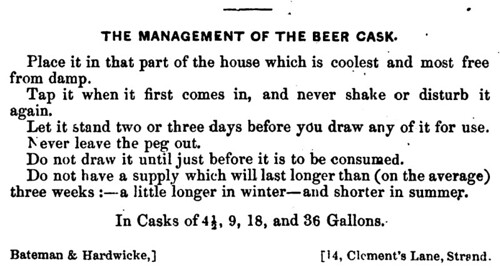
The Management of the Beer Cask (1850)
The Management Of The Beer Cask
  • Place it in that part of the house which is coolest and most free from damp.
  • Tap it when it first comes in, and NEVER SHAKE OR DISTRUB IT AGAIN [emphasis mine].
  • Let it stand two or three days before you draw any of it for use.
  • Never leave the peg out.
  • Do not draw it until just before it is to be consumed.
  • Do not have a supply which will last longer than (on the average) three weeks: —a little longer in winter— and shorter in summer.
—"The Proprietors of the Swan Brewery, Walham Green, Fulham - (Established 1765) - Beg to Present These Pages on Beer and Brewing; and Will Feel Honoured by Their Acceptence and Perusal."
1850

Note the cask sizes mentioned: 4.5, 9 (firkin), 18, and 36 gallons. Swan, of course, listed them in Imperial (U.K.) measure. Translating to U.S. volumes, they would be, respectively: 5.4, 10.8 (firkin), 36, and 72 gallons.

The short pamphlet also discussed the clarification of cask ale, i.e, the fining of casks.

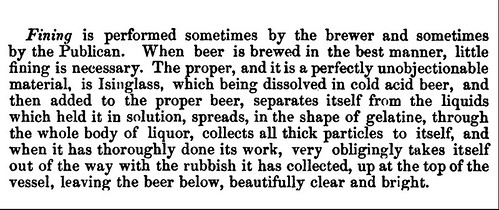
The Fining of Cask Ale (in 1850)
Fining is performed sometimes by the brewers and sometimes by the Publican. When beer is brewed in the best manner, little fining is necessary. The proper, and it is perfectly unobjectionable material is Isinglass, which being dissolved in cold acid beer, and then added to the proper beer, separates itself from the liquids which held it in solution, spreads, in the shape of gelatine, through the whole body of liquor, collects all thick particles to itself, and when it has thoroughly done its work, very obligingly takes itself out of the way with the rubbish it has collected, up at the top of the vessel, leaving the beer below, beautifully clear and bright.


Ah, but what is the "perfectly unobjectionable material," isinglass? Here, from the The Oxford Companion to Beer (2012):
Isinglass is derived from the swim bladders of certain tropical and subtropical fish. [...] Traditionally, isinglass for brewing purposes was derived from sturgeon, although modern commercial isinglass is more typically derived from tropical estuarine dwellers. [...] When used as a fining agent, [isinglass] has the ability to settle yeast and beer proteins very quickly and can do so repeatedly. This latter property is essential for cask-conditioned ales, where the casks may be moved several times prior to serving.

Many cellarmen in 21st-century U.S. have switched from the use of isinglass to non-animal-derived agents for clarifying cask ales. Others rely on gravity and time and/or rapidly-settling yeast strains.

But many others, sad to say, when it comes to cask quality, isinglass or no isinglass, couldn't give a f care less.

Fobbing at the Tut

Fobbing at the Tut:
A series of occasional posts on good cask cellarmanship.


-----more-----

Thursday, May 25, 2017

"Ice cold beer lacks the exhilarating effect."

The Wahl-Henius Institute was a brewing research laboratory and school in Chicago that operated between 1886 and 1921. Founded in 1886 by Dr Robert Wahl and Dr Max Henius as the Wahl & Henius, the name was changed to the Scientific Station for Brewing of Chicago and then to the Institute of Fermentology before becoming the Wahl-Henius Institute. Its educational division, the American Brewing Academy, was created in 1891. The school and laboratory operated successfully until Prohibition, when the near dissolution of the brewing trade forced its closure and sale to the American Institute of Baking, which retains the nucleus of the Wahl-Henius library.

The Wahl-Henius Handy Book of Brewing, Malting and the Auxillary Trades, coauthored by Wahl and Henius [in 1901], is a comprehensive and wide-ranging view into American brewing [of the time]. It also contains basic chemical analyses of many contemporary American and European beers, providing an unusually valuable window into the brewing past.
—Randy Mosher ( Craft Beer & Brewing Magazine).

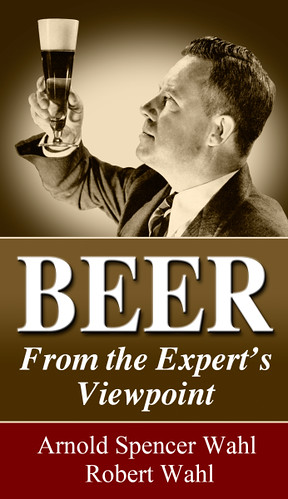
After the repeal of Prohibition in 1933, Robert Wahl and his son, Arnold Spencer Wahl, re-opened the school, but without Max Henius. In 1937, they published Beer From the Expert's Viewpoint, "the first book of what was intended to be a four-volume set designed to educate a new generation of American brewmasters." The elder Wahl died later that year and the school would close soon thereafter.

In 2014, BeerBooks (of Cleveland, Ohio) reprinted Beer From the Expert's Viewpoint. The copyright remains in the family, held now by Roger Wahl.

Beer From the Expert's Viewpoint


**************

Ice cold beer has no flavor or taste.

Among much that is fascinating (and much still valid) in the Wahls' book, here is some "exhilarating" wisdom it imparted. Eighty years on, this advice is often disdained.
Ice cold beer has no flavor or taste. The intense cold does not permit the natural flavor of the beer to become volatile and only what is volatile can be discerned as a flavor. The intense cold benumbs the taste nerves and consequently, the taste of such beer is insipid.

When a stein of beer is taken in one gulp, as is often done, it lies in the stomach like ice, chilling the nerves of the stomach that control digestion. The beer remains ice cold in the stomach until it is gradually warmed up sufficiently so that the digestive processes can begin.

The brewer, in order to have his beer effervesce properly even though ice cold, charges the beer too heavily with carbonic gas, so that, when the beer finally warms up in the stomach, it gives off this surplus gas rapidly, causing bloating or belching. Of course, this beer lacks the exhilarating effect.

Heed that advice. Protect yourself and your beer. Prevent bloating and belching. Don't drink beer ice-cold. Don't be insipid. Be exhilarated.

-----more-----

Sunday, April 02, 2017

Bonus Pic(k) of the Week: Vin Scully in Brooklyn.

Vin Scully in Brooklyn
It's time for Dodger baseball! Hi, everybody, and a very pleasant good afternoon to you, wherever you may be.

When Vin Scully retired last year, 2 October 2016, at age 88, he had broadcast Dodgers baseball games for 67 years, the longest span for any broadcaster with a single team in professional sports history.

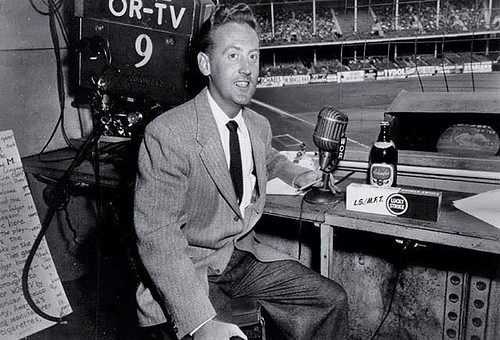
Mr. Scully began broadcasting the Dodgers' games in 1950, when the team was still playing in Brooklyn, New York, New York. In this 1950s photo of Mr. Scully in his Ebbett's Field broadcast booth in Flatbush, Brooklyn, a bottle of Schaefer Beer sits next to a carton of Lucky Strike cigarettes). Sponsor product placement!

In 1958, the Dodgers decamped to Los Angeles, California, and Mr. Scully followed. Two years later, Ebbets Field was razed and replaced by apartment buildings.

With Mr. Scully retired, Opening Day will never again be so mellifluous. But it's baseball today, and we can all hope that maybe, just maybe —to paraphrase Mr. Scully's famous call of Kirk Gibsons' 1988 World Series home run— in a year that is improbable, the impossible may happen.

It's a bonus Pic(k) of the Week on this magnificent Sunday. Play ball!

-----more-----

Saturday, February 04, 2017

Pic(k) of the Week: Schlitz vs. Michelob, LIVE during the Super Bowl

The 1981 live Great American Taste Test (Super Bowl XV)

During the broadcast of Super Bowl LI (that is, the 51st Super Bowl) tomorrow, both Snickers and Hyundai will air commercials that have been filmed live. I'm not clear on what advantage is accrued by filming a commercial three days earlier (Snicker) or a few minutes earlier (Hyundai) and broadcasting it as 'live.' The thrill of not editing, perhaps?

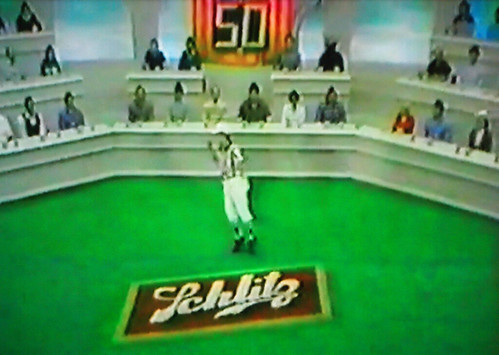
The last time the Super Bowl has actually featured a 'live,' not pre-recorded and edited, commercial, was 1981, during Super Bowl XV (15). Broadcast live from New Orleans, the host city of that year's championship game, Schlitz Brewing ran "The Great American Beer Test," a 60-second taste test of its flagship beer vs. Michelob, brewed by Anheuser-Busch.

The 1981 live Great American Taste Test (02)

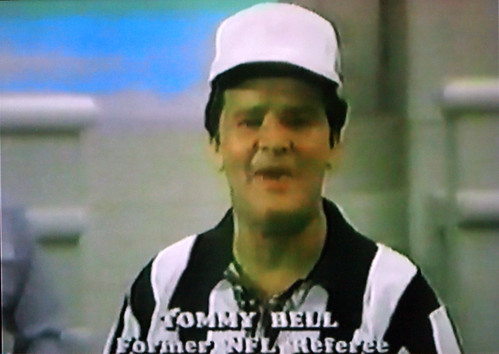
The spot was hosted by Tommy Bell, a former NFL referee dressed in referee zebra stripes. Before the broadcast, one-hundred "loyal Michelob drinkers." had sampled Schlitz and Michelob in unmarked ceramic beer steins. When the commercial went live, each pulled a lever to indicate their preference.

Part of the appeal of a live broadcast is the spontaneity; the anticipation of an unedited gaffe or unintended serendipity. When Mr. Bell explained the voting procedure, he did well, obviously well-rehearsed, except on one occasion. Hilariously, he seemed to verbally stumble, to hesitate, when saying "Schlitz," his sponsor, having no such difficulty saying "Michelob."

As the commercial concluded, an electronic football scoreboard tallied the result, and Mr. Bell announced it. Fifty of those one-hundred Michelob drinkers had preferred Schlitz. A tie.

In the game, the Oakland Raiders defeated the Philadelphia Eagles, 27-10.

But five months after the game, Schlitz would close its Milwaukee brewery, forced to so by a continuing downward spiral in sales, never recovering from a very public cheapening of ingredients and change of process. The following year, the entire company would be sold to Stroh Brewing, and "the beer that made Milwaukee famous," brewed since 1849, was no more.

Schlitz sold today is brewed by Molson Coors for Pabst, itself a brewery without any brewing facilities.


-----more-----