Showing posts with label beer style. Show all posts

Saturday, July 12, 2025

Pic(k) of the Week: Halfway Crooks' draught "Farina"

Halfway Crooks' draught Farina
Click on the image for a larger, hi-res version (on Flickr).

"Farina": a delightfully delicate 'Kölsch-style' beer brewed by Halfway Crooks Brewery (in Atlanta, Georgia, USA).

Here, served on draught (in its own glassware!), at the Brick Store Pub in Decatur, Georgia, USA, on 24 May 2025.

"Farina" is a top-fermenting lager brewed with German pilsner malt, hops sourced directly from Seitzfarm in Bavaria, a classic Kölsch yeast, Atlanta water. Notes of white wine, pear, German pilsner malt, floral German hops, and a refreshing dry finish. 4.8% ABV [alcohol-by-volume]
— Halfway Crooks
Light herbal, earthy aromas. Mild bitterness, moderate spicy, earthy hop flavors, then some light white-grape acidity. Subdued soft fruit esters come out in the middle. Nicely balanced sweetness and bitterness.
— Craft Beer & Brewing


***************

What is Kölsch (-style beer)?

1) Kölsch has the pale color of a fine Pilsner but the fruitiness of a fine ale. It has an aromatic bitterness and noticeable hop character, is well-fermented [like an ale], but is lagered cold for 14-40 days. Kölsch is properly served in a tall, narrow, straight-sided 200-ml (6.8 US fl oz) glass about 5 inches (13 cm) tall, at 55 °F (13 °C), with a pale white collar about an inch deep.

Kölsch is defined by German law as top-warm-fermented and cold-aged, with an alcohol content of 4.4 to 4.9 percent by volume. Also by German law, the beer must be brewed from Pilsner and Vienna malts, but may also contain up to 20% wheat malt.
— Encyclopedia of Beer (1995). Christine Rhodes, Thomas Bedell, Fred Eckhardt, et al.
2) Since 1997, the term 'Kölsch' has had a protected geographical indication (PGI) within the European Union, indicating a beer that is made within 50 km (31 mi) of the city of Cologne (Köln) and brewed according to the Kölsch Konvention as defined by the members of the Cologne Brewery Association (Kölner Brauerei-Verband).
— Wikipedia.

***************

A series of occasional reviews of beer (and wine and spirits).
No 'scores'; only descriptions.

-----more-----

Saturday, July 09, 2022

Pic(k) of the Week: Beer bubbles, closeup

And now for something completely different...
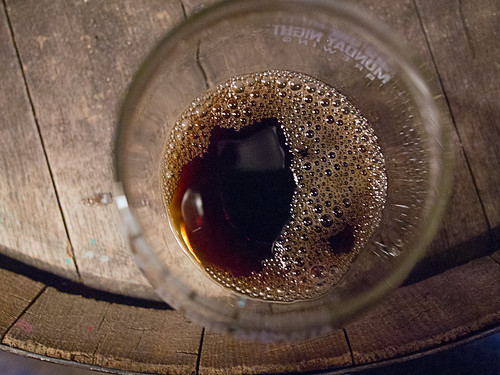
A close-up of beer-foam bubbles in a (non-hazy) IPA.

Beer bubbles closeup

I poured the beer in a straight-edged glass and set it outdoors (hence the green visible in the background). No beer was harmed —or wasted— during the shoot.

-----more-----

Saturday, May 09, 2020

Pic(k) of the Week: Zwickel-Teasing

Mad Mild (03)

Zwickel is the German word for a type of stainless steel valve designed for taking samples [from] enclosed containers, possibly under pressure. [...] The Zwickel cock is built with a highly sanitary design and is generally found on bright beer tanks and uni-vessels.
— The Encyclopedia of Beer (1995)

'Zwickel-teasing' is a euphemism for taking a sample large enough for, uh, quaffing.

In the photo, a brewer was zwickel-teasing a 'Mild Ale' from a fermenting/conditioning vessel. He offered me the 'sample' to taste. I accepted.

May is American Mild Month, the sixth such iteration of this nationwide celebration. I've written about that: here.

-----more-----

Tuesday, May 05, 2020

Cinco de Mild!

It may be Cinco de Mayo —if one less beery and margarita-y than in years past— but it's also día cinco of American Mild Month —if less mildly than in years past.

American Mild Month

Today's tender sensibilities should favor a style called mild, and perhaps they will. the designation refers to mildness of hop character. A mild is gentle, sweetish, certainly not bitter. Some milds are pale in color, but more are tawny or dark.

Mild is an ale intended to be consumed in quantity, more as a restorative than a refresher. It was once a harvest-time drink, a reward for farmworkers.

The style was also popular in areas of thirst-making industry, and [has] retained its strongest loyalties in West Midlands towns.

Mild came to be seen as an old-fashioned style, with a 'cloth cap' image. The darker examples also suffered from the mistaken belief that brews with a full color are necessarily heavier in body or stronger in alcohol. Only when the style had become almost forgotten could a new generation of drinkers rediscover it.
— Michael Jackson
Michael Jackson's Beer Companion
1993

Before the 20th century (and even into it), Mild Ale, in Britain, referred to a non-aged ale, often quite alcoholically strong. But, then, the privations (and the tax privations) of World War I —and the decades thereafter— stood Mild on its head. They transmogrified it into a low alcohol, not bitter, often darker ale...but still a fresh, non-aged one. The decades of the 1960s, 70s, and 80s did further injustice to the drink. Sales and production plummeted. To give it a kick in the pints, the UK's Campaign for Real Ale (CAMRA) began a "Mild May" campaign which continues to this day.

Hampden Mild Ale

***************

American Mild Ale

Alistair Reece is an ex-pat Scotsman and past Prague resident, who lives in Virginia in the U.S., where he blogs at Fuggled. Why, Reece thought, do we not celebrate mild in the U.S.? And so, American Mild Month was born in May 2015.

But, what is an American Mild Ale?

Start with the concept of 'session' beer. Lew Bryson, a long-time fighter for 'session' beer, defines American Session Ale as:
  • 4.5% alcohol by volume or less
  • flavorful enough to be interesting
  • balanced enough for multiple pints
  • conducive to conversation
  • reasonably priced

Now mix in Mild. British beer historians Jessica Bloak and Ray Bailey describe modern British Mild as:
First, it has to put sweet malt and flavours from sugar at the forefront, but that doesn’t have to mean that it has to be sickly or lacking in character. Bitterness can work, but excessive perfume just seems wrong. Roastiness also jars, suggesting that some brewers remain in thrall to out-of-date history that declares mild to be a degeneration of porter, which it isn’t.

And finish it off with an American twist. Mr. Reece limns American Mild as:
A restrained, darkish ale, with gentle hopping and brewed with a clean American yeast strain so that the malt and what American hops are present shine through in the finish, without fruity flavors.
  • Alcohol-content-by-volume (abv) between 3.5% and 4.5%.
  • Color greater than 17 SRM (i.e., darker than a golden ale).
  • Bitterness level of 30 International Bittering Units (IBU) or fewer. Thus, more bitter than an English Mild, but less hoppy than an American pale ale.
  • Neutral American ale yeast strain.

A null definition might help. What American Mild Ale is NOT is a 'session' IPA: it is NOT a hoppy ale. What it is NOT is a beer of greater than 4.5% alcohol. Doing either of those things, and you're playing with 'session' semantics.

But do things right, and Mild Ale — 'more-ish' in flavor while eminently 'drinkable'— becomes a quintessential 'session' beer. Again, Mr. Jackson:
Milds are not bitter beers, but can nevertheless be full of flavor...They are generally low in alcohol...and make good lunchtime drinks. Perhaps this explains their new-found popularity?

Yes, please!

Covidentially, American Mild Month might be more wistfully aspirational this May, rather than actually sloshing in our pints. Nonetheless, it's still 'strongly' Mild Ale. Look for it; plan for it; drink it! And, brew it when you can.

Dark Mild for the win

-----more-----
  • American Mild Month webpage.
  • American Mild Ale defined.
  • Twitter: @MildMonthUS (Use hashtag: #MildMonthUS.)
  • Facebook: AmericanMildMonth.

  • An in-depth examination of modern British Mild Ale, from Jessica Boak and Ray Bailey, at All About Beer: here.
  • Irony notwithstanding, these are the specifications for English Mild Ale, as defined by the [U.S.] Brewers Association.
    A. Subcategory: English-Style Pale Mild Ale
    English Pale Milds are light amber to medium amber. Chill haze is allowable at cold temperatures. Fruity-ester aroma is very low to medium-low. Hop aroma is very low or low. Malt flavor dominates the flavor profile. Hop flavor is very low to low. Hop bitterness is very low to low. Very low diacetyl flavors may be appropriate in this low-alcohol beer. Fruity-ester flavor is very low to medium-low. Body is low to low-medium.
    • Original Gravity (°Plato) 1.030-1.036 (7.6-9.0 °Plato)
    • Apparent Extract/Final Gravity (°Plato) 1.004-1.008 (1.0-2.1 °Plato)
    • Alcohol by Weight (Volume) 2.7%-3.4% (3.4%-4.4%)
    • Bitterness (IBU) 10-20
    • Color SRM 6-9 (12-18 EBC)

    B. Subcategory: English-Style Dark Mild Ale
    English Dark Milds are reddish-brown to very dark. Fruity-ester aroma is very low to medium-low. Malt and caramel are part of the aroma while licorice and roast malt tones may sometimes contribute to aroma profile. Hop aroma is very low. Malt flavor and caramel are part of the flavor profile while licorice and roast malt tones may also contribute. Hop flavor is very low. Hop bitterness is very low to low. Very low diacetyl flavors may be appropriate in this low-alcohol beer. Fruity-ester flavor is very low to medium-low. Body is low-medium to medium.
    • Original Gravity (°Plato) 1.030-1.036 (7.6-9.0 °Plato)
    • Apparent Extract/Final Gravity (°Plato) 1.004-1.008 (1.0-2.1 °Plato)
    • Alcohol by Weight (Volume) 2.7%-3.4% (3.4%-4.4%)
    • Bitterness (IBU) 10-24
    • Color SRM 17-34 (34-68 EBC)

Saturday, January 04, 2020

Pic(k) of the Week: Cream Ale for the New Year.

From the Facebook archives:

Them ---> [This beer] Literally [sic] tastes like a green sweet tart [sic] in liquid form.

Me ---> Even better: Eat a sweet-tart and drink a beer-flavored beer!

Them ---> Good idea! OR let everyone enjoy what they like and you drink what you like.

Me ---> OR realize that such relativism is always implied in anyone's organoleptic perception and thus when commented upon, a recursive exercise.

Or, in other words, every opinion is a winner except, if you disagree, yours. But how quickly I forget.

For New Year's Eve 2019/2020, a friend surprised me with Spotted Cow —a bottle-conditioned cream ale (an indigenous American beer style) from New Glarus Brewing in (New Glarus) Wisconsin. It is literally NOT a lime-green figurative sweet-tart beer.

Spotted Cow New Year's Eve

I had forgotten how this light ale, in its unassuming (4.8 % alcohol) manner, is just tasty enough, with a crisp finish and just enough fruity character, to rise just above being a plain-drinking beer. It won't satisfy the candy-beer crowd. Too bad for them. Ironically, New Glarus is well-regarded for its fruit beers, an American OG in that regard. Sconnie!

The image may be a shaky camera-phone shot, but I thought it appropriate to begin Pic(k) of the Week in the new decade with a beer photo (and the non-binary "they/them"). Sveiks!

A series of occasional reviews of beer (and wine and spirits).
No scores; only descriptions.

-----more-----

Friday, December 22, 2017

Porter: the drink that launched thousands of ships.

And if [the pint of Plain] is all drawn properly, the way it should be done, then the [contented] cream is borne majestically above to form the clerical collar that proves the goodness in its heart. And the true porter drinker would look upon such a glass with great reverence, indeed.


A brewer in Virginia, USA, recently posted a dark lament to Facebook.
"IPA, IPA, IPA! I think it's time that 'real beer' drinkers and brewers (not the Instagrammers and Untappd abusers) take beer back. When was the last time anyone saw a brown ale or a porter or stout that wasn't flavored or imperial? There is nothing quite like a nice, unflavored porter. DARK BEERS MATTER!"

A few days later, it just so happened, British beer authors Jessica Boak and Ray Bailey —in their eponymous blog's year-end list of top beer tweets— linked to a tweet from the archives of the British Broadcasting Corporation.

At the end of April 1973, then-Irish brewing company Guinness ceased production of all its porter. A few days later, on 11 May 1973, BBC presenter Larry McCoubrey drank one of the last draught pints to be had. As the BBC tweeted on 11 May 2017, the forty-fourth anniversary of that Belfast broadcast:
Larry McCoubrey's panegyric to porter was pure pub poetry. Pint of plain, please, publican.

Yes, brew (more) Porters again. Yes, make (more) beers dark again! Malted serendipity, indeed.


[A grandfather clock can be heard ticking.]

Porter, an old established tradition in Irish drinking history. Why, we've even got songs about it.

[Folk-singer sings.]
If you want your child to grow,
Your child to grow,
Your child to grow,
If you want your child to grow,
Give him a jar of porter.
Sing Toora loora loora lay,
Toora loora loora lay.
Sing Toora loora loora lay,
Give him a jar of porter.


It's an acquired taste, of course. But, at least, it comes easier than the bitter thickness of stout. But just as England produced beer that was mild and bitter, so we developed porter and stout. This is the 'mild.' "Plain" they call it. You would always call for a pint of Plain. That was just part of the mystique that grew up around this drink.

The more essential part of it was the way in which it was drawn. Barmen could rise and fall on their ability to draw a pint of Plain.

You see, it's drawn from two barrels. A high one, first, to give it a bit of life. A good glass full of gushing good cheer that settles slowly towards the bottom of the glass into a thick, contented cream.

It takes several minutes for that cream to substantiate towards the bottom of the glass, when it's ready for the muscle and the sinew, the real body of the drink itself. And that comes from the other barrel...of flat.

And if it's all drawn properly, the way it should be done, then the cream is borne majestically above to form the clerical collar that proves the goodness in its heart. And the true porter drinker would look upon such a glass with great reverence, indeed.

If work was the curse of the drinking classes, then porter was their salvation.

And, yet, you know, it was not the traditional drink of Ireland the disciples would have you believe. This was a city drink; there were definite centers for it. It was the liquid lunch of countless working men in Dublin, and Derry, and in Belfast, where the shipyard drew most of its strength from the dark substance.

It was the drink that waited for the men as the horn blew in the evening and pubs up in Newtownards rolled around the station and up Ann Street, Short Strand, the pints of plain used to be standing in rows on the counter, waiting for the onslaught from the yard.

Used to be...for pubs progressed. Bottle beer broke through; gin and tonic took over; and porter became impolite. Lately, there have been less than a hundred pubs in Ireland selling it.

And, now, these are probably the last pints of Plain you'll probably ever see in Belfast. For on the thirtieth of April 1973, they stopped making it altogether.

This was more than a way of drinking. This really was a way of life. Porter: the drink that launched thousands of ships.

[A grandfather clock ticks...and then stops.]

-----more-----

Friday, November 17, 2017

New England IPA: "the first beer style based around Instagram culture."

Garrett Oliver, at Morning Advertiser

Garrett Oliver —author, bon vivant, editor of The Oxford Companion to Beer, and brewmaster for Brooklyn Beer— recently had something to say about so-called New England India Pale Ales.
I think it (NEIPA) is a fad. These things come and go. I have seen a great many fads over my 28 years of brewing. Three or four years ago, it was black IPA —everyone brewed one. Now, it is hard to find one.

And more...
New England IPA is a beer style that can be really tasty when it is well made, but it can't even sit on a shelf for two weeks. It has no shelf life to it at all. It is the first beer style based around Instagram culture. [...] It is based on the idea that you wait online or at a brewery to get some of this limited thing.
—Read the full interview with Mr. Oliver at the The Morning Advertiser (in the U.K.), published on 15 November 2017.


******************

What is NEIPA?

Typically cloudy in appearance and loaded with fruity esters from both hopping and fermentation, New England IPAs [sometimes known as NEIPAs or Vermont-style IPAs] rose to fame on the back of a beer called Heady Topper from The Alchemist Brewery in northern Vermont. Other northeastern US and central Canadian breweries soon started to emulate the massively successful beer, and from there this new style spread westward [and south] and eventually overseas.

Along the way, the appearance of these beers gradually evolved, growing first densely cloudy, then turbid and finally reaching something resembling orange juice with a head on it. As the "turbidity stakes" grew hotter, it came out that some breweries were adding flour and fruit purées to increase the cloudiness and "juicy" character of their beers.

Surprisingly, the principal difficulty with such ales is not that their appearance might put drinkers off — a dense cloudiness has, in some circles, come to be perceived as a mark of quality — but that some of these ales lack the flavour stability necessary in a market where competition is growing and kegs or cans of beer might not wind up being consumed within an optimal time frame.
—Tim Webb & Stephen Beaumont
Best Beers: The Indispensable Guide to the World’s Beers (2017)

In their new book, Mssrs. Webb and Beaumont alliteratively placed their NEIPA description, accompanied by a few other beer 'style' candidates, under the heading, Suspect Styles & Tenous Trends. Mr. Oliver, in his interview, was adamant that his brewery would never brew such a beer, throwing shade: "We don't do bandwagon." And this blog's writer, a past brewer, simply disdains ugly beer.

So, whence NEIPA? Its murk —and beer murkiness in general— continues to pop up all over, unabated. What do we know? Instagram or not.

Yellow Beer

-----more-----

Saturday, July 01, 2017

Pic(k) of the Week: Gazpacho & witbier.

Gazpacho & witbier

For today —the first day of the northern hemisphere's hottest month of the year— here's an anodyne pleasure: soup served chilled and a beer, likewise.

Gazpacho:
a spicy soup that is usually made from chopped raw vegetables (such as tomato, onion, pepper, and cucumber) and that is served cold.
—Merriam-Webster

**************

Some other chilled soups


**************

And that witbier on the table?

It's Allagash White from Allagash Brewing of Portland, Maine: an American interpretation of ...
Belgian-style wits brewed using unmalted wheat, sometimes oats and malted barley. Witbiers are spiced with coriander and orange peel. A style that dates back hundreds of years, it fell into relative obscurity until it was revived by Belgian brewer Pierre Celis in the 1960s.
—CraftBeer.com.

There may be only one beer, here, today (and tangentially, at that), but there's a surfeit of refreshment. Chilling!

-----more-----

Tuesday, May 02, 2017

May is Mild.

American Mild Month

Throughout the United States, throughout the month of May, it's American Mild Month.

An American Mild Ale is NOT over-alcohol'd; nor spiced or sour; nor an IPA.

It IS "a restrained, darkish ale, with gentle hopping and a clean finish so that the malt and what hops are present, shine through," 4.5% alcohol-by-volume or less.

An American Mild Ale is a 'session' 'craft' ale, thank you. And I think I'd like another, please.

******************

If you'd like to learn more...

Follow the jump.

"Just The Tip of The Cap" Mild (02)
Mild Ale served cask-conditioned, pulled via handpump, during American Mild Month, at Wrecking Bar Brewpub, Atlanta (Little 5 Points), Georgia. *

-----more-----

Friday, March 31, 2017

May is American Mild Month. Will Georgia brewers participate?

"You must have seen great changes since you were a young man," said Winston tentatively. The old man's pale blue eyes moved from the darts board to the bar, and from the bar to the door of the Gents ... "The beer was better," he said finally. "And cheaper! When I was a young man, MILD beer —wallop we used to call it — was four-pence a pint. That was before the war, of course." "Which war was that? said Winston. "It's all wars,' said the old man vaguely. He took up his glass, and his shoulders straightened again. "Ere's wishing you the very best of 'ealth!"
— George Orwell, Nineteen Eighty-Four.

**************

An open letter to Georgia brewers

Dear Georgia 'craft' brewers:

As a recent Georgia immigrant (16 months and counting), I've enjoyed your beers: the sours, imperials, barrel-aged, and flavored.

Now, here's my challenge to you. In May, brew the opposite: brew...Mild Ale.


*************

Mild Ale is a Session Beer, quintessentially

Mild Ale It is not intemperate; it is not over-alcohol'd or over-hop'd; it is not spiced or soured. A Mild Ale is mild enough to disdain extreme flavors. Mild Ale is low enough in alcohol so that two (or more) can be enjoyed in sobriety. But it is more-ish: just flavorful enough that the triad of ale flavor —hops, yeast and, in particular, barley malt— are easily discerned, undisturbed by extraneous fruits and spices and flavorings.

Dark? Maybe. Fruity? A tad. Hoppy? In the background but not timidly. A Mild Ale might be mild-mannered, but it does not lack sinew. Low calorie with gusto. It is the quintessential 'session' beer.


*************
Not just for Georgia brewers...

May is American Mild Ale Month

American Mild Month 2017

The month of May 2017 marks the third American Mild Month. Throughout the month, American breweries, nationwide, will be brewing Mild Ales and 'craft' beer pubs, serving them.

The whole thing is the idea of Alistair Reece —an ex-pat Scotsman, past Prague denizen, and, for several years now, a USA resident, who blogs at Fuggled.

In the United Kingdom, the Campaign for Real Ale (CAMRA) has been celebrating Mild Month in May for many years. * Mr. Reece asked, "why not here in the U.S.?" And, for three years now, we haven't had to ask.


*****************

What exactly is a Mild Ale?

Like porter before it, Mild Ale has been a disappearing beer in the U.K. And, here in the U.S., it's but a notch above nil.

The name itself might be an impediment. Mild? What's that? Weak beer? A local brewer told me of the time, a decade ago, a Mild Ale was not selling well at his brewpub. He put the beer on the 'stout gas' line and renamed it "Nitro Monkey." It became a hit.

So, what exactly is a Mild Ale and what is an American Mild Ale?

▶ Session Beer

Start with the much-abused concept of 'session' beer. It does not mean simply brewing a lower-alcohol version of another beer. Beer and whisk(e)y writer Lew Bryson has defined American Session Ale as:
  • 4.5% alcohol by volume or less
  • Flavorful enough to be interesting
  • Balanced enough for multiple pints
  • Conducive to conversation
  • Reasonably priced
If that seems vague ... it is. Here's another definition: low-alcohol, but not low-taste. It's subjective. Live with it, and enjoy it. We're here to help make your night out more fun, more tasty, and more safe.
'Session,' therefore, is both 'sessionable' in alcohol and 'sessionable' in flavor. One and the other. Goldilocksian.

▶ Historical Milds

According to British beer historians Martyn Cornell and Ron Pattinson, milds of a hundred and more years ago tended to be sweet, but, then again, could also be highly hopped and/or very strong. The key was freshness.

Originally, the main, indeed the only standard for a beer called mild was that it should be fresh, not more than a couple of weeks old, and have the taste and aroma that come with freshness. Any older, past the point at which the beer starts exhibiting the flavours that come with maturity, and it isn't mild anymore, at least not what brewers would have recognized as mild back in the nineteenth and early twentieth centuries. [...]

All the other characteristics generally associated with mild today are secondary to the fact that it was meant to be delivered into the pub soon after it was brewed (just four to ten days after being casked [emphasis mine], against maturation periods of twenty-one days or more for the lighter draught pale ales).
— Martyn Cornell. Amber, Gold & Black. 2010

The trend toward darker milds, as we know them today, began in the late 19th and early 20th centuries. The decrease in alcohol began in the early 20th century, and accelerated rapidly, for reasons such as tax laws and wartime restrictions.

▶ Modern Mild Ales

Today, the standard for Mild Ale might be as defined by the Campaign for Real Ale (CAMRA), in the U.K.
Milds are black to dark brown to pale amber in colour and come in a variety of styles from warming roasty ales to light refreshing lunchtime thirst quenchers. Malty and possibly sweet tones dominate the flavour profile but there may be a light hop flavour or aroma. Slight diacetyl (toffee/butterscotch) flavours are not inappropriate. Alcohol levels are typically low.
  • Pale milds tend to have a lighter, more fruity aroma with gentle hoppiness.
  • Dark milds may have a light roast malt or caramel character in aroma and taste.
  • Scottish cask beers may have mild characteristics with a dominance of sweetness, smooth body and light bitterness.
Original gravity: less than 1043. Typical alcohol by volume: less than 4.3%. Bitterness 14 - 28 EBU.

Furthermore, British brewers have often used brewing sugars and other starches (such as flaked maize or flaked barley) to accompany the malted barley of a Mild Ale grist.

****************
And so, now, we come to...

American Mild Ale, defined

Mad Mild (03)

No style disciplinarians need apply: brewers should have fun with this. But there are three lines not to cross. American Mild Ale is emphatically NOT a Session IPA. It is NOT spiced or soured. And American Mild does NOT contain alcohol greater than 4.5% by volume. Doing any of these, a brewer would be playing with 'session' semantics.

American Mild Ale, Mr. Reece suggests, should have an alcohol-content-by-volume (abv) of 4.5% or less, a color greater than 17 SRM (i.e., darker than a golden ale), and an International Bittering Unit (IBU) level of 30 or less (thus stronger than an English Mild, but 'milder' than an American IPA).
American Mild is not a hop bomb, but neither need it be a hop free zone. 'Low' is not the same as 'none;' it is all about restraint, and with the wide variety of American hops available the range of hop flavors is actually quite broad, whether its the spiciness of Cluster, the grapefruit of Amarillo, or the tropical fruit of El Dorado, there is room here for differentiation, and dry hopping is ok too.
Remember though, before going crazy with the hops, an American Mild is not a Session IPA, or a Session Cascadian Dark Ale, it's still a mild. Traditional English milds top out at 25 IBUs, but for an American Mild we would suggest an upper limit of 30 IBUs.

One major departure from the English mild style in a theoretical American mild is the yeast. The classic American yeast strain used by many an American craft brewery is known for being very clean, allowing the other ingredients to shine through without contributing the fruity flavors of the British yeasts.


*****************

Why should we celebrate Mild Ale?

You'll sometimes hear a brewer mention that a lager, such as pilsner or helles, is difficult to brew well because there's no place for the brewer to hide faults. In that, a Mild Ale is its ale counterpart.

As Mr. Reece puts it, American Mild should be a "restrained, darkish ale, with gentle hopping and a clean finish so that the malt and what hops are present shine through." As Mr. Bryson puts it: it's "an unsung delicious beer style; tasty and 'more-ish' at low alcohol levels."


*****************

Mild and Cask

Firkin Brown Ale: Capitol City Brewing, May 2009


In the U.S., we often treat cask as only a special occasion thing, a one-off beer infused with extraneous gunk. And often with beer styles that are done a disservice by cask's lower carbonation and cellar temperature.

But ales like bitters and milds? On 'standard' tap, they can be wonderful. But they shine, shine, shine when presented in cask-conditioned form. Cask them, yes! Serve them uber-fresh, still living, gently bubbled without superfluous carbonation, drunk cool (NOT warm). Yes! But resist the temptation to disrespect them with cocoa-puffs or dingleberries. That is NOT Mild Ale.


***************

How to participate

  • Sign Up
    To join the fun in May, go to the sign up form. Pledge to brew a American Mild in May (cask-conditioned, a plus), and Mr. Reece will place your brewery's name and website on American Mild Month's web-roll of distinction. That's it! Brew a Mild, then package it or keg it or cask it, but serve it and tell America about it.

  • Brewpubs
    This could be a simple matter for a brewpub that wished to participate, as well as for nano-breweries and other small production breweries. It might, however, be problematic for a larger production brewery.

  • Production Breweries
    ▶ In several states, production breweries are allowed to serve beer to patrons in their tasting rooms, like a bar, but without the food. That won't be the case here in Georgia until September, but a production brewery could produce a small batch on its pilot system, and serve it exclusively in its tap room?

    ▶ Or, produce a one-off 'collaboration' beer with another brewpub or brewery.

    ▶ Or, if a brewery already has a beer that fits (or comes close to) the parameters of American Mild, it could simply re-brand it for its taproom only and serve it there.

    Oliver Brewing Company, in Baltimore, Maryland, brews a very British Dark Horse Mild. This May, it will be stamping the American Mild Month logo on the side of the cans.

    Dark Horse Mild
  • Pubs
    Restaurant, pubs, and bars: want to play along? Ask your local breweries for Mild Ales in May.

  • Homebrewers
    Organize competitions in May for American (and, okay, English-style) Mild Ales. Register those at the website.

  • Georgia (and American) good beer drinkers
    You, the discerning drinker: you're the vanguard of offense and the bulwark of good taste. Tell your local breweries about this campaign for good session American Mild Ale. Ask your local pub to search for Mild Ales, and to serve them during May (if not year round).

*************

In Mild Conclusion

Mild Ale for Mild Month (03)

In his just published book "The Secrets of Master Brewers," Jeff Alworth succintly sums up the magic of Milds:
Whatever the formulation, milds are built to be drunk in bulk, to taste as pleasant on the first sip as the fourth pint, a trick that isn't as easy as it sounds.

This May, participate in American Mild Month. Please! Many of us wish to make a bulk session of it.

-----more-----

Wednesday, March 08, 2017

Bock lucky

According to The Oxford Companion to Beer:

Bock is a traditional strong, malty Bavarian lager [with] a typical alcohol content beyond 6.5% ABV. [...] Many —but not all— bock beers tend to be full-bodied to slightly sweet and malty with a floral or fruity note. They are generally not hop-driven beers, and bitterness is kept to a moderate level.

Dopplebock is a strong beer with [...] typical alcohol content beyond 7% ABV. [...] Doppelbocks are usually reddish-brown bottom-fermented lagers, and generally show a toffee-like, bready aroma and rich malty palate with notable residual sweetness.

Maibock, although brewed to bock strength —with about 6% to 7% alcohol by volume and a substantial body— is light amber to deep golden in color. This sets it apart from the darker winter bocks, hence its other name, heller bock (pale bock). [...] Compared with the winter bocks, maibocks also tend to have slightly more hop bitterness and hop flavor from noble Bavarian hop varieties.

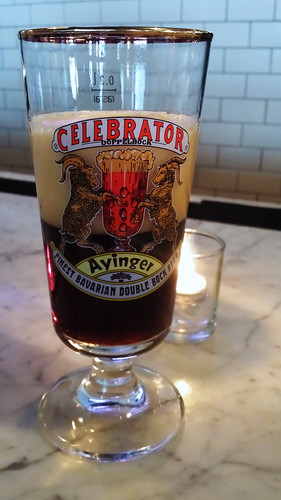
In late winter and early spring, I look for bock beers. If I'm fortunate, I'll find them in local pubs, such as this bock, brewed in Germany at Ayinger Privatbrauerei, which I found served on draught in Virginia. I call Celebrator a favorite; it's often called a doppelbock.

Ayinger Celebrator, on draft

In late spring, I've enjoyed paler, almost golden bocks, sometimes called hellerbocks or maibocks, such as this one I enjoyed, post-spring, in mid-summer, in Wisconsin, in the Bier Garten of the Capital Brewery.

A Capital maibock

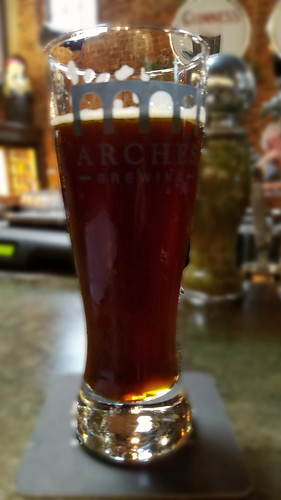
Only a few weeks ago, in winter, I drank this bock, made in Georgia, served on draught at a pub in Georgia.

Dark Maibock?

The pub called it a maibock. The Georgia brewery that brewed it —Arches Brewing Company— did not:
MYSTIK BOCK - 7.5% (MARCH-MAY)
This traditional German lager originated in the 14th-century and was lagered in caves through Winter to be consumed to celebrate the coming of Spring. The strong, sweet malt character is the hallmark of the style, complemented by a deep amber color. The malt character is balanced by a slight hop bitterness that allows the toasted grain and caramel flavors to shine through.

In my prior neck of the woods, bocks —both imported and locally-brewed— were not absent from taps and shelves.

In my newer, southern, neck of the woods, however, they are rare. Possibly, it's the climate.

Here (and not just limited to here), the emphasis is on hops and sours; bocks of malt character are not au courant. That's unfortunate. Malt is beer's irreducible soul. Tasting good should always be fashionable.

On that night a couple of weeks ago, that mis-ID'd bock was a caramelly, toasty, (slightly) concord-grapey, and reddish-brown bock. And it was tasty. Count me bock lucky.

*****************
Session 121: Bock! Beer Blogging Friday: The Session is a monthly event for the beer blogging community, begun in March of 2007 by Stan Hieronymus of Appellation Beer and Jay Brooks of the Brookston Beer Bulletin.

On the first Friday of every month, a pre-determined beer blogger hosts The Session, choosing a specific, beer-related topic, inviting all bloggers to write on it, and posting a roundup of all the responses received.


For The Session: Beer Blogging Friday #121, Jon Abernathy — blogger at The Brew Site— is the host. His theme is one word, with emphasis: "Bock!"
The month of March heralds the start of spring, and March 20 is even National Bock Beer Day. So Bockbiers seemed like a natural fit for the month! Don’t feel constrained to simply write a review of a Bock beer, though I’m certainly interested to read any reviews that come it. Some other ideas to consider:
  • Dig into the history of the style—their ties to Einbeck, the differences in the development of Bocks and Doppelbocks, and so on.
  • Do any of your local breweries brew a Bock-styled beer? Seek it out and write about it.
  • Alternatively, interview your local brewer who brewed that beer; get their take on the style and why/how they brewed it the way they did.
  • Have you ever attended Bockfest in Cincinnati, Ohio? It just so happens to take place the first weekend of March—write a review for The Session!
  • There are already the styles of traditional Bock, Doppelbock, Maibock, Eisbock, Weizenbock (and Helles Bock and Dunkles Bock in the BJCP) guidelines. Just for fun, invent a new style of Bock and describe it.
  • Have you homebrewed a Bock or similar style? Tell us about it, and anything you learned brewing this lager style at home.
  • Bock puns!
-----more-----

Saturday, January 21, 2017

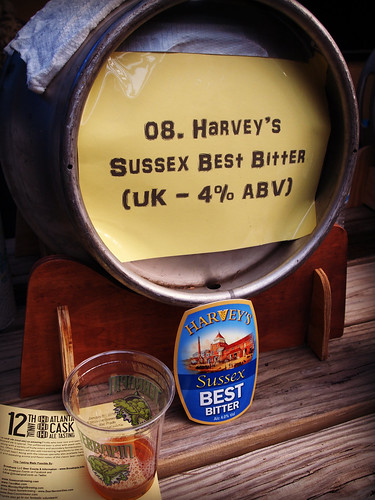
Pic(k) of the Week: Harvey's Sussex Best Bitter

Harvey's Sussex Best Bitter

“Ordinary bitter is perhaps the single greatest achievement of British brewing, combining a huge amount of character, flavour and variety into something that, by international standards, is untypically low in strength.”
—The Pub Curmudgeon.
By definition, [ordinary bitter is] intended as an everyday quaffing beer for having a couple of pints at lunchtime without writing off the rest of the day, or an evening session in the pub that still leaves you reasonably clear-headed the following morning. It’s not meant to be an exotic show pony for sniffing, sipping and holding up to the light.

While its market share has been eroded in recent years by the rise of widely-distributed premium best bitters such as London Pride, Bombardier and Wainwright, ordinary bitter

—defined broadly as any beers between 3.4% and 4.0% ABV in the gold-amber-copper colour spectrum [emphasis mine]—

probably still accounts for half of all cask beer drunk in the UK, and undoubtedly more if you extend the definition to include keg ales too. But it still tends to be regarded as something of a poor relation against more fashionable, stronger and more heavily-promoted beers.

Which ordinary bitters stand out amongst those currently available? The one that immediately springs to mind is Harvey’s of Lewes, which many see as a perfect balance of malt and hops.

Whether Sussex is an ordinary (but not so ordinary) bitter or a best bitter, I'll not debate dinging nits. I'll simply stipulate to its goodness.

In 2005 and 2006, it won the Best Bitter category at the Great British Beer Festival. Last year, I was happy to taste it, not there, but over here, at the 12th annual Atlanta Cask Ale Tasting. It had survived its trans-Atlantic voyage well. I hope it will again be so fortunate, later today, at the 13th annual.

13th annual Atlanta Cask Ale Tasting

The Pub Curmudgeon concludes his encomium as a devils' advocate: “So can any beers in this category truly be regarded as great, or are they all well, just a bit "ordinary"?”

To which, I answer, “Yes —a hearty quaff and repeat— yes.” Bravo, session beer.

-----more-----
Sunday, November 27, 2016

Session beer of the 1950s?

Session beer in the 1950s?
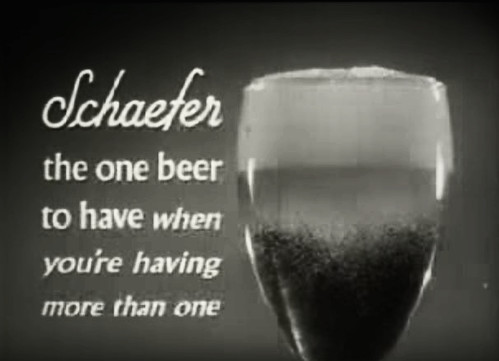
Shaefer is the one beer to have when you're having more than one.
Shaefer's pleasure doesn't fade even when your thirst is done.
The most rewarding flavor in this man's world,
For people who are having fun,
Shaefer is the one beer to have when you're having more than one.

That's a 1950s-era television commercial for F. & M. Schaefer Brewing Company of New York, New York (1842-1981), once a titan of the American beer industry.

Suggesting —encouraging— that a consumer drink more than one beer? That's an inducement to intemperance that would not be permitted in the 21st century. Or would it? Compare that sixty-year-old jingle to this slogan of very recent vintage:
The beer you’ve been waiting for. Keeps your taste satisfied while keeping your senses sharp. An all-day IPA naturally brewed with a complex array of malts, grains and hops. Balanced for optimal aromatics and a clean finish. The perfect reward for an honest day’s work and the ultimate companion to celebrate life’s simple pleasures.


Founders Brewing (of Grand Rapids, Michigan) first publicly brewed its All Day IPA as a 'seasonal' beer in 2012; in 2013, the brewery released it as a year-round item. With an alcohol content of 4.7% and an IBU content of 42 (a measure of hop-derived bitterness), All Day IPA is widely considered the most most-imitated —if not the progenitor— of 21st-century so-called 'session IPAs.' Of having more than one.

The Alcohol Tobacco Tax & Trade Bureau (TTB) is the agency of the U.S. government tasked with regulating alcoholic beverages under Federal law. It has specific rules on the advertising and labelling of beer, prohibiting, for example, health statements of a therapeutic nature or claims "that imply a physical or psychological sensation results from consuming the malt beverage." Such as keeping your "senses sharp"? It's meretricious when the 'big' boys do it, but brilliant when the 'craft' boys do?

Beer writer —and 'session' beer campaigner— Lew Bryson defines an American session beer as of 4.5% alcohol-by-volume or less, with flavor. Others insist upon moreish 'drinkability' as an additional, necessary postulate: a beer out-of-whack in any one department would not be a session. Like lots of hops. Others would disagree. All Day? I'd not call it a 'session' beer, but a hoppy American pale ale. (HAPA anyone?) But that's just me.

Session beer: the one beer to have when you're having more than one.


-----more-----

Monday, October 10, 2016

A Brown October Ale? Yes, please.

Brown Ale: rich color, malt complexity, and a sweet, deep caramel-like flavor that many beer lovers describe as 'luscious.' The sublime result- a beer that is at once luxurious and quaffable.
—Brown Ale: History, Brewing, Techniques, Recipes
Ray Daniels and Jim Parker

Oliver's 3 Lions Brown Ale @spacebar

A Brown October Ale? Yes, please. But quickly, today. Before 'craft' innovation re-renders it as a basket of hops, with dark malt merely the wrapping of a pretty bow.

*************
Brown October Ale was a well-known song from the comic opera Robin Hood, an American light opera first staged in Chicago in 1890. It was revived there as recently as 2004. The music was by Reginald De Koven, and book and lyrics, Harry Smith, both Americans. [...] The opera interprets the Robin Hood legend. The gas lamp era was a time when medieval England had some hold on the public imagination. [...] Brown October Ale, the song, had a long career in the American popular music repertoire and was performed into the 1940s at least.
—Gary Gillman
Beer et seq.


Earl Wrightson sings Brown October Ale, from a radio broadcast of 1944.

And it's will you quaff with me, my lads 
And it's will you quaff with me? 
It is a draught of nut brown ale I offer unto ye. 
All humming in the tankards, lads, 
T'will ease thy heart folorn, 
For here's a friend to everyone, 
'Tis stout John Barleycorn.

So laugh, lads, and quaff lads. 
T'will make you stout and hale. 
For all my days, I'll sing the praise of 
Brown October Ale. 

And it's will you love me true, my lass 
And it's will you love me true? 
If not, I'll drink one flagon more and so farewell to you, 
If Kate or Moll or Nan or Doll has left thy heart forlorn, 
Fill up the pail with nut brown ale 
And toast John Barleycorn. 

So laugh, lads, and quaff lads. 
T'will make you stout and hale. 
For all my days. I'll sing the praise of 
Brown October Ale. 
-----more-----
Friday, August 05, 2016

Pilsner as beer's Mozart

Session 114: Pilsners! Beer Blogging Friday: The Session is a monthly event for the beer blogging community, begun in March of 2007 by Stan Hieronymus of Appellation Beer and Jay Brooks of the Brookston Beer Bulletin.

On the first Friday of every month, a pre-determined beer blogger hosts The Session, choosing a specific, beer-related topic, inviting all bloggers to write on it, and posting a roundup of all the responses received.


For The Session: Beer Blogging Friday #114, Alistair Reece, aka Velky Ale — blogger at Fuggled— is the host. His theme is one word, with emphasis: "Pilsners!"

What I want folks to do is put down their IPAs, their Belgians, their sours, their barrel aged stuff, and hunt out a few pilsners to compare and contrast, whether they be Czech, German, Belgian, American, etc, etc. Try to get examples of Czech and German in particular to see the differences. Most of all though I just want people to re-discover what I consider the pinnacle of the brewing craft, so off hunting you go!


****************

Pilsner as beer's Mozart

In 2013, a columnist for the Washington Post wrote these seven dirty words:
Pilseners tend to be simple, straightforward beers.

In retort, I wrote these two-hundred eleven righteous words.
No, no, no, and no!

At best, the statement is dismissive praise, like saying that Mozart's String Quartet No. 19 —the Dissonance Quartet— is 'simple' music because the notes have been written down.

At worst, his comment finds common cause with the major brewing companies in doing harm to their distant legacies of Czech and German lagers —and SAB/Miller Brewing, in particular, with its apostasy "true Pilsner" campaign: if we repeat something enough, it will be believed to be true.

I'm going to avoid quoting formalistic delineations of OG/ABV/IBU and other alphabetic parameters. But I know a pilsner when I taste one: firm, slightly sweet, deep golden-hued malt; spicy, floral hops; crisp character, with a whiff of yeasty sulfur; gentle enough alcohol at about 5% to allow another sip, yet strong enough to make a statement; a long, dry, dare I say, bitter finish. And, above all, a clear, joyful declaration of the four ingredients of beer —malt, hops, yeast, and water— unencumbered by ale's zig-zag riot of dank hop, fruited yeast, and, nowadays, back-of-the-cupboard oddities.

Bob Tupper —the past host of renowned beer tastings at Washington D.C.'s Brickskeller— is fond of a music analogy for beer.
Ales are like jazz quartets. Each member goes his own way, but all finish together.

Lagers are like string quartets. Hops, malt, water, and yeast play together in seamless performance.

I would add to that: pilsners (lagers) are like Mozart string quartets.

Jazz as an analogy predates Millenials, Gen X-ers, and even many baby boomers. If that's the rub, substitute your musical experience and you'll (hopefully) get to the nub.

Pilsner for Beer Blogger Friday

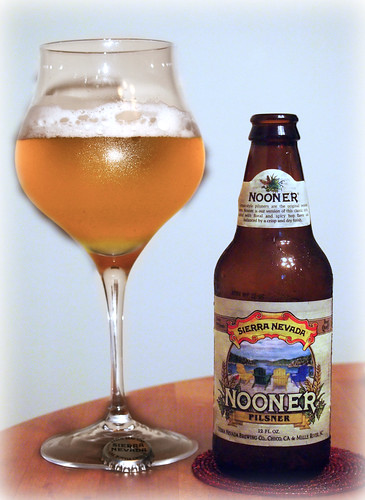
California's (and now also North Carolina's) Sierra Nevada Brewing —well-known for its American 'craft' beer iconic Pale Ale— also brews lagers. One, its Nooner Pilsner, it describes like this:
German-style pilsners are the original session beers. Nooner is our version of this classic style, loaded with floral and spicy whole-cone hop flavor and balanced by a crisp and dry finish.
  • Yeast: Lager yeast.
  • Bittering hops: German Perle.
  • Finishing hops: Saphir, Tettnanger, Strisselspalt.
  • Malts: Two-row Pale, Pilsner, Munich, Acidulated.
  • Alcohol-by-volume (abv): 5.2%.
  • International Bittering Units (IBUs): 32.
Get past the silly name, the less-than-expected clarity, and the higher-than-'session' alcohol level. What one is left with is a lovely beer: scents of a meadow field (not barnyard muck!), shortbread cookie malt in the background, candied lemon, and an ever-so-slightly sour-sweet finish. An American pilsner.*

It's a fascinating juxtaposition that today's The Session on pilsners follows on the heels of yesterday's #IPADay. Or maybe not.

This month's host of The Session, Alistair Reece, is a beer polyglot: an advocate for Czech lagers, American mild ales, British/Scottish real ales, and an imbiber of American 'craft' ales. Maybe, more 'craft'-ers should be so.

In coda, I wrote:
No disrespect is meant to the world of ales. But if one fancies her or himself a beer lover, and 'simply' dismisses lagers out-of-hand, she or he leaves undiscovered an entire hemisphere of delicious choices.


-----more-----

Thursday, August 04, 2016

Why I WON'T be celebrating #IPADay

Generally speaking, I save rants for the Facebook page; and I don't wish to toss cold beer on the celebration, but ...

#IPAday

...I WON'T be celebrating Eee-Puh Day today.

That's IPA Day, celebrating a beer style that floats the American 'craft' beer boat, in which the word "India" has lost any meaning as a tag for the second most populous nation on Earth but has transmogrified into a stand-in synonym for hops, not of Indian agronomy but of new-form American hops.

Of a light ale with peach extract added, a bartender recently said this to me: "It's a Kölsch because that's what the brewery tells us it is." And so it is with IPA today: it is whatever an American 'craft' brewery decides it should be, convention or historical recipe monads be damned.

There are latter-day Eeh-Puhs that taste only of hops, sneering at the inconvenient necessity of malt.

There are those that take pride in the visually repugnant.

And there are those —you're forgiven if confused— in which the mere presence of hops is no longer a sine qua non. Take, for example, the fruited IPAs that taste of Hawaiian Punch rather than hops. If disliking these childish, sweet alco-pops puts me in the category of IPA haters who inform everyone that they can’t stand IPAs, then I stand guilty.

But I would stipulate that I do indeed like IPAs — firm and bracing, and, yes, hoppy and bright— just not those made with fruit flavorings and extracts, or those infused with other gratuitous ingredients, or those that are made ugly beyond measure, or those that are redolent only of tropically-fruity hops or devoid of any malt character, or those that are hailed as if never-before-seen hoppy pale ales re-branded as "session", or others that are simply something else — stouts, wheats, Belgianesques— but with a lotta hops: each, in various measure, guilty of one-dimensional trickery and pandering, the antithesis of any reasonable measure of 'craft.'

If that's IPA Day, thank you, but I'll pass.

-----more-----
Thursday, May 12, 2016

The paucity of Mild (and why that's changing in the U.S.).

It's nearly the middle of May, and I have yet to drink one drop of Mild Ale this month. None of the breweries in Georgia brew one. And that's a pity. They haven't heard the news. [Happy update: They have!]

It's the second annual American Mild Month. Throughout the month of May and throughout the rest of the United States, breweries are brewing American Mild Ales.

May is... American Mild Month 2016

American Mild Month is the idea of Alistair Reece: an ex-pat Scotsman and past Prague resident, who now lives in Virginia in the U.S., where he blogs at Fuggled. The Campaign for Real Ale (CAMRA) has been hosting a "May is for Milds" campaign for many years. So, Reece thought, why not here in the U.S.?

What is Mild Ale? Start with the concept of 'session' beer. Lew Bryson, a long-time fighter for 'session' beer, defines American Session Ale as:
  • 4.5% alcohol by volume or less
  • flavorful enough to be interesting
  • balanced enough for multiple pints
  • conducive to conversation
  • reasonably priced

Before the 20th century (and even into it), Mild Ale referred to something very different than it does today: then, a non-aged ale, often quite strong. Today, it's a low alcohol, not bitter, often darker ale. Of Mild's character, I'll defer to British authors Jessica Bloak and Ray Bailey:
First, it has to put sweet malt and flavours from sugar at the forefront, but that doesn’t have to mean that it has to be sickly or lacking in character. Bitterness can work, but excessive perfume just seems wrong. Roastiness also jars, suggesting that some brewers remain in thrall to out-of-date history that declares mild to be a degeneration of porter, which it isn’t.

Reece interprets American Mild as a form of modern Mild Ale, but with an American twist: a "restrained, darkish ale, with gentle hopping and a clean finish so that the malt and what [American] hops are present shine through." I should add "would be," because American Mild has not yet been 'recognized' by this nation's beer-style poobahs.
  • Alcohol-content-by-volume (abv) of 4.5% or less.
  • Color greater than 17 SRM (i.e., darker than a golden ale).
  • Bitterness level of 30 International Bittering Units (IBU) or fewer. Thus, more bitter than an English Mild, but much less hoppy than an American IPA.
  • American —thus, not-so-fruity— ale yeast strains.
American Mild is not a hop bomb, but neither need it be a hop free zone. 'Low' is not the same as 'none;' it is all about restraint, and with the wide variety of American hops available the range of hop flavors is actually quite broad, whether its the spiciness of Cluster, the grapefruit of Amarillo, or the tropical fruit of El Dorado, there is room here for differentiation, and dry hopping is ok too.

Remember though, before going crazy with the hops, an American Mild is not a Session IPA, or a Session Cascadian Dark Ale, it's still a mild. Traditional English milds top out at 25 IBUs, but for an American Mild we would suggest an upper limit of 30 IBUs.

Alcoholic restraint is a hallmark of the modern mild ale, and we believe that an American mild should follow that tradition, topping out at 4.5% abv. We imagine most American milds would fall between 3.5% and 4.5% abv.

One major departure from the English mild style in a theoretical American mild is the yeast. The classic American yeast strain used by many an American craft brewery is known for being very clean, allowing the other ingredients to shine through without contributing the fruity flavors of the British yeasts.

American Mild Ale is NOT a 'session' IPA; it is not an over-hopped ale; it does not contain alcohol of greater than 4.5% by volume. Do any of those things, and you're playing with 'session' semantics.

Do things right, and Mild Ale — 'more-ish' and (ugh, how I detest this word) 'drinkable'— might just be the quintessential 'session' beer. So, why isn't your brewery brewing one?

Some brewers will tell you that the word "mild" itself dampens sales, as in mundane or not dangerous enough. A few years back, a Virginia brewer was experiencing slow sales of his draft and cask Dark Mild Ale, called such. He re-christened it as Atomic Monkey, and sales boomed.

So, U.S. breweries: call it what you will. Just please brew it! And please serve it cask-conditioned (without extraneous stuff). And please do it, now, in May, or, while you're at it, year-round. Please, and thank you.

Mild Ale for Mild Month (03)

-----more-----
  • *UPDATE. After I posted, I received this welcome Georgia update from American Mild Month: "Georgia has a mild going on tap today - Monday Night Brewing's Sad Stove Mild in their tap room."

  • American Mild Ale:
  • An in-depth examination of modern British Mild Ale, from Jessica Boak and Ray Bailey, at All About Beer: here.
  • Irony notwithstanding, these are the specifications for English Mild Ale, as defined by the [U.S.] Brewers Association.
    A. Subcategory: English-Style Pale Mild Ale
    English Pale Milds are light amber to medium amber. Chill haze is allowable at cold temperatures. Fruity-ester aroma is very low to medium low. Hop aroma is very low or low. Malt flavor dominates the flavor profile. Hop flavor is very low to low. Hop bitterness is very low to low. Very low diacetyl flavors may be appropriate in this low-alcohol beer. Fruity-ester flavor is very low to medium low. Body is low to low-medium.
    • Original Gravity (°Plato) 1.030-1.036 (7.6-9.0 °Plato)
    • Apparent Extract/Final Gravity (°Plato) 1.004-1.008 (1.0-2.1 °Plato)
    • Alcohol by Weight (Volume) 2.7%-3.4% (3.4%-4.4%)
    • Bitterness (IBU) 10-20
    • Color SRM 6-9 (12-18 EBC)

    B. Subcategory: English-Style Dark Mild Ale
    English Dark Milds are reddish brown to very dark. Fruity-ester aroma is very low to medium low. Malt and caramel are part of the aroma while licorice and roast malt tones may sometimes contribute to aroma profile. Hop aroma is very low. Malt flavor and caramel are part of the flavor profile while licorice and roast malt tones may also contribute. Hop flavor is very low. Hop bitterness is very low to low. Very low diacetyl flavors may be appropriate in this low-alcohol beer. Fruity-ester flavor is very low to medium low. Body is low-medium to medium.
    • Original Gravity (°Plato) 1.030-1.036 (7.6-9.0 °Plato)
    • Apparent Extract/Final Gravity (°Plato) 1.004-1.008 (1.0-2.1 °Plato)
    • Alcohol by Weight (Volume) 2.7%-3.4% (3.4%-4.4%)
    • Bitterness (IBU) 10-24
    • Color SRM 17-34 (34-68 EBC)

Friday, March 04, 2016

In Praise of Porter. (The Session: Beer Blogging Friday.)

Session 109: Porter The Session is a monthly event for the beer blogging community, begun in March of 2007 by Stan Hieronymus of Appellation Beer and Jay Brooks of the Brookston Beer Bulletin.

On the first Friday of every month, a pre-determined beer blogger hosts The Session: Beer Blogging Friday. He or she chooses a specific, beer-related topic, invites all bloggers to write on it, and posts a roundup of all the responses received. For more information, or to ask to host, go to the home page.


For The Session: Beer Blogging Friday #109, Mark Lindner —of By the Barrel: The Bend Beer Librarian— is the host.

For The Session 109—my first as host—I would like us to discuss porter. It seems that this highly variable style has not been done in The Session before.

“The history of porter and the men who made it is fascinating, for it deals with the part that beer has played in the development of Western Culture. Conversely, of course, much of porter’s growth was the result of profound changes in the nature of British society. It is also a microcosm of how our industries have developed; events in porter’s history explain the structure of the modern brewing industry, not only in Britain, but in the other major Western countries.

Porter is intimately tied in with the Industrial Revolution, in which Britain led the world. Through the growth it enabled the brewers to achieve, it was instrumental in the development and technological application of a number of important scientific advances.” (Foster, Terry. Porter. Brewers Publications. P. 17).

I am not talking about your long dead relative’s porter—although you might be—but about all of the variations currently and previously available. Hey, feel free to write about the porter of the future or some as-yet-unrecognized sub-style of porter.

I am not a librarian, and none of my long-departed relatives ever owned breweries (that I know of). But I believe that the history of our heritage —whether beer or otherwise— can show us our common roots and point to our common (or uncommon) futures. Beer as liquid history? To repeat, yet again, this trope: well, yes.

As to porter substyles, I believe there is porter — Platonic or 'I can't define it but I know it when I taste it'— and then there are other things, infused with kitchen-sink ephemera. Give 'em a great name, like Double Imperial Coconut Killer ale, but, please, be honest and respectful: not porter. Modifiers heaped upon modifiers yield differences of kind not degree.

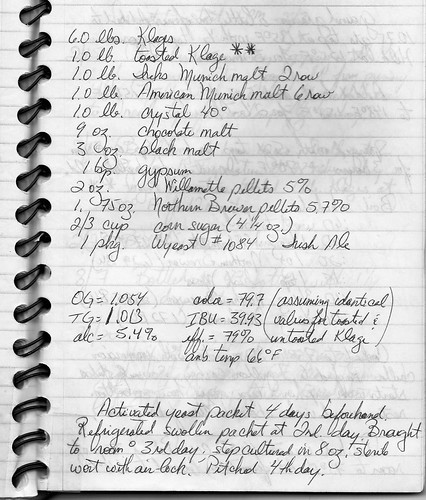
I began brewing at home in the late 1980s. Porter was my go-to brew. In 1992, I trepidatiously entered an enth-generation batch in the Spirit of Free Beer, a contest organized by B.U.R.P. —Brewers United for Real Potables— a Washington, D.C.-area home brew club.

1992 Porter (01)

The recipe was not complex —especially as contrasted with today's so-called 'extreme' beers of high alcoholic strength and exotic procedures— but, at 5.5% alcohol by volume, it was flavorful enough to garner a silver medal.

I went on to brew professionally, but porter would remain insinuated in my soul. That bakers chocolate nose; whiff of dark fruit and pine cone; chocolate-malted body; more-ish but not boozy; that brisk slap of a finish.

At the risk of sounding elegiac: is porter dying in the U.S.? I find it harder and harder to find examples on tap or in bottle. If so, that would be a shame: a neglect of tradition and a loss of a delicious thing.

But, then, when I can still drink something sublime like this, I smile, mollified.

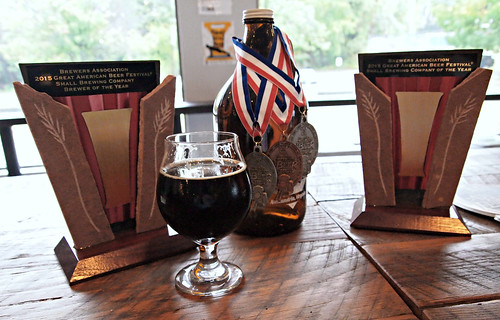
Port City is the American Small Brewery of the Year, 2015.
Porter from Port City Brewing (of Alexandria, Virginia) won Silver Medal at 2015 Great American Beer Festival, at which the brewery took top honors as Small Brewery of Year.

-----more-----