Showing posts with label UK. Show all posts

Saturday, February 11, 2023

Pic(k) of the Week: Tynt Meadow English Trappist Ale

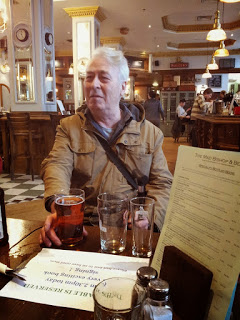
Tynt Meadow English Trappist Ale

Tynt Meadow English Trappist Ale is an English Trappist beer, brewed by Trappist monks (precisely: the Order of Cistercians of the Strict Observance, a Roman Catholic monastic order) at Mount St Bernard Abbey, located in the town of Coalville, in Leicestershire, England, UK.

The monastery was founded in 1835. Brewing only commenced in 2018, when the abbey's small-scale dairy farm had become non-viable (vs. large agribusiness). Tynt Meadow English Trappist Ale is its only beer.

***************

HOW DOES IT TASTE?

Short answer: delicious. Long answer:

In color, Tynt Meadow is burnished-copper; clarity is good. The beer is well-conditioned, pouring with a long-lived, off-white head and some nice lacing down the glass...possibly because of bottle-conditioning (with live yeast). That also may have contributed a measure of oxygen-scavenging (i.e, active protection against staling). The beer tasted fresh, despite its trans-Atlantic voyage.

The principal flavor is dark fruit with lesser motifs of bitter chocolate and treacle. Interestingly, the monastery does NOT use Belgian yeast (which is the norm for most Trappist ales) but an unidentified English yeast-strain (in addition to English barley and hops, both also unspecified) that is noticeable in a fruit-cake flavor. The ale finishes smooth (I detest the illogical neologism "drinkable"), although the alcohol does seem to create a strong presence in the aftertaste. 7.4% alcohol-by-volume (abv).

Imported bottle (330 ml / 11.2 fl.oz), tasted in Atlanta, Georgia, USA. 20 September 2022.

***************

ERGO

Based upon their Cistercian adherence solely to prayer and work, the monks of Mount St Bernard Abbey literally produce only enough beer to pay their bills and support their charities. They quote Psalm 104:
You make the grass grow for the cattle and the plants to serve man’s needs, that he may bring forth bread from the earth and wine to cheer man’s heart.

I say, beer is liquid bread. So, please, "give us this day our daily bread."

A series of occasional reviews of beer (and wine and spirits).
No scores; only descriptions.

-----more-----

Friday, November 09, 2018

The first autobiography in English was written by a brewster.

14th century brewer Margery Kempe: the English language's first autobiographer

On this day (9 November) the Anglican Community honors Margery Kempe (c. 1373 – 1438): a brewster *, grain-miller, Christian mystic, and the English language's first autobiographer.

Kempe wrote the "The Book of Margery Kempe," chronicling her domestic tribulations, her extensive pilgrimages to holy sites in Europe and the Holy Land, and her mystical conversations with God. The book is generally considered to be the first autobiography written in the English language.

Although the Church of England honors Margery Kempe today, the U.S. Episcopal Church does so earlier in the year, on 28 September. And the Catholic Church has never designated her a saint.

-----more-----

Wednesday, June 06, 2018

"Like mixing your beer with rainwater and sugar."

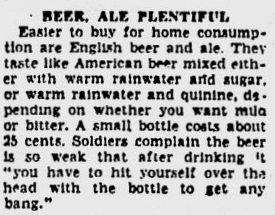
On 25 May 1944 —a fortnight before the D-Day invasion of Nazi-occupied Normandy, France— the Fredericksburg (Virginia) Free-Lance Star published a story by the overseas American war correspondent Hal Boyle. It was one of many for Boyle —who would later win the Pulitzer Prize for his wartime reporting— but this particular dispatch described the World War II condition of booze in London, England.

At his blog "Beer et. Seq.," Gary Gillman has summarized the account, in wry style. His story —"Blondes, Taxis, and the West End"— includes Boyle's description of what Boyle and the American GIs thought of British milds and bitters of the time.

Not much.

Seeking to explain mild ale and bitter beer to Americans, Boyle said mild is like mixing your beer with rainwater and sugar. And bitter is like mixing it with rainwater and quinine. (Today he might say the IPA that is the rage around the world is like mixing Bud with vodka and grapefruit juice).

Given that American lager in this period was still fairly bitter, it shows that English beer – pale or bitter ale – easily outstripped it. Since no unusual bitterness was detected in mild ale, one can assume its bitterness was about equal to mid-century American lager.

Mild & bitter in 1944 London (as an American tasted them)

The weakness of British beer was remarked on, something I’ve discussed before as noticed by an Australian journalist. He stated the government must have pondered long and hard to get the stimulant/austerity balance exactly right. The American soldier’s reaction was typically popular and idiomatic: it’s like our beer if you drink it and get hit in the head with the bottle.

-----more-----

Saturday, January 13, 2018

Pic(k) of the Week: Graham Wheeler, homebrew guru, R.I.P.

Graham Wheeler, homebrew guru, R.I.P.

Sad news.

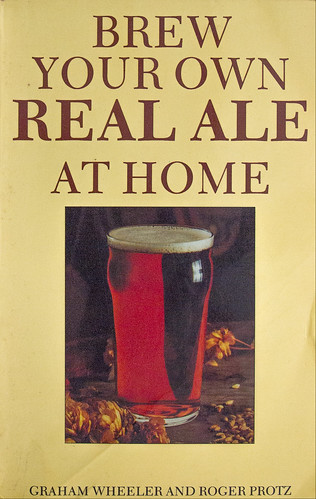
Graham Wheeler —the author of several editions of a seminal homebrewing guide published by U.K.-based CAMRA (Campaign for Real Ale)— died in late November 2017. His books provided instruction for several generations of budding homebrewers, British and stateside. Many of those amateur brewers —it would be safe to surmise— went on to brew professionally.

I already had been brewing when Wheeler first wrote Brew Your Own Real Ale at Home in 1993, but the book wet my whistle for Bitters. And I haven't lost that since.

Thank you, Mr. Wheeler.

Brew Your Own Real Ale at Home (1993)

-----more-----

Friday, December 22, 2017

Porter: the drink that launched thousands of ships.

And if [the pint of Plain] is all drawn properly, the way it should be done, then the [contented] cream is borne majestically above to form the clerical collar that proves the goodness in its heart. And the true porter drinker would look upon such a glass with great reverence, indeed.


A brewer in Virginia, USA, recently posted a dark lament to Facebook.
"IPA, IPA, IPA! I think it's time that 'real beer' drinkers and brewers (not the Instagrammers and Untappd abusers) take beer back. When was the last time anyone saw a brown ale or a porter or stout that wasn't flavored or imperial? There is nothing quite like a nice, unflavored porter. DARK BEERS MATTER!"

A few days later, it just so happened, British beer authors Jessica Boak and Ray Bailey —in their eponymous blog's year-end list of top beer tweets— linked to a tweet from the archives of the British Broadcasting Corporation.

At the end of April 1973, then-Irish brewing company Guinness ceased production of all its porter. A few days later, on 11 May 1973, BBC presenter Larry McCoubrey drank one of the last draught pints to be had. As the BBC tweeted on 11 May 2017, the forty-fourth anniversary of that Belfast broadcast:
Larry McCoubrey's panegyric to porter was pure pub poetry. Pint of plain, please, publican.

Yes, brew (more) Porters again. Yes, make (more) beers dark again! Malted serendipity, indeed.


[A grandfather clock can be heard ticking.]

Porter, an old established tradition in Irish drinking history. Why, we've even got songs about it.

[Folk-singer sings.]
If you want your child to grow,
Your child to grow,
Your child to grow,
If you want your child to grow,
Give him a jar of porter.
Sing Toora loora loora lay,
Toora loora loora lay.
Sing Toora loora loora lay,
Give him a jar of porter.


It's an acquired taste, of course. But, at least, it comes easier than the bitter thickness of stout. But just as England produced beer that was mild and bitter, so we developed porter and stout. This is the 'mild.' "Plain" they call it. You would always call for a pint of Plain. That was just part of the mystique that grew up around this drink.

The more essential part of it was the way in which it was drawn. Barmen could rise and fall on their ability to draw a pint of Plain.

You see, it's drawn from two barrels. A high one, first, to give it a bit of life. A good glass full of gushing good cheer that settles slowly towards the bottom of the glass into a thick, contented cream.

It takes several minutes for that cream to substantiate towards the bottom of the glass, when it's ready for the muscle and the sinew, the real body of the drink itself. And that comes from the other barrel...of flat.

And if it's all drawn properly, the way it should be done, then the cream is borne majestically above to form the clerical collar that proves the goodness in its heart. And the true porter drinker would look upon such a glass with great reverence, indeed.

If work was the curse of the drinking classes, then porter was their salvation.

And, yet, you know, it was not the traditional drink of Ireland the disciples would have you believe. This was a city drink; there were definite centers for it. It was the liquid lunch of countless working men in Dublin, and Derry, and in Belfast, where the shipyard drew most of its strength from the dark substance.

It was the drink that waited for the men as the horn blew in the evening and pubs up in Newtownards rolled around the station and up Ann Street, Short Strand, the pints of plain used to be standing in rows on the counter, waiting for the onslaught from the yard.

Used to be...for pubs progressed. Bottle beer broke through; gin and tonic took over; and porter became impolite. Lately, there have been less than a hundred pubs in Ireland selling it.

And, now, these are probably the last pints of Plain you'll probably ever see in Belfast. For on the thirtieth of April 1973, they stopped making it altogether.

This was more than a way of drinking. This really was a way of life. Porter: the drink that launched thousands of ships.

[A grandfather clock ticks...and then stops.]

-----more-----

Sunday, October 29, 2017

Cask advice for 2017...from 1850.


In 1765, the Swan Brewery began brewing in London. It would continue doing so for an additional one hundred seventy-one years until 1936, when the Ind Coope/Samuel Allsopp & Sons brewing consortium purchased the brewery ... and promptly closed it.

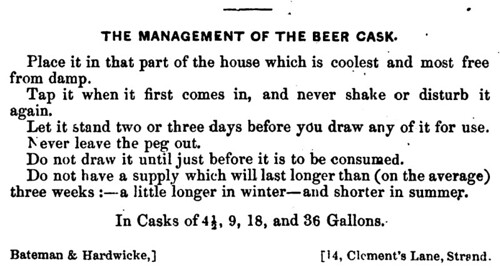
But nearly a century earlier, in 1850, when The Swan was still going strong, it published a pamphlet for the trade that described its brewing procedures and its beers, and offered advice on how to properly care for them. Included was a short passage on cask cellarmanship. It was sensible advice then and remains so now, nearly two centuries later.

The Management of the Beer Cask (1850)
The Management Of The Beer Cask
  • Place it in that part of the house which is coolest and most free from damp.
  • Tap it when it first comes in, and NEVER SHAKE OR DISTRUB IT AGAIN [emphasis mine].
  • Let it stand two or three days before you draw any of it for use.
  • Never leave the peg out.
  • Do not draw it until just before it is to be consumed.
  • Do not have a supply which will last longer than (on the average) three weeks: —a little longer in winter— and shorter in summer.
—"The Proprietors of the Swan Brewery, Walham Green, Fulham - (Established 1765) - Beg to Present These Pages on Beer and Brewing; and Will Feel Honoured by Their Acceptence and Perusal."
1850

Note the cask sizes mentioned: 4.5, 9 (firkin), 18, and 36 gallons. Swan, of course, listed them in Imperial (U.K.) measure. Translating to U.S. volumes, they would be, respectively: 5.4, 10.8 (firkin), 36, and 72 gallons.

The short pamphlet also discussed the clarification of cask ale, i.e, the fining of casks.

The Fining of Cask Ale (in 1850)
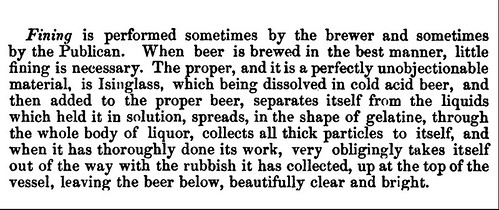
Fining is performed sometimes by the brewers and sometimes by the Publican. When beer is brewed in the best manner, little fining is necessary. The proper, and it is perfectly unobjectionable material is Isinglass, which being dissolved in cold acid beer, and then added to the proper beer, separates itself from the liquids which held it in solution, spreads, in the shape of gelatine, through the whole body of liquor, collects all thick particles to itself, and when it has thoroughly done its work, very obligingly takes itself out of the way with the rubbish it has collected, up at the top of the vessel, leaving the beer below, beautifully clear and bright.


Ah, but what is the "perfectly unobjectionable material," isinglass? Here, from the The Oxford Companion to Beer (2012):
Isinglass is derived from the swim bladders of certain tropical and subtropical fish. [...] Traditionally, isinglass for brewing purposes was derived from sturgeon, although modern commercial isinglass is more typically derived from tropical estuarine dwellers. [...] When used as a fining agent, [isinglass] has the ability to settle yeast and beer proteins very quickly and can do so repeatedly. This latter property is essential for cask-conditioned ales, where the casks may be moved several times prior to serving.

Many cellarmen in 21st-century U.S. have switched from the use of isinglass to non-animal-derived agents for clarifying cask ales. Others rely on gravity and time and/or rapidly-settling yeast strains.

But many others, sad to say, when it comes to cask quality, isinglass or no isinglass, couldn't give a f care less.

Fobbing at the Tut

Fobbing at the Tut:
A series of occasional posts on good cask cellarmanship.


-----more-----

Sunday, October 01, 2017

More "drinkers' beer," please.

In the latter aughts, the glory days of beer blogs, Jeffrey John Bell was a much-admired British beer blogger and publican, pseudonomically known as Stonch. He took a sabbatical from blogging, but now he's returned, if somewhat stealthily (or, at least, relatively concealed by the noise of the manic social media world).

To the point, he calls his blog, Stonch's Beer Blog. In his most recent update, he quotes the tweet of a small brewery's brewer, who asks for the return of "drinkers' beer."

I'm a brewer, but I struggle to find the appetite for more than half a can of DIPA. Can we all get back to making drinkers beer please?

Drinkers' beer! What a poetic and logical construction where the unfortunate 'drinkable' is neither. Or the pedestrian 'session beer' and its unseemly companion, 'sessionable.'

Of course, the brewer in question could merely have been dissing DIPAs as 'not beer' and, thus, I've altered his meaning, leaving my previous paragraph for naught. But, you know what? I'll go with the first, less snarky interpretation (and, in fact, I've added an apostrophe to indicate possession). And, then, let's have more drinkers' beer, please.

Stonch, himself, is no slouch as a wordsmith, a 'craft' that was in his kit a decade ago and remains so now. Here, from the same blog post:
In case you aren't up with the lingo, a 'DIPA' is a 'Double IPA', and invariably refers to a madly strong beer that's supposed to be really hoppy but ends up tasting like a sweet, sticky mess. Before all this nonsense took hold we'd probably have called most of them barley wines.

*******************
The small brewery, lauded above, is the Summer Wine Brewing Company *, of Yorkshire, in the U.K. According to its website, SWB produces cask ales, but hopped 'New World'-style —as well as in bottles and kegs— and all, as it appears from the descriptions, being drinkers' beer in alcohol levels and construction.

Another recent tweet from the brewery encapsulates its cask 'process' (and art). American 'weekend' cask brewers: look!

-----more-----
Friday, August 11, 2017

In the real ale world, regular order is restored.

GBBF 2017

The Great British Beer Festival (GBBF) is Britain’s largest beer festival, with over 50,000 attendees. On the festival tasting floor, there are over 900 (cask-conditioned) real ales ranging from
microbreweries to the most well known British brands, and hundreds of bottled and foreign beers, and a selection of real ciders and perries.

It's also a competition among British brewers for national bragging-rights. Last year, Binghams Brewery's Vanilla Stout won the judging with a cask-ale pickled American-style with vanilla beans, cocoa, chocolate 'essence,' and 'natural' plum flavoring.

Upon hearing that, I bemoaned, "Oh the humanity." The beer reporter for the Washington Post took me to task for that, accusing me of demeaning the skills of the brewers and judges.


Stuff and nonsense, as if holding an opinion would be prima facie wrong, and expressing one, insulting. I don't much like extraneous nonsense tossed in a beer I drink. I do much enjoy the uber-freshness of an unadulterated cask ale. And I freely stipulate to that.

This year —despite the eschatological presence of "fine English wines," for the first time in the London beer festival's forty years— regular order has been restored. A 3.8% (!) alcohol-by-volume bitter (cask-conditioned, of course) has been crowned Champion Beer of Britain.
A bitter beer first brewed as a one-off for a pub in Lincolnshire has walked away with the prestigious Champion Beer of Britain award at the Great British Beer Festival at London Olympia. Goats Milk was produced by the Church End Brewery in Warwickshire for the Goat Pub in Market Deeping in Lincolnshire but proved so popular that it’s become a regular beer in the brewery’s range.

Head brewer Carl Graves says the 3.8% beer has a simple recipe of Maris Otter pale malt with a touch of crystal malt and malted wheat and is hopped with American Cascade and Chinook hops.

The judges on the final panel said the beer was the stand-out one among the six finalists and praised its fine balance of malt and hops and refreshing palate.

This year, like last, I was not fortunate to be there to taste the winner. But (risking re-opprobrium from the 'mainstream media') I'll still exult that an unpolluted bitter —a moreish session beer— has bested stronger zymur-sisters and brothers, resting victorious atop its stillage.

All is right with the world, at least for a moment.

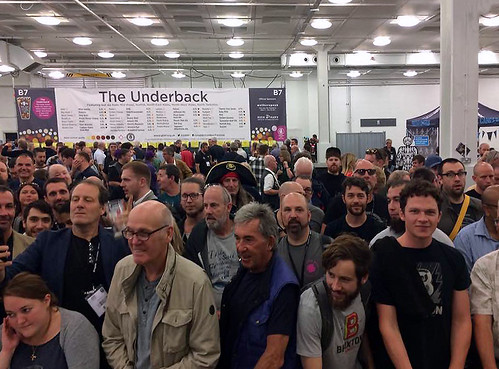
Queue for American casks at Great BRITISH Beer Festival
Even so, a long line stood for a stand of
AMERICAN cask ales (exhibited but not judged).

-----more-----