Showing posts with label Ireland. Show all posts

Friday, February 01, 2019

Happy Brewsters' Day!

Happy Brewsters' Day! (1 February)
I should like a great lake of ale, for the King of the Kings. I should like the family of Heaven to be drinking it through time eternal.
— Opening line of a poem attributed to Saint Brigid of Kildare

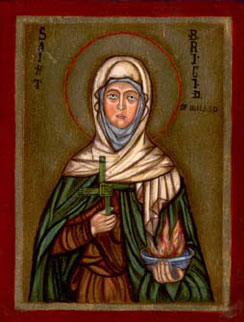
On 1 February, the Catholic Church celebrates the feast day of Saint Brigid of Kildare (c. 451 – 525 AD): a patron saint of brewers and one of three patron saints of Ireland (in league with Saints Patrick and Columba). Brigid herself was a brewer: one miracle attributed to her was turning (bath) water into beer, a gift she has since bequeathed to many brewsters and brewers alike (if without that spritz of sitz).
"Probably the best known Irish saint after Patrick is Saint Brigid (b. 457, d. 525). Known as 'the Mary of the Gael,' Brigid founded the monastery of Kildare, in Ireland. She was a generous, beer-loving woman, known for her spirituality, charity, and compassion.

Brigid worked in a leper colony which once found itself without beer. "For when the lepers she nursed implored her for beer, and there was none to be had, she changed the water, which was used for the bath, into an excellent beer, by the sheer strength of her blessing and dealt it out to the thirsty in plenty."

She also is reputed to have supplied beer out of one barrel to eighteen churches, which sufficed from Maundy Thursday [Holy Thursday] to the end of paschal time [52 days]. Obviously, this trait would endear her to many a beer-lover.
— Via the Brews Brothers: "Saints of Suds (When The Saints Go Malting In)."

-----more-----

Friday, December 22, 2017

Porter: the drink that launched thousands of ships.

And if [the pint of Plain] is all drawn properly, the way it should be done, then the [contented] cream is borne majestically above to form the clerical collar that proves the goodness in its heart. And the true porter drinker would look upon such a glass with great reverence, indeed.


A brewer in Virginia, USA, recently posted a dark lament to Facebook.
"IPA, IPA, IPA! I think it's time that 'real beer' drinkers and brewers (not the Instagrammers and Untappd abusers) take beer back. When was the last time anyone saw a brown ale or a porter or stout that wasn't flavored or imperial? There is nothing quite like a nice, unflavored porter. DARK BEERS MATTER!"

A few days later, it just so happened, British beer authors Jessica Boak and Ray Bailey —in their eponymous blog's year-end list of top beer tweets— linked to a tweet from the archives of the British Broadcasting Corporation.

At the end of April 1973, then-Irish brewing company Guinness ceased production of all its porter. A few days later, on 11 May 1973, BBC presenter Larry McCoubrey drank one of the last draught pints to be had. As the BBC tweeted on 11 May 2017, the forty-fourth anniversary of that Belfast broadcast:
Larry McCoubrey's panegyric to porter was pure pub poetry. Pint of plain, please, publican.

Yes, brew (more) Porters again. Yes, make (more) beers dark again! Malted serendipity, indeed.


[A grandfather clock can be heard ticking.]

Porter, an old established tradition in Irish drinking history. Why, we've even got songs about it.

[Folk-singer sings.]
If you want your child to grow,
Your child to grow,
Your child to grow,
If you want your child to grow,
Give him a jar of porter.
Sing Toora loora loora lay,
Toora loora loora lay.
Sing Toora loora loora lay,
Give him a jar of porter.


It's an acquired taste, of course. But, at least, it comes easier than the bitter thickness of stout. But just as England produced beer that was mild and bitter, so we developed porter and stout. This is the 'mild.' "Plain" they call it. You would always call for a pint of Plain. That was just part of the mystique that grew up around this drink.

The more essential part of it was the way in which it was drawn. Barmen could rise and fall on their ability to draw a pint of Plain.

You see, it's drawn from two barrels. A high one, first, to give it a bit of life. A good glass full of gushing good cheer that settles slowly towards the bottom of the glass into a thick, contented cream.

It takes several minutes for that cream to substantiate towards the bottom of the glass, when it's ready for the muscle and the sinew, the real body of the drink itself. And that comes from the other barrel...of flat.

And if it's all drawn properly, the way it should be done, then the cream is borne majestically above to form the clerical collar that proves the goodness in its heart. And the true porter drinker would look upon such a glass with great reverence, indeed.

If work was the curse of the drinking classes, then porter was their salvation.

And, yet, you know, it was not the traditional drink of Ireland the disciples would have you believe. This was a city drink; there were definite centers for it. It was the liquid lunch of countless working men in Dublin, and Derry, and in Belfast, where the shipyard drew most of its strength from the dark substance.

It was the drink that waited for the men as the horn blew in the evening and pubs up in Newtownards rolled around the station and up Ann Street, Short Strand, the pints of plain used to be standing in rows on the counter, waiting for the onslaught from the yard.

Used to be...for pubs progressed. Bottle beer broke through; gin and tonic took over; and porter became impolite. Lately, there have been less than a hundred pubs in Ireland selling it.

And, now, these are probably the last pints of Plain you'll probably ever see in Belfast. For on the thirtieth of April 1973, they stopped making it altogether.

This was more than a way of drinking. This really was a way of life. Porter: the drink that launched thousands of ships.

[A grandfather clock ticks...and then stops.]

-----more-----

Saturday, January 14, 2017

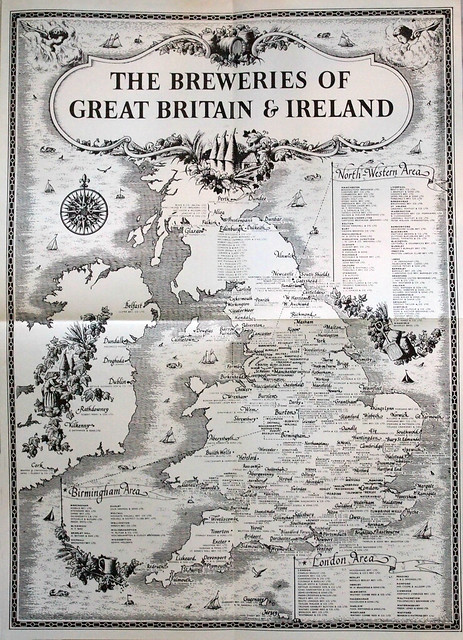
Pic(k) of the Week: The Breweries of Great Britain & Ireland, in 1958.

The Breweries of Great Britain & Ireland (1958)

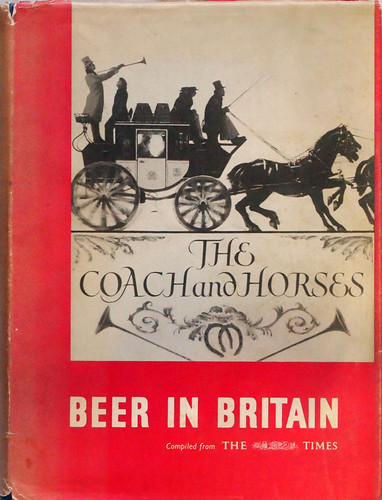
In April 1958, British newspaper The Times published a month-long special supplement.
It offers a comprehensive survey of the very varied aspects of beer, from barley to consumer. ¶ Beer is known as Britain's national beverage, and this volume contains something of interest to most people.

In 1960, The Times compiled the articles, publishing them in a standalone book, Beer In Britain. The map is from that book, long out-of-print. Like the book, many (most) of the breweries depicted are now long gone.

Beer In Britain

-----more-----