Showing posts with label breweriana. Show all posts

Sunday, February 02, 2020

Beer-Cheese Dip

Beer-Cheese Dip

There's something to celebrate — beer isn't just "beer' anymore; it; a delightful beverage to share with family and friends who appreciate quality ingredients in cooking and a new experience in American cuisine. There is nothing "common" about beer anymore.

Written in 1989 by Jack Erickson, Great Cooking! With Beer is a snapshot of American beer 'culture' in the 1980s, when 'craft' beers were called "microbrews" and beer 'culture' was a nascent thing to be coddled. 1 Of course, it was also a cookbook: a useful beginning point for learning about beer IN food. And it remains so today (though sadly out-of-print).2

Mr. Erickson lived in the northern Virginia area through the early 1990s, where he evangelized on the goodness of the new-fangled microbrews. I met him there on a few occasions. I never gathered up the nerve to make his recipe for "Beer Syrup" for pancakes (for which he admonished me), but I have prepared (and enjoyed) other of his recipes, including Beer-Cheese Dip.

Today, the Sunday of Super Bowl LIV, it might be a good day to post about that. So, here's the recipe, but with some personal adaptions. 3


***************

Recipe

INGREDIENTS
  • 2 cups (6-8 ounces) shredded cheddar cheese, at room temperature
  • 2 ounces cream cheese, at room temperature
  • 1 tsp dry mustard powder
  • 1 clove garlic, mashed...or 1/4 tsp garlic powder (see note below)
  • 1 tsp (vegan) Worcestershire sauce 4
  • 1/2 tsp black pepper
  • 1/2 tsp turmeric
  • 1/2 tsp onion powder
  • 1/2 tsp cumin
  • 1/4 tsp cayenne pepper (or more to taste)
  • 1 tsp malt vinegar
  • 1/2 cup (4 ounces) light lager (e.g., PBR: Pabst Blue Ribbon)
  • 1 dash smoked Spanish paprika
  • scant handful spring onions, chopped
PROCEDURE
  1. Combine cheddar, cream cheese, mustard, pepper, turmeric, onion powder, cumin, garlic, vinegar, cayenne, and Worcestershire in a food processor or blender. (No salt needed; the cheese will be salty enough!) 
  2. Process/blend 30 seconds to blend. 
  3. NOTE:
    When recently re-making the dip, the taste of the single fresh garlic clove overpowered the dish. So, I would recommend first blending all else and only then adding a little at a time of the smashed garlic to the blender/processor and checking for flavor before (or not) blending more.
  4. With processor/blender running, add the beer gradually, blending until the mixture is 'peanut-butter' smooth, not runny. Add more, only if necessary. 
  5. Transfer the mixture to a serving bowl and refrigerate for at least an hour to allow the flavors blend. 
  6. Before serving, bring to room temperature. Garnish with chopped spring onions and a dash of paprika. Serve with raw vegetables. 

Great Cooking! With Beer

Great Cooking! With Beer
  • Author: Jack Erickson
  • Paperback, hardcover: 146 pages
  • Publisher: Redbrick Press (February 1989)
  • Language: English
  • ISBN-10: 0941397017
  • ISBN-13: 978-0941397018
-----more-----
  • 1 American beer writer Vince Cottone is credited with first using the term "craft brewery" in print in 1986, although it didn't enter the common usage until more than a decade later.
  • 2 Erickson also wrote several beer travelogues, themselves snapshots of 'microbreweries' of the 1980s and early 1990s. These are also out-of-print, but you cna find them if you search for second-hand sources.
  • 3 See Erickson's original recipe: here.
  • 4 Worcestershire sauce, although fermented from barley malt, also contains anchovies. There are non-fish, vegan/vegetarian alternatives.
  • Vegan? Try this 21st-century recipe for a Beer-Cheese Dip, with no actual cheese, from blogger Rabbit and Wolves. Almond milk and nutritional yeast supply the 'cheesiness.' It's tasty.

  • For more from YFGF:

Saturday, November 23, 2019

Pic(k) of the Week: PBR at Northside Tavern

Northside Tavern (03)

A mural depicting a bald eagle and the logo for Pabst Blue Ribbon beer is painted on the outside wall of Northside Tavern blues club —and 'dive' bar— in Atlanta, Georgia, USA.

Despite its name, Northside sits in Atlanta's Westside, an area that has experienced rampant redevelopment since February 2016, when I took this photo. One hopes for the club's continued long life.

And for that of the blues.

-----more-----

Saturday, July 28, 2018

Pic(k) of the Week: Dog koozie

"Where's the beer?" they've asked of recent Pic(k)s of the Week. Here it is.

Dog koozie

It's amusing what you can find in a thrift store. It's even more amusing when you actually purchase it: a Labrador Retriever beer koozie ... on a pedestal.

At the Red Nose Tavern, somewhere in Atlanta, Georgia, on 26 July 2018.

-----more-----

Saturday, June 10, 2017

Pic(k) of the Week: Wahl-Henius

Wahl-Henius (01)

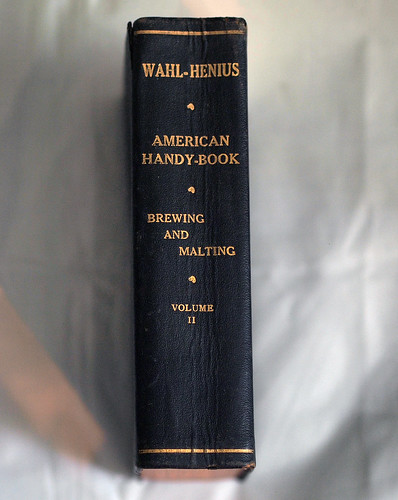
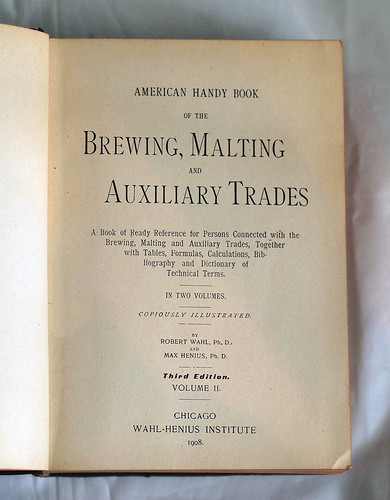
In 1901, preeminent American brewing scientists Max Henius and Robert Wahl, published —

The American Handy-Book of the Brewing, Malting and Auxiliary Trades: A Book of Ready Reference for Persons Connected with the Brewing, Malting and Auxiliary Trades, Together with Tables, Formulas, Calculations, Bibliography and Dictionary of Technical Terms

— which could be considered the Bible of American brewing, or at least the Old Testament thereof: a historical window into the brewing practices of turn-of-the-last-century America.

From their preface:
The American Handy-Book of the Brewing, Malting and Auxiliary Trades is designed to be a book of ready reference for the use of persons connected with the trades designated. It does not pretend to be a text-book, which the student of brewing will read through from beginning to end with a view of becoming acquainted with the principles and practice of this great industry. It aims to be, as it were, a pocket encyclopedia, by reference to which the brewer, maltster, refrigerating machine engineer, bottler, etc., as a person engaged in the commercial activities of a brewery, may find an immediate answer to questions that may come up in connection with the exercise of his calling, without requiring him to wade through bulky volumes and peruse quantities of information in search of a single item of knowledge.


The initial printing quickly sold out; Wahl and Henius released a second edition the following year. They published a revised, third edition in 1908, in two volumes covering 1,266 pages. An excerpt from its preface:
In these days of railroads, telephones, wireless telegraphs and rudimentary airships, six years, measured by achievement rather than by hour-glass, represent a considerable period of time. It is six years since the second edition of the Handy-Book of the Brewing, Malting and Auxiliary Trades was published, and the brewing trade has made rapid strides in that time. Many things current six years ago have been dropped and new even have taken their places. The second edition having been exhausted for over two years, a new one, taking account of the march of progress, has become necessary.

There have been important changes in the general plan of the work, and many changes of detail have been introduced.

Naturally, the more general adoption of electrical machinery in brewery and malthouse operations, growing out of the rapid development of those devices, calls for more extensive consideration. A new chapter has therefore been added on "Electricity and Magnetism." Likewise, the attention devoted of late years to the study of the barley plant and other agricultural products connected with the industry, bringing into prominence the importance of botanical marks of plants, is one of the reasons for the addition of chapters on "Botany" and "Barley." It goes without saying that the constant development of brewing methods, leading in some instances to the elaboration of entirely new systems of brewing, called for the separate treatment of "Special Brewing Systems." Another development of recent years grows out of the agitation for pure food and consequent legislation, affording grounds for a new chapter on "Beer Standards."


Wahl-Henius (03)

**************

Who was Max Henius?

Max Henius was probably America’s greatest brewing scientist, in any era. Yet he is virtually unknown to most beer and brewing fans, even those with some historical knowledge. He co-authored in 1902 the American Handy-Book of the Brewing, Malting, and Auxiliary Trades. The other writer was Dr. Robert Wahl, an American Henius had studied with in Marburg, Germany. The book was a stupendous achievement, a fat tome of 1200 pages covering every conceivable aspect of brewing operations. Many questions of science and theory were addressed but in a way accessible to practical brewing people. [...] Anyone who investigates American brewing history runs into the book sooner or later. The modern beer writer, Michael Jackson, who developed the basic stylistic schema of craft brewing, almost certainly read the book. Jackson’s basic classification seems based on Wahl & Henius’ work, not just the “ur” distinction between bottom-fermentation, top-fermentation, and spontaneous fermentation but the main beer types under each of those heads.
—Gary Gillman ( Beer st Seq.).


**************

What was the Wahl-Henius Institute of Fermentology?

The Wahl-Henius Institute was a brewing research laboratory and school in Chicago that operated between 1886 and 1921. Founded in 1886 by Dr Robert Wahl and Dr Max Henius as the Wahl & Henius, the name was changed to the Scientific Station for Brewing of Chicago and then to the Institute of Fermentology before becoming the Wahl-Henius Institute. Its educational division, the American Brewing Academy, was created in 1891. The school and laboratory operated successfully until Prohibition, when the near dissolution of the brewing trade forced its closure and sale to the American Institute of Baking, which retains the nucleus of the Wahl-Henius library.
—Randy Mosher ( Craft Beer & Brewing Magazine).

-----more-----

Saturday, February 04, 2017

Pic(k) of the Week: Schlitz vs. Michelob, LIVE during the Super Bowl

The 1981 live Great American Taste Test (Super Bowl XV)

During the broadcast of Super Bowl LI (that is, the 51st Super Bowl) tomorrow, both Snickers and Hyundai will air commercials that have been filmed live. I'm not clear on what advantage is accrued by filming a commercial three days earlier (Snicker) or a few minutes earlier (Hyundai) and broadcasting it as 'live.' The thrill of not editing, perhaps?

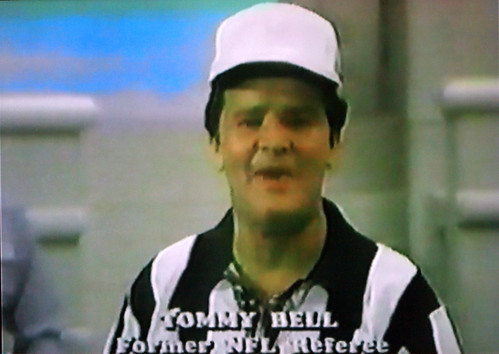
The last time the Super Bowl has actually featured a 'live,' not pre-recorded and edited, commercial, was 1981, during Super Bowl XV (15). Broadcast live from New Orleans, the host city of that year's championship game, Schlitz Brewing ran "The Great American Beer Test," a 60-second taste test of its flagship beer vs. Michelob, brewed by Anheuser-Busch.

The 1981 live Great American Taste Test (02)

The spot was hosted by Tommy Bell, a former NFL referee dressed in referee zebra stripes. Before the broadcast, one-hundred "loyal Michelob drinkers." had sampled Schlitz and Michelob in unmarked ceramic beer steins. When the commercial went live, each pulled a lever to indicate their preference.

Part of the appeal of a live broadcast is the spontaneity; the anticipation of an unedited gaffe or unintended serendipity. When Mr. Bell explained the voting procedure, he did well, obviously well-rehearsed, except on one occasion. Hilariously, he seemed to verbally stumble, to hesitate, when saying "Schlitz," his sponsor, having no such difficulty saying "Michelob."

As the commercial concluded, an electronic football scoreboard tallied the result, and Mr. Bell announced it. Fifty of those one-hundred Michelob drinkers had preferred Schlitz. A tie.

In the game, the Oakland Raiders defeated the Philadelphia Eagles, 27-10.

But five months after the game, Schlitz would close its Milwaukee brewery, forced to so by a continuing downward spiral in sales, never recovering from a very public cheapening of ingredients and change of process. The following year, the entire company would be sold to Stroh Brewing, and "the beer that made Milwaukee famous," brewed since 1849, was no more.

Schlitz sold today is brewed by Molson Coors for Pabst, itself a brewery without any brewing facilities.


-----more-----

Saturday, January 14, 2017

Pic(k) of the Week: The Breweries of Great Britain & Ireland, in 1958.

The Breweries of Great Britain & Ireland (1958)

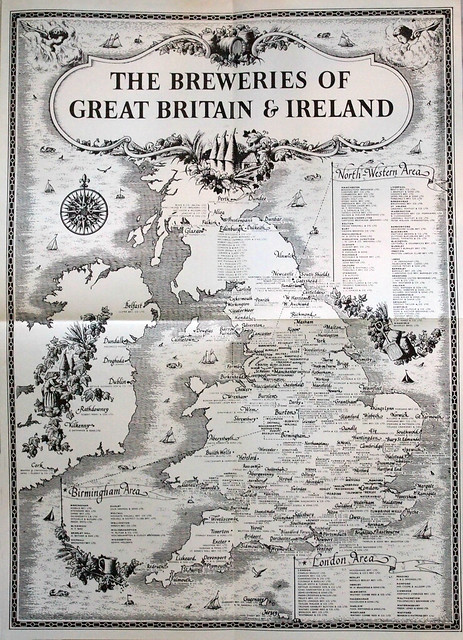
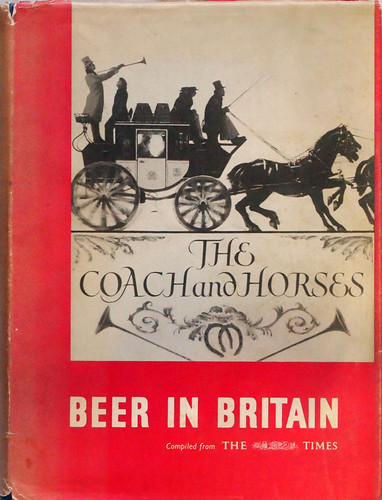
In April 1958, British newspaper The Times published a month-long special supplement.
It offers a comprehensive survey of the very varied aspects of beer, from barley to consumer. ¶ Beer is known as Britain's national beverage, and this volume contains something of interest to most people.

In 1960, The Times compiled the articles, publishing them in a standalone book, Beer In Britain. The map is from that book, long out-of-print. Like the book, many (most) of the breweries depicted are now long gone.

Beer In Britain

-----more-----

Saturday, December 31, 2016

Pic(k) of the Week: 42 years of Anchor's "Merry Christmas and Happy New Year."

Our Special Ale 2016

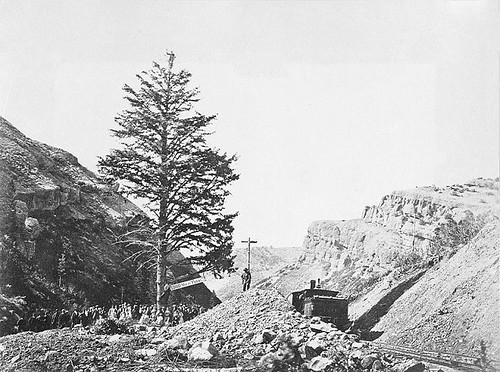
This is the forty-second annual "Our Special Ale" from the brewers at Anchor. It is sold only from early November to mid-January. The Ale's recipe is different every year, as is the tree on the label, but the intent with which we offer it remains the same: joy and celebration of the newness of life. Since ancient times, trees have symbolized the winter solstice when the earth, with its seasons, appears born anew. This lone pine was found 1,000 miles from Omaha during the westbound construction of the transcontinental railroad.

There was a time, not too long ago —but older than the birthdates of Millenial drinkers— that a beer fancier could find no Christmas beers stacked on American store shelves or poured from bar taps. None.

That is, until 1975, when Anchor Brewing —re-tooled only nine years earlier from a failing 19th-century San Francisco brewery into the first American 'craft' brewery— brewed the nation's first 'craft' Christmas beer. Owner Fritz Maytag named it "Our Special Ale" to molify the religious censors. Now, forty-two years on, Anchor is no longer alone; one can Christmas tipple in profusion.

Here is Maytag on the beer's genesis, as quoted by Don Russell — nom de bière, Joe Sixpack— in his 2008 book, Christmas Beer:
“I was aware of the tradition in medieval villages where they would make special beers for various festival days,” Maytag says. “You'd have beers brewed for weddings, festivals, and other celebrations. And certainly, you'd brew them for Christmas.” It made sense that a small brewery that had been revived thanks to old-world-beer-making techniques would rediscover the tradition of holiday beer. There was only one problem: Maytag didn't have a clue what it should taste like.

Anchor Christmas 1975

For the first few years of its life, Anchor's Our Special Ale was an IPA, brewed with Cascade hops, then a new hop variety. The 1983 version was so well-received, it became a year-round offering called Liberty Ale which is still brewed today. In 1984, Maytag decided to do "something special" for Christmas and brewed a brown ale, but with an American twist: dry-hopped with those Cascade hops. Then, following that, in 1987,
To celebrate his wedding, Maytag crafted a bridal ale filled with herbs and spices. It was so tasty, that the brewery decided to add spices to its [brown ale] holiday ale that winter —and has done so ever since. There's a different recipe each season, and neither Maytag nor any of his employees have ever revealed what's behind those mysterious flavors.

It's been a spiced brown ale ever since. I tasted this year's iteration. And yes! Dark brown with red tinges. Aromas and flavors of gingerbread, nutmeg, pine, and cloves, as if a pfeffernüsse cookie were a beer. But, Mr. Maytag has protested:
No! That's the only thing I'm going to say. There are no cloves in it none. I'm tired of hearing about cloves!

Despite the Christmas-cookie spicing, it's not a sweet dessert beer. Think of savory uses of nutmeg, such as a sweet potato or bechamel-sauce-based dish or, say, 'Cincinnati chili.'

This year marks the 50th anniversary of the year Maytag bought, saved, and revived Anchor, thus ushering in the era of American 'craft' beer. In 2011, Maytag sold the brewery, but remains as "Chairman Emeritus," proud of each of the brewery's beers as "works of art." Each of the forty-two labels of "Our Special Ale" has featured a drawing of a tree, and each (except in 1976) was drawn by one artist, Jim Stitt.

Anchor Christmas 2016

About the tree on this year's label, here's beer (and golf) writer Tom Bedell:
This year’s label is based on the Pinus solitarius, or lone pine, known as the “1,000 Mile Tree” which was found in Utah in 1869 during construction of the Union Pacific, the nation’s first transcontinental railroad. The tree, a stately ninety feet tall, was almost exactly 1,000 miles from Omaha, the eastern terminus of the railroad, and it became something of a tourist attraction, at least as far as the rail passengers were concerned. The train would often pause at the tree and some passengers would attempt to climb it, as the 1869 photograph by Union Pacific’s A.J. Russell shows:

Thousand Mile Tree (1869)

Stitt clearly based his label on the photo, though it’s hard to tell from Russell’s shot whether the man high atop the tree is holding onto a mug of beer. Probably not, but he is in Stitt’s rendering.

The tree died in 1900 and was removed. But in 1982, Union Pacific planted a new one to commemorate the site, albeit now only about 960 miles from Omaha thanks to track changes over the years. Enclosed within a fence, the tree is in roughly the same spot, though it has a long way to go to match the original’s height.

******************

Our Special Ale: 1975-2016.

This winter-holiday season, beer writer Jay Brooks has run a forty-two part series at his blog Brookston Beer Bulletin, depicting each of the beer's labels, from the incarnation of "Our Special Ale" in 1975 to the present year. With his permission, I've collected all of them here in table format: each of the forty-two labels and its corresponding tree. Click on a thumbnail to view a larger image accompanied by a brief story of that year's creation.

Anchor's "Our Special Ale" is but one beer, and by today's 'crafty' standards, fusty, even if 6.5% alcohol-by-volume. That is, until one tastes it, until one reflects on how it has been, and is, a seminal and delicious part of 'craft' beer's half-century history.

As the bottle label states: "Merry Christmas and Happy New Year." (And wouldn't the adjectives in that seasonal American salutation make more religious sense if switched, I've long wondered?)

Anchor Christmas 1975
1975
Silhouette of a Christmas tree

Anchor Christmas 1976
1976
Sequoiadendron giganteum

Anchor Christmas 1977
1977
Pseudotsuga menziesii

Anchor Christmas 1978
1978
Inspired by an evergreen in the Sierra Nevadas
Anchor Christmas 1979
1979
Inspired by the Original Christmas Ale Tree
Anchor Christmas 1980
1980
Genus: Quercus


Anchor Christmas 1981
1981
Olea europaea


Anchor Christmas 1982
1982
Notholithocarpus densiflorus

Anchor Christmas 1983
1983
Abies cephalonica

Anchor Christmas 1984
1984
Tree of Life

Anchor Christmas 1985
1985
Arbutus menziesii

Anchor Christmas 1986
1986
Castanopsis chrysophylla
Anchor Christmas 1987
1987
Sequoia sempervirens


Anchor Christmas 1988
1988
Picea glauca


Anchor Christmas 1989
1989
Acer pseudoplatanus

Anchor Christmas 1990
1990
Inspired by the work of French artist Paul Cézanne
Anchor Christmas 1991
1991
Betula papyrifera


Anchor Christmas 1992
1992
Pinus ponderosa


Anchor Christmas 1993
1993
Malus pumila


Anchor Christmas 1994
1994
Inspired by the Original Christmas Ale Tree
Anchor Christmas 1995
1995
Cocos nucifera
Anchor Christmas 1996
1996
Quercus alba
Anchor Christmas 1997
1997
Pinus sylvestris
Anchor Christmas 1998
1998
Juniperus californica
Anchor Christmas 1999
1999
Olneya tesota

Anchor Christmas 2000
2000
Torreya californica

Anchor Christmas 2001
2001
Washingtonia filifera
Anchor Christmas 2002
2002
Populus fremontii

Anchor Christmas 2003
2003
Picea sitchensis


Anchor Christmas 2004
2004
Inspired by the Original Christmas Ale Tree
Anchor Christmas 2005
2005
Quercus agrifolia


Anchor Christmas 2006
2006
Fagus sylvatica


Anchor Christmas 2007
2007
Quercus lobata

Anchor Christmas 2008
2008
Pinus jeffreyi

Anchor Christmas 2009
2009
Cupressus macrocarpa
Anchor Christmas 2010
2010
Ginkgo biloba

Anchor Christmas 2011
2011
Pinus longaeva

Anchor Christmas 2012
2012
Araucaria heterophylla
Anchor Christmas 2013
2013
Abies concolor var. Lowiana
Anchor Christmas 2014
2014
Sequoiadendron giganteum
Anchor Christmas 2015
2015
Cedrus Deodara
Anchor Christmas 2016
2016
Pinus Solitarius


-----more-----