Showing posts with label alcohol laws. Show all posts

Saturday, April 24, 2021

Pic(k) of the Week: Let us pray

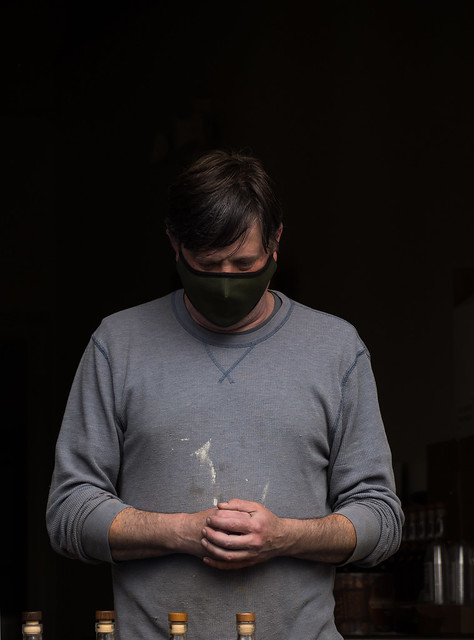
Let us pray

During a tour of Independent Distilling Company and a tasting of the company's spirits, owner/distiller Michael Anderson paused (as if in prayerful thanks).

Decatur (East Decatur Station), Georgia, USA. 26 March 2021.

***************

Et seq.

When Georgia repealed  Prohibition in the state in 1935, it forbade distilleries (and breweries) from selling their own products on-site. It wouldn't be until 1 September 2015 that Georgia’s distilleries (and breweries) were permitted to sell their products directly to consumer from their tasting rooms. But...

The law limited distilleries to offering only three, half-ounce samples of their spirits per person. And if a visitor wished to purchase a bottle of spirits, hey/she first had to pay for and attend a tour of the distillery (of course, equal to the retail cost of that bottle). Providing distillery guests with cocktails, however, remained strictly verboten. But...

Two years later, on 1 September 2017, Georgia removed blue law pretense. Now, distilleries can sell consumers up to three 750 ml bottles directly on its premises. Additionally, they can sell cocktails (of only their own house-produced liquor) and unlimited full-ounce samples to vistors to their facilities, without the pretense of a tour ticket. Topping it off, any distillery can sell up to five hundred 53-gallon barrels of its liquor per year on-site. That's 133,754 bottles of bourbon (or whatever the spirit may be)!

************

Ergo

In the photo above, Mr. Anderson may have been ruminating upon all that. That weekend, his small distillery was celebrating its 7th anniversary. But...

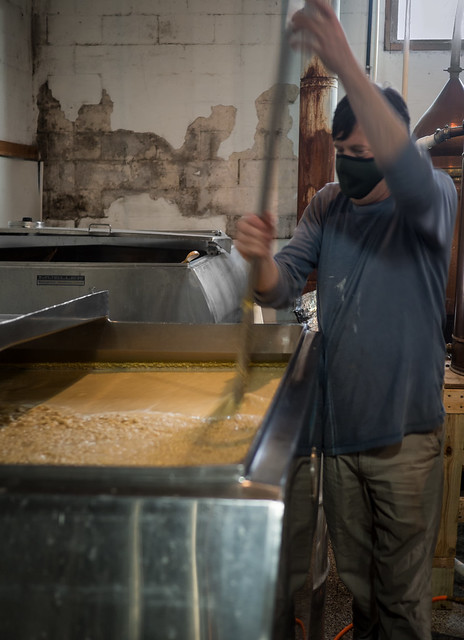
Even during a celebratory tour, his work was not done. Fermentum nunquam dormit! *

Stirring the wash


-----more-----
  • * Translated, from the Latin, as "yeast never sleeps." Amusingly, an alternate meaning of the word "fermentum" is "trouble." Thus, with poetic license, the phrase could be translated as "trouble is always brewing." Seems apt.

  • Pic(k) of the Week: one in a weekly series of images posted on Saturdays, occasionally (as is the case today) with a good fermentable as the subject.
  • Photo 17 of 52, for year 2021. See it on Flickr: here.
  • Camera: Olympus OM-D E-M10 II.
    • Lens: Olympus M.40-150mm F4.0-5.6 R
    • Settings: 123 mm | 1/250 | ISO 200 | f/5.3
  • Commercial reproduction requires explicit permission, as per Creative Commons.

  • For more from YFGF:

Saturday, January 09, 2021

Pic(k) of the Week: A pleasant Saturday afternoon

A pleasant Saturday afternoon

About to enjoy a cocktail in the alley, at Independent Distilling Company in Decatur, Georgia, USA.

Social distancing and all that: so very 2020. To be precise: 5 December 2020.

Then, this happened:
On December 29th as part of the CARES act, the FDA issued a set of two fees to craft distillers that created hand sanitizer during the pandemic. The program would require distilleries to pay a $14,060 Monograpah Drug Facility Fee as well a $9,373 Contract Manufacturing Organization Facility Fee.

Beyond the simple fact that $23,000+ is a ton of money for a small business, especially during a pandemic, the fee was also to be due almost immediately: on February 11. If distillers, who didn’t know about the fee at all until 29 December, didn’t stop selling sanitizer and de-register themselves from the FDA eDRLS system by 31 December, then they would also be charged the same fee again in 2022.

Then on New Years Eve, Brian Harrison, the Health and Human Services Chief of Staff reversed the mandate: “Small businesses who stepped up to fight COVID-19 should be applauded by their government, not taxed for doing so. I’m pleased to announce we have directed FDA to cease enforcement of these arbitrary, surprise user fees. Happy New Year, distilleries, and cheers to you for helping keep us safe!”

For distillers, many of which made hand sanitizer as a way to give back to their communities during a difficult time, not make a profit, the announced reversal was a welcome relief in the final moments of 2020.
— Forbes (1 January 2021)


Local libations

-----more-----

Friday, January 17, 2020

The shameful occurrence one hundred years ago today, 17 January 1920.


One hundred years ago, today, the 18th Amendment to the United States Constitution took effect, on 17 January 1920.

Its issue, National Prohibition, would remain in effect for thirteen years. Beer, wine, and distilled spirits had become unconstitutional.

18th Amendment to the Constitution of the United States of America

Section 1. After one year from the ratification of this article the manufacture, sale, or transportation of intoxicating liquors within, the importation thereof into, or the exportation thereof from the United States and all the territory subject to the jurisdiction thereof for beverage purposes is hereby prohibited.

Section 2. The Congress and the several States shall have concurrent power to enforce this article by appropriate legislation.

Section 3.This article shall be inoperative unless it shall have been ratified as an amendment to the Constitution by the legislatures of the several States, as provided in the Constitution, within seven years from the date of the submission hereof to the States by the Congress.

Prohibition actually had passed a year earlier, on 16 January 1919, when the Nebraska legislature became the 36th state to approve the amendment, satisfying the Constitution's 2/3-of-the-states requirement. The amendment's wording mandated a year's delay until implementation. Praise be to the enlightened citizens of Connecticut and Rhode Island: their states were the only to vote nay.

To this day, the 18th Amendment remains the only amendment to the Constitution that eliminates rights. It did not, however, prohibit the drinking of "intoxicating beverages," 'merely' their manufacture, inter-state distribution, and sale. In its collective wisdom, Congress, authorized by section 2, defined an intoxicating beverage as anything containing in excess of one half of one percent alcohol by volume. That was, of course, just enough.

Prohibition would not be repealed until 5 December 1933, with the adoption of the superseding 21st Amendment.

Who or what was responsible? Distilling an answer might be reductive sociology, but four movers stand above the others: the alcohol industry itself, the Women's Christian Temperance Union, The Anti-Saloon League, and the 16th Amendment.

About the last, first. Since the Civil War, the federal government had been growing hand-in-hand with a bourgeoning population. Revenue from excise taxes and other fees had become insufficient. The 16th Amendment, ratified in 1916, constitutionalized the income tax, which up to that time, the Supreme Court had repeatedly disallowed. Its passage made excise taxes less integral. (Were that viewpoint as sanguine today!)

The temperance movement had been growing in strength for a hundred years, especially so in the early 20th-century. Its proponents laid crime, health problems, spousal abuse, and other social ills at the feet of the alcohol industry, which —with such as 'gin joints'— was far from blameless. And the beer industry, seeing beer as indeed the beverage of temperance —that is, not of prohibition but of moderation— did little, and too late, to stem the tide.

But maybe the arch-villain of the story is Wayne Wheeler, president of the Anti-Saloon League. Single-minded in his crusade against alcoholic beverages, Wheeler became, at one point, powerful enough to influence national elections. He was to alcohol as the virulently racist Harry Anslinger later was to marijuana.

The Woman's Christian Temperance Union continues today, albeit in more quiescent form. The Anti-Saloon League also survives, but now known more politely as the American Council on Alcohol Problems. And income tax? Well, you know that story.

-----more-----

Thursday, December 05, 2019

On this date in American history, it once again became legal to sell intoxicating beverages.

Prohibition Repealed!

A prohibitionist is the sort of man one couldn't care to drink with,
even if he drank.
— Henry Louis (H.L.) Mencken

Eighty-six years ago, today —on 5 December 1933 (at 5:32 pm ET)— the state of Utah voted to approve the 21st Amendment to the Constitution of the United States of America, its decision fulfilling the requisite number of states and thus terminating the ignoble, nearly 14-year reign, of the 18th Amendment, Prohibition.

Some might find it ironic that Utah of all states —with its widespread latter-day teetotalling— would vote to ALLOW alcohol. On closer examination, it may have been logically sagacious of that state to repudiate the 18th amendment, the ONLY amendment to eradicate constitutional rights rather than creating, affirming, or clarifying them.

After Utah's vote, two more states would vote to ratify. Six states (excluding Alaska and Hawaii, which were not states at that time) would never bother to vote on the amendment. But alone among all the states of the nation, only South Carolina, deserving of ignominy, voted against repeal.

-----more-----

Saturday, July 06, 2019

Pic(k) of the Week: Beer Independence Day

Beer Independence Day 2019
Independence Day drinking, in the beer garden of Wild Heaven Beer (brewery), in Avondale Estates, Georgia, on 4 July 2019.

Other than being apropos for the day, the mural's caption —"Beer Independence Day 2017"— refers to 1 September 2017, the date on which breweries in Georgia were first 'free' to sell and pour their own beers on their own premises.

-----more-----

Wednesday, November 01, 2017

Virginia bans alcohol.

101 years ago, today, on 1 November 1916, the Mapp Act became law in Virginia: alcoholic beverages were prohibite and the entire state went dry. For the rest of the country, National Prohibition —under the 18th Amendment to the Constitution— would not take effect until 17 January 1920.

Although Virginia established statewide prohibition through a popular referendum, it nonetheless faced several challenges in enforcing the new law. Its long coastline made it difficult to prevent smuggling, i.e. rum-running. It bordered on a wet state, Maryland, which made barely an effort to enforce national dry laws from 1920-1933. Virginia contained several cities which were reluctantly dry, most notably Alexandria, Richmond, and Norfolk. In addition, Virginia had a long-established moonshining tradition in the mountainous western part of the state. As a result, Virginia struggled to live up to the dry ideal it set for itself in 1916.

[...] The referendum on state-wide prohibition [with two simple choices, “For State-Wide Prohibition” and “Against State-Wide Prohibition”] passed, on 2 September 1914 by a vote of 94,251 in favor and 63,886 opposed. Of Virginia’s 100 counties, 71 voted in favor of prohibition. Eight of the ten congressional districts went dry, and one of the remaining two was wet by only ten votes. Surprisingly, sixteen of the state’s twenty cities also voted in favor of going dry. Traditionally cities were strongholds of wet votes. However, only Arlington, Norfolk, Williamsburg, and Richmond stayed wet.Accordingly, following the referendum, the Virginia legislature quickly passed a prohibition law, called the Mapp Law after state Senator Walter Mapp of Accomack County, making the entire state dry as of midnight, the morning of November 1, 1916. [...]The Mapp law defined “ardent spirits” as “alcohol, brandy, whiskey, rum, gin, wine, porter, ale, beer, all malt liquors, absinthe, and all compounds or mixtures of any of them.” The phrase “all malt liquors” was worded to include both intoxicating and non-intoxicating drinks made of malt.

The new dry law closed numerous distillers, six breweries, as well as several hundred saloons, in addition to taking away business from bottling companies and distributors. Breweries and distillers were allowed to stay in business so long as they sold their product out of state. Five of the six Virginia breweries stayed open until 1918. Only Robert Portner’s in Alexandria closed immediately.

[...] Virginia shares the Chesapeake Bay with Maryland, and the bay seemed as if it were designed for smuggling with its many small islands, coves and inlets. Norfolk had been wet during the referendum and remained a popular spot for smugglers to import alcohol. Finally, Virginia had a long-standing tradition of moonshining, especially in the western mountains, an area which traditionally resented Richmond’s control. Moonshiners found that prohibition furnished an even larger market for their product.
—Mark Benbow of RustyCans.org, as published in the winter 2010-2011 issue of Brewery History

Seventeen years later, on 3 October 1933, Virginia voters would vote to end statewide prohibition. A few weeks later, on 25 October, a state convention would ratify the 21st amendment to the U.S. Constitution, repealing Prohibition, making Virginia the 32d state to do so. The amendment would take effect less than two months later, on 5 December. A few months after that, on 7 March 1934, Virginia's Department of Alcoholic Beverage Control would be established.

And so it goes.

-----more-----

Friday, September 01, 2017

Happy Georgia Brewery Liberation Day!

It's the first of September 2017, which means that, as of today, Georgia has joined with the rest of the Union. Breweries in the state of Georgia can now sell THEIR own beers in THEIR own taprooms to THEIR own customers.

Georgia has become the 51st (that is, the last) of all 50 states and Washington, D.C. to permit this. (The penultimate laggard, Mississippi, enabled its permission on 1 July.) Georgia Governor Nathan Deal signed bill SB-85 on 8 May; it took effect today.

Better late than never, no?

Duck the tour guide

-----more-----

Tuesday, August 08, 2017

The Beer Institute, the FDA, and transparency in beer labeling

The Beer Institute (BI) has come out in favor of the proposed U.S. Food & Drug Administration (FDA) rules on "Nutrition Labeling of Standard Menu Items in Restaurants and Similar Retail Food Establishments." Its argument is that

consumers should be provided with the highest standard of information for alcohol beverages on menus for chain restaurants and other similar dining establishments.

Keep in mind that the Beer Institute, while representing all U.S. breweries (as well as beer importers and beer industry suppliers) comprises—
  • Anheuser-Busch InBev
    (including 10 Barrel, Blue Point, Breckinridge, Devils Backbone, Elysian, Four Peaks, Golden Road, Goose Island, Karbach, and Wicked Weed)
  • Constellation Brands
    (including Ballast Point)
  • Craft Brew Alliance
    (including Kona, Redhook, and Widmer)
  • Heineken USA
    (including Lagunitas)
  • MillerCoors
    (including Saint Archer and Terrapin)
  • North American Breweries
    (including Genesee, Pyramid, and Magic Hat)
These company-members produce more than 81% of the volume of beer sold in the United States. Thus, buried deep within its letter to the FDA, the Beer Institute, by inference, makes common cause with its member Goliaths versus 'craft' brewery Davids.
Only very rarely, the BI supports disclosure of a single calorie reference for a category or group of beverages alcohol products, provided all products have the exact same nutritional values for each serving size provided to the consumer. This would only be acceptable in instances when this disclosure provides the consumer with the maximum amount of information. But we wish to reiterate our opposition to the use of a single, limited disclosure based on averages for all beer, wine, or drinks made with distilled spirits.

The large brewing companies and conglomerates which comprise the BI have the financial wherewithal to pay for lab analyses and label changes. Requiring smaller breweries to provide this information could be onerous: the cost of analysis for each and every beer could be beyond their means.

The FDA, showing small-business beneficence, however, will offer relief. If a specific type of wine, beer or distilled spirit offered for sale in a restaurant matches the description of the type of beer (wine or spirit) in the USDA database, that generic nutritional information can be used.

And the effect upon Mom & Pop, single-site, and small-chain restaurants? The mandate would apply only to restaurant chains with more than 20 locations. Appleby's has the cash. Businesses have until July 2018 (or July 2019 for businesses of less than $10 million in annual sales) to bring their Nutrition and Supplement Facts labels into compliance.

In light of the FDA regulations, it's interesting to recall that a quarter-of-a-century ago, in 1992, 'craft' beer pioneer Bert Grant voluntarily (others would say provocatively) put nutritional information on the label of his Grant's Scottish Ale. But, back then, the U.S. government told him to immediately cease and desist.

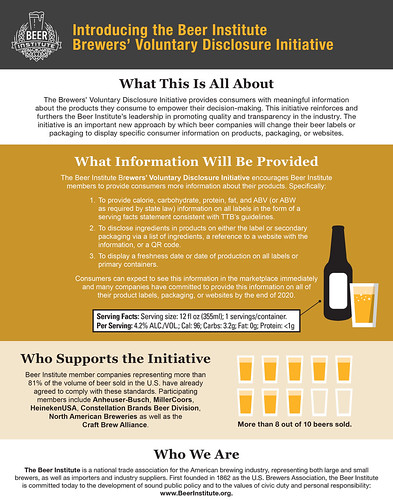
Going further, the Beer Institute, in 2016, created, what it called, the Brewers’ Voluntary Disclosure Initiative.

Brewers' Voluntary Disclosure Iniative

Participating breweries will voluntarily disclose
calories, carbohydrates, protein, fat, freshness dating; and alcohol by volume (ABV) on all labels in the form of a serving facts statement, and disclose ingredients in products on either the label or secondary packaging via a list of ingredients, a reference to a website or a QR code.

Again, easy for the big boys; difficult for the little guys. But you know what? As a beer consumer, I'd welcome transparency and honesty from the 'craft' breweries about their beers. Especially concerning the freshness of their beer or lack thereof. And make this declaration easy to see; easy to decipher. And I'd like to see that on both the can or bottle and on the carton.

I'd like to see that before I spend my $15 for a six-pack. (Kegs, too.)

-----more-----

Tuesday, February 09, 2016

Cider Industry Deserves Equal Regulation! Good laws for good apples.

Due to tax legislation that Congress passed in December 2015 (amending Section 5041(b)(6) of the Internal Revenue Code), cider —of modest alcoholic strength and bubbles— will soon be taxed at low rates similar to beer. Previously, cider could be taxed at much higher rates, at or exceeding those of wine.

Mt. Defiance "Farmhouse Style Hard Cider"

These changes were contained in the CIDER Act, which had been originally introduced in the House of Representatives in 2013 by Representatives Earl Blumenauer and Chris Collins (as the Cider Industry Deserves Equal Regulation Act) as well as in the Senate by Senators Charles Schumer and Patrick Leahy (as the Cider Investment and Development through Excise Tax Reduction Act).
  • Any cider with 7 percent alcohol-by-volume (abv) or up had been taxed at $1.17 per gallon, while any cider at 6.9 percent abv or lower had been taxed at $0.22. Now, with the passage of the CIDER Act, the upper abv limit, for the lower tax rate, will be 8.5%.

  • Any cider containing 6.4 grams per liter of carbon dioxide or fewer (equivalent to 3.25 volumes of CO2, in other words, like a highly carbonated wheat beer or a lightly carbonated champagne) will now NOT be additionally taxed (which had been a nonsensical situation). Above that carbon dioxide level, however, cider will be taxed at $3.30 per gallon. (The prior limit had been much lower, 3.92 grams of CO2 per liter, equivalent to 2.0 volumes, in other words, like a lightly carbonated cask-conditioned ale.)

  • As long as the abv of a pear cider (known as perry), is 8.5% or less, its tax rate will also be decreased, from the wine rate of $1.07 per gallon to the apple cider level of $0.226 per gallon. Above 8.5% abv: $1.17 per gallon. Carbonation will be untaxed, like cider, at or below a level of 6.4 grams CO2 per liter.
The changes take effect in December 2016.

CIDER Act passed.

-----more-----

Monday, February 08, 2016

Don't be a pillock!

Who would've thunk it? Budweiser and the incomparable Dame Helen Mirren collaborating on a brilliant anti-drunk-driving spot aired during Super Bowl 50.

Don't be a pillock!

The commercial opens with Mirren sitting at a table in a restaurant, a burger and fries in front of her. (That's chips for you non-Yanks.) A waiter brings her a bottle of Budweiser, the label turned somewhat from the camera. "Oh, my beer. Lovely," she thanks him. Mirren looks directly toward the camera and says:

Hello. I'm Helen Mirren, a notoriously frank and uncensored British lady.

The collective we are dumbfounded that people still drive drunk. So, I'll sum it up like this.

If you drive drunk, you — simply put — are a shortsighted, utterly useless, oxygen-wasting, human form of pollution, a Darwin award-deserving, selfish coward. If your brain was donated to science, science would return it.

So, stop it.

Now, the chances are you are a fun, solid, respectable human being. Don't be a pillock. Your friends and family thank you; the friends and families of other drivers thank you; your future self thanks you.

This is supposed to be fun. Cheers!

Mirren finishes by holding up a bottle of Budweiser, and slyly whispering: "Nice and cold."

Witty, powerfully direct, and succinct. Mirren did a public service announcement; she did a product placement; she got paid.

But, ah, Dame Mirren! What of Britain's culinary gift to the world? What of 'real ale'? Making fun of 'warm,' 'flat' beer? You know it isn't! And Anheuser-Busch? I saw what you did there. Making fun of less-than-ice-cold 'craft' beer? Clever bastards!


-----more-----

Wednesday, July 09, 2014

Your beer and excise taxes.

The next time you grumble about the cost of that beer you're holding, remember that, contrary to how much 18th century writer Samuel Johnson may have salivated, there are few in the 'craft' beer business growing "rich beyond the dreams of avarice."

So why is that beer expensive? One reason is taxation. Excise taxes, to be precise: the somewhat hidden, partial cost of a beer.

An excise tax is a Federal or state tax imposed on the manufacture and distribution —not the sale— of certain consumer goods, such as that beer you're holding (or glass of wine or shot of liquor). When you buy a beer, you can easily see —on your receipt— the sales tax you're paying. The excise tax, you won't see; it's already been figured into the cost of that beer.

The Federal Government's Take

The current Federal excise tax on beer is $0.58 per gallon ($18 per barrel). *

In contrast, wine is taxed at $1.07 per gallon, and spirits at $13.50 per 100-proof gallon (i.e., 50% alcohol). Per serving, that's 5¢ for a 12-ounce beer, 4¢ for a 5-ounce glass of wine, and 13¢ for a 1.5 ounce shot of liquor.1

In 2012, federal excise (and import) taxes on beer procured $3.6 billion for the U.S. government's coffers, $1.036 billion from wine, and $5.4 billion from liquor. As much as that might appear, excise taxes accounted for only 9% of the total Federal taxes collected that year.2

Don't Forget The States' Cut

The states want in on that money pile. Under the Constitution, they cannot impose tariffs on goods brought in from other states. But they can charge excise taxes on those goods —like beer, wine, and spirits— if they're made in the state or distributed within the state (a distinction which might seem a bit like constitutional semantics, except that, unlike excise taxes, tariffs can only be levied by the Feds, and only on foreign goods, sometimes selectively or punitively).


Tennessee has the highest beer excise tax rate of any state in the country: $1.17 per gallon. Wyoming, the lowest: 2¢ per gallon.3 YFGF's home territory is Washington, D.C., Maryland, and Virginia. In those jurisdictions:
  • The District of Columbia excise tax on beer is $0.56 per gallon, one of the higher rates in the country.
  • The Maryland excise tax on beer is $0.44 per gallon, also high, but less than D.C.'s.
  • The Virginia excise tax on beer is $0.26 per gallon, lower than its neighbors, and right in the middle, nationally. (In contrast, Virginia's excise tax on wine, and on liquor, is $20.91 per gallon. Both of those rates are the third highest respectively, among all states.)
So, doing some back-of-the-bottle calculations, when you pay for a bottle of beer in Washington, D.C., 10¢ of that cost is for excise taxes —Federal and city— and this excludes the sales tax. In Maryland, the total of Federal and state is 9¢; in Virginia, 7¢.

Except not. You're actually paying more, even though not all to the government.

The Multiplier Effect

When a brewery sells a beer to a wholesaler, it marks up (increases) the total cost of the beer, including the taxes, by a certain percentage, to cover costs and make a profit, i.e., pay the brewers, etc. The wholesaler does the same, by a certain percentage. And a store or restaurant does the same. It's a multiplier effect (a non-governmental Value-Added Tax, if you will) which can add 40¢ or more (or much more, as in Tennessee) to the price of that bottle of beer, just from the excise taxes alone.

Size Matters

* I stated, above, that the Federal excise tax rate was $18 per every barrel of beer that a brewery produces. That statement was not precisely correct.

If a brewery produces fewer than two million barrels of beer per year, its Federal marginal excise tax rate is $7.00 per barrel for the first 60,000 barrels it brews that year, but $18 per barrel for any production above that. But, if that brewery produces more than 2 million barrels, its rate is $18 for each and every barrel.

Thus, by tax rates, the U.S. government can be said to define a small brewery as producing fewer than 2 million barrels of beer. In contrast, the Brewers Association —the advocacy association for small, 'craft' U.S. breweries— defines a small brewery as producing 6 million barrels or fewer.4 (Among 'craft' brewers, only Boston Beer (maker of Sam Adams) and Yuengling produce in excess of 2 million barrels.)

Excise Tax Reduction

There are moves afoot to reduce those beer-excise taxes, at least on the Federal level.

The Brewers Association supports what is known as the Small BREW Act, excise tax relief for small breweries.
The Small Brewer Reinvestment and Expanding Workforce Act (Small BREW Act), HR 494 , was introduced in the 113th Congress, on February 5, 2013, by Representatives Jim Gerlach (R-PA) and Richard E. Neal (D-MA). Joining as original co-sponsors of the bill were Representatives Peter De Fazio (D-OR), Erik Paulsen (R-MN), Earl Blumenauer (D-OR) and Patrick McHenry (R-NC).

On May 9, U.S. Senators Ben Cardin (D-Maryland) and Susan Collins (R-Maine) introduced S. 917, and were joined by 16 of their Senate colleagues who signed on as original co-sponsors.

The Small BREW Act seeks to reduce the small brewer federal excise tax rate on the first 60,000 barrels by 50 percent (from $7.00 to $3.50/barrel) and institute a new rate of $16.00 per barrel on beer production above 60,000 barrels up to 2 million barrels. Breweries with an annual production of 6 million barrels or less would qualify for these tax rates.


Then, there's the BEER Act (Brewers Excise and Economic Relief Act), an excise tax reduction for all breweries, large and small. It's promoted and supported by the Beer Institute, a trade association putatively for and of all U.S. breweries and beer import companies, but founded by the large brewing companies in 1986 (whose dues are still its major driver).
The Beer Institute supports the Brewers Excise and Economic Relief Act of 2013 (BEER Act). This bipartisan, bicameral legislation would reduce excise taxes for all brewers and beer importers, and ultimately reduce taxes for all beer drinkers.
  • Small brewers would pay no federal excise tax on the first 15,000 barrels;
  • Small brewers would pay $3.50 on barrels 15,001 to 60,000;
  • Small brewers would pay $9 per barrel for every barrel over 60,000 and up to 2 million barrels;
  • For brewers producing more than 2 million barrels annually, and for all beer importers regardless of size, the federal excise tax rate would be $9 per barrel for every barrel.

These bills have been in front of Congress for a few years now, and nothing has come of them. If you believe that such excise tax reductions would be a good thing for breweries —and for you, the beer consumer— contact your Representative and Senators about supporting one of these provisions.

Taxes, revenues, mark-ups. After all of these, I think that now would be a good time for a beer.

-----more-----

Wednesday, January 08, 2014

Grilled cheese AND a pint, to go!

This just in! Now, you can have your grilled cheese and your pint of beer ... and take 'em both home.

Pubs and restaurants in Virginia have been allowed, for a few years now, to sell draft beer-to-go in 'growlers,' one or two-quart re-sealable glass containers. Just recently, the Virginia Department of Alcoholic Beverage Control (VABC) stated that these establishments could also sell draft beer-to-go in 16-ounce vessels, which are commonly known as ... pints!

The first pub to take advantage of this interpretation was Falls Church, Virginia's Spacebar, which began filling mason jars with pints of draft beer-to-go, yesterday evening (7 January 2014).


As is the case in such matters, the lack of a prohibition does not, ipso facto, imply permission. So, under an abundance of caution, Spacebar's owners, Lary and Erica Hoffman, had first asked VABC officials if a close-able one-pinter could be specifically considered an acceptable "alternate" vessel, under the agency's definition of "growler." The answer came back, they're "not prohibited." AS in: yes!

Spacebar offers 24 different draft beers and just about the same number of grilled-cheese sandwiches. The pub opens at 5 pm. Early in the evening, many neighborhood folk, returning home from work, purchase these cheese sammies as take-out. The traditional two-quart sized growler might be too much libation for the nosh; but a pint, just right.

-----more-----

Sunday, March 17, 2013

Maryland's good laws for good beer

The Maryland House of Delegates is considering several bills that would benefit breweries in Maryland. Here's more about that, from the Brewer's Association of Maryland (BAM) —the non-profit trade association of Maryland brewing companies:

Brewers Association of Maryland

This past week we brought Maryland House Bill 4 to your attention. If passed, this bill will allow Maryland breweries to sell beer by the glass in their taprooms.

House Bill 4 (HB 4) was scheduled for a vote in the Economic Matters Committee this past Monday, but was delayed because of the overwhelming response from supporters of Maryland beer. The lead Sponsor of the legislation, the Honorable Delegate Jeannie Haddaway-Riccio of the Eastern Shore, has tirelessly stood tall in the name of Maryland Beer. She deserves our thanks; as well as our admiration.

Many craft breweries around the country are already able to sell beer by the glass. The passing of HB 4 will enable manufacturing breweries to grow their taproom experience, entertain more impromptu visits, increase tourism, and grow business across the state.

Steam brew (01)

The Brewer's Association of Maryland continues to assert that as more people are able to visit Maryland breweries, sales of craft beer will increase, not only in those breweries, but also in other small businesses such as local restaurants, pubs, and beer stores throughout the community.

When successfully passed, HB 4 will be scheduled to be signed by Governor O’Malley, and will go into effect July 1, 2013.

The bill's Senate analogue is SB32, sponsored by Senator Richard Colburn, of the Eastern Shore.

According to BAM, there are a few more brewery-related bills up for consideration. Senate Bill 955 would permit production breweries (that is, not a brewpub) to fill and sell growlers to go. Both this and HB4/SB32 would put Maryland breweries on the same footing as breweries in Virginia and the District of Columbia, where laws were only recently changed to permit beer to be sold by the glass for consumption in brewery tasting rooms and to allow the sale of filled growlers of beer.

House Bill 230 would allow farm breweries to contract with brewpubs to produce beer for the farm brewery with ingredients grown on the farm.

Brewery on a hill: Stillpoint Farm (02)


And, finally, HB231/SB223 would allow brewpubs to self-distribute the beers they brew to other restaurants and shops. J.T. Smith —the Association's Executive Director— adds that "this is an incubator policy for brew-pubs to self-distribute up to an annual limit [to be determined] at which point they will go into 'normal' distribution via the 3-tier system." The neighboring state of Virginia has set up a public-private program to assist small wineries in that state (but not small breweries).

This is good work by the Brewer's Association of Maryland on behalf of its twenty-six members. If you live in Maryland, support the effort by contacting your state Senator and Delegate, and urge their support of the bills. It makes good political sense; it makes good local business sense; it makes good beer sense.

UPDATE: Passed and signed into law.
House Bill 4/Senate Bill 32: Allows for a Class 5 Production Brewery to sell beer by the glass to the general public, provided they are of legal drinking age. The proposed bill positively impacts the local municipality, county, and state as it:
  • attracts additional tourism activity
  • further supports business development local to a Class 5
  • results in the hiring of additional employees
  • increases tax revenue
  • works to equalize competition between Maryland and adjacent states
  • does not undermine current business plans of retailers or wholesalers residing in the state
  • aides a start-up Class 5 to see immediate financial return, while developing their brand with consumers

-----more-----

Saturday, February 11, 2012

Pic(k) of the Week: Bootlegger's Beer Dinner 2012

Bootlegger's Beer Dinner 2012

The remains of a successful beer dinner ...

The 2nd annual Bootlegger's Beer Dinner, sponsored by DCBeer.com, at Smith Commons Restaurant, in Washington, D.C. Five beers not normally found in the city were 'imported' via the internet, and served, each paired with a different course.

31 January 2012.

****************
Amuse-bouche
Chicken Wings in Duck Fat, with Gorgonzola-Apple Glaze

First Course
Lime & Orange Macaroons / Foie Gras Mousse
Paired with Lost Abbey (San Marcos, California):
Inferno Ale pale ale (8.5% alcohol-by-volume).

Second Course
Goat Cheese Ravioli / Duo of Raisin Purée & Citrus Pop Rocks
Paired with Hair of the Dog (Portland, Oregon):
Fred strong ale (10% alcohol-by-volume).

Third Course
Braised Pork Belly / Coffee Migas, House Smoked Bacon Lardon, Smoked Espuma
Paired with Alaskan Brewing (Juneau, Alaska):
Smoked Porter porter (6.5% alcohol-by-volume.)

Fourth Course
Sous Vide Shrimp Dumplings / Dashi, Quail & Yuzu
Paired with Cigar City Brewing (Tampa, Florida):
Guava Grove saison (8% alcohol-by-volume).

Dessert Course
Coconut Pudding / Lavender Ice Cream, Vanilla, Dried Caramel
Paired with Alchemist Brewery (Middlebury, Vermont):
Heady Topper IPA (8% alcohol-by-volume)

Lagniappe
Flying Dog Brewery (Frederick, Maryland):
2008 vintage Horn Dog Barleywine (10.2% alcohol-by-volume).

********************

  • I manipulated the photo using the CinemaScope effect from Picnik, an on-line photo editing site. See the un-retouched original: here. Picnik is to be discontinued by Google on 19 April 2012.
  • See more photos from the dinner, all courses and beers: here.
  • Unlike most other states and cities, D.C. is liberal (small 'l') when it comes to the availability of beer, wine, and spirits. Bars, restaurants, or shops with a liquor license can act as their own importer of alcoholic products. Read more from the Washington City Paper: here.
  • Pic(k) of the Week: one in a weekly series of personal photos, often posted on Saturdays, and often, but not always, with a good fermentable as subject. Commercial use requires explicit permission, as per Creative Commons.

Wednesday, February 08, 2012

YOU can assist Virginia breweries. Support SB604 ...TODAY.

If you're a fan of local breweries —of local Virginia breweries— please consider taking a few minutes to register your support of a simple bill currently in front of the Virginia Senate which, if passed and signed, would allow Virginia breweries (almost all of whom are 'craft' breweries) to pour samples for customers at their facilities during tours and to sell beer-to-go.

The Virginia General Assembly is currently in session. There is a bill, SB604, before the Senate that would greatly benefit many of the craft breweries in Virginia. This bill will be heard in the Senate Rehabilitation and Social Services committee this Friday, February 10th at 8:30am.

SB604 allows a brewery licensee to sell beer at retail at premises described in the brewery license for on-premises consumption and in closed containers for off-premises consumption. In layman’s terms, production breweries would be allowed to sell pints to customers. If passed, you could tour a Virginia brewery and enjoy a pint afterwards, much like how you can enjoy a glass of wine at a Virginia winery. More importantly, this would put us on even footing with some of our neighboring states.

If you're a Virginia citizen, contact your state Senator and ask them to support SB604. Find your state legislator online: here.

Thank you,
Mike Killelea
Chairman – Virginia Craft Brewers Guild


Support Virginia Senate Bill 604

The Virginia Craft Brewers Guild is an association of small breweries in Virginia. As a member of a larger state group, the Virginia Manufacturers Association, it brought this alert to the attention of the Brewers Association, the national advocacy group for small breweries in the United States (defined as, among other criteria, producing less than 6 million barrels per year).


UPDATE 29 February 2012.
Committees in both the Virginia House and Senate have unanimously approved the bill. It now goes to the full floors of both.

***************
A hat tip to the many Tweeters who support Virginia beer, and who alerted me and many others to this bill. A list would include, among others, @VA_BeerGeek, @RVABeerMan, @BarlowBrewing, @RobSmithiii, @HopGoddess76, @RVABeerMeister.

BYOW in VA & DC, NOT in MD

If the government wrote a law, would anyone notice? In his blog, WineLine, Dave McIntyre—who also writes a wine column for the Washington Post— posted this yesterday:

[In Virginia], it is legal for restaurants to allow customers to bring their own wine for dinner. The practice, called “corkage,” was legalized in Virginia last July 1 [2011]. But hardly anyone – restaurants or customers – knows about it.

Virginia's law sets no requirements on how much (or a how little) a restaurant may charge (the so-called corkage fee) or on whether or not the restaurant is required to allow a customer to bring in wine. That decision still remains with the individual restaurant.

I contacted two restaurateurs —one in Richmond, Virginia, and one in northern Virginia— for their opinions on the law change.

Julia Battaglini is the proprietor of Secco Wine Bar in Richmond, Virginia. She wrote:
As many of you may have heard, Virginia passed a law such that, as of July 1st, 2011, ABC-licensed restaurants may choose to allow diners to bring in their own wine and charge a "corkage" fee. After much thought, gnashing of teeth and heated debate, I have decided that Secco Wine Bar will offer a corkage option to our patrons at a $20 fee. HOWEVER, if that bottle comes from River City Cellars [next-door wine shop] we will offer a discounted corkage fee of only $10.

While I have pretty strong feelings as a restaurant owner (and the person who spends half her waking hours agonizing over and maintaining a list of 50+ uncommon, small-production, terroir-driven selections meant to match Chef Tim's ever changing food menu), I also realize there are special, rare bottles in this world meant to be shared, and a pretty rockin' wine shop right next door.

I do, however, reserve the right to trounce anyone who shows up with two buck chuck.


Photo courtesy Julia Battaglini

Adam Roth operates his restaurant, Argia's, in Falls Church, a jurisdiction found only eight miles from Washington, D.C., where BYOW and corkage fees have long been allowed. He said:
I'm all for the corkage law. Who knows how much business northern Virginia restaurants have lost to D.C. before it was passed. We've had people take advantage of it already in just one week. There is no good reason that it shouldn't be allowed. Hopefully, there is more reform to come to Virginia 'Blue laws' that really hurt Virginia businesses and the Commonwealth's tax payers.

We charge a $20 flat fee with no limit on bottles (within reason and propriety). Free corkage on Tuesday nights.

Restaurants mark up the price of wine (and beer and spirits) to cover costs of food and labor and rent). Thus, the cost of one's meal is the cost of the entire restaurant 'experience' —and for not having to wash the dishes. That being said, a customer who brings in a bottle of wine is indeed a customer, one who otherwise may not have been one.

A similar proposal in Maryland failed in 2011, opposed, ironically, by the Maryland Restaurant Association. But, in a gloriously inane exception, Maryland restaurants that do not have a liquor license are permitted to allow customers to bring in their own wine.

Bauer Grüner Veltliner

But, what if you wanted to take an unfinished bottle of wine home with you?

As long the bottle were securely resealed, that would be okay in Maryland. If you were in Washington, D.C., that would be legal as long the restaurant 'officially' re-sealed the bottle. But ... don't do it in Virginia! You'd be in violation of the 'open-container' law.

***************

  • The National Restaurant Association has published a pdf of the current state of 're-seal' wine laws: here.
  • I'm several months tardy with this post. Battaglini and Roth both gave me their opinions soon after the law was passed in July.
  • Re-sealable beer? That's another tale for another day.

Saturday, August 21, 2010

Pic(k) of the Week: A Smoking Romance

A couple shares an intimate moment —smoking together— outside Fire Works, an Arlington, Virginia, restaurant.

Smoking romance


Smoking has been prohibited inside Virginia restaurants since December of 2009. In nearby Falls Church City, police recently arrested 13 people for smoking, and allowing smoking, inside several restaurants.

***************
Pic(k) of the Week: one in a weekly series of personal photos, usually posted on a Saturday, and often of a good fermentable as subject.

Wednesday, March 03, 2010

Guns and breathalysers

The Virginia General Assembly has passed a bill permitting concealed weapons in restaurants. This 'corrects' an earlier law that had allowed only openly carried weapons.

If signed by the Governor, the law will prohibit "those who pack guns from drinking [alcoholic beverages]" in establishments serving alcohol. There are no bars, per se, in Virginia. Establishments which are allowed to serve alcohol must also serve food prepared on-site.

This begs some questions. If a weapon were concealed, how would the bartender know this? Would he/she be complicit in violating the provision?

"ID, please. Up against the wall, and spread 'em!" [The story here.]

Maryland is considering car ignition interlock devices for first-time offenders of alcohol violations. A breathalyser would prevent a car from starting if any alcohol were present in the breath of the driver. Presumably non-entertainment purposes might interfere with the ignition, such as, for example, mouthwash. The bill catches with a wide net: intoxication has not been, and cannot be, demonstrated to be the same as having one standard drink. [The story here.]

Here's a modest proposal.

If there were more public transportation, wouldn't there be less driving? If there were more sidewalks, wouldn't more residents be able to walk safely? If state and local governments would relax suburban zoning laws, might not there be more neighborhood pubs to which adults could walk ... rather than drive?

Let a thousand pubs bloom!

Saturday, December 05, 2009

The Three-Tier System

You might have to be a lawyer to understand the legalities and intricacies of the US alcohol distribution network, originally set up after the repeal of Prohibition in 1933. And even that might not be sufficient.

In most states, a shop or restaurant may only purchase alcoholic beverages from a wholesaler (or the state or municipality) and often it may only buy a particular beverage from the wholesaler designated by the state to purvey it.

This is commonly referred to as the three-tier-system, that is: producer, wholesaler, and retailer. It is regulated in each state by an agency named the ABC (Alcoholic Beverage Commission) or something similar.

In many states, when a contracts is signed between a brewery (winery, distillery, etc.) and a wholesaler to give distribution rights to that wholesaler in that area, that contract remains legally binding in perpetuity. Forever.

(There is an escape hatch, however, from 'forever'. A contract can be purchased or sold for a mutually agreeable amount, commonly the equivalent of gross sales over the period of one to three years.)

The primacy of the states in such matters — and the three-tier system itself— has been challenged in Federal court.

Tuesday, May 05, 2009

UPDATE: 2007 Milwaukee Beer Party Protest

Here's an update of a story I first covered in July 2007. The Wisconsin legislature, prodded by local brewers, had set out to repair an outmoded restriction on dual-location beer production. But in the process, the legislators mandated that ...

each location serve at least 40% food over beer, and that all locations serve either draft beer or from bottled beer - not both. <...>

Thus if you would want to add a production facility to bottle the beer that you've been producing draft-only at your brewpub, you would be required to serve food at your bottling facility, but you would be forbidden from serving draft beer at your brewpub.

Several small breweries and brewpubs held a protest yesterday afternoon in Milwaukee to bring attention to this illogical bill. They cracked the bungs on old-style kegs (Hoff-Stevens) and allowed the beer to spray out into the Milwaukee River.

My source had been Michael Horne of MilwaukeeWorld. Better late than never, I recently sought him out to inquire about what had happened.
The distributors won, the beer dump made it onto the Today show. (It's on You Tube as Spirit of '07 Beer Protest and Demonstration). Part of the legislation lifted the self-distribute limit to 10,000 bbls. and permitted beer tastings at retail establishments.

So we went ahead and started a beer ourselves and named it after the historic intersection where our offices are located in Milwaukee -- just upstream from the "Demonstration" site. Now we scurry about promoting Buffalo Water Bison Blonde All Malt Lager Beer with good results.

The beer is designed to pair well with Buffalo Wings, and we are at a number of BW3 restaurants, large groceries and maybe 100 taverns in the area. We started with large accounts at retailers, and then filtered down to smaller locations -- rather opposite of what many others have done.

I would recommend folks consider lobbying their states to permit on-site sampling of beers as is permitted in Wisconsin -- and not too many other places.


Not all distributors have bad intentions —Beer Wars Movie notwithstanding— but they do have different goals than breweries. Where those goals coincide —increasing sales of a particular brand— is where cooperation can be fruitful.

Caveat: As a brewery representative, I have worked with honorable and helpful distributors. And, currently, I work for a wine and beer distributor in northern Virginia.