Showing posts with label beer dinner. Show all posts

Saturday, November 18, 2017

Pic(k) of the Week: Mssrs. Beaumont & Webb

Mssrs. Beaumont & Webb (03)

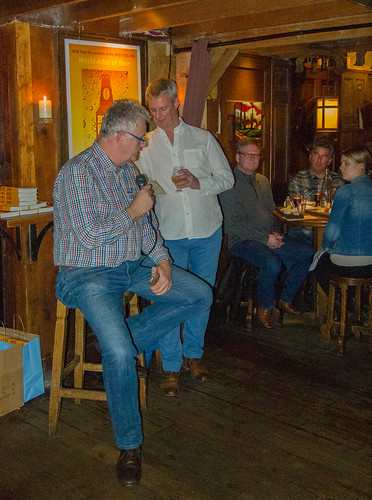
Quad is NOT a style!” insisted Stephen Beaumont, as he and Tim Webb presented the just-released edition of their new book —Best Beers: The Indispensable Guide to the World’s Beers— to a 50+ filled room (attendance, not all demographics), upstairs at the Brick Store Pub, in Decatur, Georgia, on 14 November 2017.

Among many beery accomplishments, Tim Webb is also the author of The Good Beer Guide Belgium, first published in 1992, and now in its 7th edition (the latter co-authored in 2014 with Joe Stange). The 8th edition is scheduled for release in spring 2018; in fact, Webb was working on the final revisions during this America trip. Sadly, it will be his last update to the series.

Stephen Beaumont, in his own words, has been ...
lucky enough to have spent the last 25 or so years sipping and savouring beers and spirits all around the world, and getting paid to write and talk about it. Along the way, I’ve managed to author or co-author ten books, beginning with the first of two editions of The Great Canadian Beer Guide back in 1994. [...] Among my other books, I’m extremely proud of The World Atlas of Beer, which I co-wrote with Tim Webb and has now been printed in eleven international editions in nine languages.

In previous editions, Best Beers: The Indispensable Guide to the World’s Beers had been entitled The Pocket Guide to Beer. This was both because that is what the books had been and because, to some degree, Messrs. Webb and Beaumont wrote them as an homage to the late beer writer, Michael Jackson, who had begun the Pocket Beer series in 1986.

For the 2017 edition, the authors have retitled and re-tooled the book to include fewer beer reviews. And why is that?
Our own very conservative estimate places the global brewery total at over 20,000, but it is likely that there are many more than that. [...] The worldwide count of regular beers is fast closing on a quarter-million, and when one-offs are included, doubtless well beyond it. [...]

So, you might ask, why create a book that features even fewer beers? The answer is focus. Rather than attempt to deliver a cross-section of breweries spanning the globe, we have assembled a carefully selected group of what we firmly believe are the best minds in beer [listed at the back of the book] and tasked them to deliver detailed reviews of the absolute best beers their native lands have to offer. Not the most talked about or rarest or the most obscure, but simply the finest ales and lagers and mixed-fermentation beers that eager enthusiasts might actually be able to get their hands on. Star ratings have been dispensed with because all the beers we have featured are at the top of their class.

That evening in Georgia, the audience was served anecdotes and appetizers, cheeses and full plates, and six beers, too (but no quadrupels). The presentation was recorded; at some point, I'll post a transcription, including Beaumont's quad rant and Webb's saison rant. In the meantime, here is another, less 'artistic' view of Mr. Webb (left) and Mr. Beaumont (right):

Mssrs. Webb & Beaumont (01)

-----more-----

Monday, November 21, 2016

A Twist on Tradition: The Right Beer, Thanksgiving Dish by Thanksgiving Dish.

Dining partners, regardless of gender, social standing, or the years they've lived, should be chosen for their ability to eat - and drink! - with the right mixture of abandon and restraint. They should enjoy food, and look upon its preparation and its degustation as one of the human arts.
M.F.K Fisher

Beer for Thanksgiving? Yes! But as to what beer to drink with which dish, let the curators drink alone. There are no rules, but only enthusiastic suggestions.

Be that as it may, maybe a non-dank pilsner, or a spicy, dry (that's the key) saison or dubbel, or, if you're so blessed, a cask-conditioned bitter: sip, pull, and repeat. (Or, okay, a dry IPA.) Beer drunk with cheese; with everything else, don't make beer the star, just the pal. Maybe with sweets, it should be sweeter. Over-hoppy-ed examples? They belong in long special-release queues; over-alcohol-ed, with postprandial digestive stupors.

Pretty in Pink Saison

But, above all, this should be fun. And it's all been done before.


************

A Twist on Tradition: The Right Beer, Dish by Dish

In 1983, the late British beer writer Michael Jackson commented upon American Thanksgiving for the Washington Post. In A Twist on Tradition: The Right Beer, Dish by Dish, Jackson wrote on drinking beer, not wine, at the Thanksgiving meal. The principles endure, even if the beers have been superseded by latter-day choices.

[N.B. Jackson's essay is unavailable to read at the Washington Post, even via the paper's archive service. Fortunately, The Beer Hunter, Real Beer's archive of Jackson's writing, has preserved it. And, from there, re-printed here.]

A Twist on Tradition: The Right Beer, Dish by Dish
Shared Glass

By Michael Jackson
Special to The Washington Post
Nov 16, 1983.

Everyone knows what to eat on Thanksgiving, but what to drink? The most dismal Thanksgiving I can imagine is the one detailed by Dale Brown in his definitive work "American Cooking": "A glass of spring water stood at each place. No wine here, not ever - except perhaps when the men drank it in the barn." So what should it be next week: A little Seawright Spring Water, from the Blue Ridge Mountains? Or, to be moderately more chic, a glass of Perrier - while the men drink Zinfandel in the garage?

Water taken in moderation cannot hurt anybody, as Mark Twain observed. Those watery celebrants, however, were guilty of what Twain termed "intemperate temperance." There is an idea, whose time has surely gone, that, because they were Puritans, the Pilgrims did not drink alcohol. I have heard of poor souls in New England who, in glorification of this myth, affect to enjoy glasses of cranberry juice with their Thanksgiving meal.

To give thanks is a matter of joy; should that be confined by excessive sobriety? Better still, Thanksgiving is an annual opportunity to refresh old friendships and make new ones, in which matter both the ritual and effect of a shared glass is the best tie.

Wine should be more than acceptable at this feast, for even the most ordinary meal without the grape is, proverbially, like a day denied sunshine. Unless, of course, you prefer beer.


In Europe, whether you drink wine or beer with your meal may depend simply upon where you live.

On this choice between wine and beer, there is a snobbism which is particularly American.
In Europe, whether you drink wine or beer with your meal may depend simply upon where you live.Wine is the natural drink in the hedonistic, warm, grape-growing countries of the South, like France, Spain and Italy. The diligent folk of the Protestant North, whence the Pilgrims came - from The Netherlands and England - grow grain and make beer.

There is some significance, too, in the fact that the social cultures are similarly split on the question of hard liquor. The Catholic South produces various types of brandy; the Protestant North makes gin (in The Netherlands and England) and whisky. As a matter of fact, the birthplace of gin was the city of Leiden, in The Netherlands, one of the points of departure for the Pilgrims. Gin was originally produced as a medicine, and was customarily taken on sea journeys.

Suspicions about the Pilgrims' drinking habits must mount when it is noted that their other two points of departure, London and Plymouth, are the English towns most associated with the distillation of gin. Perhaps there is a vestige of tradition in the only recognized cocktail for Thanksgiving, which is gin-based. It also includes lemon juice (to combat scurvy?) and, incongruously, apricot brandy and vermouth.

The Thanksgiving cocktail is presumably intended as an aperitif, and it sounds moderately awful. Better to precede the meal with a beer and carry on in the same vein. This pays homage to the priorities of the Pilgrims.

When the Pilgrims sought a place to make their permanent landing in America, they did so, according to their diaries, "our victuals being much spent, especially our beer." Having thus landed because they had run out of beer, they probably set out to make some, perhaps using birch sap (Captain Cook did the same with spruce when he landed in New Zealand).

A more conventional type of beer - a darkish and broadly English ale - was last month (October) brewed especially for a commemorative dinner at Plymouth Plantation, the "living museum" of Pilgrim life, in Massachusetts. Such delight has been expressed over this beer that the Plantation now hopes to secure a regular supply from its source, a home brewery called William P. Byrnes.


Just as the wine-drinker can choose a different style to accompany each course of his Thanksgiving meal, so can the beer-buff.

Just as wine has attained a hint of sophistication since the days when it was consumed surreptitiously in the barn, so beer has gained a degree or two of refinement since it was brewed from birch sap. Today's wine drinker has an elegant choice of varieties, styles, vineyards and regions from which to select, and the choice before the beer-buff is arguably even greater. Just as the wine-drinker can choose a different style to accompany each course of his Thanksgiving meal, so can the beer-buff. In either case, so to speak, it might be fastidious to the point of pedantry to plough through six or seven different wines or beers (though it would make for a roseate Thanksgiving); in practice, three or four would be plenty. Let us, nonetheless, explore the possibilities.

As an aperitif, a wine-drinker might well choose a fino sherry: intensely dry, individualistic and with its own freshness and vitality. Precisely the same characteristics are to be found in a magnificent beer called Orval, which is brewed in a monastery in Belgium and is now a quite widely available import in the United States. Like some fine wines, it throws a sediment, so decant it carefully into the glass. It should be only lightly chilled, to what would be a natural cellar temperature, ideally about 55 degrees F. Orval has an alcohol content of more than 4.5 per cent by weight; about 5.75 by volume.

Since the Pilgrims were Protestant, purists might object to a beer from a Catholic monastery. An alternative might be to cleave to the good old Scottish name of Ballantine and the famous American beers behind that label: not the regular beer, nor the basic Ballantine Ale, but the same company's quite different I.P.A. (India Pale Ale). This type of beer was originally brewed by the Scots and English for long sea voyages to the Empire. Ballantine's I.P.A. was first brewed in the Northeast of the United States, where it has a staunch following, though it is now a national product. It is a dry, aromatic ale of about 6.0 per cent by weight; 7.5 by volume. Like all ales, it expresses its palate most fully at a natural cellar temperature.

With oysters, the wine-drinker would opt for Chardonnay, Muscadet or, best of all, Champagne. On the question of beer, there is no doubt: it has to be a dry stout, preferably Guinness or one of the Irish examples like Murphy or Beamish, which are occasionally to be found in the United States. Perhaps it is that dry, tangy quality that makes such a wonderful success of the unlikely marriage between big, black beers and delicate shellfish. No one has been able wholly to analyze the magic, but dry stout and oysters are a long-honored partnership in Ireland. If you feel that an American feast should be more patriotic, substitute a native porter like Pottsville (from Pennsylvania) or Narragansett (originally from New England, of course, though again now national). Serve these beers only lightly chilled or better still, half-and-half with cold Champagne, in a flute. Stouts generally have an alcohol content of around 4.0 per cent by weight; 5.0 by volume.


Two labels are imported: one from the Lindemans farmhouse brewery and the other under the commercial Belle Vue trademark.

For both wine and beer, one of the most difficult relationships is with salad, whether savory or fruity. Wine-writer Hugh Johnson has an interesting approach to this question: the character of a wine is assassinated by vinegar. So, in your salad dressing, use wine instead. An impudent extension of this theory would be to use a wine-like beer. This is an opportunity to try one of the world's most unusual beer-types: gueuze, a specialty of the Senne valley, near Brussels. This is one of those beers that gain a special fruitiness from the use of wheat in addition to the normal barley. More important, as in traditional wine-making, it is fermented with wild yeasts, in wooden casks. It has a tart, vinous, perhaps even cidery, character and is in its native country regarded as the most refreshing type of beer for summer. Two labels are imported: one from the Lindemans farmhouse brewery and the other under the commercial Belle Vue trademark. To serve gueuze with (and in) a salad might prove quite a coup. An even bolder stroke would be to present its companion beer, kriek, with a fruit salad. This is a beer of the same basic type but with the addition of dark cherries in the maturation cask. Both Lindemans and Belle Vue have kriek beers in the American market. Gueuze beers generally have an alcohol content of around 4.5 by weight or 5.5 by volume. Kriek comes out at about 5.0; 6.0. They are best served lightly chilled. Alternatives might be the German wheat beers, Berlin weisse and Bavarian weizen respectively. There is no American counterpart to any of these products at the moment, though wheat beers were produced in the U.S. before Prohibition and one brewer is toying with the idea of reintroducing them.

With the centerpiece of the meal, the turkey, the wine-drinker has a difficult choice. Should it be a medium-dry white? Or a drier, medium-bodied red? Among beers, I would opt for a pale but medium-dry brew of the type produced in the city of Munich and elsewhere in Bavaria. This type of beer features in the extensive portfolios produced by all the famous Munich brewers: Augustiner, Hacker-Pschorr, Hofbrau, Paulaner and Spaten. In this instance, though, check to make sure that what you are buying is described in one way or another as the brewery's Light beer. It may be designated as Munich Light, Light Reserve or Light Export or have some similar sobriquet, perhaps even the irreverent-sounding German counterpart Hell. These descriptions refer to a light color, and most definitely not to body; nothing quite like these beers is produced in the U.S., and they are not intended to quench the thirsts of footballers.

With just a hint of sweetness to match some of the turkey's accompaniments, these Munich Light beers have plenty of body without being too filling. Their alcohol content is pretty ordinary, at well under 4.0 per cent by weight or 5.0 by volume. As for serving temperatures, the simplest rule to observe is that any beer from Munich or elsewhere in Bavaria should be served chilled but not to American popsicle level; not less than 48 degrees, in fact.

A more pronounced sweetness is clearly required to go with the pies, and this might be a case for the chocolate-colored Munich dark (around 4.0; 5.0) or the stronger, amber Marzen or Oktoberfest beers (4.5; 5.5), from the same selection of breweries. Among dark beers alone, these Munich breweries produce so many different varieties that intrepid drinkers have a considerable challenge on their hands. It might be advisable at this stage to retire gracefully, but you don't have to....

After dinner, instead of a brandy or port, the determined drinker will return to Munich for a bock, (5.0; 6.25) or even a double one, a doppelbock, (6.0; 7.5). All double bock beers have names ending in -ator, in deference to the original, Salvator ('Saviour'). This sounds like a suitably religious beer with which to salute the Pilgrims, though celebrator is another fitting label. Only the brave will try E.K.U.'s Kulminator '28', which has an alcohol content of around 10.0 per cent by weight, 12.5 by volume and is the strongest regularly-produced beer in the world.

By the time the nuts come round, anyone still fit to drink might opt for a Madeira or perhaps a sweet stout like Mackeson, from England, at around 4.0; 5.0. Serve this one at room temperature, preferably in a big, leather armchair.

Some foods are perhaps less well suited to wine than to beer. Shellfish go well with either but sushi, for example, has a happy relationship with a light Japanese or American beer. The same is true of any spicy Oriental food. Naturally enough, smoked meats and sausages are perfectly accompanied by German beer. Perhaps the happiest combination of all is red meat, especially roast beef, with English Pale Ale. Here are some simple guidelines.

As an aperitif: Dry, hoppy beers with some bitterness. Try New Amsterdam (from New York) or Anchor Steam (San Francisco).

With fish: Pilsners. Almost all of the well-known American beers are loosely of this style. So are the best-known imported brands, like Heineken and Carlsberg. Czech and German Pilsners tend to be drier, and therefore go especially well with the more oily varieties of fish.

Shellfish: Dry stouts or porters.

Smoked meats, sausages: If you can find it, the smoked Rauchbier of Bamberg, Germany. Or a German altbier or weizenbeier.

Pasta: The less spicy pasta dishes of Northern Italy go quite well with the Munich Dark type of beer. It is, after all, commonly served with the admittedly-heavier noodle dishes of Germany.

Fowl: Munich Light with turkey; perhaps the slightly less sweet Dortmunder style might go better with chicken.

Red Meat: English Pale Ale.

Game: Scottish ale, which is heavier.

The myth that American beers are especially weak derives in part from the use of U.S. regulations of the alcohol-by-weight measure. This produces lower figures than the measure of alcohol by volume. A typical American beer of 3.75 alcohol by weight would have almost 4.7 by volume. This is typical of ordinary beers in many parts of Europe. The beers mentioned in this article are inclined to be stronger because they are specialties. Alcohol by volume is the best guide for the shopper because it is the system used on wine labels. Beer is, of course, the more filling of the two drinks, though wine is stronger, at 11.0-13.0 by volume in most cases. Anyone planning to sample a beer with every course at Thanksgiving might consider using goblets like those employed for red wine. An eight-ounce serving of beer with each course should be plenty.

The style of beer familiar to Americans is, in connoisseurs' language, a lager broadly of the Pilsner style, which originated in Bohemia, Czechoslovakia. However, 'beer' is a general term which covers many other styles, including ale, porter and stout.

-----more-----

Saturday, July 05, 2014

Pic(k) of the Week: Wearing USA colors at Abita Brewing Beer Dinner.

Wearing USA colors at Abita Brewing beer dinner

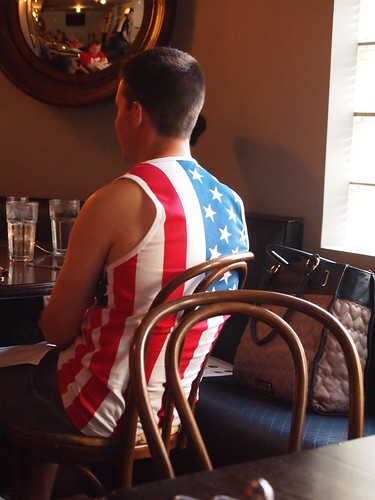
Possibly forlorn about USA's 2-1 loss to Belgium in the 'knockout' round of the soccer World Cup, this Star-Spangled-Bannered fan may have taken solace in the beer dinner he attended, immediately following the game, at Lyon Hall Restaurant, in the Clarendon neighborhood of Arlington, Virginia.

For the dinner, Lyon Hall's executive chef Matt Hill had designed a 5-course menu. In return, David McGregorLyon Hall's Beer Director— selected a Belgian beer for each of the 5 courses. In competition, Brendan Cahill —the Washington, D.C.-area representative for Louisiana, USA's Abita Brewing— chose an Abita beer for each.

Then, at the dinner, the diners voted for their preferred beer-with-meal pairings. It's a clever concept, and one that Lyon Hall has executed on several prior occasions, with other breweries.

On this evening, it was schadenfreude. Abita Brewing —of the USA— 'defeated' Belgium.

The menu


Abita Brewing may have 'won' the vote, but the applause at the dinner's end was strong for Chef Matt Hill and his menu. And, in defense of the flag-bedecked gentleman above, the bag to his right was not his man-purse.

1 July 2014.

-----more-----

Saturday, May 24, 2014

Pic(k) of the Week: Chocolate Stout Crème Brûlée

It may have been a case of accidental 'beer cuisine'.

A Neapolitan chef at an Italian restaurant in northern Virginia was not a fan of American beer, but when he took to the task of creating a menu for a 'craft' beer dinner, the results were delicious.

For his final course of the evening, he baked a crème brûlée. He infused the custard with an 'imperial', bourbon-aged, chocolate-nibbed stout. Then, he served it with the very same stout, on the side.

Beer, bourbon, and chocolate: it was syzygy.

Chocolate Stout Crème Brulee
  • The beer:
    Siren Noire from Heavy Seas Brewing (of Baltimore, Maryland).
    Our Siren Noire isn’t your father’s chocolate stout. We’ve used almost 3 pounds of Belgian cocoa nibs per barrel. We’ve aged it for five weeks in bourbon barrel, with vanilla beans added. A mix of dark malts gives Siren Noire a well-rounded body that is decidedly chocolatey—but without being extraordinarily sweet. Brewers Gold hops contribute an earthy spiciness, with notes of black current.
    ABV: 9.5%. IBUs: 18.5
  • The restaurant:
    Ovvio Osteria (of Merrifield, Fairfax, Virginia).
    15 May 2014.
-----more-----

Saturday, June 01, 2013

Pic(k) of the Week: Welcomed by a Blonde

Welcomed by a Blonde

During American Craft Beer Week, Fire Works Pizzeria (in Arlington, Virginia) invited Allagash Brewing Company (of Portland, Maine) to host a 5-course, 6-beer dinner.

The brewery's draft-only spring ale, Allagash Blonde —brewed with pilsner malt and traditional, noble hops (Hallertauer and Saaz), and finishing at 7.1% alcohol-by-volume— was the welcome beer for the evening.

Things then went like this:
  • 1ST COURSE
    Baked Apple and Walnut Tart
    Served with Allagash Dubbel (7% alcohol-by-volume)

  • 2ND COURSE
    Trio of Sushi Rolls: Tuna, California & Crab Tempura
    Served with Allagash Tripel (9% alcohol-by-volume)

  • 3RD COURSE
    Brown Sugar Cedar Planked Salmon
    Served with Allagash Curieux (11% alcohol-by-volume)

  • 4TH COURSE
    Pork Roulade, Sour Cherries and Spinach with Sweet Potato Mash
    Served with Allagash Four Ale (10% alcohol-by-volume)

  • DESSERT COURSE
    Almond Cinnamon Phyllo Purse with Bittersweet Chocolate Sauce
    Served with Allagash Bourbon Barrel Black (9.2% alcohol-by-volume)

Fire Work's chef, Frank Mayo designed and prepared the menu. He and bar manager Devin Ochs chose the beer for each course. Suzanne Woods, the mid-atlantic representative for Allagash Brewing spoke at the dinner.

14 May 2013.

********************
  • More photos from the dinner: here.
  • Caveat lector: As a representative for Select Wines, Inc. —a wine and beer wholesaler in northern Virginia— I sell the beers of Allagash.
  • Pic(k) of the Week: one in a weekly series of personal photos, often posted on Saturdays, and often, but not always, with a good fermentable as a subject. Camera: Olympus Pen E-PL1. Commercial reproduction requires explicit permission, as per Creative Commons.
  • Saturday, March 02, 2013

    Pic(k) of the Week: Snuggery Seas

    Snuggery Seas

    I like the (accidental) 21st century Bruegel-esque composition of the photo: diners enjoying the food, beer, and conversation at a Heavy Seas Brewing 'beer dinner' at The Old Brogue, in Great Falls, Virginia, in the restaurant's back room, the "snuggery."

    The Old Brogue Irish Pub & Restaurant
    Great Falls, Virginia.
    26 February 2013.

    ********************
  • More photos from the dinner: here. Menu: here.
  • Pic(k) of the Week: one in a weekly series of personal photos, often posted on Saturdays, and often, but not always, with a good fermentable as a subject. Camera: Olympus Pen E-PL1. Commercial reproduction requires explicit permission, as per Creative Commons.
  • Caveat lector: As a representative for Select Wines, Inc. —a wine and beer wholesaler in northern Virginia— I sell the beers of Heavy Seas.

  • Sunday, January 13, 2013

    Advance screening for "Beer Hunter: The Movie" announced for Washington, D.C.

    J.R. Richards is an independent filmmaker. For several years, he has been working on Beer Hunter: The Movie, a film about the late beer and spirits writer, Michael Jackson. After finding archival footage, securing rights, conducting interviews, and editing, Richards has finished. He's announced a special preview screening, in Washington, D.C., for 27 March 2013, on what would have been Jackson's 71st birthday.

    Join us in Washington D.C., on March 27th, 2013, to celebrate and remember Michael Jackson, the "Beer Hunter". We are teaming up with Dave, Diane, and Josh Alexander at RFD Washington for a very special Beer Hunter Birthday Celebration, featuring an advanced preview screening of Beer Hunter: The Movie.

    Attendees will enjoy five special complimentary craft beers, discounts on all other beer, beer-centric food all evening, and a custom logo glass commemorating the event.

    There will be a birthday toast for Michael, and a variety of special guests, brewers, and beers on hand. We'll also be showing rare videos and footage throughout the evening.

    Proceeds from the event will benefit the Michael J. Fox Foundation for Parkinson's Research, and the Michael Jackson Beer Education Scholarship Fund. This event marks the first year of what will become an annual fundraising event in Michael's honor. It also kicks off our Beer Hunter documentary tour. Tickets are very limited.

    When: March 27th, 2013
    Where: RFD, Washington D.C.
    Time: 7-11. Movie begins at 8 pm.
    Tickets: $100. Available: here.


    There's a good chance that the beer in your hand is the result of Michael Jackson's writing. No other individual did more to celebrate the history, culture, and enjoyment of craft beer. Yet many new fans of craft beer have no idea who he was, and his role in the global phenomenon that is the craft brewing movement. This film is a tribute to his efforts and life.

    Michael Jackson is a legend in the world of craft brewing. His 1977 book, The World Guide to Beer, was the first of its kind, and the first to categorize almost every major style of beer in the world. His 1993 television series, The Beer Hunter, became an instant classic, and helped launch the spectacular craft beer movement that we take for granted today. Michael's engaging writing literally saved many styles of beer from extinction, and his work inspired an entire generation of brewers to experiment with beer styles from around the world. Many in the beer world are unaware that Michael was also the leading author on the subject of whiskey, and his books on whiskey have sold more copies worldwide than his books on beer. His sudden death in 2007, at the age of 65, shocked the beer and whiskey worlds. His legacy and contributions were substantial, and should be recognized and remembered. As a person, Michael was one of the best, as those fortunate enough to know him can attest to.

    I first met Michael in London in 2004, and began producing DVD tasting segments for his Rare Beer Club. As time went by, I was sent out to follow Michael on his many trips through Europe and the U.S., and we discussed the idea of making a documentary, or even another Beer Hunter series. After Michael's passing, it was decided that the footage from these travels should be made into a documentary.

    Through this rare visual record we are treated to an intimate picture of Michael, as he traveled to beer meccas such as Belgium, the Czech Republic, Ireland, California, and the Delaware Valley. Woven into this unprecedented library of Michael's later years will be current interviews with the world's leading brewers, distillers, and beer enthusiasts, giving us insight into Michael's enigmatic personality, his remarkable contributions to beer and whiskey, and his secret struggle with Parkinson's Disease.

    J.R. Richards


    For more information:

    Monday, January 07, 2013

    Lyon Hall Restaurant challenges Allagash Brewing

    Lyon Hall, a bistro in the Clarendon district of Arlington, Virginia, continues its series of "Versus" Beer Dinners on Tuesday, 8 January 2013.

    David McGregor, the restaurant's Beer Director, 'battles' Suzanne Woods, the local representative from Allagash Brewing (of Portland,Maine). The dinner features five courses and ten beers. Each course, prepared by Chef Andy Bennett, is paired with two beers: one from Allagash and the other selected by McGregor. Customers vote for their preferences for the better beer-food pairings. A winner is declared.

    @DavidLyonHall 

    The Menu 

    1st Course 

    Cauliflower velouté sauce, grapes, and caviar.
    Allagash White vs. Hitachino Nest White White Ale
    An interpretation of a traditional Belgian wheat beer, Allagash White delicately balances full flavor with a crisp, refreshing taste and subtle hints of spice. Naturally cloudy, with yeast. 5% alcohol-by-volume.

    Hitachino Nest White Ale (Japan) is brewed in the tradition of a Belgian style white beer with coriander, nutmeg, orange peel, and orange juice. Malts: Lager, Wheat  Hops: Perle, Styrian Golding  Adjuncts: Flaked Wheat, Flaked Barley. Spices: Coriander, Nutmeg, Orange peel. Sugar: Orange Juice. 5.5% abv 

    2nd Course 

    Carrot salad, tossed with house-made ricotta, pecans, and yogurt-cumin dressing.
    Allagash Curieux vs. Pretty in Pink Saison
    Allagash Curieux was the brewery's first foray into barrel aging. Curieux is made by aging its Tripel Ale in Jim Beam bourbon barrels for eight weeks in cold cellars. The aged beer is then blended back with a portion of fresh Tripel. The resulting beer is soft with coconut and vanilla notes, with hints of bourbon. 11% alcohol-by-volume. [The brewery pronounces the beer as 'CURE eee oh'.]

    In honor of Breast Cancer Awareness Month, four women from four breweries —Lost Rhino (Virginia), Bluejacket (Washington, D.C.), Vintage 50 (Virginia), and Hardywood (Virginia)— came together to craft a beer for hope, Pretty in Pink: Awareness Ferments Hope. Using the finest malts, two strains of hops, and an Ardennes yeast, then adding flavor, aroma, and hue with (hibiscus and pomegranate), they produced a brisk saison. Pink, slightly tart with subtle fruit-esters and hints of spice. 5.8% abv.

    2nd course: Carrot salad


    3rd Course

    Pan roasted Artic Char, served with red cabbage, salsify emulsion, and bitter chocolate.
    Allagash Tripel vs. Petrus Aged Pale Ale
    Allagash Tripel is strong golden ale, marked by passion fruit and herbal notes in the aroma, with suggestions of banana and honey in the complex palate. The Tripel has a long and smooth finish.9% alcohol-by-volume. 9% alcohol-by-volume.

    From Brouwerij Bavik (Belgium), Petrus Aged Pale Ale is matured 3 years in oak barrels. Deep golden in hue, tart in flavor. 7.3% abv

    4th Course

    Glazed short ribs, served with Brussels sprouts kimchi and smoked pineapple jus.
    Allagash Dubbel vs. Great Lakes Edmund Fitzgerald Porter
    Allagash Dubbel boasts a deep red color and a complex malty taste. The finish is dry with subtle hints of chocolate and nuts. The yeast asserts itself by lending a classic Belgian fruitiness. 7% alcohol-by-volume.

    From Great Lakes Brewing (in Cleveland, Ohio), Edmund Fitzgerald Porter has a complex, roasty aroma with a bittersweet, chocolate-coffee taste and a bold hop presence. 5.8% abv.

    5th Course

    House made Camembert and apple panna cotta, with chestnut honey and celery salad.
    Allagash Interlude  vs. Brouwerij Bosteels Deus
    Two yeast strains were used to create Allagash Interlude. The first, a Belgian farmhouse yeast, establishes the flavor foundations of a classic Belgian-style ale. The second, a house strain of Brettanomyces yeast, brings it to the next level contributing a myriad of flavors including pear, apricot, graham cracker, and bread crust. Finally, a portion of the Interlude is aged in French Merlot and Syrah oak barrels, which impart a vinous plum character and a drying, almost tannic finish. 9.5% alcohol-by-volume.

    Brewed at Brouerij Bosteels in Belgium, Deus Brut des Flandres is transferred, after fermentation, to the Champagne region of France, were it is treated much like a champagne, with the bottles inverted and the yeast expunged and bottle re-corked. 11.5% abv.

    @BeerLass

    The facts: 

    5 courses/10 beers: $60 per guest (plus tax and gratuity) 
    Tuesday, January 8th at 6:30 pm 
    Call Lyon Hall @ 703.741.7636 for reservations.

    ***************
  • UPDATE. By a narrow margin, Allagash 'won' the vote. Photos from the dinner: here.
  • Caveat lector: As a representative for Select Wines, Inc. —a wine and beer wholesaler in northern Virginia— I sell the beers of Allagash.     
  • Thursday, November 08, 2012

    VeggieDag Thursday: Beers & Vegetables for dinner.

    VeggieDag Thursday


    Pairing vegetables with beer is not always an easy matter.

    Mad Fox Brewing Company, a brewpub in Falls Church, Virginia, hosted a vegetarian beer dinner in August. All of the five dishes, prepared by the chef Andrew Dixon were good, some superb, as were the five beers, served with the dishes (well 4 out of the 5), brewed by brewmaster and owner Bill Madden. But, while the dinner on the whole was enjoyable, not all of the combinations were ultimately successful.


    THE PAIRINGS

  • Steamed Buns & Kölsch
    Mad Buns

    A brioche roll pounded flat and steamed, then topped with hoisin-glazed portabello mushrooms, crispy fired shitake mushrooms, and cucumbers, and finished with house-made ginger-mayonnaise. On the side, hot chili sauce. You ate it it like a taco: delicious and fun.

    Kölsch is a delicate ale, gently fruity, softly hopped, with just-so malt. Mad Fox Kölsch —although a fine, if somewhat sulfury beer (appropriate to the style)— seemed not bad, but not inspired. The mushrooms needed something more earthy as a foil. (The unfiltered, straight from the fermenter version of the beer —Kellerbier Kölsch— received a gold medal at the 2011 Great American Beer Festival.)

    Pairing score: B-


  • Provençal Vegetable Package & St. Swithin's ESB
    Provençal Vegetable Package (01)

    A confit of summer vegetables, wrapped within a thin ribbon of grilled zucchini, finished with a tapenade vinaigrette and toasted pinenuts, and topped with a parmesan tuile.

    This multi-layered vegetable dish —and I mean that both in terms of cantilever and flavor— was enhanced by the malty yet 'bitey' ale: a cask-conditioned St. Swithin's E.S.B. Caramel flavor preceeded by an earthy/sweet aroma and succeeded by a dry lingering finish.

    Pairing score: A


  • Goat Cheese Tamale & Witte Vos Wittebier
    Mad Tamales (02)

    Goat cheese-filled tamales, with red quinoa salad, guajillo chili salsa, and avocado purée. A diner was over overheard telling Chef Dixon: "I'm a meat-eater, but these tamales are off-the-chart!"

    Served with Mad Fox's Witte Vos Wittebier. Brewer Bill Madden told the crowd that the beer was a Belgian-style 'white' beer made with imported German pilsner malt, raw winter red wheat, and flaked oats, and spiced with lemon and orange peels, and toasted coriander.

    The wit beer was one of the better I've tasted recently, and it's not a style of beer I'm crazy for. But, flavor-wise, the wit and the tamale had little to do with each other.

    Pairing score: C


  • Crispy Tofu & Orange Whip
    Artichoke risotto

    Battered tofu with braised artichokes, risotto, ricotta, pepperanata, and toasted walnut pesto. The risotto was prepared with a vegetable stock emulsion that was deeply savory: umami-full.

    Served with Mad Fox's Orange Whip, Mad Fox's 'India Pale Ale.' Brewed with hard-to-find Citra hops, the beer smells and tastes like orange and grapefruit pith, and finishes with a bracing bite. It's only occasionally brewed, and has reached a cult status in the DC beer scene.

    Everything was good with this combo. The beer, the entree, the flavor-pairing between the two. The sauce was stunningly flavorful; the beer proved a worthy companion.

    Pairing score: A+


  • Apple Tart Tatin & Krieken Blonde
    Mad Tart

    The dessert course for the evening was a Peach Tart Tatin: an upside-down puff pastry with with local Virginia peaches, pistachio cream, wildflower honey ice cream, and oat crumble. Chef Dixon suggested waiting for the ice cream to begin melting to meld all the flavors. Tried it: he was right.

    The pastry was served with Mad Fox Krieken Blonde, which, brewer Bill Madden told us, was a Blonde Ale, brewed with Belgian yeast, to which Oregon cherry purée had been added post-fermentaion. but, to me, something was was off-kilter about this beer. Rather than a cherry flavor, I tasted something akin to green-olive.

    For a pairing, I think the wit beer would have better here, or, for contrast, a chocolaty dark beer, or even the Orange Whip, with its strong citrusy-orange flavor.

    Pairing score: C-


    THE TAKE-AWAY

    Mad explanations

    Madden was a gracious, informative host. Chef Dixon would follow his beer presentations with concise descriptions of ingredients, techniques, and flavors. The evening was, in fact, the second vegetarian food/beer dinner that the pub has presented.

    Pairing the flavors of food and beer —whether through contrast, like-flavors, flavor hooks, or texture cut— can be evanescently difficult. But, oh, when it all falls into place!

    ***********************
    • More photos from the dinner: here.
    • VeggieDag is an occasional Thursday post on vegetarian issues. Why the name? Here. Prior VeggieDag Thursday posts: here. Follow on Twitter: #VeggieDag. Logo by Tom Lee, beer columnist for Baltimore Examiner. Suggestions and submissions from chefs and homecooks: welcomed!
    • Caveat lector: As a blogger, I was given a reduced price for admission.

  • Tuesday, September 04, 2012

    DRP welcomes Heavy Seas, with 5-course dinner

    Del Ray Pizzeria presents 
    A 5-course beer dinner 

    featuring the menu of
    Chef Eric Reid 
    & the beers of
    Heavy Seas Brewing

    of Baltimore, Maryland. 

    General Manager Sean Snyder welcomed the 25 guests to the restaurant's new upstairs private dining room. Co-hosting was Spencer Hannas, the newly-minted local representative for Heavy Seas, and Stephen Marsh, the brewery's cask cellarmaster. Photos and commentary added after the dinner.

    • 1st COURSE 
      Kartoffelsuppe (Potato Soup) & Leberwurst

      Served with Heavy Seas
      Red Sky at Night Saison,
      on draught (7.5% abv, vintage 2011)


    • 2nd COURSE 
      Spätzle and Mushrooms

      Served with a freshly tapped firkin of The Great Pumpkin Imperial Pumpkin Ale (8.5% abv)
      Reid and Snyder collaborated with Heavy Seas' cellarmaster Stephen Marsh to fill a cask of Great Pumpkin, adding smoked vanilla beans, fish peppers, Chipotle peppers, and molasses.

      Some of those herbs and vegetables, such as the fish peppers, had been grown on Marsh's own 2,00 square food garden in Maryland. Fish peppers have an interesting provenance. According to Mother Earth News:
      The ‘Fish’ peppers came from Baltimore, where they had been employed by African-American caterers to make white paprika for the cream sauces then popular with fish and shellfish cookery. In terms of heat, they are like cayenne, but are more mellow when cooked. The white pods were also used in soups where red peppers would have created a muddied appearance. These peppers had been in use since the 19th century, one of those secret heirloom ingredients that never showed up in cookbooks. They were simply part of oral tradition.


    • Box Roasted Suckling Pig
    • 3rd COURSE
      Box Roasted Suckling Pig
      Sauerkraut and Warm Potato Salad

      Served with Heavy Seas Winter Storm Imperial ESB (7.5% abv)
      This will be the 2012 release for the brewery's award-winning annual winter beer.

    • 4th COURSE 
      Veal Cordon Bleu
      Steamed White Asparagus

      Served With Heavy Seas Loose Cannon Hop3 American IPA (7.25% abv), on draught.


    • Two collaboration casks (02)
    • DESSERT COURSE 
      Crumb Cake
      made with brown sugar and a touch of cayenne, finished with apple slices

      Served with Heavy Seas Below Decks Barleywine, on draught (10% abv, vintage 2011)
    ***************

    Friday, March 30, 2012

    Heavy Seas Fire Works: beer dinner(s)

    It's a date; well, actually, it's two.

    Cask of Raging Bitch (02)


    Fire Works —pizzeria, restaurant, and good-beer bar, in the Court House district of Arlington, Virginia— has invited Heavy Seas Brewing —of Baltimore, Maryland— to dinner on the 3rd and 4th of April. Chef Frank Mayo will do the cooking. Beer manager Mike Berry will do the hosting.
    Fire Works & Heavy Seas Beer Dinner Menu: April 2012.

    The first beer —a 'welcome' beer, not on the menu above— is Heavy Seas' Classic Lager. The brewery has modeled the beer on recipes for premium all-malt American lagers of years prior to 1950, when there yet was maltiness and hoppiness in those beers. Liquid history, if you will.

    The first beer with dinner —Holy Sheet Uber Abbey Ale— Heavy Seas has retired from its fleet. This keg —one of the last available— has aged (well) over 15 months, softening the bite of its 9% alcohol-by-volume, while retaining the fruity fusel alcohols produced by its Belgian yeast strain.

    Tapping the cask (01)

    The next two beers with dinner —Heavy Seas Pale Ale and Loose Cannon American Hop3 IPA— will be served from firkins: 10.8 gallon casks, within which the beers have been naturally carbonated.

    Berry personally filled these two casks at the brewery with his choices of spices and hops. To the Pale Ale, he added sour cherries, chips of toasted poplar wood, vanilla beans, pomelo peel, and so-called 'wet'* Cascade hops. In the cask of Loose Cannon, it's Spanish lemon peel, dried white peaches, grated fresh ginger, and 'wet' Amarillo hops.

    Not pictured, an additional course: Jerk chicken thighs, stuffed with Linguiça sausage, served over red beans and rice, with pineapple puree. Beer selection: a surprise!

    With dessert —Chef Mayo's Peanut Double Chocolate Fudge— Berry has chosen to serve Siren Noire.
    Approx. 8% ABV. An English style imperial stout, fermented and flavored with imported Belgian chocolate nibs. Smooth and easy drinking. Named for the Sirens who lured seafarers off course and ultimately to their demise.

    As it might have be impractical to host all 30 employees of the brewery at dinner, two will be making the 45 mile trek from Baltimore to Fire Works. Tuesday evening, Stephen Marsh will guest host. He is the cellarmaster for the brewery: the manager of the brewery's burgeoning cask program. Wednesday evening, it's Hugh Sisson: the founder and managing partner of Heavy Seas Brewing.
    Hugh Sisson


    ***************


    THE LAGNIAPPE

    The dinner may also feature the official Virginia release of Plank II.
    the second in a series of beers showcasing unique wood ageing treatment to add flavor and nuance. Plank II features an 8.5% ABV Dopplebock style lager matured with specially treated Eucalyptus and Yellow Poplar wood planks.

    Six-foot planks of Eucalyptus and Poplar were placed in the fermenter and allowed to age with the beer for six weeks. The Eucalyptus wood lends notes of chocolate
    [and mint], balanced with a hint of toffee and smoky dryness from the Yellow Poplar.

    As of this post (Friday morning, 30 March), the state of Virginia has not yet granted approval for the beer to be sold in the state. Failing timely approval, Mike Berry has plans to offer a different, sixth, Heavy Seas beer as a bonus.

    THE SKINNY

    The cost of admission is $75 (including tax and gratuity). Wednesday's session has sold out, but there are still a few seats remaining for Tuesday's dinner. For reservations, call Fire Works on 703. 527.8700 or email: courthouse@fireworkspizza.com.
    ***************
    • Photos from the beer dinner: here.
    • The term 'wet' is used to describe hops that have been freshly picked and shortly thereafter, without storage or curing, used to brew beer. Most hops are gently heat-cured to remove moisture content and stabilize the flavor and aroma. Just-picked, they have more of grassy character: similar as to how fresh mint has a 'green' character in addition to its minty flavor.

      Think of 'wet' hops as beer's answer to 'farm to table.' Most hopyards in the U.S. are found in the Pacific Northwest. Breweries not nearby arrange for freshly-picked hops to be air-shipped overnight after fall harvest. 'Wet' hops in April will have been vacuumed-packed. As well, many areas in the U.S., such as here in Virginia and Maryland, are seeing a resurgence of local hop-farms.


    • Caveat lector: As a representative for Select Wines, Inc. —a wine and beer wholesaler in northern Virgina— I sell the beers of Heavy Seas Brewing.

    Friday, March 02, 2012

    Lyon Hall cooks dinner for Heavy Seas Brewery.

    Lyon Hall is a brasserie in Clarendon, Virginia. There, for Tuesday, 6 March, Beer Director David McGregor has organized a Heavy Seas Beer Dinner.

    Lyon Hall to open (02)

    Executive chef Liam LaCivita and chef de cuisine Andy Bennett will prepare four courses, each of which they'll serve with a different beer from Heavy Seas Brewing, of Baltimore, Maryland. Jonathan McIntire —the local representative for the brewery— will present the Heavy Seas beers.

    But, there is a twist. McGregor will offer an alternate beer choice for each course, and diners can choose their preference.


    THE MENU


    UPDATE:
    See photos from the dinner: here.

    THE SKINNY
    ***************
    Caveat lector: As a representative for Select Wines, Inc. —a wine and beer wholesaler in northern Virgina— I sell the beers of Heavy Seas Brewing.

    Saturday, February 11, 2012

    Pic(k) of the Week: Bootlegger's Beer Dinner 2012

    Bootlegger's Beer Dinner 2012

    The remains of a successful beer dinner ...

    The 2nd annual Bootlegger's Beer Dinner, sponsored by DCBeer.com, at Smith Commons Restaurant, in Washington, D.C. Five beers not normally found in the city were 'imported' via the internet, and served, each paired with a different course.

    31 January 2012.

    ****************
    Amuse-bouche
    Chicken Wings in Duck Fat, with Gorgonzola-Apple Glaze

    First Course
    Lime & Orange Macaroons / Foie Gras Mousse
    Paired with Lost Abbey (San Marcos, California):
    Inferno Ale pale ale (8.5% alcohol-by-volume).

    Second Course
    Goat Cheese Ravioli / Duo of Raisin Purée & Citrus Pop Rocks
    Paired with Hair of the Dog (Portland, Oregon):
    Fred strong ale (10% alcohol-by-volume).

    Third Course
    Braised Pork Belly / Coffee Migas, House Smoked Bacon Lardon, Smoked Espuma
    Paired with Alaskan Brewing (Juneau, Alaska):
    Smoked Porter porter (6.5% alcohol-by-volume.)

    Fourth Course
    Sous Vide Shrimp Dumplings / Dashi, Quail & Yuzu
    Paired with Cigar City Brewing (Tampa, Florida):
    Guava Grove saison (8% alcohol-by-volume).

    Dessert Course
    Coconut Pudding / Lavender Ice Cream, Vanilla, Dried Caramel
    Paired with Alchemist Brewery (Middlebury, Vermont):
    Heady Topper IPA (8% alcohol-by-volume)

    Lagniappe
    Flying Dog Brewery (Frederick, Maryland):
    2008 vintage Horn Dog Barleywine (10.2% alcohol-by-volume).

    ********************

    • I manipulated the photo using the CinemaScope effect from Picnik, an on-line photo editing site. See the un-retouched original: here. Picnik is to be discontinued by Google on 19 April 2012.
    • See more photos from the dinner, all courses and beers: here.
    • Unlike most other states and cities, D.C. is liberal (small 'l') when it comes to the availability of beer, wine, and spirits. Bars, restaurants, or shops with a liquor license can act as their own importer of alcoholic products. Read more from the Washington City Paper: here.
    • Pic(k) of the Week: one in a weekly series of personal photos, often posted on Saturdays, and often, but not always, with a good fermentable as subject. Commercial use requires explicit permission, as per Creative Commons.

    Saturday, January 14, 2012

    Pic(k) of the Week: Victoria by candlelight

    Candlelight illuminates a glass of Allagash Brewing's Victoria Ale.

    Victoria by candlelight

    The occasion was a 7-course beer dinner at RedRocks Pizza Napoletana —in Alexandria, Virginia— featuring the beers of Allagash Brewing Company —of Portland, Maine. Seven different beers were paired with seven different courses. The brewery's National Sales Manager —Naomi Neville— and its area representative —Suzanne Woods— presented the beers.

    Rather than attempt to shout over the clamor of a busy restaurant, the two walked table-to-table, talking one-on-one with the customers, as the beers and food were served. This made a 'big' event seem much more intimate.

    This was only the first 'full-bore' beer dinner at the restaurant. (RedRocks has hosted prior beer 'tastings,' at which small-plate pizzas were served, but not with specific pairings.) General Manager James O'Brien, pleased at evening's conclusion, promised there would be more.

    Alexandria (Old Town), Virginia.
    11 January 2012.

    • FIRST COURSE
      Allagash White
      Belgian-style Wheat Ale (ABV: 5.0%)
      Served with:
      Charcuterie plate: an assortment of house-made cured meats and vegetables.

    • SECOND COURSE
      Allagash Tripel
      Belgian-style Strong Golden Ale (ABV: 9%)
      Served with:
      Wood-roasted sea scallop salad.

    • THIRD COURSE
      Allagash Odyssey
      Oak Aged Dark Wheat (ABV: 10.4%)
      Served with:
      Wood-fired eggplant parmesan, basil, grana cheese, house-baked bread.

    • FOURTH COURSE
      Allagash Victoria
      Belgian-style ale fermented with Vidal Blanc white wine grapes. (ABV 9%)
      Served with:
      Gulf shrimp wrapped with prosciutto in a black truffle sauce.

    • FIFTH COURSE
      Allagash Dubbel
      Belgian Style Dubbel (ABV: 7%)
      Served with:
      Lamb meatballs al forno served over soft polenta.

    • SIXTH COURSE
      Allagash Black
      Belgian Style Stout (ABV: 7.5%)
      Served with:
      Gorgonzola with honey drizzle.

    • SEVENTH COURSE
      Allagash Curieux
      Bourbon barrel aged Belgian-style Strong Golden Ale (ABV: 11%). The brewery pronounces it "CURE ee oh."
      Served with:
      Panna Cotta with fresh berries.
    ********************
    • More photos from the beer dinner: here.
    • Pic(k) of the Week: one in a weekly series of personal photos, often posted on Saturdays, and often, but not always, with a good fermentable as a subject. Commercial use requires explicit permission, as per Creative Commons.
    • Caveat lector: As a representative for Select Wines, Inc. —a wine and beer wholesaler in northern Virgina— I sell the beers of Allagash.

    Thursday, December 01, 2011

    Christmas Time in New Orleans: Abita Beer Dinner in Alexandria, VA.

    My friends at Del Ray Pizzeria, in Alexandria, Virginia, are throwing a New Orleans Christmas party, a couple of weeks early, and one thousand miles north, Tuesday, 13 December 2011.


    Chef Reid
    Del Ray's Chef Eric Reid, has designed a 5 course/6 beer dinner, pairing New Orleans-style fare with beers from Abita Brewing, a brewery located in Abita Springs, only 30 miles north of the Big Easy.

    Abita has been celebrating its 25th anniversary of operation this year. They're sending their local representative, Nick Smith —himself, a past brewer for the brewery— to co-host the dinner.

    Here's Chef Reid's menu:

    SALAD
    • Smoked Duck Salad
      with currants & figs, blood orange vinaigrette

    • Served with Abita Amber Ale
      Munich style lager brewed with crystal malt and Perle hops. the brewery's first beer and still its top seller. 4.5% alcohol-by-volume (abv)

    FIRST COURSE

    • Red Fish Étouffée
      Sautéed Redfish served over rice
      Smothered in Crawfish Étouffée

    • Served with Abita Jockamo IPA
      "Jockamo is named for the tribes of dancing, singing, chanting “Mardi Gras Indians” who have marched in New Orleans for over 250 years." An India Pale Ale made with pale malt and light crystal malts that give the beer a copper color and malty flavor. Hopped and dry hopped with Willamette and Columbus hops. 6.5% A.B.V.


    Oysters Bienville w/Abita S.O.S

    SECOND COURSE
    • Oysters Bienville
      Oysters baked with bacon & cheese crust.

    • Served with Abita Save Our Shore Weizen Pils
      For every bottle sold, Abita donates 75¢ to the rescue and restoration of the environment, industry and individuals fighting to survive the Gulf of Mexico oil spill. This unfiltered Weizen Pils is made with Pilsner and Wheat malts, hopped and dry hopped with Sterling and German Perle hops. 7% abv.

    THIRD COURSE

    • Grillettes & Grits
      Sautéed Veal Medallions
      In a Creole demi-glace over creamy grits.

    • Served with Abita Christmas Ale
      Generally a dark ale, the recipe changes each year. This year, a hoppy brown ale. 5.5% abv


    Bananas Foster w/Abita Double Dog

    DESSERT COURSE
    • Bananas Foster Bread Pudding
      Chocolate Raisin Bread Pudding, topped with Bananas Foster.

    • Served with Abita 25th Anniversary Vanilla Double Dog
      Abita's 'standard' brown ale —Turbo Dog— is the inspiration for a 7% abv version. Brewed with pale, caramel, and chocolate malts, and Willamette hops. Whole natural vanilla beans are added during maturation.

    BONUS BEER

    Abita Select Honey Rye. Brewed with pale malt, 4 different caramel malts, wheat malt, rye malt, wildflower honey, and Willamette hops. Limited, and draft-only. 7% abv.

    **************

    • UPDATE: Photos added to this post, after the dinner. More pics: here.
    • Caveat lector: As a representative for Select Wines, Inc. —a wine and beer wholesaler in northern Virgina— I sell the beers of Abita.