Showing posts with label literature. Show all posts

Thursday, February 16, 2017

The perfect pub?

When is a pub a 'good' pub? Is there a perfect pub? Is this sentimental nonsense, a pub simply a business like another? Or can a pub indeed be a 'third place' of social significance?

1984's author, George Orwell, published his answer to the "perfect" question —Moon Under Water— in the Evening Standard (now London Evening Standard) seventy-one years ago, on 9 February 1946.

My favourite public-house, the Moon Under Water, is only two minutes from a bus stop, but it is on a side-street, and drunks and rowdies never seem to find their way there, even on Saturday nights.

Its clientele, though fairly large, consists mostly of ‘regulars’ who occupy the same chair every evening and go there for conversation as much as for the beer.

If you are asked why you favour a particular public-house, it would seem natural to put the beer first, but the thing that most appeals to me about the Moon Under Water is what people call its ‘atmosphere’.

To begin with, its whole architecture and fittings are uncompromisingly Victorian. It has no glass-topped tables or other modern miseries, and, on the other hand, no sham roof-beams, ingle-nooks or plastic panels masquerading as oak. The grained woodwork, the ornamental mirrors behind the bar, the cast-iron fireplaces, the florid ceiling stained dark yellow by tobacco-smoke, the stuffed bull’s head over the mantelpiece — everything has the solid, comfortable ugliness of the nineteenth century.

In winter there is generally a good fire burning in at least two of the bars, and the Victorian lay-out of the place gives one plenty of elbow-room. There are a public bar, a saloon bar, a ladies’ bar, a bottle-and-jug for those who are too bashful to buy their supper beer publicly, and, upstairs, a dining-room.

Games are only played in the public, so that in the other bars you can walk about without constantly ducking to avoid flying darts.

In the Moon Under Water it is always quiet enough to talk. The house possesses neither a radio nor a piano, and even on Christmas Eve and such occasions the singing that happens is of a decorous kind.


The barmaids know most of their customers by name, and take a personal interest in everyone. They are all middle-aged women—two of them have their hair dyed in quite surprising shades—and they call everyone ‘dear,’ irrespective of age or sex. (‘Dear,’ not ‘Ducky’: pubs where the barmaid calls you ‘ducky’ always have a disagreeable raffish atmosphere.)

Unlike most pubs, the Moon Under Water sells tobacco as well as cigarettes, and it also sells aspirins and stamps, and is obliging about letting you use the telephone.

You cannot get dinner at the Moon Under Water, but there is always the snack counter where you can get liver-sausage sandwiches, mussels (a speciality of the house), cheese, pickles and those large biscuits with caraway seeds in them which only seem to exist in public-houses.

Upstairs, six days a week, you can get a good, solid lunch—for example, a cut off the joint, two vegetables and boiled jam roll—for about three shillings.

The special pleasure of this lunch is that you can have draught stout with it. I doubt whether as many as 10 per cent of London pubs serve draught stout, but the Moon Under Water is one of them. It is a soft, creamy sort of stout, and it goes better in a pewter pot.

They are particular about their drinking vessels at the Moon Under Water, and never, for example, make the mistake of serving a pint of beer in a handleless glass. Apart from glass and pewter mugs, they have some of those pleasant strawberry-pink china ones which are now seldom seen in London. China mugs went out about 30 years ago, because most people like their drink to be transparent, but in my opinion beer tastes better out of china.

The great surprise of the Moon Under Water is its garden. You go through a narrow passage leading out of the saloon, and find yourself in a fairly large garden with plane trees, under which there are little green tables with iron chairs round them. Up at one end of the garden there are swings and a chute for the children.

On summer evenings there are family parties, and you sit under the plane trees having beer or draught cider to the tune of delighted squeals from children going down the chute. The prams with the younger children are parked near the gate.

Many as are the virtues of the Moon Under Water, I think that the garden is its best feature, because it allows whole families to go there instead of Mum having to stay at home and mind the baby while Dad goes out alone.

And though, strictly speaking, they are only allowed in the garden, the children tend to seep into the pub and even to fetch drinks for their parents. This, I believe, is against the law, but it is a law that deserves to be broken, for it is the puritanical nonsense of excluding children—and therefore, to some extent, women—from pubs that has turned these places into mere boozing-shops instead of the family gathering-places that they ought to be.

The Moon Under Water is my ideal of what a pub should be—at any rate, in the London area. (The qualities one expects of a country pub are slightly different.)

But now is the time to reveal something which the discerning and disillusioned reader will probably have guessed already. There is no such place as the Moon Under Water.

That is to say, there may well be a pub of that name, but I don’t know of it, nor do I know any pub with just that combination of qualities.

I know pubs where the beer is good but you can’t get meals, others where you can get meals but which are noisy and crowded, and others which are quiet but where the beer is generally sour. As for gardens, offhand I can only think of three London pubs that possess them.

But, to be fair, I do know of a few pubs that almost come up to the Moon Under Water. I have mentioned above ten qualities that the perfect pub should have and I know one pub that has eight of them. Even there, however, there is no draught stout, and no china mugs.

And if anyone knows of a pub that has draught stout, open fires, cheap meals, a garden, motherly barmaids and no radio, I should be glad to hear of it, even though its name were something as prosaic as the Red Lion or the Railway Arms.

Seventy-one years ago, Mr. Orwell 'found' his perfection. I'm still looking.

-----more-----

Sunday, December 25, 2016

The grand charity Christmas Bierabend of the Tortsäuffers of Baltimore.

Christmas service

A Christmas carol

The first Christmas after her husband had passed away, the widow was paid an afternoon visit by the young married couple who lived across the quiet street. Youthful Santas, they came bearing gifts: conversation, a bottle of wine, and a book. The house became loud and jolly. The woman was cheered.

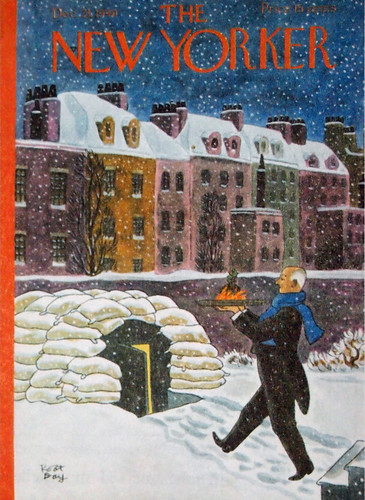
The book they left was Christmas at The New Yorker, a compendium of Christmas stories, poems, and cartoons that had appeared in The New Yorker magazine over the years. Contributors included —posthumous and au courant— such as John Cheever, Garrison Keillor, Alice Munro, Ogden Nash, Calvin Trillin, E.B. White, Roger Angell, Brendan Gill, Ken Kesey, Vladimir Nabokov, James Thurber, and John Updike.

Later, in quiet, one of the stories the woman would read was Stare Decisis, written by H.L. Mencken, the cantankerous gadfly of the Baltimore Sun newspaper in the early 20th century. It told the Christmas adventure of a turn-of-that-century brewery salesman of Baltimore, Maryland. He was, as Mencken described him, a Tortsäuffer: "literally a dead-drinker, a brewery's customers' man. One of his most important duties is to carry on in a wild and inconsolable manner at the funerals of saloonkeepers."

**************

Stare Decisis

Despite all the snorting against them in works of divinity, it has always been my experience that infidels —or freethinkers, as they usually prefer to call themselves— are a generally estimable class of men, with strong overtones of the benevolent and even of the sentimental. This was certainly true, for example, of Leopold Bortsch, Tortsäuffer for the Scharnhorst Brewery, in Baltimore, forty-five years ago, whose story I have told, alas only piecemeal, in various previous communications to the press. If you want a bird's-eye of his character, you can do no better than turn to the famous specification for an ideal bishop in I Timothy III, 2-6. So far as I know, no bishop now in practice on earth meets these specifications precisely, and more than one I could mention falls short of them by miles, but Leopold qualified under at least eleven of the sixteen counts, and under some of them he really shone.

He was extremely liberal (at least with the brewery's money), he had only one wife (a natural blonde weighing a hundred and eighty-five pounds) and treated her with great humanity, he was (I quote the text) "no striker...not a brawler," and he was preëminently "vigilant, sober, of good behavior, given to hospitality, apt to teach." Not once in the days I knew and admired him, c 1900, did he ever show anything remotely resembling a bellicose and rowdy spirit, not even against the primeval Prohibitionists of the age, the Lutheran pastors who so often plastered him from the pulpit, or the saloon-keepers who refused to lay in Scharnhorst beer.

Mencken continued, with the saga of a gala —shall I say, huge— Christmas dinner for Baltimore's poor and homeless, "the masterpiece of a benevolent career, [...] a Christmas party for bums to end all Christmas parties for bums." [No hindsighted moral superiority, please.]
First and foremost, they wanted as much malt liquor as they would buy themselves if they had the means to buy it. Second, they wanted a dinner that went on in rhythmic waves, all day and all night, until the hungriest and hollowest bum was reduced to breathing with not more than one cylinder of one lung. Third, they wanted not a mere sufficiency but a riotous superfluity of the best five-cent cigars on sale on the Baltimore wharves. Fourth, they wanted continuous entertainment, both theatrical and musical, of a sort in consonance with their natural tastes and their station. Fifth and last, they wanted complete freedom from evangelical harassment of whatever sort, before, during, and after the secular ceremonies.

As in the wonderful 1990s flick, Big Night, the dinner does indeed go on.
It might have cost him his last cent if he had gone it alone, for he was by no means a man of wealth, but his announcement had hardly got out before he was swamped with offers of help. Leopold Bortsch pledged twenty-five barrels of Scharnhorst beer and every other Tortsäuffer in Baltimore rushed up to match him. The Baltimore agents of the Pennsylvania two-fer factories fought for the privilege of contributing the cigars. The poultry dealers of Lexington, Fells Point, and Cross street markets threw in barrel after barrel of dressed turkeys, some of them in very fair condition. The members of the boss bakers' association, not a few of them freethinkers themselves, promised all the bread, none more than two days old, that all the bums of the Chesapeake littoral could eat, and the public-relations counsel of the Celery Trust, the Cranberry Trust, the Sauerkraut Trust, and a dozen other such cartels and combinations leaped at the chance to serve. Even the ketchup was contributed by social-minded members of the Maryland canners' association, and with it, they threw in a dozen cases of dill pickles, chowchow, mustard, and mincemeat.

And it was grand. A bierabend!
A Bierabend, that is, a beer evening. Extra pitchers were put on every table, more cigars were handed about, and the waiters spread a substantial lunch of rye bread, rat-trap cheese, ham, bologna, potato salad, liver pudding, and Blutwurst.

Mencken was a cantankerous scribe of the early twentieth-century; he pilloried establishment figures, disfavoring businessmen, government, the middle class, and organized religion alike. So, again avoiding PC-ism, understand Mencken's peroration, as he bemoans how the benevolent Bierabend —of course and unfortunately— ultimately went awry.
I didn't see Fred again for a week. But the next day, I encountered a police lieutenant ["then the only known freethinker on the Baltimore force"] on the street, and he hailed me sadly. "Well," he said, "what could you expect from the bums? It was the force of habit, that's what it was. They have been eating mission handouts so long they can't help it. Whenever they smell coffee, they begin to confess. Think of all that good food wasted! And all that beer! And all them cigars!"


******************

And to all a good night

Stare Decisis was an H.L. Mencken Christmas carol. There never was a Scharnhorst Brewery. There were no Tortsäuffers or Bierabends. But how glorious if there would have been ... if today there would be.

The merry widow? After reading this story, she bookmarked it as a fable she thought that I —then earning a living as a brewery's customers' man— might enjoy. She was my mother, since reunited with my father in the firmament.

This Christmas season, I re-discovered her handwritten bookmark. I turned to page fifty-eight of that book, as she had suggested long ago. And I read along, with a winter beer near at hand. It was a Bierabend of one.

Peace, happiness, and health to you, my readers. Don't waste your beer!

Santa at the diner

-----more-----