Tuesday, April 08, 2014

Help save a 19th-century archaeological piece of Washington D.C. & Alexandria Virginia brewing history.

Help save a 19th century archaeological piece of the brewing history Washington, D.C. and Alexandria, Virginia. (Alexandria was once part of Washington, D.C.) Donate to the Friends of Alexandria Archaeology toward their efforts to preserve and restore a wooden beer barrel of the long-closed Washington Brewery Company.

On Wednesday, 9 April, the City of Alexandria is holding its annual Spring2Action Campaign, a day-long fundraiser for city-wide charities. As part of that campaign, the Friends of Alexandria Archaeology is looking for supporting funds. To donate to the restoration fund, go to this link, today or tomorrow (Wednesday). The Alexandria Archaeology Museum will match up to $1,000 in donations.

The barrel was recovered during an archaeological investigation at the site of the Shuter’s Hill Brewery in 1993 - 1994 in advance of the construction of the Carlyle complex in the 2000 block of Duke Street. "The barrel was excavated from a subterranean passageway that led from the brewery to the beer cellar,” said Paul Nasca, an archaeologist and collections manager at Alexandria Archaeology, which runs a small but illuminating museum on the third floor of the Torpedo Factory (105 N. Union Street #327). "The passage and cellar contained 7-8 feet of water when first exposed during excavation. It’s because of this wet environment that the barrel was so well preserved.”

The beer barrel is itself a bit of a mystery. A quarter the size of a standard 32-gallon barrel 1, it is stamped W.B.C. WASH.DC, or the Washington Brewery Company, Washington, D.C. <...>

Alexandria Archaeology dates the barrel to the Washington Brewery that operated from 1889 to 1917. (There were six Washington Breweries that operated at seven different locations in DC’s history; this particular location is now the site of Stuart Hobson Middle School on Capitol Hill). The Shuter’s Hill Brewery opened in Alexandria’s West End in 1858, and was the first Alexandria brewery to produce lager.

—Washington, D.C. historian Garrett Peck, at DC Beer.

UPDATE: Ruth Reeder —Education Coordinator for the Office of Historic Alexandria/Alexandria Archaeology— told me that the campaign raised $1,770. "We still can’t believe it." Thank you to all who supported the effort. Now, barrel restoration and preservation begins.

-----more-----

Monday, April 07, 2014

Clamps & Gaskets: News Roundup for Weeks 12/13, 2014.

Clamps and Gaskets: weekly roundup
A bi-weekly, non-comprehensive roundup
of news of beer and other things.

Weeks 12/13
16 March - 29 March 2014


  • 2014.03.29
    Paste Magazine picks the top ten baseball ballparks with the best selection of 'craft' beer. PNC Park in Pittsburgh, Pennsylvania, is 1st; Washington, D.C. Nationals Park, is 6th; Baltimore, Maryland, Camden Yards, 9th. In contrast, The Daily Meal selects Safeco Field in Seattle, Washington, as 1st; Nats Park as 5th; Camden Yards as 9th.


  • 2014.03.28
    Toronto beer blogger Chris Schryer has forsaken solid food for Lent, partaking only of beer (and juice), and no solid food. Via National Post.


    Maryland beer cans
  • 2014.03.27
    'Craft' beer trademark wars. Maryland's DuClaw Brewing sues Colorado's Left Hand Brewing for trademark infringement. Via City Paper. Rocker Ozzy Osbourne sends cease-and-desist letter to Baltimore brewpub Brewers Art over its longtime Ozzy Ale. Cease & desist your longtime Ozzy Ale. Via City Paper.


  • 2014.03.25
    Philadelphia's Dock Street brewpub brews beer with goat brains, as homage to season finale of cable-television series, "The Walking Dead." Via CNET.


  • 2014.03.25
    The Alcohol and Tobacco Tax and Trade Bureau (TTB) —of the U.S. Department of the Treasury— okays the use dimethyl dicarbonate in beer as a preservative. The Food and Drug Administration (FDA) —of the U.S. Department of Health and Human Services— has okayed the use of dimethyl dicarbonate for several years in wine and non-alcoholic beverages. Via Beerpulse.


  • 2014.03.25
    Citizens of Milwaukee, Wisconsin, petition to have Pabst Brewing return to the city as city or publicly-owned brewery. Via WUWM radio.


  • 2014.03.24
    A small Massachusetts brewery exits the (U.S.) Brewers Association, cites several reasons including including the residency of very large breweries now in same organization as very small breweries. Via Pivní Filosof.


  • 2014.03.23
    New Federal Trade Commission (FTC) study on alcohol advertising finds that Internet access to alcohol-related sites should be tightened against minors. Via Brewbound.


  • 2014.03.20
    Anheuser-Busch InBev spending $4.3M lobbying for an excise tax-lowering bill that it admits has little chance of passing. [The Brewers Excise and Economic Relief Act of 2013, known as the BEER Act, proposes reducing the per-barrel tax on beer from $18 to $9 and implementing a bigger reduction for small brewers that would virtually eliminate excise taxes on the first 15,000 barrels.] Why, via The Motley Fool.


    "Brewmore" poster
  • 2014.03.20
    "Brewmore │Baltimore" —documentary on brewing history of Baltimore, Maryland— debuts at Maryland College Institute of Art. Via YFGF.


  • 2014.03.18
    Scientists detect gravitational waves from 1 trillionth of 1 trillionth of 1 trillionth of 1 second after the Big Bang. Via Scientific American.


  • 2014.03.17
    The human nose can detect at least ... 1 trillion odors (!) ... says new study of sense of smell, conducted at Rockefeller University, published in Science Magazine. Via Washington Post.


  • 2014.03.17
    Beer bloggers blog on the question: "Why do you drink beer?" Via Baltimore Bistros & Beer for The Session: Beer Blogging Friday.


  • 2014.03.17
    In 2013, craft beer accounted for 7.8% of the total United States beer market volume (up from 6.5% in 2012) and 14.3% ($14.3 billion) in terms of dollars of all beer sold. Via Brewers Association.


    Remembering Dr. James Kollar, VMD, craft beer pioneer (1946 - 2014).
  • 2014.03.14
    'Craft' beer pioneer, Dr. James Kollar —founder, in the early 1980s, of the Chesapeake Bay Brewing Company, Virginia's first-ever microbrewery, and only the second microbrewery to open on the East Coast— has died. Via Allen Young (at YFGF).

-----more-----

Saturday, April 05, 2014

Pic(k) of the Week: Me and Mr. Jackson

Me and Mr. Jackson (1995)

In 1995, British beer and whisky journalist Michael Jackson —known as The Beer Hunter— had plans to write a book on the burgeoning American microbrewery movement.

In March of that year, he would begin his research tour, flying into BWI Airport, just outside of Baltimore, Maryland. Jackson's first stop was the nearby Oxford Brewing Company —Maryland's original microbrewery— in Linthicum, Maryland. In the photo above, Jackson (on the left) is taking notes on the brewery's beers, as described by the then-brewery manager, me. (Note the date stamp on the photo: it was one day after Mr. Jackson's 53rd birthday.)

Jackson's 'chauffeur' that day was Jim Dorsch, a freelance beer writer, who is now the editor/publisher of American Brewer Magazine. The three of us would go on to visit the Baltimore Brewing Company, Brimstone Brewing, the Wharf Rat Pub, and Sisson's brewpub. Of those, only the Wharf Rat, now known as the Pratt Street Alehouse, continues on today. [I recounted the day's adventures: here.]

Wags would call the whirlwind American visit, "Michael Jackson: The Iron Liver Tour", and, Jackson, a prolific writer, would never write that book. He observed that there were far too many American microbreweries opening far too quickly to chronicle them comprehensively. (Back then, he and we didn't readily refer to them as 'craft' breweries.)

Jackson would continue to write books —and pieces for numerous periodicals— on beer in America, in Belgium (where he was officially recognized for his efforts), at his 'local' in London, and around the world. He wrote on whisk(e)y. He became a much sought-after lecturer on these things.

Jackson died in 2007 of complications due to Parkinson's Disease. He left behind an unsurpassed oeuvre of witty and erudite reporting, singlehandedly establishing the concept of beer styles: geographical, historical, and modern. His book, "The World Guide to Beer," first published in 1977, remains a sine qua non.
"Do you ever drink wine?" people ask me, as though beer were a prison rather than a playground. A day may pass when I do not drink wine, but never a week. Whatever is argued about other pleasures, it is not necessary to be monogamous in the choice of drink. Beer is by far the more extensively consumed, but less adequately honored. In a small way, I want to help put right that injustice."
—Michael Jackson

Jackson's 72nd birthday would have been celebrated on 27 March of this year.

-----more-----

Thursday, April 03, 2014

#VeggieDag Thursday. Recipe: Black Pepper Beer Bread

VeggieDag Thursday
VeggieDag Thursday is an occasional Thursday post
on an animal-free diet and ecological issues.


As the weather pivots from winter to spring, there's still time for a hearty loaf of Black Pepper Beer Bread. In fact, plenty of time: this recipe requires no more than sixty minutes from start to slice. And, there's no yeast kneaded needed.

INGREDIENTS

  • 2 cups white flour
  • 1 cup whole wheat pastry flour
  • 1 tablespoon baking powder
  • 1/2 tablespoon kosher salt
  • 1/8 cup brown sugar
  • 1 teaspoon freshly ground black pepper
  • 6-12 ounces lightly hopped lager or ale
  • 1 tablespoon melted non-dairy butter substitute.

DIRECTIONS

  • Preheat the oven to 375°F. Lightly grease a nine-inch loaf pan.
  • Sift the flour, baking powder, salt, sugar, and pepper. Whisk together.
  • Pour in the beer, a few ounces at a time, and whisk gently until combined. (Cold beer is easier to use that room temperature: it won't foam as much.) Use only enough beer to make the dough just the moist side of stiff, balling up and separating from the bowl. (Any beer remaining in the bottle is reserved for the baker.)
  • Dump the batter into the loaf pan, and smooth out the top. Create a crease, and top with the ersatz butter.
  • Bake, uncovered, for 45 minutes, or until golden brown and crusty in appearance.
Black Pepper Beer Bread (01)

NOTES

  • Recipe adapted from Pop Sugar.
  • I substituted a portion of the all-purpose flour with whole-wheat pastry flour to produce a less dense consistency. I halved the sugar and doubled the pepper, and, since this is a no-yeast recipe, all of the sugar could be omitted.
  • Avoid a hoppy beer. The hops will impart an unpleasant bitterness. Similarly, avoid a roasty beer, such as a strong stout. (Guinness Stout —neither particularly roasty nor strong— would be okay.)
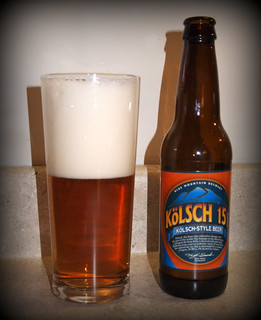
  • I used Kolsch 151, a delightful golden ale from Blue Mountain Brewery (in Afton, Virginia).

    A light German-style ale indigenous to Cologne. This ale is treated like a lager, undergoing extensive cold aging to produce a clean, crisp beer. German Pilsen and Vienna malts, and Hallertau region hops, lend a balanced flavor to our lightest beer.
    5% abv; 18 IBUs.

    Blue Mountain Kölsch 151

  • Serve with a hearty soup, such as this Split Pea Soup from Moosewood. Vegetarian, of course. (Well, okay, vegan. How, I detest that ugly word!)
-----more-----

Tuesday, April 01, 2014

Craft Beer 2013: by the numbers

According to the Brewers Association (BA), the growth rate of the 'craft' beer business has averaged 10.9 percent per year over the past decade. That's in the face of flat overall beer sales, dominated by the international big boys. 1

Continuing that growth, the most recent figures show that 2013 'craft' beer sales controlled 7.8% of the total U.S. beer market. (In 2012, the share was 6.5%.) Put in dollar terms, it's dramatic: 'craft' beer is 14.3% of the U.S. market. That's $14.3 billion in sales (versus $11.9 billion in 2012).2


Who is the Brewers Association?

It's a 2005 merger of the Association of Brewers (a somewhat happy-go-lucky group representing microbreweries, when it was created in 1975 with only a few onboard) with the Brewers' Association of America (the remnant of what was once a powerful, small brewery caucus, formed during World War II, as a counterweight to the United States Brewers Association).3 In 2013, here's how the now influential BA defined its membership:
An American craft brewer is small, independent, and traditional.
  • Small: Annual production of 6 million barrels of beer or less (approximately 3 percent of U.S. annual sales). Beer production is attributed to the rules of alternating proprietorships.
  • Independent: Less than 25 percent of the craft brewery is owned or controlled (or equivalent economic interest) by a beverage alcohol industry member that is not itself a craft brewer.
  • Traditional: A brewer who has either an all malt flagship (the beer which represents the greatest volume among that brewers brands) or has at least 50% of its volume in either all malt beers or in beers which use adjuncts to enhance rather than lighten flavor.

So, here are the top 50 'craft' breweries in the United States, as determined by the BA's 2013 definition: 4


The top 5 are: Rounding out the list is 21st Amendment Brewery (of San Francisco, California), at 50th, new to the list.

Now, compare that list to the BA's list of the top 50 overall brewing companies operating in the U.S. in 2013. 5 Note that the No.1 'craft' brewery of the first list, Boston Beer, falls to the 5th position overall.


Years ago, I worried that 5% was the Rubicon for a no-holds-barred beer war pitting big against small. 5%? How about 14.3%?

Do you think that, in 2013, the international beverage-and-beer conglomerates, such as Anheuser-Busch InBev, SABMiller, Miller/Coors, Heineken, and their ilk, hadn't noticed that 14.3% share they'd lost? You bet your pallid I.L.L.s (International Light Lagers), they had.

Which may be a reason the Brewers Association, this year, changed its definition of traditional to be more inclusive.
  • A brewer that has a majority of its total beverage alcohol volume in beers whose flavor derives from traditional or innovative brewing ingredients [emphasis mine] and their fermentation. Flavored malt beverages (FMBs) are not considered beers.

  • Breweries, such as family-owned Yuengling, will now be part of the 'craft' beer coalition. The BA will need as many allies as it can get for the battles to come.

    Light the watchtowers. The conglomerates are coming. And they aren't happy.

    -----more-----