Tuesday, May 10, 2016

Budweiser buys America.

Somewhere, Woody Guthrie is restless.

At first, I thought such self-indulgent pandering couldn't possibly be anything other than a joke. But, now, with enough 'credible' sources reporting on this, it does actually appear that Anheuser-Bush Inbev's pseudo-patriotic, tone-deaf marketing ploy is a true thing.

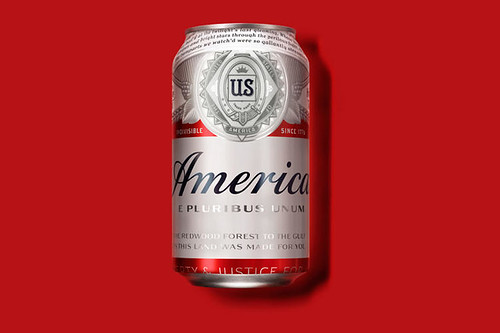
Anheuser-Busch InBevnot American-owned but a Belgian-owned beverage conglomerate— plans to re-brand Budweiser, its flagship light lager beer with the name ... "America" during the summer months, beginning in late May and continuing through the election season in November.

Budweiser buys America
Budweiser wants to cement its reputation as the quintessentially American beer, by re-branding itself simply as "America" this summer.

The change of label has been submitted for approval to the Alcohol and Tobacco Tax and Trade Bureau, according to Ad Age, which first spotted the filing.

The proposed new label will also give increased prominence to the Latin phrase which appears on the American seal: 'E Pluribus Unum" — meaning "One out of many."

Budweiser wants to further capitalize on the patriotic fervor of the Olympic summer by using the phrases: "From the redwood forest to the Gulf stream waters this land was made for you and me" and "indivisible since 1776."
Business Insider: 10 May 2016.

Will AB-IB also rebrand its lighter-than-light lager, Bud Light, as America Light, or, as one Twitter wag phrased it, 'Murica?

Budweiser buys America. Befits the times.

-----more-----

Monday, May 09, 2016

Clamps & Gaskets: News Roundup for Weeks 15/16, 2016.

Clamps and Gaskets: weekly roundup
A bi-weekly, non-comprehensive roundup
of news of beer and other things.

Weeks 15/16
10 April - 23 April 2016

    500 years of Reinheitsgebot
  • 23 April 2016
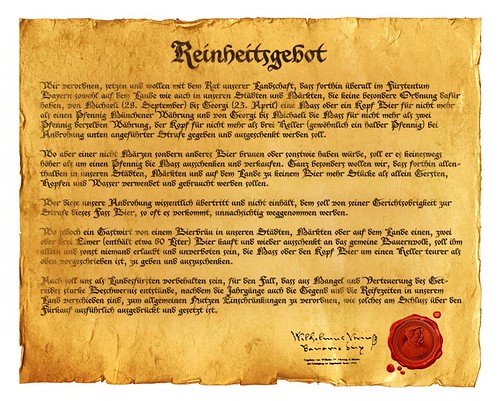
    23 April, 2016, marked the 500th anniversary of the Reinheitsgebot, the German beer “purity law.” Why didn't Wilhelm IV, Duke of Bavaria, include yeast as an ingredient of beer?
    “in all our towns, marketplaces and the whole of the countryside, that beer shall have no other ingredients than barley, hops, and water be used and employed.”
    —Via Jeff Alwroth, at All About Beer.

  • 22 April 2016
    “The era of consumption without consequences is over.” 175 world leaders sign the Paris climate accord.
    —Via USA Today.

  • 22 April 2016
    Anheuser-Busch InBev purchases well-regarded Italian 'craft' brewery Birra del Borgo, adding to its portfolio of small European and American 'craft' breweries. Birra del Borgo, which produces about 13,000 hectolitres (11,100 barrels) a year, will become a wholly-owned subsidiary of AB InBev.
    —Via Brewbound.

  • 22 April 2016
    A people's definition of 'craft' beer.
    Craft beer is a beer that's not a light beer and costs more than one. Consumers don't care where it's from.
    —Via Lew Bryson, at YFGF.

  • 22 April 2016
    A beer can be Kosher, but, during Passover, no beer is Kosher.
    —Via Steve Frank and Arnie Meltzer, at YFGF.

  • 21 April 2016
    The recording artist known as Prince has died at age 57.
    —Via AP.

  • 21 April 2016
    The Chicago Beer Riot began today in 1855, caused by prejudicial actions against immigrants (German, Irish, Catholic) and large fee and tax increases on beer and taverns.
    —Via Encyclopedia of Chicago.


  • 20 April 2016
    Abolitionist and former slave, Harriet Tubman, to replace slaveholding President Andrew Jackson on the front of the $20 bill; Alexander Hamilton to remain on the $10. Treasury Secretary Jacob J. Lew announced "the most sweeping and historically symbolic makeover of American currency in a century," also adding women and civil rights leaders to the $5 and $10 notes.
    —Via New York Times.

  • 20 April 2016
    How April 20 ("420") came to be ‘Weed Day,’ and 4:20pm the time of day to smoke marijuana.
    —Via Huffington Post.

  • 19 April 2016
    A successful brewer resigns from [U.S.] Brewers Association Board of Directors because ... he is successful.
    With his craft beer company being acquired by [Anheuser-Busch InBev] the world’s largest beer producer, Devils Backbone Brewing Co. co-founder Steve Crandall is relinquishing his position on the board of a trade group for craft beer makers. “It was a requirement,” Crandall said of his decision to resign from the board of directors of the Brewers Association, which represents craft beer companies across the nation. “We are considered no longer independent,” he said of Devils Backbone, Virginia's largest craft beer maker by volume.
    —Via Richmond Times-Dispatch.

  • 18 April 2016
    1,400 activists have been arrested at the Democracy Awakening and Democracy Spring protests in Washington, D.C., but few in the media have covered it.
    The march and arrests were the culmination of Democracy Awakening, a weekend of workshops, rallies, speeches, and demonstrations of civil disobedience that brought thousands of activists from across the country together in DC. They are fighting to protect voting rights, to end the corrosive influence of big money on the political system and to force Republicans to confirm Barack Obama’s nominee to the Supreme Court.
    —Via The Nation.


  • Anheuser-Busch InBev's 'Craft' America
  • 16 April 2016
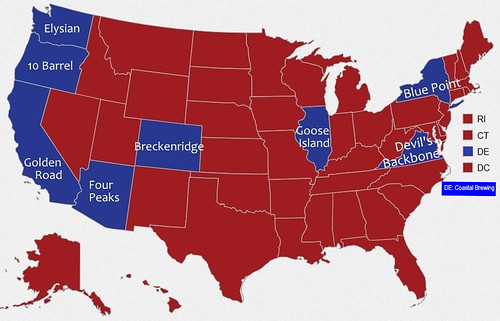
    Anheuser-Busch InBev's America: map of its 'craft' beer acquisitions, as of April 2016.
    The one category of interest that these acquisitions bring to mind has to do with strategy, future acquisitions, and timelines. How many breweries does Anheuser-Busch InBev need to complete their 'High End' portfolio? What do they plan to do with these beers? How will the US strategy unfold as ABI pairs the 'High End' brands with the flagship mass market lagers? All interesting stuff. We have begun to suspect that ABI is looking to knit together a portfolio of regional breweries, so looking at the map might suggest where they're headed next. We know that they tend not to purchase very large breweries--50,000 to 100,000 seems to be the range.
    —Via Jeff Alworth, at Beervana.

  • 15 April 2016
    After twenty years together, Lew Bryson and Whisky Advocate magazine have parted ways. Reading that the Whiskey Advocate is "going in a different direction" and no longer requires the services of Mr. Bryson —one of America's foremost writers on beer and whiskey— is like listening to a lecture on bourbon with only a glass of water to drink.
    —Via Lew Bryson, at Seen Through A Glass.

  • 14 April 2016
    Is Anheuser-Busch InBev about to "steamroll craft beer into submission?"
    • The sheer number and regularity of AB InBev's craft beer buys has been overwhelming. Starting with Goose Island in 2011, the craft portion of AB InBev's craft and European imported beer unit, The High End, is now approaching one million barrels a year. [...] (To compare, Boston Beer's volumes last year were 4.2 million barrels).
    • A likely strategy from a company that already owns the biggest-selling beer in the US and controls a portion of the industry's route-to-market through its owned-distribution network [...] appears to be the following: position Goose Island as the national craft beer while using the smaller brewers as a network of local brands that will eventually - after future acquisitions - cover the whole country.
    • The crowded middle-ground of brewers - those a few notches below Boston Beer and Yuengling - are under pressure to get big while they still can or stay local and hunker down.
    • The combined clout of The High End unit - with Goose Island leading the way - will come in useful as the US craft beer scene becomes more competitive. Expectations are that a shake-out will send a lot of the smaller brewers to the wall as high growth in consumer demand slows and costs rise.
    —Via Just-Drinks.

  • 13 April 2016
    The Centers for Disease Prevention confirms that the Zika virus causes microcephaly and other severe fetal abnormalities; the epidemic that has spread to more than 40 countries.
    —Via Washington Post.

  • 13 April 2016
    There were 4,824 breweries operating in the United States at the end of 2015, says the TTB (the Alcohol and Tobacco Tax and Trade Bureau of the U.S. Department of the Treasury). Together, these breweries brewed 175,243,006 barrels of beer. In addition, there were 1,811 more breweries not yet brewing but with their licenses in hand. That's 6,080 "permitted" breweries already on the playing field in the U.S. for 2016.
    —Via YFGF.

  • 12 April 2016
    The [U.S.] Brewers Association identifies eight new beer 'styles'; releases its 2016 Beer Style Guidelines, describing one-hundred fifty-two beer 'styles.'
    —Via [U.S.] Brewers Association.

  • 11 April 2016
    Some members of Congress plan to affix the Craft Beverage Modernization and Tax Reform Act (CBMTRA) as a rider to the Federal Aviation Administration (FAA) Reauthorization Act of 2016, "a 'must-pass' bill that would reauthorize the FAA and specified FAA programs."
    As written, CMBTRA reduces the federal excise tax to $3.50 per barrel on the first 60,000 barrels for domestic brewers producing fewer than 2 million barrels annually. It also reduces the federal excise tax to $16 per barrel on the first 6 million barrels for all other brewers and all beer importers. “There are some tax provisions in the FAA Act which make the craft beverage bill a potential add-on,” Beer Institute president Jim McGreevy told Brewbound. “We have a lot of support in the Senate and a lot of support in the House. There are a lot of members of Congress that think beer tax reform is a good idea, so I am hopeful.” “We are working with our congressional supporters to have it added to the FAA act,” said Brewers Association CEO Bob Pease.
    Important to the 'craft' beer business, but under what logic is it essential to air traffic safety?
    —Via Brewbound.

  • 11 April 2016
    Lithuania and its peculiar, little-known farmhouse ales: kaimiskas.
    When we name the world’s great beer-drinking people—the Czechs, Germans, Belgians, Brits, and what the hell, Americans, too—we probably ought to include the Lithuanians.
    —Via Joe Stange, at DRAFT Magazine.


  • Pulled pint of Bulldog Bitter
  • 10 April 2016
    What is British Bitter?
    American drinkers, unless they travel frequently to the UK, will struggle to get to know Bitter. It doesn’t translate well into bottles and the best examples derive their character from the gentle carbonation and an almost-but-not-quite imperceptible funk imparted by cask-conditioning; from subtle variations between house yeast strains; and, crucially, from context. [...] Bitter is the quintessential English beer. Low in alcohol, light bodied, typically amber-brown in color, it seems to represent the essence of a country where pubs are Victorian and emotions are kept in check. [...] Today in the UK, Bitter is not a strictly governed style and beers bearing that appellation might be golden to red, drily bitter or honey-sweet, rich in hop perfume or rather austere. Depending on strength, they might be called “Ordinary,” “Best,” or “Extra Special Bitter (ESB).” [.. .Exploding] in layers of flavor —hay, earth, newly mowed grass, orange marmalade, and baking bread. [...] There is no shopping list of grocery store flavors and aromas here: it tastes and smells like beer, with a stolid, single-minded bitterness that defies pretension.
    —Via Jessica Boak and Ray Bailey, at Beer Advocate.
-----more-----

Sunday, May 08, 2016

And yet, she still blooms.

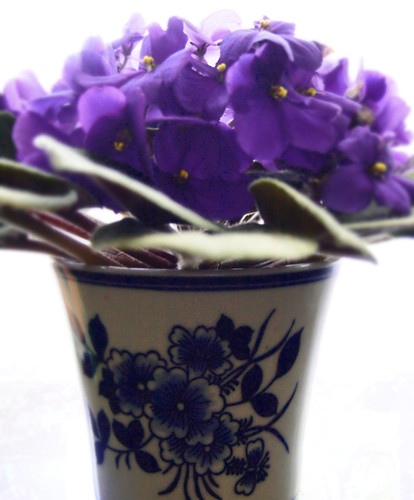
This was Gene's African violet in November 2015.

Mom's African Violet, in November 2015.


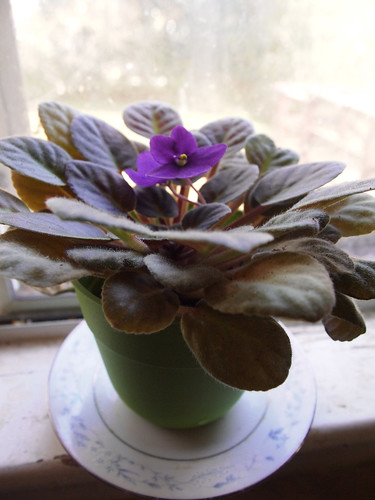
Transplanted and relocated, this is Gene's African violet, today, in May 2016.

Mom's violet blooms (05)

And yet, she still blooms.

Happy Mother's Day,
Genovaite (Gene) A. Cizauskas!

-----more-----

Saturday, May 07, 2016

The 2016 World Beer Cup.

Since 1982, the [U.S.] Brewers Association has hosted an annual championship of American beer: the Great American Beer Festival (GABF). Since, 1996, it has also organised an international beer championship, the World Beer Cup (WBC).

The GABF is held every year in September or October, in Denver, Colorado. The World Beer Cup, in contrast, travels around the United States, and is held concurrently with the Craft Brewers Conference, but in alternating years. The 2016 edition has just concluded in Philadelphia, Pennsylvania.


There is a whiff of American exceptionalism to the World Beer Cup: the bias of an international event held in the U.S., categories based upon American interpretations of world beer 'styles,' the cost of international shipping and transportation to the U.S., the deleterious effects upon beer from that travel. Be that as it may, at this year's competition, there were 6,596 beers —from 1,907 breweries in 55 countries— judged in 96 'style' categories.
  • The average number of beers entered per category was 69, up from 50 in 2014.
  • The category with the most entries was American-Style India Pale Ale with 275 entries.
  • The second most-entered category was Imperial India Pale Ale with 181 entries.
  • The third most-entered category was American-Style Pale Ale with 167 entries.
Judges (75% of whom were from outside of the United States) awarded bronze, silver, and gold medals in each category (other than the "Fresh or Wet Hop Ale" category, in which no gold recipient was selected). Out of 287 medals awarded, American breweries received 231, or 80% of the total; breweries from other nations, 56, or 20%. (Germany had the second highest total after the U.S., at 17 medals, or 6%.)
  • Gold
    A world-class beer that accurately exemplifies the specified style, displaying the proper balance of taste, aroma and appearance.
  • Silver
    An excellent beer that may vary slightly from style parameters while maintaining close adherence to the style and displaying excellent taste, aroma, and appearance.
  • Bronze
    A fine example of the style that may vary slightly from style parameters and/or have minor defects in taste, aroma, or appearance.
Additionally, 6 overall brewery champions were selected (all from the U.S.), based upon their size and a complex algorithm.
Breweries are awarded points based on medals won, and these points are tabulated to arrive at the results. Here are the criteria used for awarding points, and the tie-breaking system used to rank breweries.
  • Most Total Points – breweries are awarded points based on the number of gold (3 points), silver (2 points) and bronze (1 point) medals won in the competition.
  • Most Gold Medals
  • Most Medals
  • Most Total Entries in all Medalled Categories
  • Number of Entries in Gold Medalled Categories
The second and third criteria have the effect of making a gold and two bronzes worth more than a gold and silver, while two golds would be worth more than a gold, silver and a bronze. The fourth and fifth criteria recognize overall competitiveness by achieving medals in categories with more entries than others.

Depending upon the audacity of their marketing departments, each of these six breweries ...
  • Very Small Brewing Company Category: Arch Rock Brewing Company
    brewer: James Smith
    Fewer than 1,001 barrels per year (1,190 hectoliters)
  • Small Brewing Company Category: Noble Ale Works (Anaheim, California)
    brewers: Evan and The Giants
    1,001-15,000 bbl (1,191–17,600 hl)
  • Mid-Size Brewing Company Category: Brewery Ommegang (Cooperstown, New York)
    brewers: Brewery Ommegang
    15,001–6,000,000 bbl (17,601–7,040,000 hl)
  • Large Brewing Company Category: Miller Brewing Company (Milwaukee, Wisconsin)
    brewers: Miller Brewing Co. Brewing Team
    Greater than 6,000,000 bbl (7,040,000 hl)
  • Brewpub (A restaurant-brewery that sells 25% or more of its beer onsite):
    • Small Brewpub Category: 12 Degree Brewing (Louisville, Colorado)
      brewers: Jon Howland and Tor O'Brien
      Fewer than 1,201 bbl (1,408 hl)
    • Large Brewpub Category: Beachwood BBQ & Brewing (Long Beach, California)
      brewer: Julian Shrago, Ian McCall, and Gene Wagoner Greater than 1,201 bbl (greater than 1,409 hl)
... could claim the mantle of Best Brewery In The World, and, more so, Noble Ale Works, which not only brewed the gold-medal winning IPA —'craft' beer's most popular 'style— but the bronze for its Imperial IPA. I'd lay a wager that Miller Brewing —before it's subsumed into the Anheuser-Busch InBev hegemon— will claim the "World's Best" title.

That is, until May 2018.

-----more-----

Pic(k) of the Week. A silo for 5 Seasons.

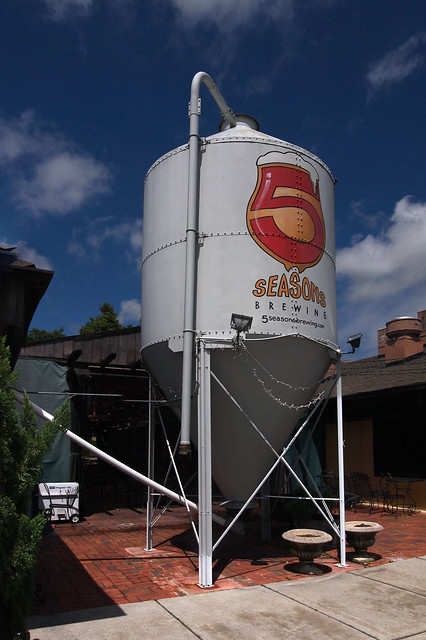
5 Seasons' silo

Many 'craft' beer drinkers tend to pay hops a lot of attention, yet barley malt not so much. Incorrectly. Hops are herbs, spice in beer. It is malt that is beer's fermentable foundation —its quiet soul.
Woe to the malster, brewer, or distiller who simply treats malt as a commodity ingredient. Understanding the relationships between hydration, food reserves, and enzymes within the cereal grain can make the difference between a good tasting product and a great tasting product. The role of maltsters, brewers, and distillers [is] one of "fashioning into a scientifically controlled industry, the noble art of converting barley malt into a wort upon which yeast may feast and ultimately fatten into a beverage with character."
The Craft Maltster's' Handbook.
Dave Thomas. White Mule Press (August 2014).

Pictured above is a grain silo holding barley malt for a later brew at the 5 Seasons Brewpub, as seen on 22 April 2016, under a deep blue sky in Sandy Springs, Georgia.

But what is barley and what is barley malt? The National Barley Growers Association has a pithy answer:

No Barley, No Beer

The The Oxford Companion to Beer (Oxford University Press, 2012) provides more depth:
Barley is the primary cereal grain used as the source of carbohydrates for brewing beer. It is designated Hordeum vulgare, and originates in the fertile Crescent of the Middle East (formerly Mesopotamia and its surroundings, now Syria, Iraq and surrounding lands). [...]

Malting is the process in which raw barley or another grain is made ready to become the main ingredient in the brewing process. It is essentially the first step in beer making. The grain is steeped in water, then rested under precise conditions to encourage germination, and finally dried in a kiln and/or a roaster. One of the key functions of malting is to degrade the grain's proteins and to create the enzymes and modify the starches needed for the brewing process. Professionally, the person responsible for this process is known as a maltster.

Returning to the silo above and referring to its brewpub, a question might arise: What is the fifth season?

The answer is ... beer-drinking season, of course. You can thank a barleycorn for that. And a farmer. And a maltster.

-----more-----