Monday, March 31, 2014

Drinking, again! What's my favorite beer?


It's happened again.

I was asked what my favorite beer was (and, I was asked, as I often am, with a hint of challenge). I answered as I always have: "I don't have one ... yet."

Some form of "Oh, you're being glib," or "Oh, you're avoiding the question," is the usual response, as it was this time. Next comes repetition of the interrogative, but with increasing insistence, and, then, eventual, annoyed dismissal.

Is my answer more evasive than that of someone who is constantly amending his top choice? Such as: "Last week's IPA was epic and life-changing, but this week's sour? Dude, it's monumental." And, what about the next flavor-of-the-moment? Might it be the mind-blowing-est of them all? Until the subsequent?

Yes, there are beers with which I'm familiar, with which I'm comfortable, so-called 'go-to' beers. But, my preferences have, and will, evolve. Current beer choices are many, and the options will change. Breweries will open, and breweries will close. So, no, my response is not an equivocation. I'm simply being forthright about the unknown possibilities.

**************
But, this time around, I did offer a few specifics:
  • I'll often choose a lower-alcohol'd beer over one fully-laden. (I'll save the 'session-beer' discussion for another day.)
  • I prefer to taste my beer in a full glass. I can't render judgement with an infant-portioned sample. (Maybe I'm just not as discerning as others.)
  • I prefer my beer fresh rather than stale. (Although I do enjoy 'cellared' strong beers —and, in fact, have many in my 'cellar'— I just can't understand why anyone would age an IPA, a beer in which the dominant characters —hop aroma and flavor— diminish so rapidly.)
  • When appropriate, I'll choose fresh cask ale over packaged beer. (There was that Great British Beer Festival winner in 1999.)
**************

In the end, however, how incredibly boring it would be for me if I would indeed find the 'best' beer. Quest achieved. Game over.

So, no. I'm playing on.

Whitney Balliet —a past writer for The New Yorker— once described jazz as the sound of surprise. Why not beer as the taste of surprise? Inspired riffing on a flavored theme. Jazz in a glass.

Today, there are beers, ignored, waiting to be re-tasted. Tomorrow, there will be beers yet to taste. So, when you ask me what my favorite beer is, I'll tell you, "I don't have one ... yet." Get over it. That's my answer, and I'm drinking with it.

-----more-----

Saturday, March 29, 2014

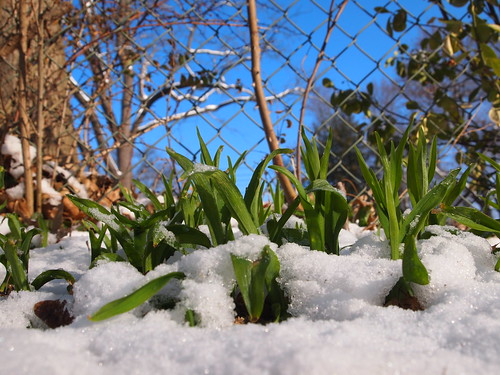
Pic(k) of the Week: Snow sprouts

Snow sprouts

Snow, snow, led astray,
Why, why, here today?
It's calendar sprin(g),
Or, so we thin(k).
Winter's nine months away.

A snowstorm hit the Washington, D.C.-area, on 25 March, five days after the start of spring. A premature April Fools' Day prank, perhaps?

*****************
P.S. Please excuse my doggerel.

-----more-----

Thursday, March 27, 2014

#VeggieDag Thursday: Quick Links for March 2014.

VeggieDag Thursday
VeggieDag Thursday is an occasional Thursday post
on an animal-free diet and ecological issues.


*************
Quick links for March 2014:
  • According to a study published in the journal Cell Metabolism, a diet that is high in animal proteins is four times more likely than a low-protein diet to cause death by cancer, and several times more likely to cause death by diabetes. Via Washington Post Health.

  • Do lobsters, crabs, and other invertebrates feel pain? New research at Queen's University Belfast says yes. Via Washington Post.


    Slaughter sauce (1)
  • The chemistry of hot sauce: capsaicin and endorphins. Via NPR.

  • Today's fruits and vegetables in the U.S. are less nutritionally dense than those grown only a few decades ago. Via Scientific American.


    via Washington Post
  • U.S. nutrition labels to be re-designed with an emphasis on calories, sugar content, and realistic portion sizes. Via Washington Post.

  • Vegetarian or omnivore: the environmental implications of diet. "The argument that a vegetarian diet is more planet-friendly than a carnivorous one is straightforward: If we feed plants to animals, and then eat the animals, we use more resources and produce more greenhouse gases than if we simply eat the plants. As with most arguments about our food supply, though, it’s not that simple." Many inputs enter the equation. Via Tamar Haspel (in the Washington Post).

  • Popped teosinte —an ancestor of modern corn— may have been crucial food for the nutrition, and hence, growth of, the Aztec empire. Popped, it was called "totopoca." Via NPR.


    Wake up, and smell the coffee
  • Via extrapolation, a study claims that the human nose can detect at least 1 trillion odors, up from previous model of 10 thousand. Via Science Magazine (as reported in the Washington Post).

  • A comprehensive list of 2014 Washington, D.C.-area community-supported agriculture programs (CSAs). Via Washington Post Food.

************
RECIPES
  • Okonomiyaki: Japanese-style cabbage pancakes. Via The Guardian Food.

  • Brussel Sprout Fried Rice. Via Isa Chandra Moskowitz at Post Punk Kitchen. "The rice has to be cold for this recipe to work correctly, otherwise it will get mushy and sticky. "

  • St. Patrick's Day recipes made vegetarian. Via Jolinda Hackett at About.com.

  • Kale and Black-Eyed Peas with Smoky Grits. Via "Global Vegan," Robin Robertson (as posted in Washington Post by Joe Yonan).

  • Crisp Baked Tofu. Via David Lebovitz (from a recipe by Joe Yonan in Eat Your Vegetables).

  • Vegan whipped 'cream.' Via EveryDayDishTV.

  • How to make gluten-free 'seitan'. Via Happy Herbivore.

  • "Dinner in the Beer Garden" (front cover)
  • New cookbook by Lucy Saunders: Dinner in the Beer Garden. "Pairing craft beer with plant-based recipes, with profiles of brewery gardens and other social spaces." Purchase at toll-free number, 800-760-5998. More details at Facebook.

-----more-----

Wednesday, March 26, 2014

Miller Fortune: Sorry and misleading

Why bother with a mega-conglomerate beer?

Because it's an obvious ploy to grab small-brewery 'craft' beer 'cred,' which is, in and of itself, a sorry commentary on the state of un-innovation at the international brewing/beverage conglomerates.

And, it's patently misleading.

MillerCoors "Spirited golden lager": misleading and untrue

Hold the chaser. MillerCoors is bringing a dash of hard liquor to the beer market by introducing a brew flavored with a hint of bourbon.

MillerCoors is hoping that the new “Miller Fortune” will tempt drinkers of hard liquor back to a glass of suds, according to Bloomberg News. Beer sales have lost 6 percent of market share to spirits drinkers since 1999. The brewer plans to widely distribute Miller Fortune in the next couple of months, hoping a sleek black bottle and 6.9 percent alcohol content attracts the prized demographic of male drinkers aged 21 to 27.

Miller Fortune is brewed with Cascade hops to give it its bourbon-like flavor. Bloomberg describes the taste as “resting somewhere between a craft beer and a light lager.”

TIME Business & Money on-line
Alexandra Sifferlin
27 January 2014.

  • 1) "brewed with Cascade hops to give it its bourbon-like flavor."

    Cascades are a variety of hops; hops are herbs; they add herbal flavor and aroma to beer, and bitterness. No herb (be it oregano, basil, parsley, or hops) tastes anything remotely like bourbon. Saying hops add bourbon flavor to beer is like saying grapes add oak flavor to wine. What adds bourbon-flavor to beer? Simply put, bourbon barrels do. Aging beer in barrels that formerly held bourbon, or adding bourbon barrel chips to a maturation tank, or mixing in artificial flavoring, are all methods to add bourbon flavor. I would guess that MillerCoors chose the last course, considering the cost and labor of the other two. Small American breweries have been aging their beer in bourbon barrels (and other spirits) since the early 1990s, when Goose Island first re-introduced the concept with its Bourbon County Stout.

    UPDATE: When I originally posted this, I mentioned below the jump that it was the reporter who erred on Cascade hops and bourbon. In hindsight, I should have put that up here, big and obvious. So, to be clear, MillerCoors has NEVER stated that hops taste like bourbon. It was the reporter for TIME who wrote that. As Lew Bryson wrote in a comment below:
    Miller actually sent out a corrective press release to try to clear up some of these mistakes...to which I thought, so what? You blew this one. I think the current ad campaign supporting Fortune is an even bigger mistake than the launch press; it seems to consist mostly of an actor urging men to go back into the bar and have another beer after they'd decided to go home. Brilliantly responsible. This is SO Miller; just so clueless. They haven't done anything right since Lite beer.

    So, abashed, I did blow it. I've edited this piece (and its title) to reflect that, and I apologize to MillerCoors. However ...

    I do find it strange that TIME has never corrected the piece, at least on-line. A request from MillerCoors would not have been unanswered. And, I believe that my other points, #2 and #3, remain valid. The 'big' boys, such as SAB MillerCoors, are losing market share to wine, spirits and 'craft' beer; they seem to be flailing about trying to solve the problem.

  • 2) The logo reads" Spirited Golden Lager. Undistilled."

    That's clever, but misleading. It plays off the word "spirited" as in spirits —distilled liquor— without actually saying so.

    Beer is fermented. No beer, as beer, is distilled. If it were, it would be spirits, and regulated as such. In fact, the higher alcohol of the Miller Fortune (6.9% alcohol by volume) comes not from any added bourbon-barrel-chips, but simply from the fermentation of an additional amount of fermentable starch, which in MillerCoors' case is additional high-fructose corn syrup.

  • 3) From Bloomberg: “Resting somewhere between a craft beer and a light lager.”

    The gulf of difference between those two extremes makes such a statement ludicrous. 'Craft' beer is brewed to emphasize flavor to create interest; American light lager is brewed to de-emphasize flavor so as not to offend. And, why hard liquor drinkers would be expected to put down their 40%+ alcohol shots of bourbon, whiskey, scotch, etc., for a beer of 6% is hard to fathom ... except, obviously, for international conglomerate marketeers.

**************
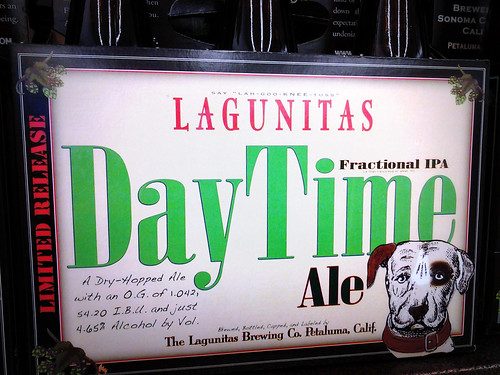
Now, compare all that with this from Lagunitas —a 'craft' brewery in Petaluma, California— that always seems to be having fun with its marketing.

Fractional humor


With its Day Time Ale, Lagunitas seems to be poking (good) fun at All Day IPA (a hoppy pale ale of 4.7% alcohol-by-volume) from Founders Brewing (of Grand Rapids, Michigan). (Day Time is only 4.65%, after all.) And, by styling the beer as a "Fractional IPA," Lagunitas is poking fun at the neologistic style designation of session IPA, a current hot thing in the 'craft' beer world.

The 'big' boys are losing market share to spirits and 'craft' beer (and wine). I suspect that being a marketeer at SAB/MillerCoors is not a fun thing —albeit a lucrative job. I suspect that the good folk at Lagunitas wake up every morning eager to go to work.

-----more-----

Monday, March 24, 2014

Clamps & Gaskets: News Roundup for Weeks 10/11, 2014.

Clamps and Gaskets: weekly roundup
A bi-weekly, non-comprehensive roundup
of news of beer and other things.


Weeks 37/38
2 March - 15 March 2014

  • 2014.03.15
    Farm brewery bill makes headway in Maryland state legislature. House Bill 337 would allow 'farm-breweries' (Class 8M) to self-distribute up to 3,000 barrels of their beer annually. Via Frederick News-Post.


  • 2014.03.15
    Boise, Idaho, sports arena sells 'large' beer cups holding only as much beer as in 'small' cups, but charging $4 more. Sued by fans. Via Washington Post.


    Parisi & Madden

  • 2014.03.15
    Megan Parisi, past brewmaster at Washington, D.C.'s Bluejacket (and its first), accepts position at Wormtown Brewing, in Worcester, Massachusetts. To be head brewer of its new production facility. Via YFGF on Twitter; more details from Washington Post.


  • 2014.03.14
    Maryland House okays two bills that allow beer sales at Montgomery County breweries (removing a restriction that had required them to be fully licensed restaurants), and allow Montgomery County brewery self-distribution to licensed recipients in the county. Via WAMU.


  • 2014.03.13
    Phyllis Schlafly —an anti-ERA organizer decades ago, and founder of conservative interest group, the Eagle Forum —now fights against granting Schlafly Brewery, in St. Louis, Missouri the trademark to the name Schlafly. “Certainly alcohol has a connotation that is the opposite of conservative values, ” said Andrew Schlafly, a New Jersey lawyer who represents his mother in the matter. Via Associated Press.


  • 2014.03.13
    There will be more choices of Washington DC-area craft beer available at Nationals Park this year, including cask ale. Via Washington Business Journal.


  • 2014.03.13
    Official release party for "Capital Beer: A Heady History of Brewing in Washington, D.C." —written by historian Garrett Peck— held at Heurich House Museum, in Washington, D.C. Photos via YFGF.


    via World Wide Web Consortium

  • 2014.03.12
    The World Wide Web was created 25 years ago, on 12 March 1989, when British computer scientist Tim Berners-Lee wrote a proposal for a "global hypertext system." Via Los Angeles Times.


  • 2014.03.10
    The disgrace of 'craft' beer hooligans: a video of a near-riot during Cigar City Brewing's Hunahpu’s Day, in Tampa, Florida. The story via All About Beer.


  • 2014.03.10
    The issues of legal smuggling of 'craft' beers and those breweries' desire to protect the quality of their beer after it leaves the facility. Via The BeerMonger.


  • 2014.03.10
    Seven 'craft' beer professionals are named as James Beard Foundation Award semi-finalists. Via CraftBeer.com.


    via Zyhthophile

  • 2014.03.10
    Thought lost, more poster works by artist John Gilroy for Guinness Stout have been discovered. All were done in the style of other famous artists. Via Martyn Cornell at The Zythophile.


  • 2014.03.08
    The 300th birthday of C.P.E. Bach, son of J.S. Bach, and iconoclastic composer. Via NPR.


  • 2014.03.06
    Frank Jobe, the surgeon who, in 1974 pioneered of elbow medial collateral ligament replacement/repair surgery —which became known as Tommy John surgery after its first recipient/patient— dies at 88. A more common, and highly successful, surgery now for baseball pitchers. Via Washington Post.


  • 2014.03.06
    Continued consolidation in U.S. supermarket business. Private equity firm Cerberus to buy Safeway supermarkets for $9.4 billion, and merge them with Albertson's stores. Via NPR.


  • 2014.03.04
    No, no, don't tell me! After a 5-decade career, Carl Kasell, mellifluous-toned host and reporter for National Public Radio to retire. Currently the announcer of NPR news-quiz-show, "Wait, Wait! Don't Tell Me." Via NPR.


  • 2014.03.04
    The 2014 Virginia Governor’s Cup had many more red blends as entrants than in the past. This year, Williamsburg Winery won top honors for its 2010 Adagio, a Bordeaux-style blend of cabernet franc, merlot and petit verdot. Barboursville Vineyards received the most medals, three. Via Dave McIntyre (at Washington Post).


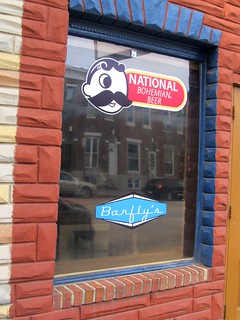
    Barfly's (04)

  • 2014.03.03
    Once the largest hometown brand of Baltimore, Maryland, Natty Boh, now brewed elsewhere under contract, is for sale. Asking price? $1 billion. Okay, the sale also includes the much larger Pabst, a marketing company, also without any brewing facilities of its own. Via Brewbound.


  • 2014.03.03
    The Brewers Association —advocacy group for 'small' breweries in the U.S.— changes its definition of 'craft' brewery, again. To permit and include the use of adjuncts, such as corn. Via YFGF.


  • 2014.03.03
    'Craft' beer production was up 9.6 percent in 2013, while overall beer production fell 1.4 percent. Via CNBC. "58.9 percent of craft beer drinkers have annual incomes of $75,000 or more." [Not the brewers themselves!]


  • 2014.03.03
    Surgeon, author, Sherwin B. Nuland —author of “How We Die” and “How We Live”— dies at age 88. Via Washington Post.


-----more-----