Saturday, February 10, 2007

Beer and chocolate

Chocolate Truffles with StoutThis is getting to be fun: puncturing people's perceptions about beer and food. Yesterday evening, I hosted an in-store demonstration at Olney Beer and Fine Wine, where I paired Clipper City Brewing's Peg Leg Imperial Stout with oh-so-delicious chocolates from local Maryland chocolatier - Chocolates by Cacao. (All are good but I'm partial to their Light Rum Chocolates.)

If eyebrows are arched when I talk about beer and cheese, the reaction is even smirkier when I link beer and chocolate. But think about it: with a stout, you're mating the complimentary character of roasted barley malt with that of the roasted cocoa beans of chocolate!

Chef Stephanie Zonis describes the synergy effect of beer (or wine) with food, if they pair well, thus:

It takes unique pairings to find ones that I call the “one plus one equals three” effect. That is, a great chocolate and a great wine combine to create a third flavor that is better than the sum of the parts. These pairings create the WOW effect.
(Garrett Oliver refers to this harmonious accommodation between beer and food as the flavor hook.)

In her on-line article, Chef Zonis pairs different beer and chocolates. She begins with stout and dark chocolate. But soon she becomes even more adventurous than I was last evening: she pairs a hoppy IPA with a malted-milk chocolate.
This time, the two were contrasts in flavor. The malty flavors paired well together and although the bitterness of the beer and sweetness of the malt crunchies were opposites, they ended up working together.
To borrow the catch phrase used by the cartoon pitchmen for that dark beer from Ireland: Brilliant! Chef Zonis says that, in her experience, only 10% of chocolate and wine pairings are successful. She finds a much higher percentage of success when it comes to beer.

At Olney Beer last evening, many visitors did decide to purchase both the Peg Leg Imperial Stout AND the Cacao chocolates. (Truth be told: there was one customer who did not appreciate the pairing; but she did enjoy the stout.)

  • Beer cookbook author Lucy Saunders has several stout and chocolate food recipes on her website: BeerCook.com.
  • Peter LaFrance's now hard-to-find book - Cooking and Eating With Beer - has a fantastic recipe for Chocolate Imperial Stout Mousse. The beer called for is Brooklyn Brewing's Black Chocolate Stout, but, having made the recipe, I can say that Clipper City's Peg Leg Stout is a delicious substitution.
  • How to pair beer and chocolate: Brewers Association.

Friday, February 09, 2007

Sale of Old Dominion - update

Terry Fife, Marketing Director, Old Dominion


The sale of Old Dominion Brewery to Anheuser-Busch and Fordham Brewing may be final - if not yet publicly announced.(After so many false starts, may is an essential modifier.)


In an earlier post - Say It Ain't So, Jerry! - I came out somewhat strongly against the sale. But let's examine this a bit further. As a direct competitor (I'm Virginia Territory Manager for Clipper City Brewing Company), I should be both wary and optimistic about the sale.

Anheuser-Busch has deep pockets, with which, after purchasing Old Dominion, they would be able to infuse a lot of money into the brewery - on advertising, on incentives, on capital improvements, on quality control and assurance. A-B can spend so much more than Clipper City can for itself, or Old Dominion could without the sale, or any craft brewery could.

But I can also be cautiously sanguine about the sale. The fact that Old Dominion would now, de facto if not de jure (since Fordham would actually be the 51% owner), be an Anheuser-Busch property might create consumer backlash. Would local beer lovers really wish to drink a beer from the behemoth they love to disparage?

But, then again, as a beer lover (and removing my Clipper City cap), shouldn't I desire the sale? If it does occur, Old Dominion might regain the wherewithal - financially and strategically - and the enthusiasm to be a leader in the craft beer movement, as it once was.

A wild card in all this is Fordham Brewing. As beer writer Lew Bryson has remarked, and as have had others who are associated with the local beer business, why Fordham? Other than its three pubs, the company has not been much of a player - to date. We shall see.

Earlier posts:
Say it Ain't So, Jerry!
Old Dominion Festival update
Old Dominion Brewing Company sold [not! 2006.03.08]
My first rumor mongering (2005.09)

Thursday, February 08, 2007

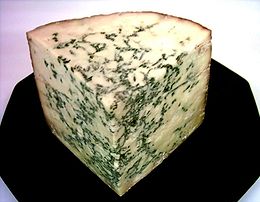
Stilton and stout - non conundrum

Duo of Stilton-Style Cheeses

One New World, One Old World; with Mâche Salad & Blueberry Syrup

Paired with Brooklyn Black Chocolate Stout

That was one of the pairings at what appears to have been a fabulous dinner Tuesday night at Tallulah's, hosted by Garrett Oliver. The mating of a strong stout - with its big malt backbone and smoky/roastiness - with a blue cheese, especially Stilton, is one of the great beer and cheese pairings.

That is why I disagree with a passage in an otherwise informative piece by the Brews Brothers in the current issue of Mid-Atlantic Brewing News (Vol. 9, #1, p.9, The Cheese Conundrum).

[Victory Brewing's] HopDevil, despite its name, has too much of a malt backbone and needs more strident hoppiness to overcome fats in the blue cheese [Point Reyes].
No! The problem with pairing the HopDevil with Point Reyes was not the beer's malt; it was its tannic hoppiness. HopDevil would have mated very well with other types of cheeses (such as cheddars or washed-rind cheeses).

The authors note how they were surprised at the difficulty of predicting the pairings. I find that it's often the taste combination of beer and cheese together that changes the character of both.

With blue and strong stout, it's just such a synergistic dance, as the stout's roast pulls the funk from the blue cheese while the mold softens the bitter roast of the stout.

Of course, de gustibus non disputandam, or to put it another way: "The first rule of beer-and-cheese pairing is that there are no rules, 'only enthusiastic suggestions.' "

More from Crafty Combo (Baltimore Sun, 2005):

"Wine struggles with cheese," says Tom Cizauskas, a sales representative for Clipper City Brewing Co. and a veteran of many cheese and beer tastings. The butterfat in cheese "often overwhelms the flavor of wine. And the acidity of wine seems to create an off-putting metallic character in the presence of cheese," he says. Beer and cheese "don't joust with each other in the mouth; they complement each other," Cizauskas says. "The natural sweet graininess of beer brings forward the aromas and flavors of cheese, just as a good hunk of bread accompanies cheese."

Cheese and beer are natural companions, he adds. "The fermented flavors of cheese - cream, nut, slight fruit, funk - all are present to various degrees in beer." Beer, as well, "has its own built-in palate cleanser," Cizauskas says, "the bubbles, or carbonation."

Wednesday, February 07, 2007

Brewmaster's Table

Andrew Stewart, owner Dr. Dremo's (l); Garrett Oliver (r)
Andrew Stewart, owner of Dr. Dremo's (l), Garrett Oliver, brewmaster Brooklyn Brewery (r)
I ran into the ever sartorially resplendent Garrett Oliver yesterday in Arlington, VA's Dr. Dremo's Taphouse. He was in town for business and to host a couple of beer dinners.

In his lovely book - The Brewmaster's Table - Garrett proselytizes for beer - and for beer with food - while avoiding the patrician haughtiness often affixed to wine writing.

Beer has always been present at the dinner table; we have simply, from time to time, taken it for granted. Some of beer's beauty lies in its comman-man sheen, the unadorned pleasure implied in that end-of-the-day invitation: "Let's go have a beer!"

On the topic of beer and food, I had an interesting encounter with Bill Owens - Buffalo Bill Owens - one of our craft beer pioneers - in the early 1990s at a craft beer conference.

I began a conversation with him -- or I tried to, at least -- about beer and food combinations (which at that time were just beginning to garner gravitas from beer writers).

Owens interrupted me, almost growling: "Food is for eating. Beer is for drinking." He turned away, shaking his head.

Tuesday, February 06, 2007

Alcohol % on beer labels

Forget free speech. Forget public health. Until 1995, it was a crime in the United States for a brewery to inform a consumer as to how much alcohol was in her beer.

It was not until Rubin v. Coors, a Supreme Court decision in 1995, that breweries were legally permitted to list alcohol levels on their bottles, six-packs, cases, etc. The court decided it as a 1st Amendment free speech issue.

Up to that time, the Bureau of Alcohol, Tobacco, and Firearms (BATF) had forbidden such information. The Rubin of the case was Robert Rubin, (Bill) Clinton's Secretary of the Treasury; Coors was, naturally, Coors Brewing. (There is some apocryphal evidence that the Big Brewers may have encouraged the formation of the no-alcohol rules as protection against foreign competition and as cover against neo-Prohibitionism.)

Concurrent with the creation of the Department of Homeland Security, the BATF was cleft in two:
* remaining with the Department of the Treasury was the TTB - Alcohol and Tobacco Tax and Trade Bureau, which collects excise taxes and regulates labeling
* moving to the Department of Justice was the BATFE (gaining an E) - Bureau of Alcohol, Tobacco, Firearms, and Explosives, a law enforcement and anti-terrorism agency.

Related to the Rubin v. Coors decision are 21st Amendment issues.

That amendment repealed Prohibition - the 18th Amendment. But it also gave to the states the right to control the importation of alcohol within each state's own borders. (North Carolina, for example requires that any beer in excess of 5.9 % abv must have the alcohol percentage listed on the bottle.) This is sometimes read as a partial trumping of the Commerce Clause (Article I, Section 8, Clause 3) of the 'un-amended' Constitution, which had given to Congress the ultimate right to regulate commerce.

Recent rulings of the Supreme Court, and a case still in the federal system, have challenged this interpretation to some extent, especially in regard to three-tier distribution issues.

Of tangential significance, there are two bills currently up for consideration in the Virginia legislature - HB2450 and SB1062 - which would allow for limited self-distribution by Virginia wineries.

UPDATE:
Saving Private Wines