Showing posts with label food. Show all posts

Saturday, June 12, 2021

Pic(k) of the Week: 'Old-Fashioned' tacos

Old-Fashioned tacos

Cocktails and tacos!

Pop-up kitchen Mascogo Tacos 1 was cooking up their fare on 4 June 2021, outdoors on the 'whiskey patio,' at small Independent Distilling Company, in Decatur, Georgia, USA.

We were there; we ate; we drank. Pictured clockwise from top:
  • Old Fashioned cocktail 2
    Independent Distilling Hellbender Bourbon, demerara syrup, aromatic bitters, Regan's Orange Bitters, twists of lemon and orange.

  • Barbacoa taco
    Braised brisket cooked in smoked chilis, with spices, onions, cilantro.

  • Pollo con Chili Verde taco
    Hatch-chili-verde-stewed chicken breast, onions, cilantro, Cotija. 3

  • Los Cactus taco (partially obscured)
    marinated grilled cactus, onions, cilantro, charred tomato salsa, with/without Cotija.
"What's the cactus in the taco?" I asked Mascogo Tacos' chef, Craig L. Headspeth, "It's tasty." "There's only one edible cactus," he replied. "Prickly pear." 4 "Ah!"

I thanked him; the other half complimented him on the two meatier tacos. Thanks were also proffered to Independent's 'mixologist' Corey for the cocktail and to Michael Anderson, Independent's owner/distiller, for the Hellbender Bourbon, the first bourbon distilled in the Atlanta area since before Prohibition. That's one hundred-one years ago, in 1920(!), in case you're counting.

-----more-----

Saturday, August 01, 2020

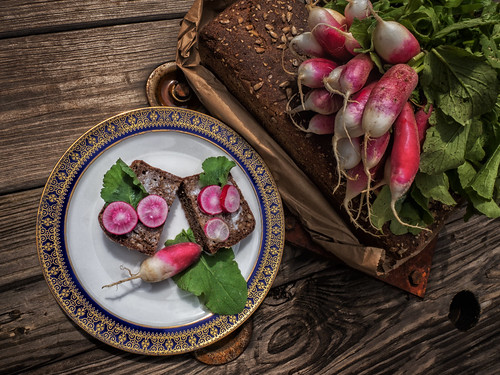
Pic(k) of the Week: Radishes & rye

Radishes & rye

Moons of garden radishes.
Slices of hearty, 'buttered' rye bread. 
And, then, we feast.

Locally-grown organic radishes and locally-baked Estonian rye bread purchased at a local farmers' market, and plated (so fancy) for a backyard brunch.

28 June 2020.

-----more-----

Thursday, July 05, 2018

#VeggieDag Thursday: To cook and eat an artichoke.

To cook and eat an artichoke...

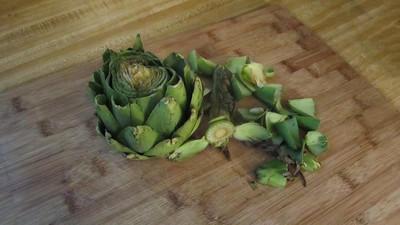
Cooking an artichoke: Trimming the leaves.

1) Select a fresh artichoke. Select a fresh artichoke. (The top leaves of a fresh artichoke will squeak a bit when pinched.) Use a large, sharp knife and cut off the top third of the artichoke. Peel off the smallest bottom leaves, and use scissors to trim the sharp thorn tips off each of the remaining leaves. Use the knife to cut the stem off close to the bulb, making the cut as straight as possible so the artichoke can easily sit upright without tipping over.


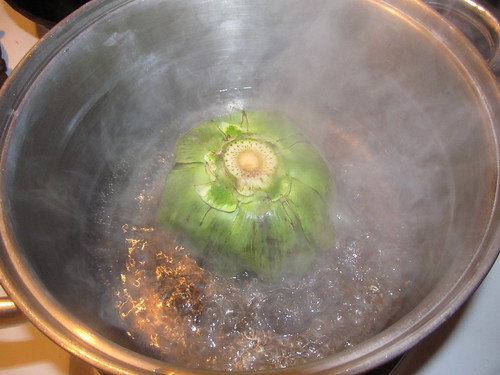
Cooking an Artichoke: Simmer upside-down.

2. Fill a large pot with 1/2 inch of water and bring to boil. Reduce to a strong simmer. Place cleaned, prepared artichoke face down in the water. Cover the pot with a lid and simmer the artichoke for 20 minutes.


Cooking an Artichoke: Simmer right-side-up

3. Grab the artichoke with tongs and turn it right-side-up in pot. Re-fill stock pot to 1/2 inch of water and bring to boil. Reduce to a strong simmer, cover, and simmer for 20 minutes.

4. Remove the artichoke from the pot with tongs and drain off the cooking water. Allow the artichoke to cool a bit. Squeeze the juice of a lemon between the leaves. Sprinkle with Kosher salt.


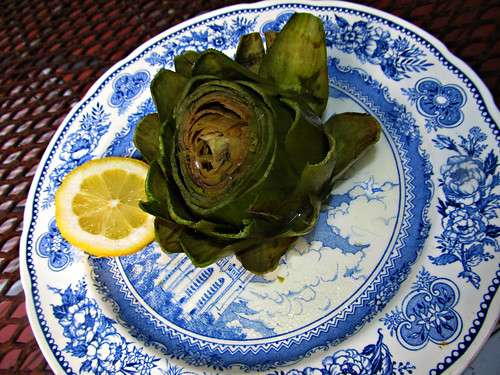
Artichoke, ready to eat!

5. To eat, remove a leaf from the artichoke bulb, dip in olive oil (or not) and scrape the meaty part of the leaf off with your teeth. Discard the rest of the leaf. (Once down to the inner part of the artichoke, the small, inner leaves should be tender enough to be eaten whole.)


Eating an Artichoke: Preparing the choke
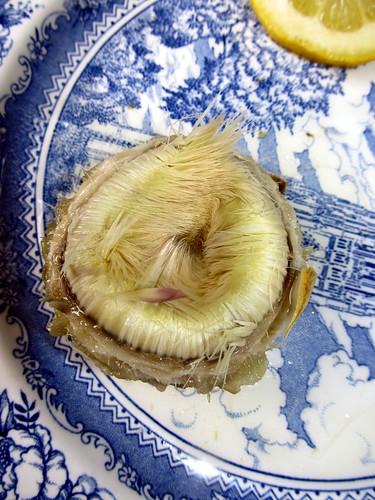
6. At the center of the artichoke, remove the remaining tiny, spiky leaves. Use a spoon to scoop out the fuzzy hairs in the center of the heart (the "choke").

Eating the Choke!

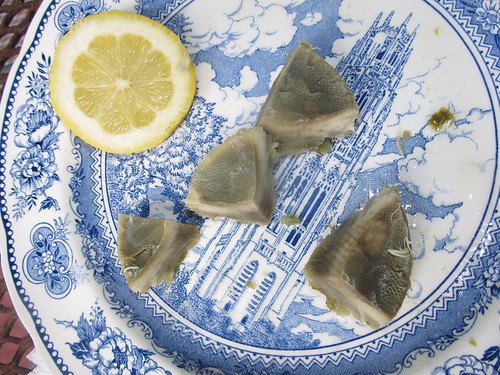
7. Cut the choke into pieces. (Careful. It will be hot.) Sprinkle with a bit of lemon juice and olive oil (or not), and eat and enjoy.
How to 'pair' with a beer, and which? That choice is, bien sûr, up to you (although I might —gasp— grab a Chablis or unoaked Chardonnay).

VeggieDag Thursday
In communion with the fine people of Ghent, Belgium, #VeggieDag Thursday (DonderDag) is a series of occasional Thursday posts on an animal-free diet and the ecology.

-----more-----

Wednesday, November 14, 2012

"Allagash: The Cookbook" visits D.C.

Mix in equal parts love of cooking, dissatisfaction with a PhD program, a chance encounter with Roxanne Quimby of Burt's Bees, curricula at the Culinary Institute of America, wanderlust, love of beer, chutzpah, preparing a private dinner for Allagash Brewery owner Rob Todd and brewer Jason Perkins, and the attention of an independent publisher/photographer.

Allagash: The Cookbook (02)

That's the recipe for the genesis of chef James Simpkins' new cookbook, Allagash: The Cookbook, published by "boutique" publishing house Blue Tree.

Simpkins —and Brian Smestad, photographer and publisher— were in Washington, D.C. tonight, signing copies of the The Cookbook for the public and media at beer bistro Churchkey.

Author, publisher, & brewery ( Allagash: The Cookbook)
l-r: Brian Smestad (publisher/photographer;
Suzanne Woods (mid-Atlantic representative for Allagash);
James Simpkins (author/chef).

Over a two year period, Simpkins has created a book of recipes inspired by the Belgian-styled beers of Allagash Brewing, of Portland, Maine. Not so much cooking with beer as an ingredient, but cooking a meal to be served with beer. As brewery owner Rob Todd says in a foreward:
Great food had been a part of our lives at Allagash for well over a decade, and this book seemed like a perfect natural progression.

Chef Simpkins divides the cookbook into ten principal chapters, in which several different recipes are paired with each of ten different beers from Allagash: White, Dubbel, Tripel, Four, Curieux (pictured below), Interlude, Black, Victoria, Hugh Malone, Coolship (spontaneously fermented beers).

Curieux by candlelight

In well-written comments, Simpkins explains and describes the flavor hooks for each association. He offers not only an index of the recipes, but a pre-index, if you will, by culinary region: New England (e.g., Maine Scallops with Caramelized Onions and Bourbon Butter), Mid-Atlantic (Sweet Potato Bisque with Sourdough Croutons), South (Chicken Plantain Roulades), Heartland (Double Cheddar Grilled Cheese Sandwich), West (Stuffed Poblano Peppers).

The book itself is a gorgeous creation: glossy card-stock, well-bound pages, and beautiful photographs, all done under the care of publisher Smestad. There's one final, nice touch: a built-in old-fashioned, ribbon bookmark. Mine opens to page 37: the poblanos stuffed with quinoa.

If you weren't at Churchkey tonight, look for Allagash: The Cookbook at independent bookshops, wine/beer shops and restaurants, and on-line: here. Amazon? Nope! You can't buy it there.

***************
  • More photos from the book signing: here.
  • Caveat lector: As a representative for Select Wines, Inc. —a wine and beer wholesaler in northern Virginia— I sell the beers of Allagash.

Friday, December 26, 2008

No misfortune #1

The YFGF Christmas meal was served with Malheur 12° from Brewery DeLandtsheer of Belgium and a 2007 Thorn-Clarke Shotfire Barossa Shiraz.

The first had a marvelous brown-sugary aroma and flavor. Toss in flavors of prunes, toffee, maybe Bailey's Irish Cream. In this case, the 12° is 12% alcohol by volume.

The Shiraz was plummy and oaked, with notes of vanilla and spice.

Christmas table

The menu wasFor dessert, it was Maple-Baked Spiced Nuts (and a final glass of the Malheur 12).

And for all, it was a good night.

["Misfortune" is the translation of "malheur".]

Saturday, December 20, 2008

Dahl, beer, & chocolate

In the mid 1990s, I was the original brewer for the Manayunk Brewery, a brewpub in Philadelphia.

Rich Pawlak —a freelance writer and, at the time, a newly converted good beer fan— stopped in to talk one afternoon.

Rich had been intrigued that the brewpub was listing beer pairings for the food items on the menu. That might be common now, but it was not then.

KingfisherOver pints, afternoon became evening. We went on to discuss other beer with food pairings. One was Indian cuisine.

We both agreed that the international style lagers normally served at Indian restaurants might be a good wash with the food's aromatics and spice, but that a hefe-weizen (a German-style wheat beer), with its sweet food-spices notes (cloves, allspice, banana, etc.), would be a complimentary flavor mate.

German and Indian: call it international food diplomacy.

Our discussion was wide-ranging: The brewpub neither served Indian cuisine, nor was I brewing a wheat beer.

I lost touch with Rich in the intervening years, so I was happy to hear of him thriving, and that he had begun a blog he calls The Omnivore.

In a recent post, Rich lists some beer and food pairings, but omits the dahl-with-weizen we had discussed. I'll remind him.

Brewer Garrett Oliver, in his book The Brewmaster's Table, has written similarly of this flavor 'hook':

Many of the spices of Indian cooking are mirrored in the spiciness of weissbier.

Yet to this day, it remains out of the ordinary to find a hefe-weizen at an Indian restaurant.

Cheers for Beers!A few evenings ago, I led a beer-tasting discussion at Red, White, & Bleu, a Falls Church, Va. wine and gourmet shop (and beer).

The 5th and final beer of the presentation was Hang Ten, a "Weizen Dopplebock," brewed once a year by the Clipper City Brewing Company of Baltimore, Md.

Most German-style wheat beers have an alcohol level of about 5% by volume, give or take. A weizen doppelbock, such as Aventinus from Schneider of Germany amplifies that to about 8%; the Hang Ten to 10%.

With this increase in alcohol comes a bigger shake of clove and allspice characters, an infusion of dark plums, some vanilla and white chocolate, and healthy dollops of banana and cherry fruit essence. None of these items are tossed into the beer; it's the fermenting yeast that provides the flavors.
Garam Marsala Chocolate
For the evening presentation, I had paired the weizen dopplebock with chocolate.

But remembering that long-ago conversation, I paired the beer not just with any chocolate, but with one from local chocolatier, Kingsbury: a Garam Marsala-infused dark chocolate.

The combination was flavor affinity cubed, and it was delicious.

Wednesday, November 26, 2008

Happy Apple Thanksgiving

Turkey, who needs a turkey?

For me, the Thanksgiving meal is the culminating celebration of a mid-Atlantic bounty of vegetables and fruit. Beginning with the shoots of spring, this feast continues through summer (real tomatoes!), and finishes now with all those wonderful apples, and gourds and root vegetables.

Of course, most Americans will be enjoying turkey tomorrow. But it's those side dishes that seem to foment bibulous consternation: What wine to serve that can stand up to those flavorful foods yet not overpower the bird.

And, as if to add to the annual angst, a legion of epicures has appeared in the last decade or so, advocating not wine but beer at the table. Count me as one of that horde.

Even though wines such as cru Beaujolais (not insipid Beaujolais Nouveau) or Gruner Veltliner or Champagne (or slightly fruitier Prosecco) can be fine wine accompaniments, it is beers —with their flavors derived from roasting, toasting, sprouting, and cooking— that are natural complements to the meal.

As beer writer Lew Bryson put it:

with Thanksgiving you've got a variety of traditional foods on the table, usually simple, and generally not sourced from wine-country cuisine.

In a 2003 piece I wrote, entitled —surprise— Turkey and Beer, my recommendations were saison and Flemish sour reds. I'll stand with those tomorrow.

But beer writer Stephen Beaumont suggests:
Ordinarily, I enjoy Champagne with turkey. On the beer front, I'd probably side with that wine's close cousin and select a firm, dry gueuze.

I'm a dedicated fan of gueuze and unsweetend lambics. But the intense sourness of gueuze, and its lactic and gamey aromas (though appropriate to the meal), may be too much for some diners.

So I'll offer one more recommendation.

Writing in the winter issue of BEER, the house magazine of the Campaign for Real Ale (CAMRA), Dylan Jones —editor of GQ Magazine (!)— said this:
just a few months ago, I had one of my very rare epiphanies, sitting in the River Café in Glasbury-on-Wye. Studying the drinks menu and looking for something that would successfully accompany a gargantuan portion of the (very good) food they serve there, I spied something called Westons Vintage Special, an 8.2 per cent proof cider. <...> My experience with with Westons has made me completely change my attitude towards the drink. Not only have I recently sought out two local ciders in France (one in Brittany and one near Banyuls), but I have started paying more attention to real British organic ciders. <...> Simply put, I've been converted.

Being from the British Isles, Mr. Jones did not link real cider to Thanksgiving. I will.

Real cider is not sweet flavored alcoholic apple juice. Very different in production and flavor, it bursts with phenolic complexity, tannic structure, sharp effervescence, and refreshing acidity.

And although real cider lacks the cooking-flavor hooks of beer, its inherent character and seasonality makes it an appropriate mate for the entire Thanksgiving meal.

Aspall Dry Cider


The Washington Post recently ran a piece on cider in the Spirits column: It's Time Cider Got Some Good Press.
In the early years of America, most apples ended up in the cider barrel. Cider was the beverage of choice in those days, mainly because apples were cheaper and easier to come by than the grains and grapes with which Europeans made their liquor [and beer and wine]. By the 17th century, cider often was being substituted for water, which was considered to be unsafe.

Cider ruled until the end of the 19th century, when temperance-movement zealots began chopping down entire apple orchards, "unable to conceive of any other use for the fruit except spirits," according to "Laird's Applejack Cookbook." That resulted in one of the saddest and least-acknowledged culinary legacies of the temperance movement and Prohibition: the loss of acres and acres of American cider apple varieties.

As to real cider suggestions, stay away from what you see on supermarket shelves and on tap at many bars. Those ciders are merely sweet, flavored, artificially carbonated apple juice with alcohol added. Rather, the Post's Jason Wilson recommends
the clean, refreshing notes of the British cider Aspall; the dry, champagne-like elegance of french products such as Eric Bordelet Sydre Argelette; the crisp, sappy Farnum Hill's Extra dry, which hits some of the same notes as, say, a New Zealand sauvignon blanc. <...> A cider such as Etienne Dupont, my other favorite, has tiny, sparkling bubbles, a yeasty and ripe fruit aroma, an intense yet round apple flavor, and a lightness that makes it very drinkable.

Real ciders —or 'cidre' as the Brittany French refer to them— are often packaged in 500-ml or 750-ml bottles. They can run, price-wise, the same as cheap wine, but as Wilson notes, at 6% to 9% alcohol, they make for tasty replacements over mediocre white wine.

In the U.K., real cider is usually served fresh from casks like real ale. More here.

Whatever your food choice, and whatever your libation choice, enjoy a happy and safe Thanksgiving.

Caveat: I work for a beer and wine wholesaler in northern Virginia —Select Wines— which sells Aspall Cider.

Sunday, November 23, 2008

Hidden Appetites

Hidden AppetitesIt was foodie serendipity.

A few days after I had attended the Hidden Kitchens discussion at the D.C. Historical Society, a friend showed me a copy of the book Hometown Appetites, subtitled:

The Story of Clementine Paddleford, the Forgotten Food Writer Who Chronicled How America Ate

Clementine Paddleford —with a name like a pseudonym for a writer of early 20th century romance novels— died in 1968. For the 4 decades prior, she had indeed been a writer, but not of novels.

B
efore celebrity chefs, before Zagat, before Julia Child, Paddleford had traveled the US, limning what America ate and cooked: its common food culture 'hidden' in plain sight.

Hidden Appetites
chronicles Paddleford's career, and includes many recipes she wrote about. Authors Keely Alexander and Cynthia Harris provide explanations and substitutions for 21st century kitchens and pantries.

The Hidden Kitchens series, broadcast and webcast by National Public Radio (NPR), also searches for that sub rosa cornucopia, but as it can be found in today's America. Producers Davia Nelson and Nikki Silva —a.k.a. the Kitchen Sisters
explore the world of unexpected, below the radar cooking, legendary meals and eating traditions — how communities come together through food. Hidden Kitchens travels the country chronicling American kitchen cultures, past and present.

Kitchen Sisters: Hidden KitchensNelson and Silva's D.C. Historical Society presentation was moderated by NPR's Susan Stamberg. They read passages from their book (along with various NPR announcers as well) and played snippets of 'food' audio from their programs.

For instance, how Fritos, invented in Texas, were originally developed as a 'health' food!

How a man held in solitary confinement in Louisiana prison for three decades still managed to create and cook praline candy confections— an impossibility, at least as claimed by the Louisiana State Penitentiary authorities.

But there his pralines were, at the end of the evening, for all of us to try.

Now released from prison, Robert King Wilkerson had sent us a large fresh batch of his 'freelines'. (He has renamed them in honor of his status.) And they were, indeed, 'impossibly' delicious.

  • Thank you to Cabot Cheese, who arranged for me to attend the Hidden Kitchens program. More here about that presentation.
  • Photos.
  • Apropos of the topic, I would also recommend Bob Skilnik's Beer and Food: An American History. It's one part history, one part beer myth exposé, and one part beer-as-ingredient cookbook.

Monday, May 19, 2008

SAVOR taster

more photos from SAVORIt was SAVOR, a national food-and-beer exposition, Friday and Saturday at the beautiful neo-classical Mellon Auditorium in Washington, DC.

The event was sold out for all three sessions. The sponsoring group was the Brewers Association, the national advocacy group for small breweries. Well done!

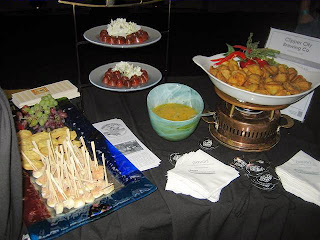
In the photo, it's Clipper City Brewing's Loose Cannon Hop3 Ale (an IPA or India Pale Ale), hoppy and herbal, paired with washed rind cheeses (to the rear, Italian Tallegio, and, in front, Grayson from Meadow Creek of Virginia), citrus-infused chocolates (from artisan chocolatier Christopher Elbow) and beef-stuffed empanadas with mango salsa.

Clipper City was the only brewery to pair one beer three ways. With the empanadas, the spicy and fruity character of the mango salsa paired with that same character of the melange of American hops in Loose Cannon.

The cheeses? What a delight! I had recommended Grayson to the Brewers Association and was pleased to see it included. Local food, local beer, after all. Pungent IPAs mate almost perfectly with the aromatic (okay, stinky) character of washed-rind cheeses.

And then to mate the beer with chocolate after the first two choices was a delight. Citrus-infused with the citrusy tasting Pacific Northwest hops. Again, a flavor hook.

I stayed behind the table talking the tasters through the pairings throughout most of the evening. This is something I delight in; and the pairings, while delicious, were quite illustrative of the theme of the event: beer with food.
more photos from SAVOR
I worked the Friday session only, with owner Hugh Sisson and other members of Clipper City's staff covering the Saturday sessions.

More from SAVOR:

(I missed the Saturday sessions, because I was pouring Clipper City beers in Norfolk for the 6th annual Virginia Beer Festival. After many days of soaking rains, Saturday was clear, bright, and dry with temperatures in the mid 70s.)

[Edited and re-posted.]

Tuesday, March 25, 2008

THE Meme of Beer: FRESH

Food should please the eyes as well as the stomach.

And beer should as well. Beer is, after all, a foodstuff.

It's made from grain, just as is bread. If you were to bake a loaf of bread tonight, would you wait to consume that lovely, redolent loaf ... for 6 months? No!

Treat your beer with the same love and respect.

Drink it Fresh
. That's THE meme of beer.

Sunday, March 23, 2008

Where are the veggie-men who cook?

are you male;do you cook vegetarian?
A puzzling observation, and then a challenge, at Eat Air, a blog on vegan cooking:

There are 40 vegan cooking-related blogs now in my RSS reader. Four of them are written by men. I've thought about this disparity in the past and I've been pondering it again recently. Now that I'm going to have a son I don't necessarily want him to be tied to stereotypical gender roles. Darlene does a lot of knitting and sewing and if our son wants to learn those skills I have no problem with that. I certainly want him to learn how to cook. So guys, let's set a good example for him and all the other little (and big) dudes out there. Here's my proposal:

All you female bloggers - convince the men in your lives to cook a meal, then post it on your blogs. For all the men who are already cooking, good on you - post something fun on your blog. When you post something, let me know in the comments here or in an e-mail. If you don't have a blog e-mail me a picture and description of what you've cooked.

Do this by next Sunday, March 30 and I'll compile all the responses here. Feel free to grab the graphic above and use it in your posts. Happy cooking!
*********************************

So, here's my entry.

I served it at Easter Brunch with a glass of Victory Brewing's Prima Pils ... beer. As wine educator Marni Old says in He Said Beer; She Said Wine:
In a cruel twist of fate, a couple of the very worst veggie offenders rank among the culinary elite of vegetables. Both the slender asparagus and the portly artichoke can be self-centered, often leaving their wine partners tasting strangely off-balance and askew.

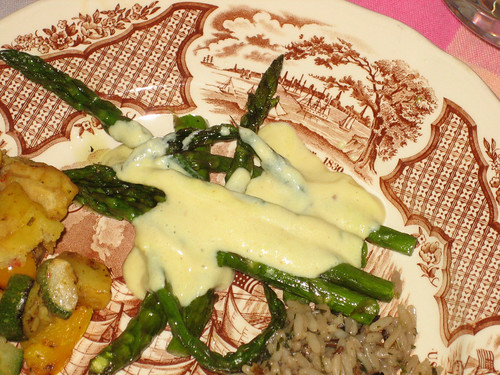
Roasted Asparagus with Mock Hollandaise

Ingredients
asparagus with mock hollandaise
  • 1/2 pound asparagus
  • sesame seeds
  • 4 TBSP margarine (Earth Balance)
  • 4 TBSP potato starch
  • 1/2 cup sweet onion, finely minced
  • 1 TBSP, garlic, finely minced
  • 12 oz silken tofu
  • 2 TBSP freshly squeezed lemon juice
  • 4 TBSP vegetable stock
  • 1 tsp dry mustard powder
  • 1/2 tsp turmeric
  • 3 TBSP extra virgin olive oil
  • 1 tsp cracked black pepper
  • 1 tsp freshly cracked nutmeg

Method

1) Pan-toast a small handful of sesame seeds over medium-high heat in dry pan until fragrant (not burned!).

2) Make a roux.
Heat a pan and melt 4 TBSP margarine over medium-low heat. Slowly blend in 4 TBSP potato starch, whisking constantly until thoroughly mixed. Continue to cook, whisking, until the flour and margarine achieve a copper color. Set aside.

3) Make the hollandaise sauce
In small pot, heat 1 TBSP extra virgin olive oil. sauté 1/2 cup finely minced onions over medium-low heat until translucent. Add 1 TBSP minced garlic (and more oil if necessary); sauté until fragrant. Remove from heat.

Add to blender or food processor with 12 oz silken tofu, 2 TBSP lemon juice, 4 TBSP vegetable stock, 1 tsp dry mustard powder, 1 tsp freshly cracked nutmeg, 1/2 tsp turmeric, 1 tsp kosher salt.

Blend until a smooth consistency.

Return to pot. Add roux. On low heat, mix well. Set aside (or refrigerate for later use.)

4) Prepare asparagus
Take half-pound of asparagus. Cut of stems; trim woody stalks.

Place in bowl and toss with 2 TBSP virgin olive oil, 1 tsp Kosher salt, and 1 tsp freshly cracked black pepper.

5) Roast and serve!
Place prepared asparagus on foiled baking sheet. Set oven to 425°F. Roast for 10 minutes.

Remove from oven. Top with dollop of mock hollandaise sauce. Sprinkle with toasted sesame seeds.

Wednesday, February 27, 2008

No coffee for you

Like a scene out of the movie The Treasure of the Sierra Madre, the older gentlemen was 'Howard', amused by the younger, crazed 'Dobbs'.

'Howard' was sitting outside of a local Starbucks, early last evening, sipping his coffee. His was the last café latte served at this local store, before the overnight stand-down at all Starbucks nationwide.

Sort of an employee java re-gestalt-ing in the face of soggy sales, the brown-out was also a brilliant publicity ploy, gaining mention for the chain throughout the national and local media.

But this 20-something-ish 'Dobbs' was nonplussed by the very idea.

He said to 'Howard': "What?! Starbucks is closed?" He pulled a couple of times at the locked door. He glared inside. "No way! Really? Not opening until tomorrow?"

Muttering into his cellphone, 'Dobbs' walked away. 'Howard' and I shared a surreptitious chuckle.

"Coffee? We ain't got no coffee. We don't need no coffee!
We don't have to brew you any stinkin' coffee!"

Thursday, February 21, 2008

Better Beerfood

I met up recently, over beers, with William Flanagan and Paul Rinehart to discuss their new website: Better Beerfood.

Better BeerFood is not simply about cooking with beer as an ingredient, they told me. Rather, each episode lists specific recipes that pair well with beer and, likewise, suggests beers that pair with those dishes.

Each of the duo are 'beer-guys'. Paul is the culinary-schooled chef; William is the film-schooled videographer/webmaster. Paul prepares the food in short videos, filmed by William in a breezy manner over indie-rock soundtracks.

Coming soon, they told me, will be a segment on Clipper City Brewing's Loose Cannon Hop3 Ale. What recipe Paul and William cook up for this India Pale Ale (I.P.A.) will depend—they said, grinning—upon their upcoming 'taste-testing'.


Beer author Bob Skilnik recently announced similar plans—casting a wider net—at Drinkz-N-Eatz-TV.

Tuesday, February 19, 2008

Captain Thom's Peg Leg Beer Cheese Soup

At an Atlanta-area beer dinner I co-hosted in January, a cask of Clipper City Brewing's Loose Cannon Hop3 Ale remained not (gasp) completely drained at the conclusion of the evening. So, Muss & Turner's chef, creative and frugal, utilized the remainder at lunch the following day to prepare some Beer & Cheese Soup.

Here's a recipe for a spicy version that's posted on Clipper City Brewing's website. Captain Thom's is a Baltimore-area hot sauce producer.

CAPTAIN THOM'S PEG LEG BEER CHEESE SOUP

Ingredients:

Soup:
1 1/2 cups minced Carrot
1 1/2 cups minced Onion
1 1/2 cups minced Celery
2 minced Garlic Cloves
1 Tbsp Captain Thom's White Zombie Sauce
1/8 Tsp. Cayenne Pepper
1/4 Tsp. Black Pepper
3 cups Chicken Broth
2 cups Clipper City Peg Leg Imperial Stout
4 cups Milk
6 cups shredded, sharp Cheese
[I'd suggest Black Wax or Huntsman Cheddar from
Cabot Cheese]
1 Tbsp. Dijon Mustard
2 Tsp. Worcestershire Sauce
1 Tsp. dry Mustard

Roux:
1/2 cup Flour
1/3 cup Butter

Topping:
1 slice French Bread (per bowl)
1 Tbsp. Butter


Directions:

In a pot over medium heat, stir carrots, onion, celery and garlic together. Pour in the Peg Leg Stout, chicken broth, cayenne pepper, black pepper and White Zombie Sauce. Simmer vegetable mix for about 12 minutes until the vegetables are tender. Remove from heat.

In another pot, melt butter over medium-high heat, stirring not to burn. Gradually whisk in the flour and cook until a light brown color appears. Stir in milk and continue stirring until roux starts to thicken. Remove from heat and stir in shredded cheese slowly until all of the cheese is blended.

Add vegetable soup mix and roux/cheese mix together, stirring in Dijon Mustard, Worcestershire sauce and dry mustard. Bring to a simmer and cook for about 10 minutes. In the meantime, in a frying pan over medium heat, add the slices of French Bread (which have been buttered on both sides) turning to toast golden brown on each side. Put the toasted bread in a bowl, add the hot, Peg Leg Beer Cheese Soup and serve.


A roux is an essential part of the soup. It prevents the melted cheese from becoming stringy.

Other recipes for Beer & Cheese Soups often call for lighter flavored and colored beers. Peg Leg Imperial Stout is thus an interesting choice; it will impart an additional layer of flavor complexity.

And, I would substitute vegetable stock for chicken broth ... but that's just me!

Monday, February 11, 2008

Savory Beer Crêpes

INGREDIENTS

  • 1 1/2 cups flour (unbleached, if you're a good person)
  • 1/2 cup potato starch
  • 1 tsp kosher salt
  • 1/2 tsp dried rosemary
  • 1/4 tsp ground black pepper
  • 2 TBSP olive oil
  • 1 1/2 cup water
  • 1/2 cup Dortmunder-style Lager (Victory Lager, McHenry Lager, Dominion Lager)

PROCEDURE

Saturday, February 09, 2008

DC beer guy makes national news

Greg Engert, beer manager at Rustico Restaurant in Alexandria, Virginia received mention in yesterday's USA Today.


"First we needed a good product," says Greg Engert of Rustico, a beer-centric restaurant in Alexandria, Va. "Then enough people started banging the drum that there is good beer out there."

That drumbeat is being fueled in part by the millennial generation, that wave of consumers in their 20s and early 30s whose wide-open curiosity toward the culinary world already is fueling record wine sales and the cocktail renaissance.<...>

To court these consumers, a new generation of chefs is demonstrating that beer is not just for drinking.

Rustico chef Frank Morales uses beer as a foam, bouillon or jelly in more than half his dishes. And for all of Morales' dishes, Engert offers pairings from a list of nearly 300 bottled and 50 draught selections.

Also quoted is Lucy Saunders, with whom I and Clipper City Brewing are cooperating on two beer dinners in early March:
"Younger chefs are more open to consider beer as worthy of respect in the kitchen," says Lucy Saunders, who has written The Best of American Beer and Food: Pairing & Cooking With Craft Beer and runs the website beercook.com.

----> details on the Tuscarora Mill dinner here
----> details on The Royal Mile Pub dinner here

Jim Koch, of Boston Beer Company, sums it up in good fashion:

Koch, however, isn't arguing that beer should replace wine -- only that it should not be overlooked.

"The idea that wine is the exclusive beverage to be served with good food is very outdated," he says. "If you limit yourself to the wine list, you'll miss out on a lot."

Thursday, February 07, 2008

Where's the local at SAVOR?

Chris O'Brien — the "Beer Activist" — raises a valid point about SAVOR — the beer and food symposium to be held in Washington, D.C., 16/17 May.

Chris says:

Surprisingly, I don’t detect even a tinge of the local and sustainable craze that has been coursing through the foodie community. Witness the growth of organizations such as Slow Food International, the ‘locavore‘ phenomenon, the 100-mile diet, and the continued double-digit growth in organic food. I suppose the simple concept of beer being a partner worthy of thoughtfully pairing with food is revolutionary enough without complicating matters by weaving sustainability into the agenda. Still, it seems a lost opportunity to showcase fine regional and organic foods from small companies that are such natural allies to the small brewing movement.

Don’t get me wrong, I’ll be perfectly happy to slowly savor a “Shell-fish Free ‘Crab’ Cake” with a glass of saison, but wouldn’t it have been nice to feature a real crab cake instead, made with blue crabs from the Chesapeake bay, and thus providing an educational opportunity about the collapse of this species? Lots of brewers are hip to the local/sustainable food phenomenon and it seems like the industry really ought to make a point of highlighting regional delicacies that are themselves in danger of becoming as rare as good beer was a couple decades ago.

It's that meme again: fresh beer is the better beer, fresh food is the better food.

Organic is the new hip cause — for beer and food — and that's all well and good.

But how gentle to the environment is organic food shipped in from thousands of miles away? Local and sustainable are the valid issues. If organic follows, as it often does, so much the better.

UPDATE: There will be local food.
  • Hugh Sisson of Baltimore's Clipper City Brewing will be conducting a Chesapeake Bay seafood (and duck) demonstration with chefs from the Phillips Seafood Restaurant.
  • Meadow Creek Dairy from Virginia will be there with its Grayson washed rind cheese.

Chris concludes his blog with resigned praise:
I guess I just want it all. I should just shut up and be happy that they decided to locate Savor right here in my own fair city.

SAVOR promises to indeed be a special event, and, in a way, a watershed moment for craft beer. At least the sponsoring organization — Brewers Association — didn't drop a letter, à la mode, and entitle it SAVR.

Friday, January 11, 2008

Beer with dessert: Sweet Charity

Sweet Charity 2007
Clipper City Brewing Company annually participates in Sweet Charity — a gala fundraiser against illiteracy, for the Heart of America Foundation. Chefs from throughout the area create incredible—if I say so myself—desserts and pastries for the festivities.

In the photo above, taken at the 2007 event, that's Carole Palmer of the American Cheese Society in the foreground. If you look closely, you'll see Clipper City Brewing's booth and me in the background.

We'll be there again, later this year, 5 May.

Jump here for the post on the 2007 gala.
Jump here for the post on the 2008 gala.

Saturday, December 29, 2007

Hot Sex Beer Chocolate

Red Wine and Chocolate: arranged marriage. Beer and Chocolate: hot sex.
Alright!

That's Maggie Dutton, writing in her Wine Offensive blog about her recent Seattle Weekly article:
Red Wine Doesn't Go With Chocolate
Try beer instead.
December 12, 2007

Red wine with chocolate is like an arranged marriage. The only thing they have in common is fruit: Red wine tastes like it, and chocolate sometimes tastes good with it. However, red wine's overbearing tannin, oak, and acid affront a fine chocolate's complex creaminess, and neither lets the other finish a sentence. They don't belong together.

<...> With beer and chocolate, it's not a matter of getting it wrong. It's more likely to be just right.

Saturday, December 15, 2007

SAVOR: American Craft Beer and Food

www.savorcraftbeer.orgThe SAVOR: An American Craft Beer & Food Experience site doesn't have details posted on its site yet. So, here are some, taken from the Brewers Association's website and emails.

UPDATE 2007.12.20.
The site has been expanded. Go to: www.savorcraftbeer.org.

The Brewers Association, producers of the Great American Beer FestivalSM, is bringing the quintessential craft beer and food event to Washington D.C. in celebration of American Craft Beer Week.

A must attend for craft beer aficionados and foodies alike, SAVOR will offer a memorable craft beer and food experience to a limited number of attendees in the columned archways of the Andrew W. Mellon Auditorium.


When and Where

The inaugural event is taking place at the Andrew W. Mellon Auditorium in Washington, D.C. There will be three sessions for the event.
Friday, May 16, 2008 6:30 pm – 10:00 pm
Saturday, May 17, 2008 12:30 pm – 4:00 pm
Saturday, May 17, 2008 6:30 pm – 10:00 pm

Events

Plan to delight your senses with the diversity of flavors featuring some of America's finest ales and culinary combinations at this grand tasting experience. Visit with owners and brewers representing small breweries from across the country including 48 breweries from 8 regions. Meet who's making the great craft beers the national media is raving about. Participate in directed tasting seminars featuring an A-list of rising stars of the craft beer and food scene (limited seating available).


Tickets

Tickets for each of the three sessions are limited to the first 700 ticket purchasers. The $85 ticket includes a commemorative tasting glass, souvenir program and Craft Beer Taster's Commemorative Journal, fabulous food and craft beer pairings, seminars, and 2- ounce samples of specially selected craft beer.

Contact the Brewers Association for details: info@brewersassociation.org


Beer and Food Pairings

Breweries will be allowed to showcase one or two (one complimenting and/or one contrasting) beer at the event.

Breweries will choose a food dish from our pairing menu once they have been selected for the event. Food pairing samples will be served at a food station by the brewery's table.


Participating Breweries

The event will consist of 48 breweries from 8 regions of the country pairing 1 to 2 of their beers with a pre-selected menu of food. There will be 5 breweries randomly chosen from each of 8 regions. There will also be an additional 8 spots available for participating brewery sponsors.

  • 21st Amendment
  • Abita Brewing Company
  • Allagash Brewing
  • Avery Brewing Company
  • Blackfoot River Brewing Co., LLC
  • Boscos Brewing Company
  • Boston Beer Company
  • Brooklyn Brewery
  • Clipper City Brewing Co
  • Deschutes Brewery
  • Dogfish Head Craft Brewery
  • Florida Beer Company
  • Flying Dog Ales
  • Foothills Brewing
  • Four Peaks Brewing Co.
  • Free State Brewing Co
  • Full Sail Brewing Co.
  • FX Matt Brewery
  • Great Divide Brewing Co.
  • Great Lakes Brewing Company
  • Harpoon Brewery
  • Heiner Brau Microbrewery
  • Hoppy Brewing Company
  • Iron Hill Brewery & Restaurant
  • Jolly Pumpkin Artisan Ales
  • Legacy Brewing Co
  • Montana Brewing Company
  • Natty Greene's Brewing Company
  • New Albanian Brewing Company
  • New Belgium Brewing Co.
  • New Holland Brewing Company
  • Otter Creek Brewing
  • Pelican Pub & Brewery
  • Port Brewing and The Lost Abbey
  • Rock Art Brewery
  • Rock Bottom Restaurant & Brewery - Des Moines, IA
  • Rogue Ales
  • Russian River Brewing Company
  • San Diego Brewing Company
  • Sierra Nevada Brewing
  • Smuttynose Brewing Co.
  • Southampton Bottling, llc
  • Sprecher Brewing Company
  • Stoudts Brewing Company
  • The Saint Louis Brewery, Inc
  • Troegs Brewing Company
  • Two Brothers Brewing Company
  • Williamsburg Alewerks