Monday, November 17, 2014

Clamps & Gaskets: News Roundup for Weeks 44/45, 2014.

Clamps and Gaskets: weekly roundup
A bi-weekly, non-comprehensive roundup
of news of beer and other things.

Weeks 44/45
26 October - 8 November 2014

  • 2014.11.07
    The U.S. Constitution explicitly forbids ex post facto laws: laws which retroactively change the legal consequences (or status) of actions that were committed, or relationships that existed, before the enactment of the laws. But Richmond, Virginia, is assessing a retroactive tax and penalty on a brewery, Hardywood Park Craft Brewery, for a tax regulation that didn't exist when the brewery opened.
    —Via Richmond Times-Dispatch


  • 2014.11.05
    In 2010, the city of Washington, D.C., the U.S. nation's capital, had zero production breweries. In November 2014, it welcomed its fifth production brewery.
    —Via YFGF


  • 2014.11.05
    If you can't beat 'em, buy 'em. Anheuser-Busch InBev buys Oregon/Idaho 'craft' brewery, 10 Barrel Brewing.
    —Via All About Beer


  • 2014.11.03
    Ever craftier. The largest beer distributor in the U.S., Reyes Beverage Group, gets bigger, buying Florida's Gold Coast Beverage for one billion dollars.
    —Via Brewbound


  • 2014.11.04
    Tom Magliozzi, one-half of the comedy-cum-car repair brother duo "Click and Clack the Tappet Brothers," on Nationals Public Radio has died, at 77, of complications from Alzheimer's disease.
    —Via USA Today


  • 2014.11.01
    A Thomas Jefferson re-creator, $31 million in bonds, and $7 million in grants and incentives. How the state of Virginia and the city of Richmond lured California's Stone Brewing to choose Richmond for the brewery's East Coast facility.
    —Via Richmond Times-Dispatch


  • 2014.11.01
    Fifteen, often only whispered, problems with craft beer, as it is today.
    —Via First We Feast


    Hip Hops at The New Yorker
  • 2014.10.31
    Craft beer on the cover of The New Yorker, and the reaction of the 'craft' beer world to the cartoon.
    —Via John Holl at All About Beer


  • 2014.10.29
    Monks at the Monastery of Christ in the Desert in New Mexico and their native "holy hops": Humulus neomexicanus.
    —Via Stan Hieronymus at Appellation Beer


  • 2014.10.28
    Russia may have hacked the computers of "unclassified Executive Office of the President network.'
    —Via Washington Post


  • 2014.10.28
    An unmanned commercial rocket, owned by Orbital Sciences, headed for the International Space Station to deliver supplies, exploded just after launching from the Eastern Shore of Virginia.
    —Via USA today


  • 2014.10.28
    The connection between Washington D.C.'s oldest repertory theater, Arena Stage, founded in 1950, and the Heurich Brewing Company, which closed in 1956.
    —Via WAMU


-----more-----

Sunday, November 16, 2014

Halfway there, or, why I do what I do.

Having hit the halfway point for NaBloPoMo, I could reflect on ...

How and when America became the craft-assumed only repository of all beery good things, or how the word 'microbrewery', suffused with joyful struggle, became replaced with 'craft', rife with arrogance, or how and when small, independent beer wholesalers (such as myself) became harangued as impediments to small, independent 'craft' breweries (even as 'craft' beer has surged ever forward), or how 'cask ale' in America has become to mean tossing Twix bars in a firkin and calling that innovative (that happened!), or when the flavor of beer's noble and naturally necessary grain, barley, became a mere annoyance to the 'other' flavors of beer, or how fables of hoppy beers became required reading, or how real documents of beery things, of history and people past, became to be ignored and replaced, cyberman-like, with the adamantine constant of now-ness, or why experience was demoted from co-equal of experiment, or how the science of beer became damned as heretical, like Galileo by the Church.

I could reflect on all that, and I would reject it.

When all the hipsters and poseurs and culture-vultures have moved on to their next big anti-thing, I, and so many others, will still be there for good beer —we, the makers and the sellers and the scribes and the appreciators of good beer — we will all be there to re-confirm good beer for its 'old'-fashionedness.

I'll sign off, like pre-email epistle-writers might have:

Yours for good fermentables,
Thomas Cizauskas

Saturday, November 15, 2014

Pic(k) of the Week: Something (still) about Mary

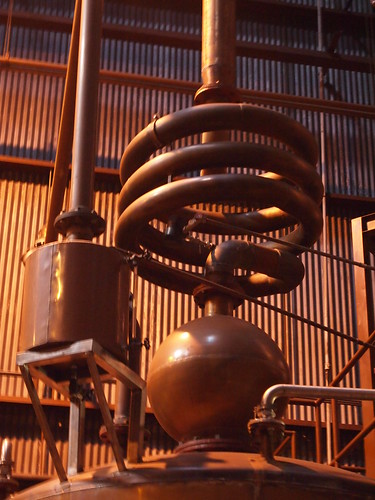
Something (still) About Mary.


This is the thirty-something-year-old, 1,700 gallon, copper double reflux still, given the name "Mary" (after the mother of the first Bowman brothers in Revolutionary War days) which distills the whiskey at the A. Smith Bowman Distillery, in Fredericksburg, Virginia. The very act of distilling the whiskey with distilled water thins the copper. Mary is reaching the end of her lifespan, and will eventually have to be replaced (with Mary II)?

The fermentation, and initial distillation, of the grain mash takes place off-site at the Buffalo Trace Distillery, in Kentucky, and then is shipped to Bowman, where it is distilled again —with Mary— and then aged in first-use charred American oak barrels ... to become bourbon.
A boiler creates distillate vapors. These are then allowed to rise up through the column in the reflux still. At the top of this column, the vapors are condensed. The condensed vapors now run back down the column as a liquid; as they come back down, they pass through other rising vapors. These rising vapors enrich this condensed liquid. Once the condensed liquids reach a lower level in the column, they then become hot enough to boil again. This creates more vapors and the process continues.
—Wikipedia

Abram Smith Bowman founded his eponymous distillery soon after the end of Prohibition, in 1934, in the town of Reston, Virginia (then a bucolic region, now a built-up, if planned, suburb of Washington, D.C.). In 1988, the company was moved to Fredericksburg, Virginia, into the capacious site of a former cellophane manufacturing plant. In 2003, the distillery was purchased by Sazerac, an alcoholic beverage company based in Louisiana.

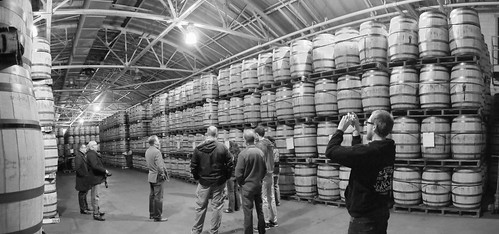
Barrel room @A. Smith Bowman (03)

I took these photos while touring the distillery on a Saturday morning, 8 November 2014. Yes! Sipping bourbon on a crisp autumn morning.

Unique among bourbon-makers, Bowman stores its barrels vertically on pallets, rather than horizontally in rickhouses. Why? "Because, this way," said our tour guide, Ralph, "we don't have to physically roll around any of our seven-thousand barrels!" Each barrel —coopered from Ozark white oak— weighs over 510 pounds when filled with 53 gallons of bourbon.

And what is 'bourbon'? As defined by the U.S. government, it is:
  • Produced in the United States.
  • Made from a grain mixture that is at least 51% corn.
  • Aged in new, charred oak barrels.
  • Distilled to no more than 160 proof (80% alcohol by volume).
  • Entered into the barrel for aging at no more than 125 proof (62.5% alcohol by volume).
  • Bottled at 80 proof or more (40% alcohol by volume).
  • Bourbon has no minimum specified duration for its aging period.
  • Bourbon that meets the above requirements, and has been aged for a minimum of two years, and does not have added coloring, flavoring, or other spirits may (but is not required to) be called straight bourbon.
Bowman's current master distiller, Brian Prewitt, gained his experience at E&J Distilleries (Modesto, California). But he also has valid brewing chops, having worked at New Belgium Brewery (Fort Collins, Colorado), and, as head brewer, at Great Divide (Denver, Colorado). At A. Smith Bowman, he's producing:
  • Virginia Gentleman bourbon
  • Bowman Brothers small batch bourbon
    named for four ancestors of Abram Bowman: 18th-century frontiersmen and American Revolutionary War military officers.
  • Abraham Bowman limited-edition small batch whiskey
    named for Colonel Abraham Bowman (1749–1837), the great grandfather of Abram Bowman
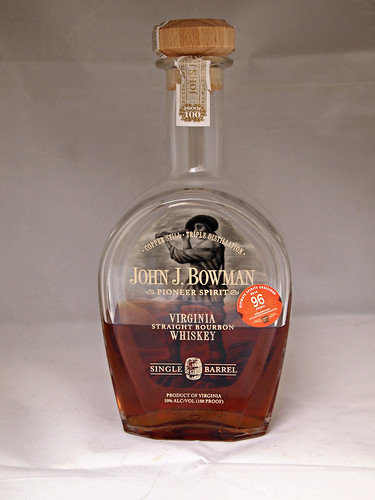
  • John J. Bowman single-barrel bourbon
    named for Colonel John Bowman (1738–1784), the great, great uncle of Abram Bowman.
John J. Bowman bourbon (02)

The distillery also produces vodka and rum, and, in 2015, will be installing an additional 25-gallon still solely to produce gin.

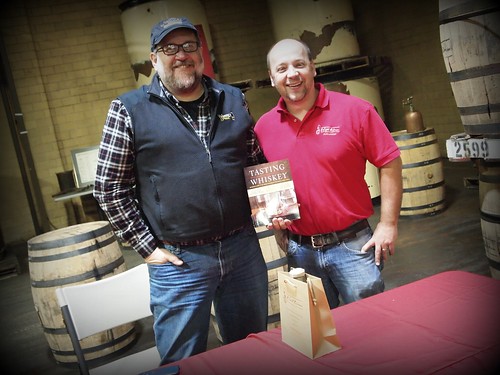
Also there the morning I was there was Lew Bryson. The editor of Whiskey Advocate Magazine, Bryson has just written a book called Tasting Whiskey: An Insider's Guide to the Unique Pleasures of the World's Finest Spirits. A. Smith Bowman was one stop on his book-signing tour. Here he is (on the left) with Brian Prewitt (on the right).

Bryson & Prewitt

I'm reading Bryson's book (and sipping Prewitt's bourbon). Review to follow.

-----more-----

Friday, November 14, 2014

It's the 3rd annual Cider Week Virginia.

Virginia Cider Week 2012 In 2010, there were only two cideries in Virginia.

In February 2011, the Virginia Senate passed a bill, sponsored by then Delegate David Englin, which raised the legal alcohol limit of 'hard' cider from seven to ten per cent. In 2012, then Virginia Governor Bob McDonnell issued a Virginia Cider Week Proclamation, which made Virginia the first state to have an officially proclaimed 'Cider Week.' 1

Now, in 2014, there are eleven cideries in Virginia, one of which is an urban cidery, one of only a handful such in the nation. 2

All of this is being celebrated from 14-23 November 2014, during Cider Week Virginia 2014 (actually a 10 day 'week'), the third annual such event.

“Cider Week Virginia is a great opportunity to showcase this fast-growing industry in our state,” said Cider Week spokesperson Diane Flynt [owner of Foggy Ridge Cider]. “Similar to the wonderful wines of Virginia, fine hard cider is made from well-grown fruit, fermented carefully to create a balanced and flavorful beverage. Cider Week Virginia provides many opportunities to sample the best of Virginia's artisanal cider, carefully crafted from Virginia apples.”

According to the Cider Week Virginia website, cider styles can be dry or sweet, still or sparkling, simple or complex, or even funky (think leather, oak, mushrooms!). The variety of apple is crucial to the production of good cider. Apples are selected for tannins, acid, and sweetness. High tannin levels provide the structure and mouthfeel of a cider, acid, the balance, and sweetness, the 'fruitiness.' 3

Jupiter's Legacy Cider Flute & Bottle (01)


There are ten cideries participating in Virginia Cider Week. The eleventh cidery is Mount Defiance Cidery & Distillery, in Middleburg, Virginia.

Cheese and cider

If only a Virginia cidery were to produce an honest-to-goodness cask scrumpy. Now, that would be worth celebrating.

-----more-----

Thursday, November 13, 2014

There's A Beer For That.


"There's a Beer for That" is a U.K. beer industry advert (as they say over there), produced by Britain's Beer Alliance, promoting beer, in general, and beer as appropriate at table.

It's not sixty-seconds of self-congratulatory bravado. It's not booty-shaking or churlish distraction. It's like a mashup of "Got Milk?" and Apple's "There's an App For That" served with just-folk vignettes and beer-and-food rhymings.

Sunday roast; cheese on toast; cockles from the Cornish coast. There's a beer for that. [...] Homely and hearty, or somewhat refined. There's a beer for that.

There's an amusing scene at 0:35 where a pub 'regular' and a hipster (or is that a British bro?) encounter one another at the pub. But, there's a beer for that, for them.

There are some in the 'craft' beer world to whom marketing is anathema, but who, without any sense of abashed irony, themselves boast of "the end of bad beer," or "we are revolutionaries," "No Rules. It's craft." or some such thing. That is marketing, kids.

The above ad is not boastful; it's simple and disarming. It might even benignly coerce you into going out and having a beer with friends ... with a meal. Which is the point. It did me.

Now, why can't we Americans produce a beer advert like that?

-----more-----