Today: a photo only a cask-ale partisan could love.
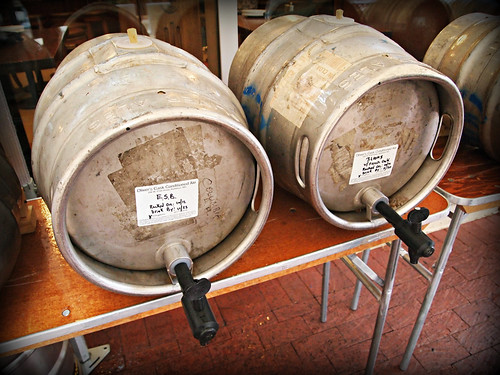
These two firkins (10.8 gallon casks) definitely have seen some use over the years: beat up on the outside but pristine clean on the inside.
The proof of the latter was indeed the beer on the inside. Brewed and conditioned by the Oliver Brewing Company (in Baltimore, Maryland), the ales were full-flavored, bright, naturally carbonated, and traditional, devoid, as it were, of extraneous, 'non-beer' ingredients. (My parameters for that last requirement appear to have become more forgiving: the strong brown ale on the right was infused with oak spirals.)
At a cask ale festival, at ...
Mad Fox Brewing Company
Falls Church, Virginia.
7 November 2015.
-----more-----
Saturday, November 21, 2015
Pic(k) of the Week: Oliver's conditioned casks.


Friday, November 20, 2015
Thank you, Bill Siebel!
There are many 'rock stars' in 'craft' beer: some deservedly so, some by acolyte acclaim, some self-anointed. The number of real stars is far fewer.
Despite the Luddite choir currently ascendant in some sections of the 'craft' beer industry, preaching creativity over 'rules', it's the beer educators who are indeed among those true stars, whom we should be celebrating for their essential work in training us, promulgating the zymurgy and technology that advances good beer.
To name but three:
- Michael Lewis, professor emeritus of brewing science: the University of California, Davis.
- Steve Parkes, brewmaster; owner and lead instructor: American Brewers Guild.
- Bill Siebel.
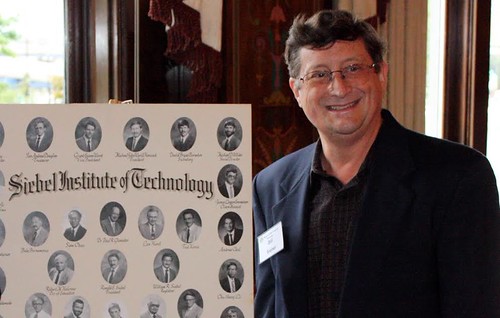
As an educator and administrator at the school, Bill Siebel wielded influence upon several generations of American-trained brewers: microbrewers (such as this blogger), 'craft' brewers, large mainstream brewery brewers, and just plain ol' American brewers. The school's reputation was global; many foreign breweries sent their employees to be zymurgically educated.
I remember well my first day there, in the early 1990s. Bill greeted me. I addressed him as "Mr. Siebel." He corrected me, "It's just Bill." My career path changed that day, and it's been beer ever since.
Bill died earlier this month.
R.I.P., (and I will say it incorrectly one more time) Mr. Siebel. Thank you for all you have done for the advancement of good beer, in America and globally. Your influence upon us: that is your living legacy.
— Chicago Sun-TimesBill Siebel, leader of historic Chicago beer brewing school, dies at 69.
Bill Siebel was the fourth generation of his family to head [the Siebel Institute of Technology], a Chicago beer-brewing school that has produced tens of thousands of alums with surnames such as Busch, Coors, Pabst, Stroh, and Floyd — as in 3 Floyds Brewing Company.
It wouldn’t be exaggerating to call him a member of the “First Family” of beer education in the U.S., said Charlie Papazian, president and founder of Denver’s Great American Beer Festival, the nation’s largest.
Mr. Siebel, who had esophageal cancer, died on November 8, 2015, at Northwestern Memorial Hospital [in Chicago, Illinois]. He was 69.
Bill Siebel was chairman and CEO of the Siebel Institute of Technology, established in Chicago in 1872 by his great-grandfather, Dusseldorf-born immigrant John Ewald Siebel. It bills itself as the oldest brewing school in the Americas. “There is one, based in Germany, established before us,” said Keith Lemcke, vice president of the Institute, at 900 N. Branch Street.
“It’s been a continuous run,” Lemcke said, “except for this inconvenient time we call ‘Prohibition.’ ” During Prohibition, it kept going as a school of baking — which, like brewing, uses yeast.
Siebel Institute students, Lemcke said, have included August Busch III of Anheuser-Busch; John Mallett of Bell’s Brewery in Kalamazoo; the father and grandfather of Samuel Adams brewer Jim Koch; and Greg Hall, a brewmaster at Goose Island Beer Company and son of Goose Island founder John Hall.

“The contributions that the Siebel Institute has made to brewing — and to training craft brewers — in its long history, are far too numerous to count,” said Koch of Samuel Adams. “I’m a sixth-generation brewer, and my father graduated from Siebel in 1948 and my grandfather in 1908. . . . The industry has lost a great one.”
The family school is “the longest-living institution that has served as an educational institution for brewers in the United States,” Papazian said. “They’ve gone through a lot of transitions, from the small breweries going out of business in the ’50s, ’60s and ’70s, to embracing the small craft brewers that were emerging in the ’70s and ’80s, welcoming them, and offering them educational opportunities. Bill was involved with that transition.”
“Many of our employees are graduates of Siebel Institute, and the impact the school has made on the beer community is impressive,” said Ken Stout, general manager of Goose Island Beer Company. “A great industry leader has been lost, and we’ll miss him dearly.”
Bill Siebel and his brother, Ron, grew up near Devon and Caldwell in Edgebrook, and at the Southwest edge of the Evanston Golf Club in Skokie, where one of the tees was behind their home. A highlight of their youth was spending summers with their mother, Mary, at Paradise Ranch near Colorado Springs, while their father, Raymond, commuted back and forth from the Siebel Institute in Chicago. The Siebel boys became accomplished horseback riders.
They attended grade school at the old Bishop Quarter Military Academy in Oak Park. Bill Siebel graduated from Florida’s Admiral Farragut Academy and the University of Miami. He served in the Navy, rising to lieutenant, before returning to Chicago — and the family beer school — in 1971, said his wife, Barbara Wright Siebel.
Both brothers attended the Siebel Institute, where a variety of classes, diplomas and certificates focus on yeast, malt, fermentation, biological science, quality control, engineering and packaging. “One of my classmates in 1967 was August Pabst, and August Busch III was a few years before,” Ron Siebel said.
For decades, the school and laboratory were located at 4055 W. Peterson, where the Siebels had a brewing library and a second-floor bierstube with heirloom steins.
After their father and uncle sold the business, “Bill and I were successful in getting it back,” Ron Siebel said. “We got it back in the family hands, and it stayed there until [Bill] retired and wanted to liquidate his holdings in the institute.” Today, the school is owned by Lallemand, a Canadian yeast company.
Ron Siebel focused on selling products such as stabilizers, which preserve clarity in beer. “Bill was ‘Mr. Inside.’ He was very good with numbers,” his brother said. Because of him, “The business was always on a steady course.”
Bill Siebel retired in 2000, Lemcke said.
He restored himself and reveled in nature, hiking, and watching birds and animals. For their honeymoon, Bill and Barbara Siebel canoed nine days on the U.S.-Canadian Boundary Waters. And for 20 years, they canoed in Ely, Minnesota, where he enjoyed spotting bear and moose. He also loved reading Dostoevsky and Tolstoy.
A memorial service is planned from 2 p.m. to 5 p.m. on November 22, 2015, at the Siebel Institute of Technology, 900 N. Branch Street [Chicago, Illinois].
16 November 2015.
-----more-----
Monday, November 16, 2015
Clamps & Gaskets: News Roundup for Weeks 44/45, 2015.

A bi-weekly, non-comprehensive roundup
of news of beer and other things.
Weeks 44/45
25 October - 7 November 2015
- 5 November 2015
In a trend of the last few years, breweries from the U.S. west have opened second brewing facilities on the east coast. But not vice versa. Until now. Sweetwater Brewing of Atlanta, Georgia, has announced its intention to open a brewery in California, in 2017.
—Via Brewbound. - 4 November 2015
The sugar industry has sued high fructose corn syrup producers in federal court for falsely claiming that their product is just as healthful as sugar. Corn syrup producers have countered suedhit back, arguing that the sugar industry has long engaged in a campaign of misinformation. Big Sugar is seeking $1.5 billion in damages. Big Corn Syrup is seeking $530 million. Jurors will decide.
—Via Los Angeles Times. - 3 November 2015
Belgian lambic brewer, Cantillon, says climate change shortening brewing season, forced to temporarily halt early November production because of an unusually warm autumn. Jean Van Roy, owner of Cantillon:
—Via The Guardian.“Ideally [the wort] must cool at between minus 3C and 8C. But climate change has been notable in the last 20 years. My grandfather 50 years ago brewed from mid-October until May – but I’ve never done that in my life, and I am in my 15th season.' Last year we didn’t start until November 10,” he said, adding that they never go past the end of March. “We only have five months to brew and our production is very limited. If we lose a week we can survive but three weeks or more would be more complicated.” - 3 November 2015
Cité du Vin, a "modernistic museum of culture and civilization of wine around the world," to open in Bordeaux, France, in 2016.
—Via The Drinks Business. - 3 November 2015
A timeline of the demise of Baltimore, Maryland's National Bohemian beer.
—Via YFGF. - 02 November 2015
There are only two major American can manufacturers. Are they cutting off supply to smaller 'craft' breweries?
—Via Forbes MergerMarket. - 31 October 2015
—Via Adrian Tierney-Jones, at Called to the Bar.The idea of moderation in brewing is not the idea of capitulation, of surrender, of turning your back on the way forward. It's a way of seeking silence in between the gaps that modern life manages to create - it's a polite cough, a feather stroke on the inner thigh, a reflective passage from an étude by Chopin, the intermission between nothing and I love you. And sometimes we need beers like that in the way we also need beers that cackle and burn like a martyr's bonfire or ululate across the night air like a trident in its tracks or even leave us unsure of what we're tasting. Like an Earth on its axis beer also needs balance. - 29 October 2015
The English malting barley that wouldn't die. The fifty-year history of Maris Otter.
—Via Total Ales. - 28 October 2015
"Hops can take 10 to 12 years to develop before they’re marketed to breweries." Green Flash brewmaster Chuck Silva and Alpine Beer Company Brewmaster Pat McIlhenney examine the hop harvest in the Pacific Northwest.
—Via Nicholas Gingold, at All About Beer. - 28 October 2015
Federal judge throws out lawsuit which alleged fraud by MillerCoors for stating Blue Moon beer is "artfully crafted." There is "no case supporting the proposition that the price of a product can constitute a representation or statement about the product."
—Via Alan McLeod, at A Good Beer Blog. - 28 October 2015
It has been twenty-five years since the Discovery Channel first aired The Beer Hunter." A documentary on beer, produced and narrated by British beer writer Michael Jackson, it was "ahead of its time."
—Via Tom Acitelli, at All About Beer. - 26 October 2015
Scandal! The Archbishop of Cologne, Germany, admits that he prefers Dusseldorf's rival Altbier to Cologne's native Kölsch ales.
—Via Kölner Stadt-Anzeiger. - 26 October 2015
The seven denominators of 'cult' California wines. And why their producers shouldn't bemoan the wines described as such.
—Via Steve Heimoff. - 25 October 2015
Washington, D.C. radio legend, Ed Walker, dies at 83.
—ViaWashingtonian. - 25 October 2015
A theory as to why brewery 'tied house' pubs existed to such a large extent in England, but not so much elsewhere.
—Via Ron Pattinson, at Shut Up About Barclay Perkins. - 25 October 2015
In 2011, 2% of U.S. 'craft' beer was sold in cans. In 2014: 10%.
—Via Bart Watson, economist for Brewers Association. - 25 October 2015
What is the number one 'craft' beer style on tap in the U.S.? It's no surprise that it's IPA (India Pale Ale), with a 19.2% share. Pale Lager is second; Pale Ale is third.
—Via YFGF. - 25 October 2015
By December 2016, the FDA will require all chain-restaurants (with twenty or more locations) to display on their menus caloric and nutritional information for any beers they serve. Breweries will be expected to supply this information. The cost of analysis, etc., could be a major problem for mid-size and small breweries.
—Via MiBiz.
In 1992, early 'craft' brewery owner Bert Grant put nutritional information on the label of his Grant's Scottish Ale. At that time, the U.S. government told him to cease and desist.
—Via YFGF.

Saturday, November 14, 2015
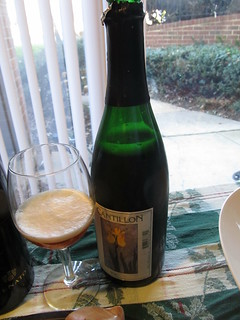
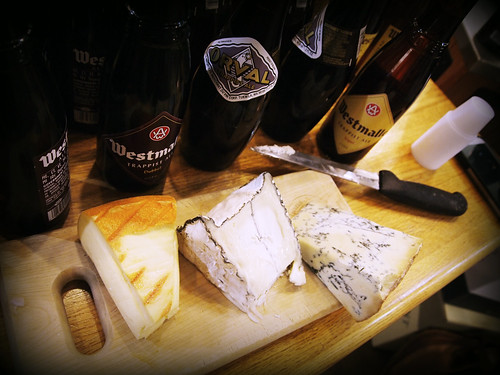
Pic(k) of the Week: Cheese with Trappists
Yours For Good Fermentables was recently press'd into service; mentioned, that is, photographically (with credit) in a broadcast story on beer-with-cheese pairing.
Beer-cookbook writer Lucy Saunders and cheese-writer Jeanette Hurt discussed the topic on Lake Effect, a "magazine program" of Milwaukee Public Radio station, WUWM 89.7, on 4 November 2015.
"Beer and cheese are fermented friends," Lucy Saunders said "And we are fermented friends, too," laughed Jeanette Hurt.
"There's nothing against wine and cheese pairings, said Saunders, "but one of the most interesting things is that beer and cheese have more of a similar profile of aromatic compounds."
"When I'm looking at wine and food pairings, and beer and food pairings (and beverage and food pairings, in general)," Hurt said. "I'm looking for that perfect marriage. By themselves they taste great, but together, they taste even better."
"Beer and cheese complement each other very well," she continued. "Beer is liquid bread, and milk is hardened milk, the makings of a sandwich in your mouth."
"Beer is bubbly," said Saunders. "The effervescence of the bubbles cleanses the palate of the cloying creaminess of the cheese."
The pair discussed the importance of food pairing 'bridges.'
"Foods and accouterments can bridge the cheese and the beer (or the cheese and the wine) to bring them together," Hurt said. "One of the bridges we're using is honey, which is an amazing accessory for cheese. Just a little bit drizzled is just so, so good, and it goes so well with the honey aspect of a beer."
"Also dried fruits," added Saunders, "and some of the spices like cocao nibs, and a dusting of pepper can really elevate the tastes of a cheddar or a creamy, really soft cheese."
And then there was this wonderful exchange on the spice of beer, the hops.
Hurt observed that, "The fragrance of the hops tends to be a little resinous, piney, and that citrusy note elevates the butterfat in cheese, and you get a really nice harmony going on with that."
To which Saunders replied, ""With the hops, you have the aroma and the aftereffect. When you swallow, which is really important in beer, you get that retro-nasal reverb. It's really delightful when you have a beer and cheese pairing, because there's a before, during, and after."
Retro-nasal reverb, indeed! Listen to Hurt and Saunders' entire discussion: here.
*****
About the photo
A beer sampling Balducci's Food Market (in McLean, Virginia, 9 April 2015), in which I served three Belgian Trappist ales (brewed by monks) with three cheeses.- Westmalle Dubbel
Served with Stilton cow's milk blue cheese (U.K.) - Orval
Served with Humboldt Fog goat cheese (California). - Westmalle Tripel
Served with Chimay Grand Cru washed rind cheese (Belgium).
A Trappist cheese!
-----more-----
Tuesday, November 10, 2015
The best beers in Maryland, 2015 edition.
The Brewers Association of Maryland (BAM) recently hosted the 10th Annual Maryland Craft Beer Competition to determine the best beer—by category—crafted by Maryland breweries.
The Brewers Association of Maryland (BAM) announced the results in late September. Better late than never, I've re-posted them here, today.
Congratulations to the winners, and good luck to all in the next round, as Maryland's best of the best is announced.
UPDATE: 13 November 2015.
Peabody Heights Brewery Old Oriole Park Bohemian Lager was named Maryland’s top beer at the 2015 Maryland Craft Beer Competition. Other overall winners included Evolution Craft Brewery’s Lot #6 Double IPA which placed 2nd overall, RavenBeer’s The Cask which placed 3rd overall, and Franklin's Brewery was awarded Honorable Mention for their Bombshell Blonde.
 Maryland Comptroller Peter Franchot (second from left) awards the Maryland Craft Beer Competition Cup to Ernesto Igot, brewmaster for Peabody Heights.
Photo courtesy Maryland Brewers Association.
- Pale Lager / Pilsner
- Gold – Peabody Heights Brewery, Old Oriole Park Bohemian Lager
Advanced to Best of Show Round - Silver – Full Tilt Brewing, In Memory Of ... Pilsner
- Bronze – Gordon Biersch (Rockville), Czech Pilsener
- Gold – Peabody Heights Brewery, Old Oriole Park Bohemian Lager
- Amber Lager / Dark Lager / Bock
- Gold – Raven Beer, The Cask,
Advanced to Best of Show Round - Silver- Flying Dog Brewery, Dogtoberfest
Advanced to Best of Show Round - Bronze (Tie) – Ruddy Duck, Maibock
- Bronze (Tie) – Union Craft Brewing, Blackwing Lager
- Gold – Raven Beer, The Cask,
- Amber Ale
- Gold – Franklins Brewery, Rubber Chicken Red
Advanced to Best of Show Round - Silver – Barley & Hops, Clustered Spires Abbey Dubbel
Advanced to Best of Show Round - Bronze – Milkhouse Brewery, Goldie’s Best Bitter
- Gold – Franklins Brewery, Rubber Chicken Red
- Pale Ale
- Gold – Union Craft Brewing, Anthem
Advanced to Best of Show Round - Silver – Flying Dog Brewery, Doggie Style Pale Ale
Advanced to Best of Show Round - Bronze (Tie) – Milkhouse Brewery, Dollyhyde Farmhouse Ale
Advanced to Best of Show Round - Bronze (Tie) – Calvert Brewing Co., Good Company Pale Ale
Advanced to Best of Show Round - Honorable Mention – Franklins Brewery, Bombshell Blonde
Advanced to Best of Show Round
- Gold – Union Craft Brewing, Anthem
- IPA
- Gold – Evolution Craft Brewery, Lot #6 Double IPA
Advanced to Best of Show Round - Silver – Evolution Craft Brewery, Lot 3 IPA
Advanced to Best of Show Round - Bronze – Flying Dog Brewery, Snake Dog IPA
- Gold – Evolution Craft Brewery, Lot #6 Double IPA
- Brown Ale
- Gold – Monument City Brewing, American Brown Ale
Advanced to Best of Show Round - Silver – Eastern Shore Brewing, Buffelhead Brown
- Bronze – Assawoman Bay Brewing Co., Angry Clown Brown Ale
- Gold – Monument City Brewing, American Brown Ale
- Stout
- Gold – Heavy Seas Beer, Siren Noire Bourbon-Aged Chocolate Imperial Stout
Advanced to Best of Show Round - Silver – Monocacy Brewing Co., Brewtus Coffee Imperial Stout
Advanced to Best of Show Round - Bronze – Flying Dog Brewery, Pearl Necklace
- Gold – Heavy Seas Beer, Siren Noire Bourbon-Aged Chocolate Imperial Stout
- Porter
- Gold – Heavy Seas Beer, Deep Six Porter
Advanced to Best of Show Round - Silver – Evolution Craft Brewery, Lucky 7 Porter
Advanced to Best of Show Round - Bronze – Gordon Biersch (Rockville), Robust Porter
- Gold – Heavy Seas Beer, Deep Six Porter
- Strong Beer
- Gold – Barley & Hops, Snowmaggedon
Advanced to Best of Show Round - Silver – Franklins Brewery, Jack The Giant Killer
Advanced to Best of Show Round - Bronze – Franklins Brewery, 97 Pound Weakling
Advanced to Best of Show Round
- Gold – Barley & Hops, Snowmaggedon
- Wheat Beer
- Gold – Franklins Brewery, Weisenbock
Advanced to Best of Show Round - Silver – Gordon Biersch (Rockville), Broyhan
Advanced to Best of Show Round - Bronze – Barley & Hops, Pickett’s White Star
Advanced to Best of Show Round - Honorable Mention – Gordon Biersch (Rockville), Hefeweizen
Advanced to Best of Show Round
- Gold – Franklins Brewery, Weisenbock
- Sour Beer / American Wild
- Gold – Franklins Brewery, More Bounce to the Ounce
Advanced to Best of Show Round - Silver – Franklins Brewery, Slippin’ Into Darkness
Advanced to Best of Show Round - Bronze – Franklins Brewery, Outaspace
- Gold – Franklins Brewery, More Bounce to the Ounce
- Spiced Beer
- Gold – Full Tilt Brewing, Patterson Pumpkin
Advanced to Best of Show Round - Silver – Gordon Biersch, Hibiscus Shandy
- Bronze – Mully’s Brewery, Ancho IPA
- Honorable Mention – Gordon Biersch (Rockville), Coffee Stout
- Gold – Full Tilt Brewing, Patterson Pumpkin
- Fruit, Wood, or Smoked Beer
- Gold – Heavy Seas Beer, Red Sky at Morning Wood-Aged Saison
Advanced to Best of Show Round - Silver (Tie) – Heavy Seas Beer – Blackbeard’s Breakfast Barrel-Aged Coffee Porter
Advanced to Best of Show Round - Silver (Tie) – Oliver Brewing Co., Don’t Fear The Creeper
Advanced to Best of Show Round - Bronze- Gordon Biersch (Rockville), Bourbon Barrel Aged Porter
- Gold – Heavy Seas Beer, Red Sky at Morning Wood-Aged Saison
- Specialty Beer
- Gold – Union Craft Brewing, Broken Record
Advanced to Best of Show Round - Silver – Brewers Alley, 1634 Ale
Advanced to Best of Show Round - Bronze – Flying Dog Brewery, Juniper White IPA
Advanced to Best of Show Round
- Gold – Union Craft Brewing, Broken Record
Afterthoughts
Tied for most medals won were Franklin's and Gordon Biersch (Rockville location) with seven apiece (although three of the latter's were honorable mentions).Flying Dog was second with five medals overall; Heavy Seas Beer, third, with four.
For most gold medals won, Franklin's and Heavy Seas Beer were tied with three apiece. Union Craft had two.
Thirty-four of the fifty-one beers that won medals were pushed on to Best of Show. That's nearly two-thirds of the medalists, somewhat akin to the "every kid in the sport wins an award." It might be less unwieldy and less silly if the number were capped at, say, ten percent.
If one were keeping score, Franklin's had the most beers pushed forward, seven. Next was Heavy Seas Beer with four, and both Barley & Hops and Flying Dog with three. As mentioned above, an overall winner has yet to be announced.
Jailbreak Brewing (in Laurel) was the only Maryland brewery to win a medal at this year's Great American Beer Festival —the nation's commonly accepted premier beer festival and competition. Its Van Dammit won top honors among all American beers entered in the Belgian-Style Strong Specialty Ale category. But Jailbreak won nothing at all in the Maryland competition.
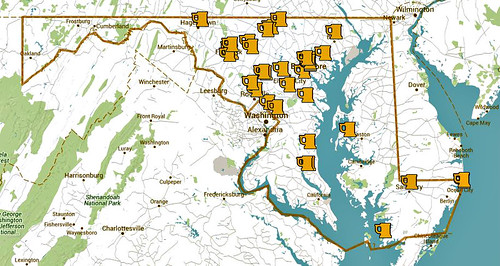
The map above, from BAM's website, shows forty-four breweries: that is, those forty-four Maryland breweries that are, as of today, members of the Association. According to the Comptroller of Maryland, however, there are fifty-four breweries in the state, that is, have a license to brew.
-----more-----
Subscribe to:
Comments (Atom)