Sunday, December 25, 2016

The grand charity Christmas Bierabend of the Tortsäuffers of Baltimore.

Christmas service

A Christmas carol

The first Christmas after her husband had passed away, the widow was paid an afternoon visit by the young married couple who lived across the quiet street. Youthful Santas, they came bearing gifts: conversation, a bottle of wine, and a book. The house became loud and jolly. The woman was cheered.

The book they left was Christmas at The New Yorker, a compendium of Christmas stories, poems, and cartoons that had appeared in The New Yorker magazine over the years. Contributors included —posthumous and au courant— such as John Cheever, Garrison Keillor, Alice Munro, Ogden Nash, Calvin Trillin, E.B. White, Roger Angell, Brendan Gill, Ken Kesey, Vladimir Nabokov, James Thurber, and John Updike.

Later, in quiet, one of the stories the woman would read was Stare Decisis, written by H.L. Mencken, the cantankerous gadfly of the Baltimore Sun newspaper in the early 20th century. It told the Christmas adventure of a turn-of-that-century brewery salesman of Baltimore, Maryland. He was, as Mencken described him, a Tortsäuffer: "literally a dead-drinker, a brewery's customers' man. One of his most important duties is to carry on in a wild and inconsolable manner at the funerals of saloonkeepers."

**************

Stare Decisis

Despite all the snorting against them in works of divinity, it has always been my experience that infidels —or freethinkers, as they usually prefer to call themselves— are a generally estimable class of men, with strong overtones of the benevolent and even of the sentimental. This was certainly true, for example, of Leopold Bortsch, Tortsäuffer for the Scharnhorst Brewery, in Baltimore, forty-five years ago, whose story I have told, alas only piecemeal, in various previous communications to the press. If you want a bird's-eye of his character, you can do no better than turn to the famous specification for an ideal bishop in I Timothy III, 2-6. So far as I know, no bishop now in practice on earth meets these specifications precisely, and more than one I could mention falls short of them by miles, but Leopold qualified under at least eleven of the sixteen counts, and under some of them he really shone.

He was extremely liberal (at least with the brewery's money), he had only one wife (a natural blonde weighing a hundred and eighty-five pounds) and treated her with great humanity, he was (I quote the text) "no striker...not a brawler," and he was preëminently "vigilant, sober, of good behavior, given to hospitality, apt to teach." Not once in the days I knew and admired him, c 1900, did he ever show anything remotely resembling a bellicose and rowdy spirit, not even against the primeval Prohibitionists of the age, the Lutheran pastors who so often plastered him from the pulpit, or the saloon-keepers who refused to lay in Scharnhorst beer.

Mencken continued, with the saga of a gala —shall I say, huge— Christmas dinner for Baltimore's poor and homeless, "the masterpiece of a benevolent career, [...] a Christmas party for bums to end all Christmas parties for bums." [No hindsighted moral superiority, please.]
First and foremost, they wanted as much malt liquor as they would buy themselves if they had the means to buy it. Second, they wanted a dinner that went on in rhythmic waves, all day and all night, until the hungriest and hollowest bum was reduced to breathing with not more than one cylinder of one lung. Third, they wanted not a mere sufficiency but a riotous superfluity of the best five-cent cigars on sale on the Baltimore wharves. Fourth, they wanted continuous entertainment, both theatrical and musical, of a sort in consonance with their natural tastes and their station. Fifth and last, they wanted complete freedom from evangelical harassment of whatever sort, before, during, and after the secular ceremonies.

As in the wonderful 1990s flick, Big Night, the dinner does indeed go on.
It might have cost him his last cent if he had gone it alone, for he was by no means a man of wealth, but his announcement had hardly got out before he was swamped with offers of help. Leopold Bortsch pledged twenty-five barrels of Scharnhorst beer and every other Tortsäuffer in Baltimore rushed up to match him. The Baltimore agents of the Pennsylvania two-fer factories fought for the privilege of contributing the cigars. The poultry dealers of Lexington, Fells Point, and Cross street markets threw in barrel after barrel of dressed turkeys, some of them in very fair condition. The members of the boss bakers' association, not a few of them freethinkers themselves, promised all the bread, none more than two days old, that all the bums of the Chesapeake littoral could eat, and the public-relations counsel of the Celery Trust, the Cranberry Trust, the Sauerkraut Trust, and a dozen other such cartels and combinations leaped at the chance to serve. Even the ketchup was contributed by social-minded members of the Maryland canners' association, and with it, they threw in a dozen cases of dill pickles, chowchow, mustard, and mincemeat.

And it was grand. A bierabend!
A Bierabend, that is, a beer evening. Extra pitchers were put on every table, more cigars were handed about, and the waiters spread a substantial lunch of rye bread, rat-trap cheese, ham, bologna, potato salad, liver pudding, and Blutwurst.

Mencken was a cantankerous scribe of the early twentieth-century; he pilloried establishment figures, disfavoring businessmen, government, the middle class, and organized religion alike. So, again avoiding PC-ism, understand Mencken's peroration, as he bemoans how the benevolent Bierabend —of course and unfortunately— ultimately went awry.
I didn't see Fred again for a week. But the next day, I encountered a police lieutenant ["then the only known freethinker on the Baltimore force"] on the street, and he hailed me sadly. "Well," he said, "what could you expect from the bums? It was the force of habit, that's what it was. They have been eating mission handouts so long they can't help it. Whenever they smell coffee, they begin to confess. Think of all that good food wasted! And all that beer! And all them cigars!"


******************

And to all a good night

Stare Decisis was an H.L. Mencken Christmas carol. There never was a Scharnhorst Brewery. There were no Tortsäuffers or Bierabends. But how glorious if there would have been ... if today there would be.

The merry widow? After reading this story, she bookmarked it as a fable she thought that I —then earning a living as a brewery's customers' man— might enjoy. She was my mother, since reunited with my father in the firmament.

This Christmas season, I re-discovered her handwritten bookmark. I turned to page fifty-eight of that book, as she had suggested long ago. And I read along, with a winter beer near at hand. It was a Bierabend of one.

Peace, happiness, and health to you, my readers. Don't waste your beer!

Santa at the diner

-----more-----

Saturday, December 24, 2016

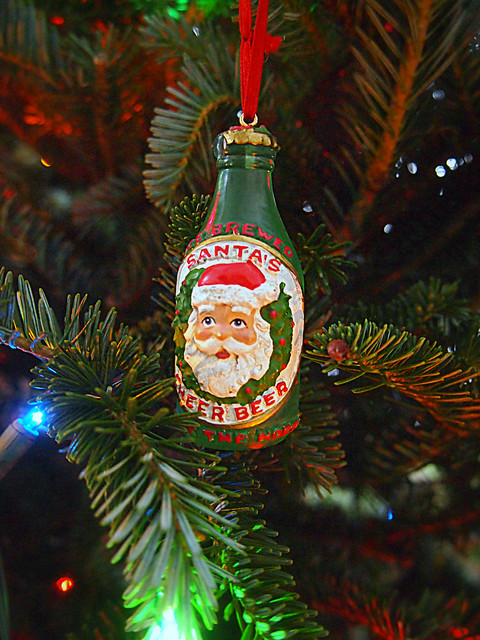
Pic(k) of the Week: Santa Cheer Beer

Santa's Cheer Beer

Espied on the YFGF Christmas tree, 24 December 2016: Santa Cheer Beer ornament, "Ice-Brewed at the North Pole."

-----more-----

Saturday, December 17, 2016

Pic(k) of the Week: Friday night brews

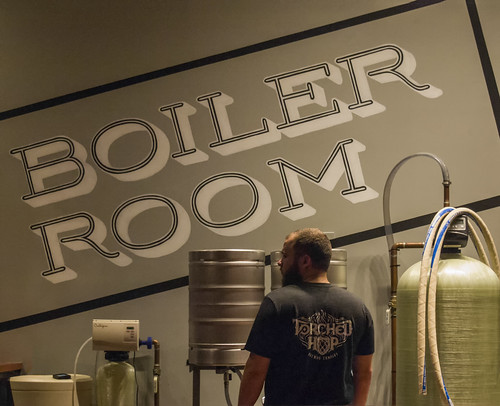
Brewer at work

We play; a brewer works. Yeast never sleeps, even on a Friday night.

A brewer in the boiler room, at Torched Hop Brewing Company, a brewpub in the Old Fourth Ward neighborhood of Atlanta, Georgia. 18 November 2016.

-----more-----

Monday, December 12, 2016

Clamps & Gaskets: News Roundup for Weeks 47/48, 2016.

Clamps and Gaskets: weekly roundup
A bi-weekly, non-comprehensive roundup
of news of beer and other things.

Weeks 47/48
20 November - 3 December 2016

  • 1 December 2016
    Legal marijuana, which by 2026 could be a $50 billion business in sales alone, remains the biggest threat [to the craft beer business]. Support for legalization is growing: 58 percent of the country supports recreational use.I think it will negatively impact alcohol consumption.
    —Via presentation at Brewbound conference.

  • "The Pub," by Pete Brown (front)
  • 1 December 2016
    Author Pete Brown has been named Beer Writer of the Year 2016 at the British Guild of Beer Writers’ annual awards ceremony, staged on 1 December in London. The Award represents a ‘hat trick’ for Brown, who also took the title in 2012 and 2009. Beer Writer of the Year is the top award in the Guild’s annual competition for writing about beer and pubs, which this year received more than 150 entries across nine categories. Brown won two categories – for the best writing in trade press and in national media – on his way to the top prize.
    —Via British Guild of Beer Writers.

  • 1 December 2016
    The Craft Brewers Conference & BrewExpo America returns to Washington, D.C., 10-13 April 2016, for its second time there.
    Presented annually by the Brewers Association [for 34 years], the Conference is the craft brewing industry’s leading event, and the only one that serves both brewpubs and packaging breweries. BrewExpo America is the premier trade show for craft brewers.
    —Via [U.S.] Brewers Association.

  • 1 December 2016
    The United Nations Educational, Scientific, and Cultural Organization (UNESCO) selects Belgium's beer and brewing culture as an Intangible Cultural Heritage of Humanity, one of sixteen new additions that were announced.
    Making and appreciating beer is part of the living heritage of a range of communities throughout Belgium. It plays a role in daily life, as well as festive occasions. Almost 1,500 types of beer are produced in the country including by some Trappist communities. Craft beer has become particularly popular. Beer is also used by communities for cooking, producing products like beer-washed cheese, and paired with food. Knowledge of the element is shared in the home, social circles, breweries, universities and public training centres.
    —Via NPR.

  • 29 November 2016
    The International Hop Growers Convention has announced its preliminary data on 2016 global hop production.
    • 107,203 metric tons (approximately 236,342,159 pounds) of hops were produced in 2016 on 54,210 hectares of planted acreage. While neither of these measures were record highs, they represent significant increases over the 2015 crop.
    • It is expected that 2016 will represent the third year in a row that global beer production will decline slightly, but with increased hop dosage in craft beers, supply appears to be in balance with demand.
    • Global alpha hop production was up significantly over 2015. For the first time since 2009, more than 10,000 metric tons of alpha was produced.
    • U.S. acreage increased 17%, but production was up only 10%. The U.S. crop experienced a major shift to aroma varieties in order to meet global 'craft' beer demand.
    —Via YCH Hops.

  • 29 November 2016
    “My word, I’m as old as the hills.” Emma Morano, born in 1899, is last known living person to have been born in 19th century. Morano, an Italian citizen, celebrated her 117th birthday on 29 November 2016.
    —Via Telegraph.

  • 28 November 2016
    Under a new Texas law, brewers must surrender their distribution rights to distributors without compensation. Those distributors are then allowed to sell those rights, again with no compensation to the brewers. Texas brewers claim that the Texas law violates their PROPERTY rights under the Texas constitution. Based upon its interpretation that the Texas Constitution protects the property rights of entrepreneurs, ostensibly forbidding this practice, an Austin trial court agreed in August. The Texas Alcoholic Beverage Commission has appealed the decision to the Third Court of Appeals.
    —Via Craft Brewing Business.

  • 23 November 2016
    For second consecutive year, U.S. has planted more hops (52,962 acres) than Germany (45,957). Since 2012, U.S. hops production has increased 50%. Record-high 91.8 million pounds of hops harvested in Pacific Northwest this year.
    —Via Brewbound.

  • 26 November 2016
    Two bills are pending in Congress to permit "full-fledged agricultural and industrial use" of hemp.
    —Via Washington Post.

  • 26 November 2016
    Today, we have successive waves of people turning 21 who never saw BudMillerCoorsPabst in their refrigerators; never had the discussion, in middle school, on the relative merits of Bud vs. Old Style vs. Schlitz. These young men and women were raised, in fact, knowing that beer can actually be wildly and gloriously flavorful and diverse; knowing they have Real Choices...
    —Via Steve Body, at The Pour Fool.

  • 25 November 2016
    In praise of Baltic porters’ naughty comfort: this great style is underrated everywhere ... except maybe Poland [and, I would add, Lithuania and Latvia].
    They can be sweetish or bitterish or both, but above all they are most enjoyable when smooth in flavor and thick of body, revealing layers of malt complexity that can include dark fruit, cocoa, coffee, toffee and licorice. [...] These days, Baltic porter is nearly always bottom-fermented, leading to a cleaner profile that further showcases—in a good one, anyway—that nearly fathomless dark malt character.
    —Via Joe Stange, at DRAFT.

  • 25 November 2016
    Fidel Castro, who ruled Cuba as Communist dictator from 1959 to 2008, dies at 90.
    —Via Washington Post.

  • 19 November 2016
    U.S. National Oceanic and Atmospheric Administration (NOAA) launches GOES-R (Geostationary Operational Environmental Satellite): first of new generation of geosynchronous weather satellites. To provide atmospheric and surface measurements of the Earth’s Western Hemisphere for weather forecasting, severe storm tracking, space weather monitoring, and meteorological research.
    —Via Washington Post.

  • 20 November 2016
    University of Maryland Extension office runs program to research hops and barley for the 'craft' beer industry most suitable for growing with Maryland's terroir and climate. Has local brewery produce beer with program's first released hop. In 2017, plans to produce 24 new varieties of hops, as well as barley
    —Via University of Maryland.

  • Veggie 'Beastie' Loaf (02)
  • 24 November 2016
    Recipe for Milk Stout-Roasted Root Vegetables.
    —Via Susan Nowak, at YFGF.

  • 23 November 2016
    Fresh-hopped ales are NOT the Beaujolais Nouveau of the beer world. Don't demean the former with the latter.
    —Via YFGF.

  • 21 November 2016
    In 2015, the combined U.S. sales of brewing giants Anheuer-Busch InBev and MillerCoors dipped 4.34 million barrels, an amount equal to 18% of all beer produced by American 'craft' breweries that year.
    —Via Beervana.

  • 21 November 2016
    When Anheuser-Busch InBev doesn't buy a craft brewery, one of its distributors might. Northern Eagle Beverages Inc. purchases Glens Falls Brewing in upstate New York.
    —Via Craft Brewing Business.

  • 20 November 2016
    U.S. government to Massachusetts 'craft' beer distributor: pay-to-play will cost you $750,000 and continued scrutiny. The payment to the TTB, however, is separate from a $2.6 million fine that Craft Beer Guild paid the Massachusetts ABCC earlier this year. Craft Beer Guild is currently appealing that decision and has asked the Massachusetts Superior Court for relief.
    —Via Brewbound.

  • 20 November 2016
    Familiarity brews contempt? When did rarity start to equal greatness in beer? Looking at 15 years of the Beer Advocate "Top Beers" list.
    —Via Punch.

  • 20 November 2016
    The Arctic is 36°F warmer than normal; sea ice covering the polar ocean is at a record low.
    —Via Washington Post.
-----more-----

Saturday, December 10, 2016

Pic(k) of the Week: Polished copper

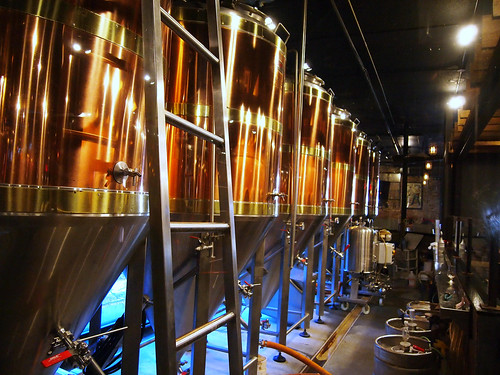
Max Lager fermenters

Copper was a metal long valuable in the construction of breweries, but is now laregely replaced by stainless steel. Copper is malleable and can be formed into sheets, which allowed the engineering of large brewing vessels. The sheets were easily joined to produce leak-proof seals. Copper is an excellent conductor of heat, which made it the metal of choice in the days when direct firing of kettles was common. In Britain, brewing kettles are still sometimes referred to as "coppers."
The Oxford Companion to Beer: Oxford University Press, 2012.

In a brewery, copper gleams mighty pretty but it can discolor mighty ugly. It oxidizes.

Fortuitously, brewers long have had a cleaning product readily at hand. They polished their copper kettles with spent yeast and a mild abrasive (such as the ash from the fire under the kettles).

Today's kettles are fabricated from stainless steel and heated by steam in wrap-around stainless-steel 'jackets'. But, for good looks, many 'craft' brewery kettles are gift-wrapped with sheets of copper on their exteriors. Today's brewers polish them not with yeast, but with chemical cleaners, most of which are acid-based.

Today's fermentation tanks are also constructed of stainless steel; many fashion-wise 'craft' breweries copper-clad those as well. Such as Max Lager's Wood-Fired Grill & Brewery in midtown Atlanta, Georgia, whose tanks, pictured above, were each beautifully polished.

I didn't ask the brewers how they cleaned their tanks and kettle. I simply admired the sheen, and enjoyed lunch and a beer(s).

-----more-----