Showing posts with label eclipse. Show all posts

Saturday, May 21, 2022

Pic(k) of the Week: Blood Moon

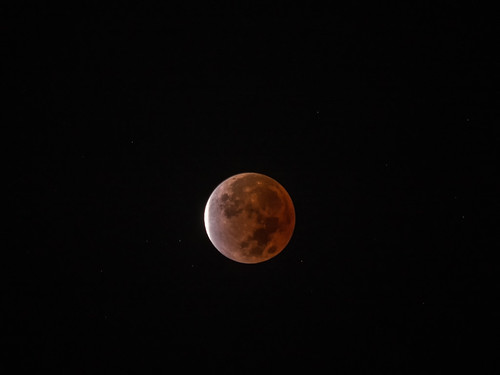
Blood Moon (16 May 2022 12:43 am EDT)

Fire up a colortini, sit back, relax, and watch the pictures,
now, as they fly through the air. *

It was a combination of full 'Flower' Moon, supermoon, 'Blood' Moon, and total lunar eclipse, all wrapped into one astronomical wow, as seen over Decatur, Georgia, USA, on 16 May 2022, at 12:43 am EDT.

***************

Blood Moon (aka total lunar eclipse)

A total lunar eclipse happens when the Moon travels through the Earth's umbra and blocks all direct sunlight from illuminating the Moon's surface. However, some sunlight still reaches the lunar surface indirectly, via the Earth's atmosphere, bathing the Moon in a reddish, yellow, or orange glow [thus colloquially called a 'Blood Moon'].

As the Sun's rays pass through the atmosphere, some colors in the light spectrum—those towards the violet spectrum—are filtered out by a phenomenon called Rayleigh scattering. This is the same mechanism that causes colorful sunrises and sunsets. Red wavelengths are least affected by this effect, so the light reaching the Moon's surface has a reddish hue, causing the fully eclipsed Moon to take on a red color.
Time and Date.

***************

Full Flower (Super) Moon

"May’s full Flower Moon name should be no surprise; flowers spring forth across North America in abundance this month. The full Moon names used by The Old Farmer’s Almanac come from a number of places, including Native American, Colonial American, and European sources. 'Flower Moon' has been attributed to Algonquin peoples.

May’s full Moon is the first supermoon of the year. A supermoon is most commonly defined as any full Moon that occurs when the Moon is at at least 90% of perigee (the point in the Moon’s orbit where it is closest to Earth). In 2022, there will be four supermoons.
Old Farmer's Almanac.

Here was the moon, two hours earlier (at 10:32 pm EDT, on 15 May), only partially eclipsed and yet un-'bloodied.'
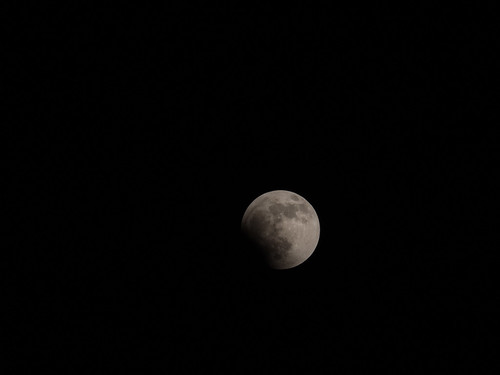
Blood Moon (15 May 2022 10:32 pm EDT)

-----more-----

Saturday, November 20, 2021

Pic(k) of the Week: Full Beaver Moon, eclipsed

Full Beaver Moon, eclipsed

Syzygy!

This was the ruddy, full Beaver Moon, 97% eclipsed, at 4:11 am ET (9:11 UT), 19 November 2021. And, unlike the night sky of a non-eclipsed full moon, on this night the stars were readily visible, surrounding the umbral-shadowed moon.

Pictured above is the maximum point of the nearly partial lunar eclipse. At nearly 6 hours, it was the longest such since the year 1440 and the longest such until the year 2669.

If you were sleeping that night or you'll be unable to wait for the next event, fret not! North America will be witness to not one but two total lunar eclipses next year, on 15 May and 7 November 2022. (Your geographical results may differ. Check your local listings.)

When the damnable alarm went off, the outside temperature was 0 °C and the winds were nippy at 16 kph. Charlie the dog didn't mind; indeed, he thoroughly enjoyed his cuckoo-o'clock constitutional. And me? Afterward, back inside, the coffee seemed somehow tastier and more warming than it had been.

Mira la luna. La bella luna!

-----more-----

Saturday, August 26, 2017

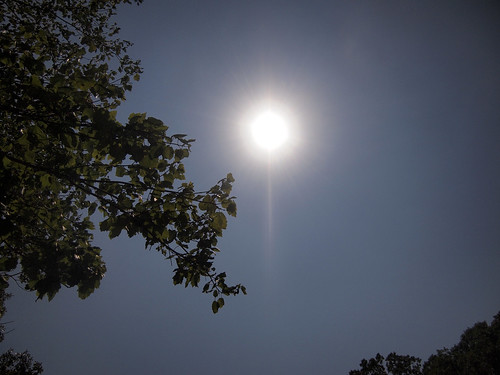
Pic(k) of the Week: Totality -minus 5 minutes.

Totality -minus 5 minutes

An eerie pall, then, almost instantly, darkness. Majestic, mysterious, and awful (in its deific sense) beauty.

Along the shores of Lake Hartwell, at the conjunction of northeastern Georgia and South Carolina, the Great American Eclipse 2017 began on the afternoon of Monday, 21 August, at 1:05 pm and ended nearly three hours later at 4:01 pm. Totality —complete eclipse— was briefer, beginning at 2:35:46 and ending at 2:38:21.

Despite having done what I thought to be due diligence, I, a piker, failed to fully comprehend the great degree of difficulty I would have, while wearing darkened eclipse glasses, to actually find and frame the sun via my camera's LCD screen. 

That being so, I dud manage to snap a few photos of the gathering eclipse (such as above, at 2:30 pm, five minutes before totality), a handful of my fellow eclipse-watchers, and a few shaky shots of the sun when totality struck.

This was the first total eclipse to traverse the entire continental United States since 1918. The wait for the next totally-American total eclipse won't be quite as long. It will darken the width of the continent twenty-eight years from now, on 12 August 2045. *

I'll be ready.

-----more-----
  • * The next total solar eclipse to be visible over North America (but not exclusive to the U.S.) will be even sooner yet: 8 April 2024.
  • More of my eclipse photos, as they were: here.

  • Pic(k) of the Week: one in a weekly series of photos taken (or noted) by me, posted on Saturdays, and often, but not always (as is the case today), with a good fermentable as the subject.
  • See the photo on Flickr: here.
  • Camera: Olympus Pen E-PL1.
  • Commercial reproduction requires explicit permission, as per Creative Commons.

  • For more from YFGF:

Tuesday, August 22, 2017

Clamps & Gaskets was eclipsed.

Due to foreseen circumstances, Clamps & Gaskets —a bi-weekly news roundup of beer and other things— did not make its regularly scheduled appearance yesterday. It will return next Monday, 28 August 2017 (and, to catch up, again, on the following Monday, Labor Day).

Totality, now (that is, yesterday)!

Eclipse viewers

-----more-----