Saturday, September 27, 2014

Pic(k) of the Week: Cask pour in Technicolor

Cask pour in Technicolor

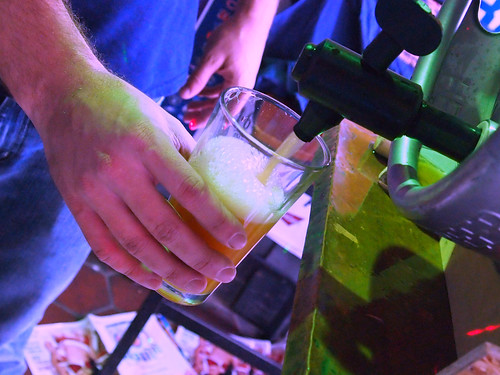
Bright colors saturate the background at Fat Tuesday's, a New Orleans-styled pub in Fairfax, Virginia, as a representative of Heavy Seas Brewing pours a pint from a cask of Loose Cannon IPA (infused, in the cask, with grapefruit zest and Maryland-grown Cascade hops).

The nautically-themed, Baltimore, Maryland-based, brewery was celebrating International Talk Like A Pirate Day by tapping casks of its India Pale Ale, simultaneously, in over forty establishments, in eleven states and the District of Columbia, in an attempt to establish a Guinness Book of World Records record for the most casks of the same beer tapped at the same time.

6:00 pm EDT
19 September 2014.

No word yet on the record.

-----more-----

Thursday, September 25, 2014

#VeggieDag Thursday. Quick Links for September 2014.

VeggieDag Thursday
VeggieDag Thursday is an occasional Thursday post
on issues of an animal-free diet, ecology, and the environment.

*************

Quick links for August 2014

  • 24 September 2014:
    "There is a tentative sign of hope for the mass migration of monarch butterflies, whose numbers dropped to their lowest level ever last year. The head of Mexico's nature reserves, Luis Fueyo, said the first butterflies have been seen entering Mexico earlier than usual this year. Fueyo said it is too early to say whether butterfly numbers will rebound this year from a series of sharp drops, but noted 'this premature presence could be the prelude to an increase in the migration.' "
    —Via Real Clear Science.

  • 23 September 2014:
    "Rare earths are a hot commodity—they’re vital to securing solutions for the world’s energy concerns, with energy-saving applications in wind turbines, solar cells, and so much more. And with China tightly clenching the purse-strings to more than 90% of worldwide production of rare earths, some countries are eager to secure their own sources of the precious materials. [...] Now a student team from the University of Houston is also working to help supply the United States’ own rare earth stream from a different source. The team is commercializing a novel and proprietary method to recycle rare earths neodymium and dysprosium from waste electronics."
    —Via The American Ceramic Society.

  • 23 September 2014:
    Presidential science adviser John Holdren counters the arguments against climate change promulgated by members of the United States House of Representatives Committee on Science, Space and Technology. Jon Stewart, host of the Comedy Channel's Daily Show, analyzes the exchange.
    —Via Salon.

  • 18 September 2014:
    The C&O Canal Park was created sixty years ago, winding 184 miles from downtown Washington, D.C. to rural Cumberland, Maryland.Five million people a year visit the canal, making it the ninth most popular park in the nation. In 1971, President Richard M. Nixon signed legislation to make the site a national historic park. Then Supreme Court Justice William O. Douglas was instrumental in its preservation.
    —Via Washington Post.

  • 18 September 2014:
    Ten wildfires are burning nearly uncontrollably over 111 square miles in California. Fueling the fires is California's ongoing historic drought. On Thursday, Governor Jerry Brown declared a state emergency in El Dorado and Siskiyou counties, where the King Fire and another wildfire burned wide swaths of land and destroyed homes.
    —Via CNN

  • 17 September 2014:
    "The artificial sweeteners that are widely seen as a way to combat obesity and diabetes could, in part, be contributing to the global epidemic of these conditions. Sugar substitutes such as saccharin might aggravate these metabolic disorders by acting on bacteria in the human gut, according to a study published by Nature."
    —Via Scientific American

  • 14 September 2014:
    A Wisconsin utility plans to add an additional charge to customers who produce their own solar energy and sell it back to the grid.
    —Via Climate Progress.

  • 10 September 2014:
    "The Awful Reign of the Red [un]Delicious Apple. How the worst apple took over the United States, and continues to spread."
    —Via The Atlantic.

  • 9 September 2014:
    The great tomato debate: to refrigerate or not to refrigerate. Serious Eats says yes, refrigerate, and has the data to prove it.
    —Via Serious Eats.

  • 9 September 2014:
    Greenhouse gases hit record high in 2013, according to World Meteorological Organization. "The volume of carbon dioxide, or CO2, the primary greenhouse gas emitted by human activities, was 396.0 parts per million (ppm) in 2013, 2.9 ppm higher than in 2012, the largest year-to-year increase since 1984, when reliable global records began."
    —Via Reuters India.

  • 5 September 2014:
    France's 'top chef,' Michelin-starred cook Alain Ducasse reopened his Parisian restaurant by ditching duck, veal and steak for largely vegetarian dishes. His three-star restaurant at the luxury Plaza Athénée hotel now features a largely organic produce menu. "The chef has not gone as far as to declare his restaurant vegetarian – fish, seafood and some meat will still be served – but Ducasse has got what he calls 'naturalité' (naturalness). 'The planet has increasingly rare resources so we have to consume more ethically, more fairly.' "
    —Via The Guardian.

  • 3 September 2014:
    The U.S. Food and Drug Administration (FDA) has issued new regulations that could effectively forbid the sale of raw-milk cheeses, both imported and domestically produced. "Roquefort — France’s top-selling blue — is in the agency’s cross hairs along with raw-milk versions of Morbier, St. Nectaire and Tomme de Savoie. [...] The limits for nontoxigenic E. coli were cut from 100 MPN (most probable number) per gram to 10 MPN. These are bacteria that live in every human gut; they are typically harmless and we coexist happily. But the FDA considers them a marker for sanitation: If a cheese shows even modest levels of nontoxigenic E. coli, the facility that produced it must be insufficiently clean."
    —Via Janet Fletcher (in the Los Angles Times). Fletcher is the author of several books on cheese.

************

RECIPES

  • Use the oven to make the second-best tomato sauce "you've ever tasted." (Your grandmother's, of course, was better.)
    —Via Serious Eats.

  • The caustic chemistry of pretzels and Maillard reactions. How to cook a proper pretzel using lye or baking soda.
    —Via NPR Food.

  • Pickled peppers - no canning required. "A briny, crunchy, brightly colored snack."
    —Via Kathy Barrow aka Mrs. Wheelbarrow.

  • Vegan 'Cream' of Tomato Soup.
    —Via YFGF.

  • Recipe for poutine with vegetarian gravy.
    —Via Flourishing Foodie.

  • Scorched and Skewered Fruit Salad. "Grilling enhances fruit’s flavor by caramelizing it, and skewers provide an easy way to cook and present it."
    —Via Washington Post "Smoke Signals" .

-----more-----

Monday, September 22, 2014

Farewell, summer. Tonight at 10:29, it's the Autumnal Equinox.

I trod upon my carpet of gold,
While the reds, the browns, and the enduring greens
Bespeckle the pathway beneath my feet,
Casting autumn's prism in all its glory.
Verse by Genovaite Ambraziejus Cizauskas, my mother.

Autumn Leaves

Tonight, at 10:29 PM Eastern Daylight Time (2:29 Universal Time), it will be the exact moment at which the Autumnal (or September) Equinox will occur. And, at that moment, autumn will have begun (or spring, in the southern hemisphere).
At the instant of the September equinox, the midday sun will be shining straight overhead at the equator. As the September equinox sun crosses the equator, going from north to south, it’ll signal the beginning of autumn in the Northern Hemisphere and spring in the Southern Hemisphere. On the day of the equinox, the sun rises due east and sets due west all over the world, with everyone worldwide receiving the same amount of day and night. By October, however, that’ll change dramatically. By then, the sun will rise noticeably south of due east and will set noticeably south of due west. That’ll mean shorter days and longer nights for the Northern Hemisphere, yet longer days and shorter nights in the Southern Hemisphere.
EarthSky


Nuts (02)


Why do leaves change color in autumn?
As the autumn days grow shorter, the reduced light triggers chemical changes in deciduous plants causing a corky wall to form between the twig and the leaf stalk. This "abscission layer" eventually causes the leaf to drop off in the breeze. As the corky cells multiply, they seal off the vessels that supply the leaf with nutrients and water and also block the exit vessels, trapping simple sugars in the leaves. The combination of reduced light, lack of nutrients, and no water add up to the death of the pigment chlorophyll, the "green" in leaves.

Once the green is gone, two other pigments show their bright faces. These pigments, carotene (yellow) and anthocyanin (red), exist in the leaf all summer but are masked by the chlorophyll. (The browns in autumn leaves are the result of tannin, a chemical that exists in many leaves, especially oaks.)

Sugar trapped in autumn leaves by the abscission layer is largely responsible for the vivid color. Some additional anthocyanins are also manufactured by sunlight acting on the trapped sugar. This is why the foliage is so sparkling after several bright fall days and more pastel during rainy spells. In general, a set growing season followed by a dry autumn filled with sunny days and cool, frostless nights produces the most vibrant palette of fall colors.
The Farmer's Almanac


***************

The season for beer

How does this all apply to a blog about good fermentables? Maybe it doesn't. But I'd like to think that the colors of autumn —yellow, red, auburn, brown, black— are indeed the colors of beer.

I remember, unfondly, a late September day, several years ago, when I was flogging small brewery imports in Annapolis, Maryland. A manager of a certain 'high-end' wine-and-beer shop dismissed my sales call. She would not be interested in any more beer for the fall, she informed me, because she could only sell beer in the summer. That she said that to me while standing amidst a stack of Miller Lite.

Please don't tell her about the late summer hop harvest and its accompanying true autumn seasonal, deep golden 'fresh-hopped' beers. Don't tell her about amber-hued Oktoberfest and Märzens. Or about beers mashed with gourds and spiced with cinnamon. And, please, do not tell her about deep auburn German doppelbocks and Belgian dubbels, or copper English barleywines, or jet-black Russian Imperial Stouts. No! Please reserve more of those for the rest of us.

Ah, but, please! Don't tell her about football and beer.

Welcome, autumn. Welcome the season for beer.

India Ink has Mt Hoods!

Clamps & Gaskets: News Roundup for Weeks 36/37, 2014.

Clamps and Gaskets: weekly roundup
A bi-weekly, non-comprehensive roundup
of news of beer and other things.

Weeks 36/37
31 August - 13 September 2014


  • 2014.09.12
    Americans prefer red wine over white, by 58% to 42%.
    —Via Washington Post Wonk Blog.


  • 2014.09.11
    Washington D.C.-based Air Force F-16 pilots, lacking live ammunition on 11 September 2001, were prepared to ram the hijackers with their jet.
    —Via Washington Post


  • 2014.09.08
    How much -and which- alcohol is drunk in the world during a week?
    —Interactive infographic via Ghost in the Data
    (Source: World Health Organization)


    Nats by water
  • 2014.09.06
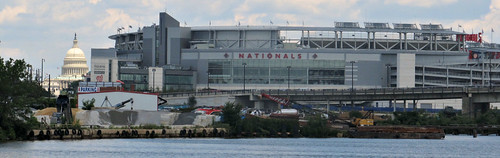
    Nationals Park, in Washington, D.C., will be the site, outdoors, for the 1 January 2015 Winter Classic National Hockey League (NHL) hockey game, between the Washington Capitals and the Chicago Blackhawks.
    —Via Washington Post


  • 2014.09.06
    There's a fear of a pretzel shortage at Munich's Oktoberfest, as the Bavarian bakers' guild threatens to strike for a 6.5% wage increase.
    —Via Telegraph


  • 2014.09.06
    The U.S. Alcohol and Tobacco Tax and Trade Bureau (TTB) recently released domestic production and domestic tax paid figures for the first six months of 2014 showing
    • Total U.S. malt beverage production growing 0.6 percent for a gain of more than 7.7 million case equivalents (560,000 barrels).
    • Canned beer packages carried the industry in 2014, growing 3.1 percent by more than 23.1 million cases in just six months.
    • Imports' share of market rose to 14.4 percent, compared to 13.8 percent for the same time frame in 2013.
    • More important for beer sales is the domestic tax paid figure that represents domestic cases sold to distributors by U.S. breweries. Year-to-date, this figure is basically flat, showing only a small volume decrease of around -0.2 percent.
    —Via National Beer Wholesalers Association (NGBW)


  • 2014.09.05
    How the rules and regulations for buying alcohol differ in each of the 50 states and Washington, D.C.
    —Via Huffington Post
    (Sources: Wikipedia, Distilled Spirits Council of the United States).


  • 2014.09.05
    Remains of a Colonial-era brewery found at College of William and Mary in Williamsburg, Virginia.
    —Via Associated Press.


  • 2014.09.02
    Year-to-date beer sales figures from the Brewers Association (whose self-described purpose is to "promote and protect small and independent American brewers":
    • Total U.S. beer sales up 2.9%
    • Craft beer up 20.9% at 7.8% of the 196 million barrels of beer sold
    • Domestic premium beer sales down 0.1%
    • FMBs (flavored malt beverages) up 24.6%.
    —Via Market Development Committee (of Brewers Association).


  • 2014.09.02
    Wine Enthusiast Magazine selects its top American tastemakers under 40 for 2014. Three are in the 'craft' beer world.
    • Meg Gill, brewer at Golden Road Brewing
    • Pat Fahey, the youngest-ever Master Cicerone, a program which "certifies and educates beer professionals in order to elevate the beer experience for consumers"
    • Travis Benoit, owner of Crowd Brewed: "financing and fundraising options for the craft beer industry and its affiliates."
    —Via Wine Enthusiast Magazine


  • 2014.09.01
    Pabst to release recreation of legendary Ballantine IPA, at 7.2% alcohol-by-volume (abv); 70 International Bittering Units (IBU).

    Ballantine may bave been "the first India pale ale (IPA) brewed in the United States. It was certainly the first made by the Peter Ballantine & Sons Brewing Company, of Newark, New Jersey, dating back to 1878. It was one of the few breweries to outlast prohibition and continue making IPAs for decades after."
    —Via Gizmodo
-----more-----

Saturday, September 20, 2014

Pic(k) of the Week: Dirndl und bier

Dirndl und bier

Autumn begins Monday evening, but today could be considered the unofficial beginning of the fall season.

At noon, today ―München (Munich), Germany time― the lord mayor of Munich, in Bavaria, tapped the first keg of the Oktoberfest. Standing in the Spaten (Schottenhamel) tent, he proclaimed, "O'zapft is!" ("the barrel has been tapped"), and the world's largest party commenced, for the 181st time.

For the next sixteen days, today until 5 October, over 6.5 million people will attend Oktoberfest in Munich. They'll drink more than 5.8 million Maßkrug of Oktoberfest beer, mugs holding a liter each. (To put it in U.S. terms, that'll be 10.6 million pints.) They'll eat more than 589,000 rotisserie chickens, 320,00 sausages, 200,000 fish, 60 deer (in smaller portions), and meat butchered from 84 cows. And, they'll make use of 1,800 toilets.

The fraulein (young lady) above, is not the lord mayor of Munich, but she is wearing a 'glamed' up variant of a dirndl: "a type of traditional dress worn in Germany – especially Bavaria – based on the historical costume of Alpine peasants."

Note, however, the non-traditional can of Red Bull at her feet. She was not in Munich, but in Arlington, Virginia, in 2011, for the Mid-Atlantic Oktoberfest, an annual one-day festival organized by the Capitol City Brewing Company, in the neighborhood outside its brewpub, in this Washington, D.C. suburb. If not quite 6.5 million people, 8,000 attended that year.


-----more-----