Thursday, November 10, 2011

VeggieDag Thursday: Beer dinner review (and the fare was vegetarian).

VeggieDag Thursday


It's been 2 months, 17 days, but who's counting? Well, I suppose I just did.

Back on August 24th, 2011, Mad Fox, a one-year old brewpub in Falls Church, Virginia, hosted its first ever vegetarian beer dinner. As a post for VeggieDag Thursday —my occasional look at an animal-free diet and its issues— here's my review.

Mad menu (01)


AS the evening began, Mad Fox's side Stammtisch room was quickly filled to capacity. The more than 40 attendees comprised the largest crowd for any of the four (three, carnivore) beer dinners the pub had held. Welcome and introductions aside, executive brewer and co-owner Bill Madden would describe the beers while executive chef Russel Cunningham would describe the meals. Both would discuss the 'pairing' of flavors.

Cunningham & Wellington


The first beer was a Kölsch, a style of 'lagered' ale that Madden told us he has been brewing, here and at other breweries in the northern Virginia area, for over 15 years. He has won several awards for it. Madden imports a yeast from Weihenstephan in Germany, specific to the style. The beer was golden in hue, 4.8% alcohol by volume (abv), with a soft floral hop presence, and a slightly grain-sweet flavor. It finished dry with a floral aftertaste.

Course #1: Kolsch


With the Kölsch, Chef Cunningham served a Chilled Fruit Soup of cantaloupe, papaya, ginger (a lot!), a non-dairy yogurt made from coconut, and a lecithin foam of grapefruit and pineapple.

Chilled Fruit Soup

Separately, the beer and the soup, were delightful. Together: neither complimentary nor hurtful.

Next up was English Summer Ale and an Heirloom Tomato Salad.

Heirloom Tomatoes & Grilled Hearts of Palm


Madden explained that Summer Ale is a new 'style' of beer popularized in the UK by newer craft brewers who brew a lighter-colored 'bitter' ale, using American hops. The pub's version was golden and 5.4% alcohol-by-volume, brewed with German Pilsner malt and a bit of wheat malt, and hopped with citra hops, a new U.S. varietal that many find to have an orange taste and aroma.

The salad was arranged with multi-colored heirloom tomatoes from Hummingbird Farms, of Ridgely, Maryland, grilled hearts of palm, and 'micro-greens,' all tossed with a house-made vinaigrette of pumpkin-seed oil and Orange Whip, the pub's IPA, brewed with Citra hops.

Heirloom Tomatoes & Grilled Hearts of Palm


I'm not a fan of Citra hops: I find their aroma and flavor to be a weird mixture of artificial orange scent and anise, but I'm in the minority. This pairing of salad and beer, however, demonstrated the ineffable character of such things. Together, there was no single point of pleasure or displeasure, but a tasty melding of citrus and tomato.

The third course served was a Quinoa and Black Bean Cake and a Saison ale.

Quinoa & Black Bean Cakes


The 'cake' was deliciously 'meaty' tasting, topped with a spicy green onion sauce. The tempura vegetables were sparingly battered, just right. Another sauce —pureed bell peppers, curry powder, garlic, cilantro, and orange juice 'gelled' with agar-agar (not the yogurt as the printed menu stated)— was served on the side. Both sauces were terrific. The tandem was one flavor too many.

Madden's Saison was a good foil for all the spiciness. 6.1% abv, crisp, yet medium-bodied, with a spicy and 'lemony' flavor and finish, derived, Madden told us, from the French yeast he uses to ferment the beer.

Vegetable Wellington


For the fourth course, Madden served his Big Chimneys Robust Porter. He named it for the first permanent building in Falls Church, erected in 1699, noted for its two chimneys. A porter is a dark ale, not quite as roasty as a stout. And Big Chimneys indeed was that: 6% abv, a character of bakers chocolate, toasted bread, and a hint of dark fruit and earthiness. Madden told us that the yeast he uses drops quickly out of the beer after fermentation, yielding a 'bright' beer without filtration. He hops the porter with First Gold, a favorite varietal of his, he told us. First Gold, grown in England, is a dwarf hop, its bines half the height of 'standard' hops. Madden likes its earthy, woody flavor that he finds similar to another English hop, East Kent Goldings.

Cunningham created a Vegetable Wellington to accompany the Porter. He filled a puff pastry with couscous, zucchini, squash, and local mushrooms (button, cremini, shitake) soaked in cognac. He finished it with an apple-carrot/ginger puree, and flash-fried spinach shreds, with grilled local white asparagus, and a crescent-shaped streak of tomato 'water' set in agar-agar, on the side. For two vegan diners, he served a similar Wellington but in a phyllo pastry, containing no egg or dairy.

When talking about pairing beer and food, descriptors can become somewhat fanciful. Suffice it to say, that this pairing 'worked.' The flavors of the porter and the Wellington did not overwhelm each other, but were similar enough (roasty, earthy) that they complemented each other, creating an experience greater than the sum of the two. This was my favorite dish of the evening, and a consensus favorite of other diners. When one asked if it might be added to the pub's 'regular' menu, Cunningham concurred: "Soon."

Then, it was time for dessert: Wee Heavy Scotch Ale with Chocolate & Berry Crème Brûlée.

Chocolate & Berry Crème Brûlée


"It's pure joy for me to brew Wee Heavy," Madden told us. He first brewed it in 1996 for Capitol City Brewpub in Washington, D.C. There, an inefficient kettle caused a long brewing day: the boil lasted for more than six hours. The boil at Mad Fox, with its more efficient system, takes up less than half of that time. Shorter brew days are more conducive to a successful marriage, Madden chuckled. "And, I'm married now.". (His wife Beth is a co-investor. Her maiden name —Fox— is half the pub's name: "She's the fox; I'm mad.") The beer has garnered Madden several awards, some of which are displayed at the pub.

The Wee Heavy was 8.6% alcohol by volume, hopped with First Gold; the grist was English pale malt with only a "touch" of crystal and roasted malts. The result was marvelous: an ale, deep reddish-brown, with flavors of chocolate and dark fruit (think Concord grapes and plums). There's been so much demand for the beer, which has won Madden awards in the past, that he brews it throughout the year, where he once offered it only as a 'Winter Warmer.' Madden told us that some of the Wee Heavy he also matures in oak barrels that have held bourbon and whiskey. These can be seen in the main dining room.

Chef Cunningham's dessert was the Brûlée, a caramelized chocolate custard finished with a reduction of blueberries, raspberries, a and strawberries. For vegans, he brought out a chocolate-ginger cookie, topped with chocolate/soy milk foam, and with a dollop of coconut milk ice cream on the side.

The dessert overwhelmed the Scotch Ale, surprising for a beer of such strength and depth of flavor. There was, fortunately, a simple remedy. Take a taste of the Crème Brûlée. Wait. Take a sip of the Wee Heavy. Wait. Repeat.

At evening's end, Chef Cunningham brought out his sous chefs. They and Madden, and the serving staff, received strong applause. It was a delicious dinner, and I and others made a point of thanking them. A vegetarian beer dinner is a rare thing. Being a non-animal eater, I can only hope for more.

The hosts
Here, Cunningham (l) and Madden (r) relax afterward.

*************
  • More photos from the dinner: here.
  • An earlier post about the dinner, with a reference to another vegetarian beer dinner: here.

Wednesday, November 09, 2011

The ... Worst ... Beer ... Bar ... In ... The ... Country

My friend Russ, a retired engineer, lives north of Baltimore City, Maryland. He loves tinkering on his cars. Ten years ago had a 25th birthday party for Sunshine, a Alfa Romeo, still roadworthy. He loves 'session' beers —milds and bitters— served cask-conditioned.

With an engineer's love of detail, he recounts great stories in a deliberate manner of speaking. One such, Russ left as a message on my voice mail. Granted his permission, I've transcribed it below, word-for-word.

Tom, there's no need to call me back. I just wanted to tell you that I have found a pinnacle, or, actually, a nadir.

It is very tough to find the best —and tough to define the best— beer bar in the country. But, at present, I am sitting in the worst ... unquestionably, the worst beer bar in the country. It can only be a question of magnitude.

There are six taps at **** Bar on **** Road. All ... six ... taps ... are ... Miller Lite. It cannot get any worse than that.

Oh, yes, it could! All six could be Natty Boh Lite —if there is such a thing.

***************
  • This reminds me of the Cheese Shop episode from Monty Python.
  • I've redacted the name of the bar (located north of Baltimore) to protect the guilty.

Tuesday, November 08, 2011

Full house for casks in Falls Church, Va.

The 'quiet' cask festival got quite noisy this evening at Mad Fox Brewing Company.

Even when it's not a festival at this brewpub, in the heart of Falls Church, Virginia, there are six hand-pump beer engines arranged behind the bar for serving house-brewed cask ale. Bartenders pour from three of the lines, while allowing additional casks to come into 'proper condition' on the other three. Serve no cask ale before its time.

But, from 4-11 November, brewmaster/owner Bill Madden and brewer Charlie Buettner have invited other breweries to send their cask beers as well, to be served through the pub's cask system, as part of Mad Fox Cask Week.

Tonight, the pair invited local brewers to attend. I saw representatives and brewers from Dominion, Flying Dog, Gordon-Biersch, Growlers, Lost Rhino (who arrived in style, in a stretch limousine), Port City, St. George, and Sweetwater Tavern.

IMG_4678
Pictured above, are:

The cask ales were:

  • Oliver Ales, Baltimore Maryland: Cask Punk (dry-hopped with Cascade hops)
  • Old Dominion Brewing, Dover, Delaware: Baltic Porter (dry-hopped with Perle and Bravo hops)
  • Lost Rhino Brewing, Ashburn, Virginia: Face Plant IPA (dry-hopped with locally grown Columbus hops)
  • Duck Rabbit Craft Brewery, North Carolina: Brown Ale
  • Mad Fox Rye Baby Pale Ale (80 IBUs)
  • Heavy Seas Brewing, Baltimore, Maryland: Winter Storm Imperial ESB (wet-hopped with West Coast Cascade hops)

The pub was filled to capacity. I'd like to say everyone was a real ale fancier, but Democrats comprised a large continent, celebrating the local election returns and lamenting the Virginia results. I didn't ask if they were real ale fans.

There is no entrance fee for Mad Fox Cask Week; simply pay for the beer you order. Casks from other breweries have been served before tonight; several others will be tapped through the end of the festival on Friday, the 11th. For more details, go to the website or Facebook page.

***************

  • See more photos: here.
  • IBU is an acronym for International Bittering Unit, a measure of the bittering power of hops in beer. Just as sweet can balance sour in cooking, so the sweetness of malted barley can balance hop bitterness in brewing. 80 BUs, however, as in the Rye Baby Pale Ale from Mad Fox, does indicate a beer with a healthy smack of bitterness.
  • Dry-hopping refers to a process of adding hops to a finished beer rather than during boiling. It's akin to a cook adding basil to a pasta sauce on the plate rather than when cooking. Hops, like basil, are an herb.
  • Wet-hopping refers to using very fresh hops within days or hours after they have been picked, rather than after having been cured and stored.
  • I was in attendance, not only as a fan of real ale, but in my 'official' capacity as a representative for Select Wines, Inc., the distributor of the beers of Heavy Seas Brewing and Oliver Ales, in northern Virginia.

Monday, November 07, 2011

Clamps & Gaskets: News Roundup for Week 44, 2011.

Clamps and Gaskets: weekly roundup
A non-comprehensive roundup
of news of beer and other things.

Week 44
30 October - 5 November 2011

  • 2011.11.05
    Andy Rooney, longtime 60 Minutes commentator, has died at age 92. "Andy Rooney was a cranky old curmudgeon who did not suffer fools gladly." Via Jack Curtin.
  • 2011.11.05
    The end of an era: crabcakes, beer, & big hair. Baltimore, Maryland's famous Obrycki's Restaurant closes its doors. Via Baltimore Sun


  • 8,000 @Shirlington (02)
  • 2011.11.30
    As of today, 7 billion humans live on the Earth. Via MarketPlace Radio.
  • 2011.11.03
    A Wharton School analysis on cores of beers at RateBeer.com. Why certain beers and breweries do better than others. Via Washington Post Food.
  • 2011.11.03
    The California wine-grape harvest occurred later than usual this year. The growing season was relatively cool with spring rains. Yields per acre were smaller than usual. Predictions are for wines of higher quality. Via Reuters.
  • 2011.11.03
    The Washington Post review of The Oxford Companion to Beer: a comprehensive tome, but it may need a Fact Checker for its 2nd edition. wapo.st/uJvAnn
  • 2011.11.03
    From Baltimore, Maryland's Oxford Brewing Co, to The Beer Factory in Petah Tikva: Israel is experiencing a craft beer movement. Via The Jewish Chronicle.


    Carol Stoudt
  • 2011.11.03
    Female brewmasters are busting stereotypes in the 'craft' beer world. Via Slate.

***************************

  • Clamps and Gaskets is a weekly wrap-up of stories  not posted at Yours For Good Fermentables.com. Most deal with beer (or wine, or whisky); some do not. But all are brief, and many are re-posts from: twitter.com/cizauskas.
  • The Clamps and Gaskets graphic was created by Mike Licht at NotionsCapital.

Sunday, November 06, 2011

Elevating cask ale

Elevated firkin shelf

What is 'cask-conditioned' ale —often referred to as 'real ale'? CAMRA (the Campaign for Real Ale in the U.K.) has this handy definition:
a natural product brewed using traditional ingredients and left to mature in the cask (container) from which it is served in the pub through a process called secondary fermentation. It is this process which makes real ale unique amongst beers and develops the wonderful tastes and aromas which processed beers can never provide.

Most pubs and brewpubs in the U.S. serving cask-conditioned real ales keep their casks in refrigerated units under the bar counter or in a cold room, out-of-sight from most of their customers. The beer is pulled to the bar spigot —without extraneous carbon dioxide or nitrogen gas— via a handpump known as a 'beer engine.'

There's, of course, nothing wrong with a beer engine, but there's no magic connected with its use either. It does nothing to preserve or protect the beer. In fact, it's not a powered engine at all, but a simple conveyance: a hand-operated piston pump that pulls beer from one location to another. When a 'sparkler' is attached to the spigot, the beer engine helps create a pretty head on the beer. It does so, however, at the expense of the carbonation (already scant) in the beer.


****************

Elevating casks: a gravity-pour system

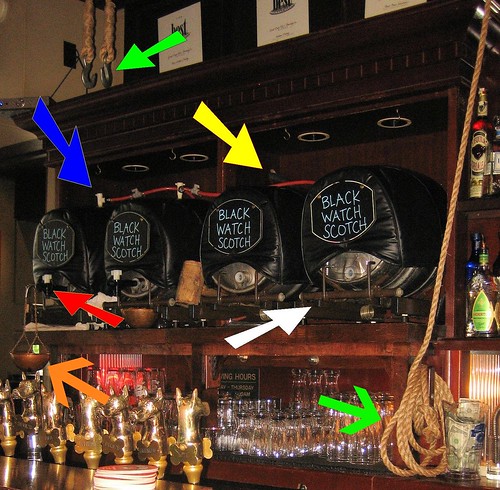
Sitting at the bar among 'standard' CO2 taps, the lever of a beer engine can appear to the cask-uninitiated to be just another tap, if a tad unusual. But at The Great Dane Brewpub —at its downtown Madison, Wisconsin, location, within sight of the state's Capitol dome— even a casual glance reveals its elevated casks to be something apart.

Four firkins (10.8 gallon casks) of Black Watch Scotch Ale sit behind and above the bar, in full view of customers.

  • Green arrows
    No lifting of full casks over one's head (at 114 pounds, give or take). A winch and pulley system is used to raise and lower the firkins.

  • Red arrow
    A tap has been hammered into the keystone of the firkin. The bartender simply gives the tap a quarter-turn and the beer flows out. This is called a gravity tap.

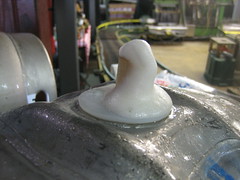
    Notice that only beer from that one cask is being served. The other casks are coming into condition, that is: the cask has been vented to bring the level of carbonation to a proper equilibrium and to give the solids in the beer (yeast, protein break, hops) time to settle below the tap so that the beer will be 'bright' and unmurky when served. A shower of beer out of the shive bung might be dramatic but is poor cellarmanship: wasteful and injurious to the quality of the beer.

    Not 'arrowed' is an ash mallet which is used to hammer in the taps. It can be seen resting, waiting, between the 2nd and 3rd casks.


  • Orange arrow
    A copper drip bucket sits under the tap. No muss, no fuss! By the way, there could have been casks of other beers set in place on the shelf. Cask-conditioned real ale is a method of serving a beer, not necessarily of any particular beer style. Great Dane serves Black Watch only as real ale, not 'standard' draft.


  • Blue arrow
    Part of the appeal of cask-conditioned real ale is that no extraneous gas —be it CO2 or nitrogen— is added to the beer. It is served as it was when it fermented.

    When a cask is vented, air is allowed to enter the top shive bung of the cask so that beer can be poured from the tap in the keystone. If a cask is emptied within 24 hours, that is not a problem; longer than that and the beer may become sour from airborne contaminants and go flat, lose its carbonation.

    The arrow points to the cask end of a device called a cask breather: a diaphragm valve that provides a blanket of protective carbon dioxide over a cask ale but at zero additional pressure. One end is connected to a tank of carbon dioxide; the other to the tut in the top shive bung. When beer is pulled or poured from a cask, the valve opens allowing an identical volume of CO2 to flow into the cask —at barometric pressure, thus, at 0 psi— and sit atop the remaining beer. The beer gains no additional pressure.


  • Yellow arrow
    A pernicious, if common, misconception is that cask-conditioned real ale is served at room temperature. This is so not true. Doing so would be quite un-refreshing. Real ale is served at what is known as 'cellar' temperature: 50-54 °F. Not as cold as draft service, this temperature allows the fuller flavors of the cask ale to be expressed. But it is definitely not warm!

    The yellow arrow points to a coolant line. It runs to twisted copper saddles which straddle each cask underneath their black insulated jackets. The coolant keeps the beer inside the firkins a cool cellar temperature.


  • White arrow
    The firkin sits on spring-loaded trestle known as a 'auto-tilt.' When the cask is full, it depresses the spring and sits nearly horizontally. As it is drained, the spring releases accordingly, allowing the cask to tilt at an ever greater angle. A publican wouldn't want to serve the final dregs from a cask, but there is a substantial amount of beer which is still bright and clear sitting beneath the level of the keystone and tap which she would want to serve.

**************

How was the beer?

Oh, and the Black Watch Scotch Ale itself? Dark russet in color, with flavors of dark fruit (almost Concord grape), bourbon, and caramel malt. 6.2% alcohol-by-volume (abv).

After all that, I'll mention that Great Dane does also offer a cask ale pulled via beer engine!

Fobbing at the Tut

Fobbing at the Tut:
A series of occasional posts on good cask cellarmanship.

-----more-----