Monday, November 09, 2015

Hippy beer! Huh?

"How pot and hippie beer explain the future of the American economy" was the headline of a recent Washington Post Wonkblog column. I've heard of 'craft' beer, microbrews, boutique beers, and fancy beers, but never have I heard of "hippie beer." Lumberjack-bearded millennials populate the small-brewery scene today; hippies are long gone, since, I believe, the 1960s. The author, a Jim Tankersley, attempted to compare and contrast the 'craft' beer industry with the newly legal marijuana industry. The nonsensical term, "hippie beers," not withstanding.

Breweries and dispensaries offer lessons for how policymakers might nurture a small-business comeback in the United States. But they offer very different lessons, one focused on government intervention, the other on reducing hurdles for entrepreneurs to enter a market — and their ultimate lesson could prove to be, the big guys tend to win in the end.

Here's some of his proof:
Some beer bloggers, though, have begun to worry that lax government oversight could endanger start-up brewers, whom the large players are targeting on multiple fronts.

Who are those beer bloggers and why are their opinions valid? To me, it looks as if Mr. Tankersley just inserted his opinion as unsubstantiated fact. Talk to brewers, restaurateurs, and beer shop owners, and, yes, beer-bloggers. Many would disagree with his low-barrier thesis. Ask them about the three tier system. Ask them about excise taxes. Ask them about licensing from the TTB, OSHA, and FDA, and about local health and zoning regulations.

Mr. Tankersley writes—
The nation has long had a start-up problem. The rate at which new businesses are formed has fallen steadily since 1984, a trend that accelerated during and after the Great Recession, according to research by University of Maryland economist John Haltiwanger and several co-authors. Since the recession ended, more businesses have failed every year than have sprung to life.
— Maybe true, but it does not necessarily follow that many start-ups haven't survived, only that fewer have survived than have been shuttered. Where, and what, are those numbers? And, in those start-ups that did fail, were quality, know-how, financing, and acumen absent or present?

There's this, for example, about Oregon, from where the author hails:
The number of breweries and brew pubs in Oregon has roughly quadrupled since 2001, to more than 200 today. Since the end of the recession, the state’s total beer production for consumption by Oregonians has grown from about 30,000 barrels a year to nearly 50,000. All but a few drops of that increase has come from start-up brewers, according to state statistics.

From that, it would appear as if start-ups are successful, at least, in Oregon, at least those making beer. And we know that to be true, nationwide. The [U.S.] Brewers Association has reported that there are now more than 4,000 breweries in the country, with double-digit sales growth over the last few years.

Mr. Tankersley does seem to find two reasons why beer start-ups might be succeeding. Little acumen, skill, or education being required is one.
It doesn’t cost much to learn to brew — just $100 or so for a starter kit and a handbook, more for hops and grains when you begin to experiment [...] It also doesn’t cost much to start a brewery, relatively speaking.

This seems a bit insulting to those who do study their craft, and is just plain wrong. What of the ability to brew WELL? There is good beer out there, but there also is a lot of bad beer out there (not meaning Oregon necessarily, but in general), on supermarket shelves and in taprooms. I once worked in a brewpub where the chef informed the brewers that "Any monkey can brew." It should go without saying that training, scientific and technological knowledge, and intelligence are vital ingredients in beer-making and beer-business-running as in any skilled endeavor. To say otherwise is to insult the monkey.

Mr. Tankersley's other premise is that government regulations on brewing are minimal, encouraging start-ups. Maybe they are such, but only as opposed to those imposed on the legal marijuana industry, of which I know little. I know much more about the legal beer industry; I'll stipulate that it is rife with many governmental regulations. This article comes off as a forced analogy.

He mentions that only the state of California is investigating potential anti-competitive implications of Budweiser's parent company, Anhuser-Busch InBev, purchasing beer wholesalers. California officials may be, but the Feds are as well. Do 'craft' breweries really wish to dismantle the entire three-tier system and then compete against tied-house Budweiser bars and restaurants?

Mr. Tankersley does make some interesting points. A bit more research on his part, and a few more conclusions from facts, would have made for better points.

-----more-----

Saturday, November 07, 2015

Pic(k) of the Week: Autumnal walnut tree

Not a beer today, but a tree.

Autumnal walnut tree (02)

A walnut tree, resplendent in golden finery. Indeed, all flora in northern Virginia seems particularly colorful this autumn.

Or is it because I'm paying closer attention this year?

10 October 2015.

-----more-----

Tuesday, November 03, 2015

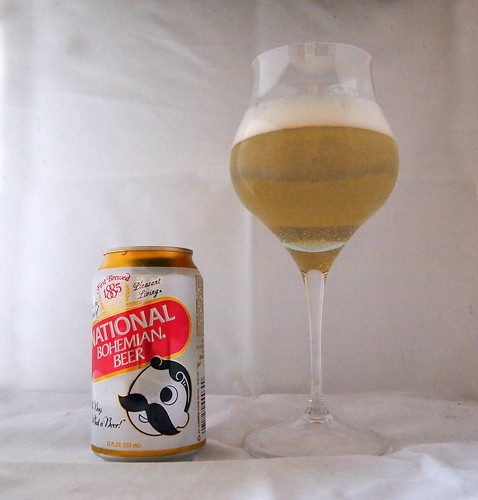
Drinking, again! Natty Boh: a review and quick history.


National BohemianNatty Boh— is no longer a Baltimore, Maryland-brewed beer; and it hasn't been so for decades. Miller/Coors brews it now in Eden, North Carolina, under a contract agreement for the Pabst Brewing Company, which itself owns no actual brewing facilities. Furthermore, MillerCoors is set to close the Eden plant in 2016, and who know what will happen to the beer after the pending sale of SABMiller to Anheuser-Busch InBev.

As Fritz Hahn of the Washington Post recently said of the beer:
These days, there’s little that’s authentically Maryland about Natty Boh, a beer brewed in North Carolina under contract to a multinational corporation based in Los Angeles with a Texas post office box as its address.

Natty Boh 2015

The timeline of the demise of Natty Boh:
  • It's been thirty-seven years (1978) since all production of National Bohemian was moved from the City of Baltimore, Maryland (in the Highlandtown district, overlooking the Baltimore harbor), to Halethorpe, Maryland (a suburb to the southwest of the city).
  • It's been twenty years (1996) since all production of Natty Boh was moved from Maryland, elsewhere.
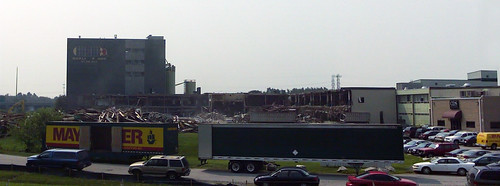
  • It's been ten years (October, 2006), since Natty Boh's final Maryland home, the Carling-National Brewery building (by then, home to Washington Flour), was razed to the ground.

The razing of Natty Boh

In 1961, Carling Brewing Company (a division of Carling-O'Keefe of Canada) built a new brewery in Halethorpe, Maryland. Annual capacity was about 1 million barrels.

In 1974, Carling bought the National Brewing Company, and rechristened the company Carling-National Breweries. It closed National's Highlandtown brewery (in Baltimore, at Dillon and Conkling Streets) soon afterward and moved all of the production [including National Bohemian, i.e., Natty Boh] to the newer Halethorpe facility.

Carling-O'Keefe sold its U.S. subsidiary to G. Heileman in the late 1970s. Rather than investing in modernization, Heilemann chose to jury-rig the Halethorpe brewery's large kettle, by then in need of major repairs or replacement, by welding-on raised sides. Production capability rose to close to 2 million barrels per year. The efforts proved insufficient. Stroh's bought G. Heileman in 1996, and closed the Halethorpe brewery shortly thereafter.

Eighty or so fermenters were installed outside (!) the brewery building in the late 1970s, looking like high-tech missile silos. Each standing nearly four-stories tall, they were state of the art at the time. Their large capacity and their exposure to direct sunlight and the outdoor elements demanded creative solutions for refrigeration, insulation, and convection control. In the summer of 1998, they were laid on their sides in the parking lot behind the brewery and sold as scrap.

The brewhouse vessels were still visible from the Baltimore Beltway, I-695, as late as 2005, unused by the last tenant, Washington Flour. When first fabricated, the kettle had a capacity of 610 barrels (almost 19,000 gallons or 8,405 cases) per brew. In October 2005, the building was razed.
Is Baltimore a Beer Town (2007)


There was a time, into the 1950s, when Maryland-brewed beers accounted for almost 90% of all beers sold in the state, and the beers from National Brewing alone National Premium, National Bohemian, and the rest of its line— accounted for 60%. *

But now? Oh, what Pabst/MillerCoors has done to the beer, ma. I took one for the home team, and drank a 2015 Natty Boh. The beer smelled of chicken stock, cabbage, and cut grass.

Look up that Google map again. Scroll south-west a quarter-mile or so along Hollins Ferry Road. What will you see? A red block captioned: Heavy Seas Beer. That 'craft' brewery opened in December 1995, while Natty Boh was an erstwhile neighbor, its sweet aroma of corn cooking redolent along the highway.

Today, in 2015, there is no more National Brewery, decades gone. Next month, in early December, however, the Heavy Seas brewery will be still be alive and brewing, celebrating its 20th anniversary. Circle of life? Circle of beer.


-----more-----

Monday, November 02, 2015

Clamps & Gaskets: News Roundup for Weeks 42/43, 2015.

Clamps and Gaskets: weekly roundup
A bi-weekly, non-comprehensive roundup
of news of beer and other things.

Weeks 42/43
11 October - 24 October 2015


  • 22 October 2015
    Steve Hindy (of Brooklyn Brewery) on 'craft' vs. mainstream beer: “We make beer. They make money.”
    —Via New York Times.

  • 22 October 2015
    San Diego, California, 'craft' brewery, Ballast Point, to sell public stock. What could be the danger in that?
    —Via The Full Pint.

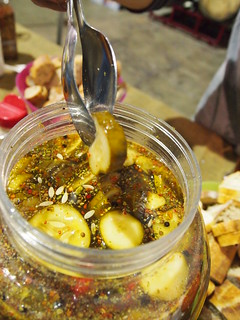
  • Cannon-ized pickles (02)
  • 22 October 2015
    Recipe for Beer-Brined Pickles.
    —Via YFGF.

  • 20 October 2015
    Historian Maureen Ogle to update her 2006 history of beer in America, Ambitious Brew. To publish a new chapter as e-book esay, in October 2016.
    —Via Maureen Ogle.

  • 20 October 2015
    In 1914, Washington, D.C. breweries produced 210,284 barrels of beer. In 2014: 20,660 barrels. But that's up from zero in 1957.
    —Via DC Beer.

  • 20 October 2015
    UnTappd, a social-networking app and website at which beer drinkers post their reviews, is five years old. And that is its spelling.
    —Via UnTappd.

  • 20 October 2015
    Although it acknowledges no culpability, AB-InBev loses a $28M class-action suit over labeling Beck's beer sold in the U.S. as being brewed in Germany. It is not. The conglomerate brews that Beck's in St. Louis, Missouri, USA, and will indicate so on the beer's bottle label as part of the settlement.
    —Via Reuters.

  • 19 October 2015
    One hundred years after the Robert Portner/Tivoli Brewery (in 1916, the largest brewery in the U.S. South) closed in Alexandria, Virginia, due to Prohibition, the Portner Brewhouse — owned by two great-granddaughters of Robert Portner— is scheduled to open in Alexandria, in summer 2016.
    —Via Virginia Craft Beer.

  • 17 October 2015
    Research published in 2011 suggested that Saccharomyces eubayanus —one-half of lager yeast's pair of parents— had originated in Patagonia (at the southern tip of South America). But left unanswered was how that yeast was able to get to Bavaria before Europeans began traveling to the Americas. Research in 2014 may have provided an answer: maybe the initial cross-hybridization came earlier, not from South America, but from Asia. Researchers have discovered S. eubayanus yeast on the Tibetan Plateau which shows a closer genetic match to modern lager yeast than that in the Patagonian forests.
    —Via LarsBlog.

  • 17 October 2015
    The tragic story of the Great London Beer Flood of 17 October 1814.
    —Via British beer historian, Martyn Cornell, at Zythophile.

  • 16 October 2015
    "What you do is make beer. Some of you do it very well. But none of you are revolutionaries. You are brewers." A definition of 'craft' beer.
    —Via YFGF.

  • 16 October 2015
    'Selling in' rather than 'selling out.' Seattle 'craft' and imported beer pioneer, Charles Finkel, sells stock in his Pike Place Brewing back to key employees.
    —Via Brewbound.

  • 14 October 2015
    What President Jimmy Carter did on 14 October 1978 that would change homebrewing in America, and eventually 'craft' beer.
    —Via YFGF.

  • 14 October 2015
    Three analyses of Anheuser-Busch InBev's proposed purchase of SABMiller.
    • Nate Micklos — who was the brand manager for Pacifico during the Anheuser-Busch InBev purchase of Grupo Modelo in 2014— examines the deal three ways: portfolio, distribution, impact upon the drinker.
      —Via Good Beer Hunting.
    • The biggest loser from ABIB-SABMiller merger may be the Brewers Association. Not craft beer. [...] Having spent thirty-plus years teaching entrepreneurs how to start and succeed as a brewer, the Brewers Association now must watch as many of its own decamp craft in favor of deep-pocketed investors with better access to distribution.
      —Via historian Maureen Ogle.
    • I’m asking you to simply remove all the corporate beers, the mass-produced, cynical, watery pablum beers from foreign conglomerates, from your worldview. Ignore the entire end of your grocery store cooler that’s devoted to the idea that we’re all the same and that we value repetition and sameness over choices and variety.
      —Via Steve Body, at A Pour Fool.

  • 14 October 2015
    Will Oregon's Deschutes Brewing pick Roanoke, Virginia, for the East Coast location of its new brewing plant?
    —Via Daily Progress.

  • 13 October 2015
    Researchers find white wine higher in antioxidants than red wine, and beneficial in weight loss and anti-aging effects.
    —Via Washington Post.


  • 13 October 2015
    Recipe for Beer-Cheese Soup.
    —Via Food Network.

  • 13 October 2015
    Anheuser-Busch InBev, the world's largest brewing company (at 350,241,009 barrels annual production, 21% of total world volume) has become even larger, purchasing number two SABMiller (at 160,037,133 barrels, 9.6%) for $104 billion dollars. Pending details to be worked out, a vote by stockholders, and governmental antitrust hurdles to cleared.
    —Via YFGF.

  • 13 October 2015
    Organizers of the greater Baltimore, Maryland, metropolitan area's annual Baltimore Beer Week celebration create the Baltimore Beer Legends Hall of Fame. Inductees to be added every year in October.
    —Via YFGF.


  • 13 October 2015
    The myth of the IPA shipwreck off the coast of Liverpool may be true after all. But in 1839, not a decade earlier as had long mis-reported. Its impact upon the popularity of IPA remains in doubt.
    —Via Martyn Cornell, at Zythophile.

  • 12 October 2015
    Despite the beer-hegemony of Anheuser-Busch InBev and SABMiller, there are nations in the world where locally-produced beers outsell the conglomerates' brands.
    —Via Bloomberg.

  • 12 October 2015
    A 'craft' beer changing of the guard. Kurt Widmer, co-founder Widmer Brewing in 1984, to retire. Younger brother, Rob, to remain at Craft Brewers Alliance (founded in 2008 as merger between Widmer and Redhook).
    —Via Jay Brooks, at Brookston Beer Bulletin.

  • 11 October 2015
    In the September/October 2015 sales and marketing issue of The New Brewer —the trade magazine of the (U.S.) Brewers Association— a piece on training wait-staff for brewery taprooms describes 'baby boomers' (Americans born during the demographic post–World War II population boom between the years 1946 and 1964) as ... "vintage customers." Really? Do they improve with age?
    —Via New Brewer.

  • 11 October 2015
    How the western U.S. drought is affecting some California breweries.
    —Via AP.

  • 11 October 2015
    A health and safety report conducted in July 2015 by the National Science Foundation uncovered that the McMurdo Station and the South Pole Station both have a widespread alcohol problem. The report also found that researchers were brewing their own beer, which is against policy.
    —Via IFL Science.

-----more-----

Sunday, November 01, 2015

A 'kraft' story that didn't make it from Facebook to blog. And other stories.

A friend recently tweeted me that she was unable to access a story that I had linked on Twitter from its original spot on Facebook. She posts to Twitter, but not to Facebook. Strange new social-media world!

Yours For Good Fermentables has its own Facebook page (of the same name). That isn't big news, but it is important to me because I maintain both. As it happens, I occasionally neglect the blog because of Facebook's quick-and-easy, brief-and-breezy posting (as if writing out three-hundred words at the blog had become a hardship). Last week, I wrote only once at the blog, but posted what amounted to twice a day at the Facebook (is 'the' correct?).

Here's the story she couldn't see:

Craft?

"Whole grain corn, sugar, marshmallows (sugar, modified corn starch, corn syrup, dextrose, gelatin, red 40, yellows 5&6, blue 1, natural and artificial flavor), corn meal, canola and/or rice bran oil, corn syrup, corn starch, cocoa processed with alkali, modified corn starch, salt, tricalcium phosphate, caramel and beet juice concentrate for color, trisodium phosphate, natural and artificial flavor, red 40, yellow 5&6, blue 1, wheat flour, peanut flour, vitamin E (mixed tocopherols) and BHT added to preserve freshness."

The ingredient list of a mainstream beer? No! Big breweries don't use those items in their beers (well, okay, maybe they do use some of them, such as gelatin, dextrose, corn syrup, caramel coloring, and natural and artificial flavoring).

But a 'craft' brewery? It would never, ever, use such ingredients, would it?

"Yeah, we added them to our beer," crowed the bartender at the taproom of a local 'craft' brewery, proudly describing to me how the brewery had tossed Count Chocula cereal into its cask ale.

General Mills beer. Not 'Kraft' beer. No, thanks.


***************
Here are a few more:
  • The FDA to require chain-restaurants (with 20 or more locations) to display nutritional information for beer, wine, cider on their menus, by Dec. 1, 2016. Could be difficult for smaller breweries (wineries and cideries) to supply that information. In light of the FDA ruling, it's interesting to recall that, in 1992, 'craft' beer pioneer (and curmudgeon) Bert Grant did put nutritional information on the label of his Grant's Scottish Ale ... but, back then, the U.S. government told him to cease and desist.

  • Balance and not balance in beer.
    The idea of moderation in brewing is not the idea of capitulation, of surrender, of turning your back on the way forward. It's a way of seeking silence in between the gaps that modern life manages to create - it's a polite cough, a feather stroke on the inner thigh, a reflective passage from an étude by Chopin, the intermission between nothing and I love you. And sometimes we need beers like that in the way we also need beers that cackle and burn like a martyr's bonfire or ululate across the night air like a trident in its tracks or even leave us unsure of what we're tasting. Like an Earth on its axis beer also needs balance.
    —Adrian Tierney-Jones, at Called to the Bar.


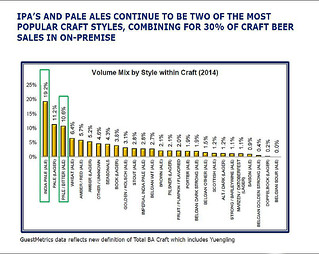
    IPA: top-selling 'craft' beer style on draft (2014)
  • The number one 'craft' beer style on tap in the U.S.? No surprise: IPA (India Pale Ale), with a 19.2% share.
    2. Pale Lager: 11.2%.
    3. Pale Ale: 10.6%.


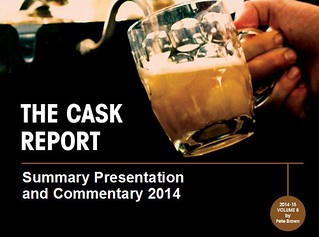
  • The Cask Report 2014-2015
  • Cask sales are growing in the U.K., but, in the U.S., we don't maintain those data.
    According to the UK Cask Report, cask sales grew 1.3% in 2014, outperforming pub keg and bottle sales growth by 4.5%. UK cask sales in 2014 accounted for 8.2% of the total beer market and 16.1% of all on-trade (restaurants, pubs). Cask is 58.6% of the "draught" market, while kegged beer is 41.4%. This represents a reversal of share since 2006, when these same figures were the other way round.

    In the U.S., the Brewers Association does not recognize cask ale as a category or production method, at least at its annual competition, the Great American Beer Festival. It publishes no accurate figures for U.S. cask-ale sales.

  • Forget the controversy at the Vatican's Synod on the Family. The real scandal was that the Archbishop of Cologne admitted that he prefered Dusseldorf's rival Altbier to Cologne's native Kölsch.

  • "Hops can take 10 to 12 years to develop before they’re marketed to breweries." Nicholas Gingold in All About Beer, a good long read, with lovely photos: "In Search of America's Best Hops."


  • Ahead of its (and his) time: twenty-five years ago, the Discovery Channel aired Michael Jackson's "The Beer Hunter."
  • “My name really is Michael Jackson, but I don’t sing and I don’t drink Pepsi. I drink beer.”

    “Why should wine drinkers be esteemed as nobs while beer drinkers are put down as slobs?,” the New York Times TV critic Walter Goodman asked his readers.

    Jackson’s show was an unprecedented effort “to correct this injustice and get equal treatment for those who prefer the mix of the malt to the fruit of the vine.”
    —Tom Acitelli in All About Beer. 27 October 2015.
-----more-----