Saturday, August 05, 2023

Pic(k) of the Week: St. Augustine Lighthouse, at morning

St. Augustine Lighthouse, at morning

The waning gibbous moon set as the sun rose, over the St. Augustine Lighthouse in St. Augustine, Florida, USA, on 5 July 2023 (7:06 am EDT).

Missed it by thaat much. Only two days earlier, the 'Buck' moon had been a full 'supermoon.' That's the price of a vacation itinerary!


***************

About the Lighthouse

The St. Augustine Light Station is a privately maintained aid to navigation and an active, working lighthouse in St. Augustine, Florida. It stands at the north end of Anastasia Island and was built between 1871 and 1874. The current lighthouse tower, original first-order Fresnel lens and the Light Station grounds are owned by the St. Augustine Lighthouse & Maritime Museum, Inc., a not-for-profit maritime museum.

The St. Augustine Light Station consists of the 165-foot (50 m) 1874 tower, the 1876 Keepers' House, two summer kitchens added in 1886, a 1941 U.S. Coast Guard barracks, and a 1936 garage that was home to a jeep repair facility during World War II. The site is also a National Oceanic and Atmospheric Administration (NOAA) weather station. The lighthouse was placed on the National Register of Historic Places in 1981.

The tower, however is the second lighthouse tower in St. Augustine, the first being lit officially by the American territorial government in May 1824 as Florida's first lighthouse. However, both the Spanish and the British governments operated a major aid to navigation here including a series of wooden watch towers and beacons dating from 1565.
Wikipedia.

-----more-----

Saturday, July 29, 2023

Pic(k) of the Week: Paddleboard morningtide

Paddleboard morningtide

A woman paddleboards in the golden light of an early summer morning.

As seen on Salt Run, off Anastasia Island, in St. Augustine, Florida, USA. 5 July 2023.
In 1940, the St. Augustine Inlet was created by dredging a new inlet of Matanzas Bay. Then, during the 1940s, the severed land mass that was south of the new inlet channel merged with the intertidal shoals of the original natural inlet. This created what is now called Conch Island, which includes the ocean shoreline of the Anastasia State Park. The old inlet closed at its southern terminus leaving the lagoon, now called Salt Run.
Florida Department of Environmental Protection

-----more-----

Saturday, July 22, 2023

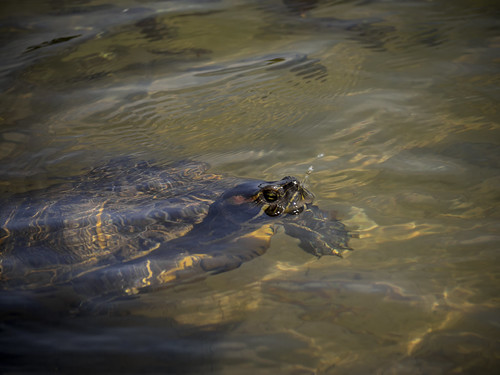
Pic(k) of the Week: Turtle, surfacing

Turtle, surfacing

A native red-eared slider turtle blows bubbles as she surfaces.

Seen at a wildlife sanctuary pond in St. Augustine Beach, Florida, USA. 3 July 2023.
The red-eared slider or red-eared terrapin (Trachemys scripta elegans) is a subspecies of the pond slider (Trachemys scripta), a semiaquatic turtle belonging to the family Emydidae. The red-eared slider is native from the Midwestern United States to northern Mexico, but has become established in other places because of pet releases, and has become invasive in many areas where it out-competes native species. The turtle gets its name from the small, red stripe around its ears, or where its ears would be, and from its ability to slide quickly off rocks and logs into the water.
Wikipedia.

-----more-----

Saturday, July 15, 2023

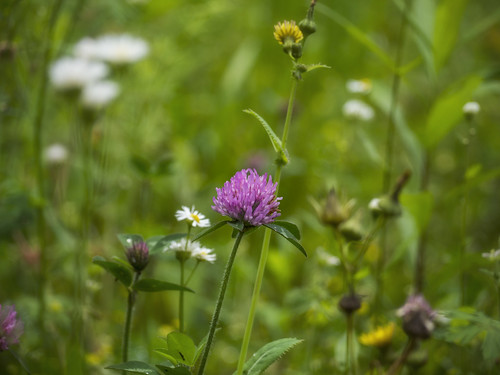
Pic(k) of the Week: Red Rover, Red Rover, send Red Clover right over!

Red Rover, Red Rover, send Red Clover right over!

Wild red clover. It's a gorgeous and valuable 'weed.' At least to the eyes of a particular observer.
Trifolium pratense — commonly known as red clover— is a herbaceous species of flowering plant in the bean family Fabaceae. It is native to Europe, Western Asia, and northwest Africa, but has been naturalized in many other regions, such as North and South America.

Trifolium pratense grows 8 to 31 inches tall (20–80 cm). The flowers are dark pink with a paler base, 0.5 to 0.6 inches long (12–15 mm), produced in a dense inflorescence [cluster of flowers arranged on a stem], attractive to bumblebees.

Tolerant to drought, Trifolium pratense is widely grown as a fodder crop, valued for its nitrogen fixation, which increases soil fertility and promotes protein rich growth, and enables it to support a wide range of wildlife including deer, turkeys, and rabbits. Its flowers and leaves are edible.
Wikipedia.

This specimen, I encountered, on 28 April 2023, in the Trailhead Community Park of the East Decatur Greenway in Decatur, Georgia, USA. The plant isn't limited to parks, however. Fecund and often ruderal, red clover doesn't discriminate over location.

-----more-----

Saturday, July 08, 2023

Pic(k) of the Week: Wild garlic on the trail

Wild garlic on the trail

Pungent aroma and brilliant color, but...a weed?

Wild garlic, blooming, in Legacy Park, Decatur, Georgia, USA, on 27 May 2023.
Allium vineale —commonly known as wild garlic, onion grass, crow garlic, or stag's garlic— is a perennial, bulb-forming species of wild onion in the genus Allium and family Amaryllidaceae (amaryllis). It is native to Europe, northwestern Africa, and the Middle East. The species has been introduced in Australia and North America, where it has become a noxious weed.

All parts of the plant have a strong garlic odour. The underground bulb is 0.4 to 0.8 inches in diameter (1–2 cm). The main stem grows 1 to 4 feet tall (30–120 cm), comprising a number of small red bulbils [exterior bulbs] with a few pinkish-green flowers, 3⁄32 to 3⁄16 inches long (2.5 to 4.5 mm).
Wikipedia.

-----more-----