Monday, October 30, 2017

Clamps & Gaskets: News Roundup for Weeks 41/42, 2017.

Clamps and Gaskets: weekly roundup
A bi-weekly, non-comprehensive roundup
of news of beer and other things.

Weeks 41/42
8 October - 21 October 2017


    Pat Baker receives Lifetime Achievement Award
  • 21 October 2017
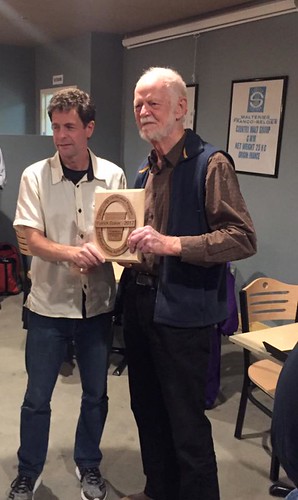
    In 1985, Pat Baker (on right in photo) founded the Beer Judge Certification Program (BJCP), "a worldwide certifying organization for judges of beer and related fermented products." On 21 October 2017, the BJCP presented him with its first-ever lifetime achievement award, christening it the Pat Baker Lifetime Achievement Award.
    • Photo courtesy Scott Bickham, BJCP Northeast Regional Representative (on left in photo), on Facebook.
    • Additional information via YFGF, on Facebook.
  • 21 October 2017
    A useful table of beer volume measures.
    —Via Beer Culture with Des de Moor.

  • 20 October 2017
    When the restaurant reviewer for the Washington Post ranked the top 10 restaurants in the Washington, D.C. metro area, a local beer website ranked those restaurants according to their beer lists. Media in other cities should emulate this.
    —Via DC Beer .

  • 19 October 2017
    Fifty-one senators —a bi-partisan majority of the U.S. Senate (out of 100 members)— have co-sponsored Senate Bill 236. Known as the Craft Beverage Modernization and Tax Reform Act (CBMTRA), the bill would cut the federal excise tax for domestic breweries making fewer than two million barrels annually to $3.50 per barrel (currently $7) on their first 60,000 barrels and would reduce and streamline reporting requirements. A similar bill in the U.S. House of Representatives —H.R. 747— also has majority bi-partisan support from 281 members (out of 435). Infighting among members of the U.S. brewing industry —small and independent (so-called 'craft') breweries vs. large breweries— could, however, hurt chances of passage.
    —Via Brewbound.

  • 19 October 2017
    A small 'craft' brewery in Gainesville, Florida, offered to exchange one free draft beer for admission tickets to a speech by white supremacist Richard Spencer at the nearby University of Florida.
    We believe free speech is a cornerstone of our great nation. That said, speech that condones, let alone, promotes racial supremacy has no home in America, and it sure as hell doesn't have a home here in our beautiful town. [...] For every two tickets you bring in, we'll trade you for a free Alligator Brewing draft beer. Those tickets and reserved spots will be disposed of, leaving two more empty seats in the Philips Center. We, unfortunately, can't stop [Richard Spencer] from bringing his hate to Gainesville, but we can empty the room so his disgusting message goes unheard.
    —Via Esquire.

  • 18 October 2017
    The (beery) etymology of the word "nip": "the smallest imaginable measure of beer."
    In his 1785 Classical Dictionary of the Vulgar Tongue, Francis Grose doesn’t list 'nip' but does have this rather wonderful related entry: 'Nipperkin, a small measure.' By the time a new edition came out in 1788, nip had been added: 'Nyp, or Nip. A half pint, a nyp of ale: whence the nip-prekin, a small vessel.' [...] When the Weights & Measures Act of 1824 was passed it did not include the 'nip/nipperkin' among the new standard Imperial units of volume which meant that, legally speaking at least, it ceased to exist.
    —Via Boak and Bailey.

  • They buy us, now we buy them. (#TakeCraftBack)
  • 15 October 2017
    The [U.S.] Brewers Association (BA) —the not-for-profit organization that “represents America’s small and independent brewers”— has proposed, supposedly tongue-in-cheek, a crowd-sourced campaign to #TakeCraftBack from Anheuser-Busch InBev — the international beer behemoth that has been busy acquiring small breweries across the country and the world— by purchasing the conglomerate for $213 billion, its current value. To reach that goal, every American would have to contribute $655 dollars apiece. As of 16 October, $1,591,390 had been 'pledged.' Although the BA says it doesn’t intend to collect from donors, it does promise swag for each. “We have no doubt that your pledge, and all the others like it, has Big Beer quaking in their [sic] custom-made Italian loafers.” It appears that this campaign is a followup to the Certified Independent Craft Beer Seal that the BA launched in June 2017.
    —Via [U.S.] Brewers Association, at TakeBackCraft.

  • 16 October 2017
    "Love beer hate, pubs?" British beer writer Des de Moor on the (not-always-salubrious) past of British pubs and their evolving present (and future).
    The idealised view of the inclusive community pub of the past, where everyone was welcome, is not only contradicted by the facts of physical segregation in pubs at least up until World War II, but by the lived experience of anyone who found themselves outside the prescribed normality of the communities that used them.
    —Via Beer Culture with Des de Moor.

  • 13 October 2017
    More than twenty-five 'craft' breweries in California helped to raise funds to assist people and businesses affected by the state's wildfires.
    —Via San Francisco Chronicle.

  • 12 October 2017
    The Trump administration announced that the United States will withdraw from UNESCO —the United Nations Educational, Scientific and Cultural Organization— effective the end of 2018, because of what it says is agency’s “anti-Israel bias.” UNESCO's missions include promoting sex education, literacy, clean water, and equality for women, and designating world heritage sites.
    —Via New York Times.

  • 10 October 2017
    The iconic Boeing 747, first commercially flown in 1969, to be retired as a passenger jet.
    —Via New York Times.

  • 10 October 2017
    The northern California wildfires burned over 170,000 acres of land, killed over 40 people, displaced 20,000, and destroyed an estimated 3,500 plus structures, including several wineries.
    —Via Wine Enthusiast.

  • 10 October 2017
    Anchor Steam, the godfather of 'craft' beer.
    If the last 50 years of American craft beer has a liquid godfather, it’s Anchor Steam. “In my mind, it’s the first craft beer,” says Randy Mosher, author of Tasting Beer and one of the world’s leading experts on the drink. Even more than that, Anchor Steam is a singular achievement in American food and drink: It’s the sole commercial representation of the oldest indigenous beer style in the United States.
    —Via Tom Acitelli, at Eater.

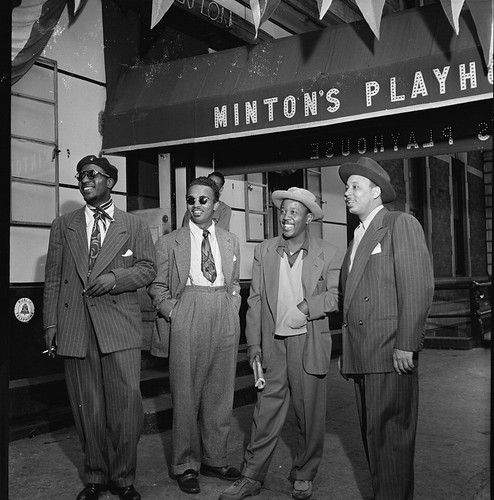
  • Monk at Minton's (c. 1940s)
  • 10 October 2017
    This day would have been the 100th birthday of composer/pianist Thelonius Sphere Monk: a giant of 20th-century music, who performed in the jazz idiom (1917 - 1982).
    • Pictured at Minton's Playhouse, New York City, circa 1940s. l-r: Thelonious Monk, Howard McGhee, Roy Eldridge, Teddy Hill.
    • Via YFGF.

  • 9 October 2017
    University of Chicago professor Richard Thaler has won the 2017 Nobel Prize in economics for his work on behavioral economics, which tries to understand how humans make decisions, especially poor ones. Thaler, an American, is one of the leading experts in the relatively new field that combines psychology and economics.
    —Via Washington Post.

  • 9 October 2017
    California wildfires have threatened the state's first legal marijuana crop. California grows an estimated 13 million pounds of pot annually and four of every five pounds is shipped to other states. In addition to burned crops and marijuana displaying smokey odors, cannabis exposed to smoke and ash is more vulnerable to disease, which can result in high levels of molds, mildews, and fungus, creating potential health risks such as lung infections.
    —Via East Bay Express.

  • 8 October 2017
    Grady Tate, a jazz musician who was nominated for Grammy Awards as a singer but was best known as a versatile drummer who helped propel the “soul-jazz” style of the 1960s and who appeared on hundreds of albums and sang for Schoolhouse Rock, has died at 85.
    —Via NPR.

  • 8 October 2017
    For the first time in Goose Island’s 29-year history, Chicago’s oldest brewery did not participate in the Great American Beer Festival, the U.S. beer industry’s premier event and competition, held annually in Denver Colorado, this year from 5-7 October.
    Goose Island’s exclusion is not for a lack of the brewery’s desire to be there. It’s the result of a complicated relationship between craft beer and Big Beer that’s only growing more complicated. The Brewers Association, which operates GABF and is the trade organization for 4,000 breweries that meet its definition of “craft” — small, traditional and independent — says the issue comes down to two intersecting factors: a wildly growing beer industry and the consolidation sparked by Goose Island’s sale to Anheuser-Busch InBev in 2011. After two years of discussion, the Brewers Association has begun limiting the number of breweries that a single beer company can have on the floor at GABF. Left on the outside are Goose Island and a handful of other breweries that have been bought by the world’s largest beer companies [such as Virginia's award-winning Devils Backbone].
    —Via Chicago Tribune.

-----more-----

Sunday, October 29, 2017

Cask advice for 2017...from 1850.


In 1765, the Swan Brewery began brewing in London. It would continue doing so for an additional one hundred seventy-one years until 1936, when the Ind Coope/Samuel Allsopp & Sons brewing consortium purchased the brewery ... and promptly closed it.

But nearly a century earlier, in 1850, when The Swan was still going strong, it published a pamphlet for the trade that described its brewing procedures and its beers, and offered advice on how to properly care for them. Included was a short passage on cask cellarmanship. It was sensible advice then and remains so now, nearly two centuries later.

The Management of the Beer Cask (1850)
The Management Of The Beer Cask
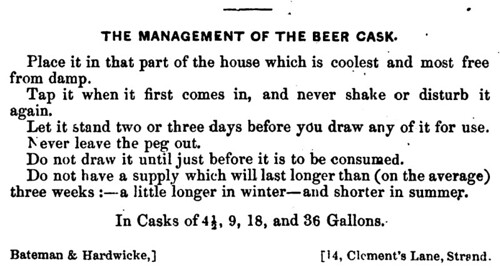
  • Place it in that part of the house which is coolest and most free from damp.
  • Tap it when it first comes in, and NEVER SHAKE OR DISTRUB IT AGAIN [emphasis mine].
  • Let it stand two or three days before you draw any of it for use.
  • Never leave the peg out.
  • Do not draw it until just before it is to be consumed.
  • Do not have a supply which will last longer than (on the average) three weeks: —a little longer in winter— and shorter in summer.
—"The Proprietors of the Swan Brewery, Walham Green, Fulham - (Established 1765) - Beg to Present These Pages on Beer and Brewing; and Will Feel Honoured by Their Acceptence and Perusal."
1850

Note the cask sizes mentioned: 4.5, 9 (firkin), 18, and 36 gallons. Swan, of course, listed them in Imperial (U.K.) measure. Translating to U.S. volumes, they would be, respectively: 5.4, 10.8 (firkin), 36, and 72 gallons.

The short pamphlet also discussed the clarification of cask ale, i.e, the fining of casks.

The Fining of Cask Ale (in 1850)
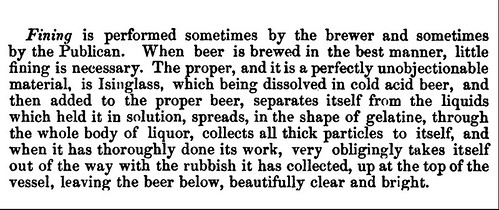
Fining is performed sometimes by the brewers and sometimes by the Publican. When beer is brewed in the best manner, little fining is necessary. The proper, and it is perfectly unobjectionable material is Isinglass, which being dissolved in cold acid beer, and then added to the proper beer, separates itself from the liquids which held it in solution, spreads, in the shape of gelatine, through the whole body of liquor, collects all thick particles to itself, and when it has thoroughly done its work, very obligingly takes itself out of the way with the rubbish it has collected, up at the top of the vessel, leaving the beer below, beautifully clear and bright.


Ah, but what is the "perfectly unobjectionable material," isinglass? Here, from the The Oxford Companion to Beer (2012):
Isinglass is derived from the swim bladders of certain tropical and subtropical fish. [...] Traditionally, isinglass for brewing purposes was derived from sturgeon, although modern commercial isinglass is more typically derived from tropical estuarine dwellers. [...] When used as a fining agent, [isinglass] has the ability to settle yeast and beer proteins very quickly and can do so repeatedly. This latter property is essential for cask-conditioned ales, where the casks may be moved several times prior to serving.

Many cellarmen in 21st-century U.S. have switched from the use of isinglass to non-animal-derived agents for clarifying cask ales. Others rely on gravity and time and/or rapidly-settling yeast strains.

But many others, sad to say, when it comes to cask quality, isinglass or no isinglass, couldn't give a f care less.

Fobbing at the Tut

Fobbing at the Tut:
A series of occasional posts on good cask cellarmanship.


-----more-----

Saturday, October 28, 2017

Pic(k) of the Week: Small ceramic beer steins

Small ceramic beer steins

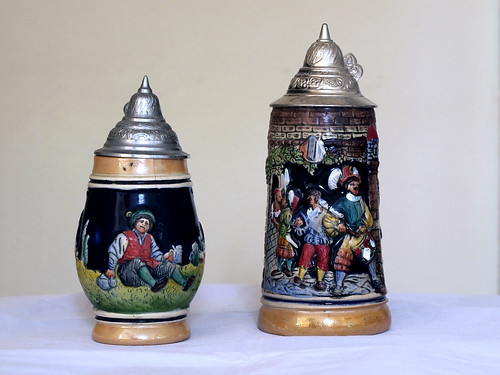
Two illustrated, aluminum-handled, ceramic German beer steins, circa 1960 *. On the left is a 200-milliliter stein (6.75 ounces); on the right, a 300-milliliter stein (10.14 ounces).

There's some German doggerel on the larger of the two:

Stich und Hieb, und ein Lieb,
muß ein Landsknecht haben.


—Two lines from a German folksong, loosely translated as:

Sword and uniform, and love,
That's what a Landsknecht has.


A Landsknecht was a mercenary, of the 15th and 16th centuries, from the 'lower' German lands of, what was then, the Holy Roman Empire (in, what is now, the Rhineland, Alsace, etc.).

Some believe that drinking steins were originally designed, hundreds of years ago, with hinged lids to keep flying insects out of the beer. If so, a worthy innovation. Danke und Prost!

-----more-----

Friday, October 27, 2017

Craft Brewery Sustainability

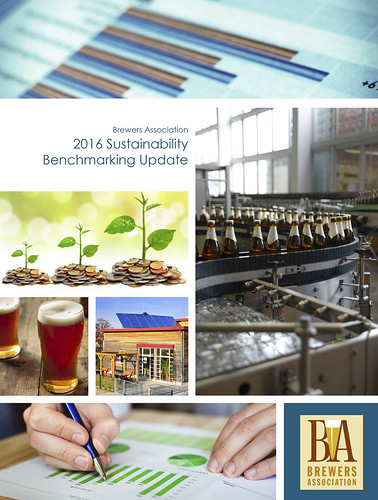
Sustainability Benchmarking Update for Craft Breweries (Brewers Association, October 2017)

In 2015, the [U.S.] Brewers Association (BA) published its first Sustainability Benchmarking Report. Based on data from 2014, the report highlighted best 'craft' brewery practices in utility usage and sustainability. Earlier this week, the BA released its newest Sustainability Benchmarking Update, based on data from 2016.
This document is an update to the inaugural report, and it highlights certain data from 2015. Electricity, natural gas, water, and purchased CO2 were evaluated based on a normalized scale per barrel (bbl) of beer packaged. [...] This update focuses on four environmental attributes as key performance indicators (KPIs): electricity, natural gas, water, and carbon dioxide. In some sections, wastewater costs and greenhouse gas emissions are also discussed. Although there are other KPIs highlighted in the 2015 Sustainability Benchmarking Report, and additional metrics can be entered on the dashboard, KPIs presented in this report capture the primary environmental and economic attributes of concern to the craft brewing industry. [...]

Best-in-class performance from the first two years of submitted data includes:
  • 6.7 kWh electricity/bbl (ranged from 6.7-709)
  • 0.84 therm natural gas/bbl (ranged from 0.84-37.6)
  • 3.31 bbl water/bbl (ranged from 3.31-81.7)
  • 0 lb CO2 purchased/bbl (ranged from 0-78)
    [Appears to mean that a brewery was able to capture and scrub from fermentation any CO2 it needed for other points of operation, an expensive proposition beyond the means of all but larger breweries.]
Sustainability benchmarking and sharing of best practices is not a one-time project. The online benchmarking tools are intended to provide an ongoing platform that constantly refreshes and identifies new best practices through tracking of sustainability-related key performance indicators (KPIs). As benchmarking participation grows, the data will become more robust, and drivers behind those best-in-class performers will be identified and shared.

It is encouraging to see the number of BA members that have recognized business value in continuing to input monthly data through 2016 and into 2017, setting and tracking progress against targets, and sharing best practices. The next benchmarking report will focus on trends and other insights from the analysis of data from 2014, 2015, and 2016. Data presented in this report supersedes [sic] previous studies and should be considered the most up-to-date.
—[U.S.] Brewers Association. 23 October 2017.

A winemaker once told me that he wasn't interested in having his winery certified organic, but in it being sustainable. With many organic practices —best practices for his farm and winery— in the mix for himself and his neighbors, he was woring toward ensuring that his business would be sustained, that is, survive, and maybe thrive, for another year(s). In other words, sustainability is not simply tree-hugging morality but profit-making, good business. I'm sure many brewers would agree.

To accompany its report, the BA provides an online suite of Sustainability Benchmarking Tools to assist breweries in tracking monthly utility bills, identifying opportunities to save energy and money, and benchmarking per-barrel performance.

This is just one example of the great work that the [U.S.] Brewers Association can do for its 'craft' brewery members as opposed to some of the silly stuff it does do.

-----more-----

Saturday, October 21, 2017

Pic(k) of the Week: Trumpeting, at Porchfest.

Trumpeting, at Porchfest

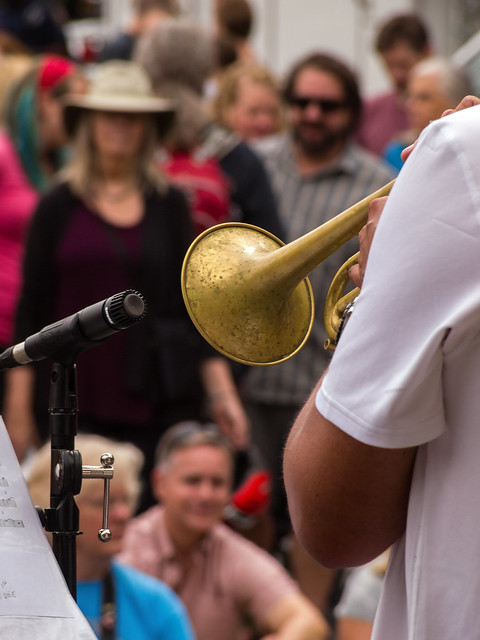
A trumpeter performs during Oakhurst Porchfest, in the Oakhurst neighborhood of Decatur, Georgia, on 14 October 2017. He played for tips.
Eleven years ago [2006] in Ithaca, New York, Lesley Greene and Gretchen Hildreth had an idea: What if we had an afternoon when porches all over the neighborhood became stages and everyone just meandered from yard to yard, listening, hanging out, and connecting/reconnecting with their neighbors?

Porchfest, the ultimate grassroots music festival, was born. 100% resident owned and operated, it’s been going and growing every year since. And in that time, other neighborhoods all around the country have taken the model and run with it. Including Oakhurst, which launched its own Porchfest in October 2015.

This year, over one hundred eighty homes opened their porches, driveways, and yards to musicians of every kind, making Porchfest the biggest and most diverse —free— music festival in Georgia.

I tipped him. (Should I toot my own horn?)

-----more-----