Every year in September, an explosion of yellow flowers covers granite outcrops such as Arabia Mountain, Panola Mountain [and Stone Mountain]. These are yellow daisies (Helianthus porteri). Related to sunflowers, they are one of the fall wonders within the Arabia Mountain National Heritage Area.
Found in only 4 states — Georgia, Alabama, North Carolina, and South Carolina — the flowers are most common on the rocky outcrops of the Georgia Piedmont region, thriving in fragile solution pits — vernal pools that are often dry and sandy — found on bare rock faces.
On a guided morning hike, Preserve Manager 'Ranger Robbie' Astrove gave us some sad news. This autumn, he's seen fewer native autumnal yellow daisies than in any of his fifteen years as ranger at the park. The intense, sustained summer heat may have been to blame.
Astrove had a plan, however. He led us along a boardwalk at the base of the mountain. There, rains, flowing down the impervious granite-gneiss rockface, had irrigated the plants during summer, while towering trees at the base provided ample shade from harsh afternoon sun. So, despite an overall deficit, the autumnal daisies were in abundance here. “Nature's gonna nature,” Ranger Robbie told us.
Click on the image for a larger, hi-res version (on Flickr).
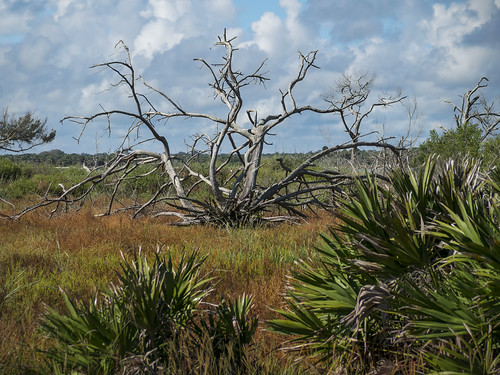
Framed by saw palmetto, a lone ghost tree stands, sered, in a salty tidal marsh of the Matanzas Inlet estuary.
St. Johns County (Palm Coast), Florida, USA.
9 September 2026.
***************
Matanzas Inlet
The Matanzas Inlet is a narrow, partially saltwater channel in the U.S. state of Florida — 14 miles (23 km) south of the city of St. Augustine — between two barrier islands and the mainland, connecting the Atlantic Ocean and the southern end of the Matanzas River estuary, comprising a coastal scrub environment and maritime forest. Part of the Atlantic Intracoastal Waterway, the Matanzas Inlet is the last remaining natural, or undredged, inlet on Florida's Atlantic coast.
A ghost forest is a coastal woodland characterized by widespread tree mortality as a result of saltwater intrusion and land submergence. Ghost forests commonly form when sea level rise, tectonic subsidence, or storm-driven coastal flooding increases soil salinity beyond the tolerance of freshwater tree species.The formation of ghost forests changes the surrounding ecology, often changing the deciduous forests into saltwater marshes or tidal wetlands.
The Toccoa River and Ocoee River are the names in use for a single 93-mile-long (150 km) river that flows northwestward through the southern Appalachian Mountains of the southeastern United States. It is a tributary of the Hiwassee River, which it joins in Polk County, Tennessee, near the town of Benton.
The river is called the Toccoa for its 56 miles (90 km) through Georgia, until it reaches the twin cities of McCaysville, Georgia and Copperhill, Tennessee. The remainder is called the Ocoee through Tennessee. The name Ocoee originates from the Cherokee name for Passiflora incarnata, the passion flower. Toccoa comes from a Cherokee word meaning "beautiful."
The Ocoee is known for its Class III-V whitewater rapids, appealing to kayakers and rafting enthusiasts. The upper section of the Ocoee was host to whitewater slalom events during the Centennial 1996 Summer Olympics held primarily in Atlanta, about 100 miles (160 km) to the south.
The Toccoa River and Ocoee River are the names in use for a single 93-mile-long (150 km) river that flows northwestward through the southern Appalachian Mountains of the southeastern United States. It is a tributary of the Hiwassee River, which it joins in Polk County, Tennessee, near the town of Benton.
The river is called the Toccoa for its 56 miles (90 km) through Georgia, until it reaches the twin cities of McCaysville, Georgia and Copperhill, Tennessee. The remainder is called the Ocoee through Tennessee. The name Ocoee originates from the Cherokee name for Passiflora incarnata, the passion flower. Toccoa comes from a Cherokee word meaning "beautiful."
The Ocoee is known for its Class III-V whitewater rapids, appealing to kayakers and rafting enthusiasts. It is also home to the local salamander, Desmognathus ocoee. The upper section of the Ocoee was host to whitewater slalom events during the Centennial 1996 Summer Olympics held primarily in Atlanta, about 100 miles (160 km) to the south.
Click on the image for a larger, hi-res version (on Flickr).
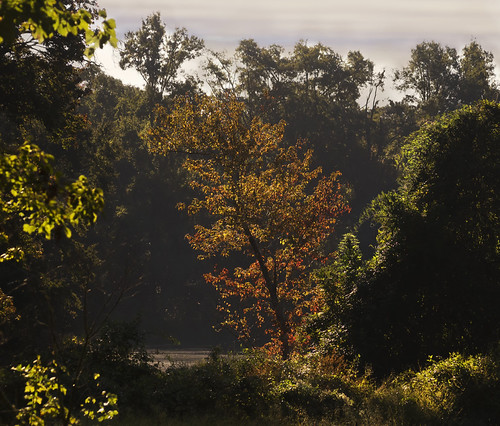
A wooden fence and woodland suggest a picturesque rural location. Appearances can be deceiving. They're actually within the front yard of a house in a densely populated suburb of Metro Atlanta.
DeKalb County (Oak Grove), Georgia, USA.
24 August 2026.
***************
Geographical/historical note
Unseen in the image, there's a small, unnamed creek just beyond the fence. To left of frame, it flows under a suburban street into Echo Lake, an 18-acre private residential impoundment lake.
Echo Lake was built in 1938 by the Soil Conservation Service, now called the Natural Resources Conservation Service (part of the U.S. Department of Agriculture). Congress passed a law establishing the SCS in 1935 stating, “the wastage of soil and moisture resources on farm, grazing, and forest lands is a menace to the national welfare.” It was a massive national effort with most of the work done by the Civilian Conservation Corps (CCC), the Civil Works Administration (CWA), and the Works Progress Administration (WPA).
Five lakes were built with earthen dams to control flooding and prevent soil erosion in tributaries of North Fork Peachtree Creek. At the time, this was a rural area of forests and farms. Today, only Echo Lake and a smaller remain.
Click on the image for a larger, hi-res version (on
Flickr).
A summer treat: a passion butterfly sips sweet nectar from a Texas lantana flower.
Avondale Estates, Georgia, USA.
9 August 2026.
***************
🐤 Fauna:
Dione vanillae (synonym: Agraulis vanillae) — commonly known as Gulf fritillary or passion butterfly — is a bright orange butterfly in the subfamily Heliconiinae of the family Nymphalidae. The Heliconiinae are 'longwing butterflies,' with longer, narrower wings than those of other butterflies.
Gulf fritillaries are found primarily in the southern parts of the contiguous United States, from Florida and Georgia to Texas and California, in open habitats near open grasslands, parks, and woodlands.
In its adult form, the gulf fritillary is a medium-sized butterfly with extended forewings and a wingspan of 2½ to 3¾ inches (6½ to 9½ cm). The underside of the wings is brown and speckled with silvery white dots. In contrast, the top surface layer of the wings is deep orange, with black streaks running across.
Lantana urticoides — commonly known as Texas lantana or calico bush — is a three- to five-foot (0.9 to 1.5 m) perennial flowering shrub within the verbena family (Verbenaceae), that grows in Mexico and the southeastern U.S. states of Texas, Louisiana, and Mississippi, especially along the Gulf coast.
Flowers are colorful red, orange, and yellow small tubes with four flared lobes; in dense, rounded clusters with a leafy bract [specialized leaf, associated with a reproductive structure] subtending each flower, at the ends of peduncles [long paired stems] usually extending beyond the leaves, appearing from April to October.
Cornus amomum — commonly known as silky dogwood — is a deciduous shrub in the dogwood family, native to central and the eastern part of the United States and parts of Canada. It is typically found in swamp borders and wetlands, and near streams and ponds.
Silky dogwood may grow 6 to 12 feet tall (1.8 to 3.6 m). The leaves and twigs have silky hairs. A distinctive feature of this shrub is the dark brown pith in 1- to 2-year-old stems and the dark reddish twigs. Clusters of creamy white flowers bloom in the spring followed by small, 1-inch (2.5cm) blue drupes [stone fruits] that ripen in late summer.
Click on the image for a larger, hi-res version (on
Flickr).
A native, wild trumpet creeper vine blooms in mid-summer, as seen from a vantage along the South Peachtree Creek Trail, on an elevated boardwalk over the wetlands of Burnt Fork Creek.
Campsis radicans — commonly known as cow-itch, cow vine, devil's shoestring, foxglove vine, hellvine, hummingbird vine, trumpet creeper, trumpet vine — is a dense, vigorous, woody, deciduous, perennial vine in the trumpetvine family (Bignoniacea) that attaches itself to structures and climbs by aerial rootlets. It is native to the central and eastern United States, inhabiting woodlands and riverbanks (and growing on roadside telephone poles).
The trumpet creeper has clusters (terminal cymes) of orange to reddish-orange trumpet-shaped flowers, 3 inches long (8 cm), with a yellowish throat and 5 shallow lobes bending backward. They appear throughout the summer (June to September), and are very attractive to hummingbirds.
Zinnia elegans — commonly known as common zinnia, elegant zinnia, and zinnia — is an annual flowering plant in the family Asteraceae. It is native to Mexico but naturalised in several places, including the United States.
The uncultivated plant grows to about 5½ inches in height (15 cm). It has solitary flower heads about 2 inches across (5 cm). The purple ray florets surround black and yellow discs. Flowering occurs during the summer months.
Zinnias are popular garden plants with hundreds of cultivars in many flower colours, sizes, and forms. The garden zinnia was bred via hybridisation from the wild form.
This is a close-up. The clover appears much larger in the image than it did in 'real' life. Somewhat paradoxically, photographers refer to this technique not as 'micro' but 'macro.'
To 'isolate' the blossom from the weedy background, I employed an off-camera flash. The light diminished quickly beyond the flower, producing a dark background.
Seven years ago, I submitted the photo to a YouTube photographer for critique. He dismissed it as too 'hot,' over-exposed by the flash. Looking at it now, I disagree...or, should I say, feh!
City of Avondale Estates, Georgia, USA.
7 June 2026.
Echinacea is a genus of herbaceous flowering plants in the daisy family. It has ten species, which are commonly called coneflowers. They are native only in eastern and central North America, where they grow in wet to dry prairies and open wooded areas
Echinacea purpurea — commonly known as purple coneflower, eastern purple coneflower, purple coneflower, purple rudbeckia — is an herbaceous perennial in the Asteraceae (daisy) family that is native to the central and eastern United States. The Genus name is Greek for meaning 'spiny one' and the species name means reddish-purple.
It may grow 3 to 4 feet tall; attractive ray petals surround a center of dark purplish brown disc flowers in summer and are long-lasting through mid-fall. The plant prefers well-drained, moist loam but is adaptable to various soil types. It is drought tolerant once established and can grow in full sun to partial shade. It is also deer, heat, humidity, and salt resistant.
Click on the image for a larger, hi-res version (on
Flickr).
A wild bigleaf hydrangea shrub (Hydrangea macrophylla), illuminated by riparian morning light.
On Glenn Creek in Melton Park
DeKalb County, Georgia, USA.
23 May 2025.
Hydrangea macrophylla — commonly known as bigleaf hydrangea — is a species of flowering plant in the family Hydrangeaceae, native to Japan, that has become naturalised in the Americas. It is is a deciduous shrub growing to 10 feet tall (3 m) with large heads of pink or blue flowers in summer and autumn. The opposite, serrated leaves can grow to 6 inches (15 cm) in length.