Showing posts sorted by relevance for query Prohibition. Sort by date Show all posts

Wednesday, November 01, 2017

Virginia bans alcohol.

101 years ago, today, on 1 November 1916, the Mapp Act became law in Virginia: alcoholic beverages were prohibite and the entire state went dry. For the rest of the country, National Prohibition —under the 18th Amendment to the Constitution— would not take effect until 17 January 1920.

Although Virginia established statewide prohibition through a popular referendum, it nonetheless faced several challenges in enforcing the new law. Its long coastline made it difficult to prevent smuggling, i.e. rum-running. It bordered on a wet state, Maryland, which made barely an effort to enforce national dry laws from 1920-1933. Virginia contained several cities which were reluctantly dry, most notably Alexandria, Richmond, and Norfolk. In addition, Virginia had a long-established moonshining tradition in the mountainous western part of the state. As a result, Virginia struggled to live up to the dry ideal it set for itself in 1916.

[...] The referendum on state-wide prohibition [with two simple choices, “For State-Wide Prohibition” and “Against State-Wide Prohibition”] passed, on 2 September 1914 by a vote of 94,251 in favor and 63,886 opposed. Of Virginia’s 100 counties, 71 voted in favor of prohibition. Eight of the ten congressional districts went dry, and one of the remaining two was wet by only ten votes. Surprisingly, sixteen of the state’s twenty cities also voted in favor of going dry. Traditionally cities were strongholds of wet votes. However, only Arlington, Norfolk, Williamsburg, and Richmond stayed wet.Accordingly, following the referendum, the Virginia legislature quickly passed a prohibition law, called the Mapp Law after state Senator Walter Mapp of Accomack County, making the entire state dry as of midnight, the morning of November 1, 1916. [...]The Mapp law defined “ardent spirits” as “alcohol, brandy, whiskey, rum, gin, wine, porter, ale, beer, all malt liquors, absinthe, and all compounds or mixtures of any of them.” The phrase “all malt liquors” was worded to include both intoxicating and non-intoxicating drinks made of malt.

The new dry law closed numerous distillers, six breweries, as well as several hundred saloons, in addition to taking away business from bottling companies and distributors. Breweries and distillers were allowed to stay in business so long as they sold their product out of state. Five of the six Virginia breweries stayed open until 1918. Only Robert Portner’s in Alexandria closed immediately.

[...] Virginia shares the Chesapeake Bay with Maryland, and the bay seemed as if it were designed for smuggling with its many small islands, coves and inlets. Norfolk had been wet during the referendum and remained a popular spot for smugglers to import alcohol. Finally, Virginia had a long-standing tradition of moonshining, especially in the western mountains, an area which traditionally resented Richmond’s control. Moonshiners found that prohibition furnished an even larger market for their product.
—Mark Benbow of RustyCans.org, as published in the winter 2010-2011 issue of Brewery History

Seventeen years later, on 3 October 1933, Virginia voters would vote to end statewide prohibition. A few weeks later, on 25 October, a state convention would ratify the 21st amendment to the U.S. Constitution, repealing Prohibition, making Virginia the 32d state to do so. The amendment would take effect less than two months later, on 5 December. A few months after that, on 7 March 1934, Virginia's Department of Alcoholic Beverage Control would be established.

And so it goes.

-----more-----

Wednesday, December 07, 2016

Did American brewers really become gangsters during Prohibition?


Earlier this week, America noted the 83rd anniversary of the repeal of Prohibition. Craft Beer & Brewing Magazine marked the occasion with a short, well-intentioned piece on "Industries That Breweries Turned to During Prohibition."

The story began promisingly, if somewhat overwrought:
While the craft-beer industry is full of talented up-and-comers, there are a handful of breweries who survived one of the darkest—and supposedly driest—eras in the American brewing industry: Prohibition. The Temperance Movement sought to crack down on all the booze-guzzling heathens, and while pointing at the alcohol industry with one hand and clutching their pearls in the other, they shut the industry down. [...] But with a little ingenuity—and a whole lot of luck—some breweries survived. Many of them are thriving today, and so are some of their Prohibition side projects.

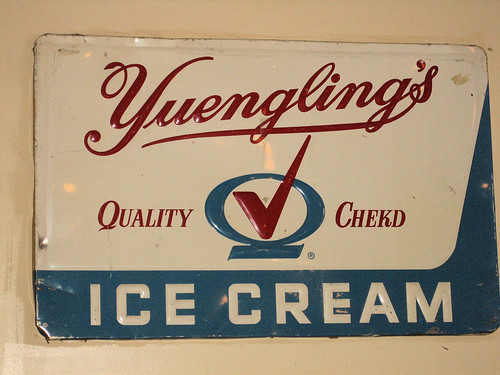
For example, Coors kilned high-tech ceramics; Yuengling churned ice cream.

Yuengling tin

But then the author, Libby Murphy, made this startling claim:
Unemployment soared after the breweries closed their doors. To make ends meet, many unemployed brewery employees turned to organized crime to keep food on the table, which, unsurprisingly, kept the underground liquor industry going stronger than ever.

Indeed, the record shows that bootlegging was rampant during Prohibition, but what is the source for Murphy's claim about law-breaking brewers? By "many," did she mean a plurality or a majority of brewers? Or did she merely assume that SOME brewery workers MIGHT have turned to organized crime? The word "many" certainly does not mean a few. This is so vague. She doesn't clarify.

As historian Maureen Ogle —author of Ambitious Brew: The Story of American Beer— told me:
Most breweries were long since out of business before Jan. 1, 1920. And companies that stayed open worked hard to keep employees in business (thus the efforts to diversify by, e.g., Yuengling, AB, Miller, etc. Did some [unemployed brewery employees turn to organized crime]? No doubt. Many? Doubtful.

Murphy's unemployment claim also seems suspect.

In 1919, when Prohibition was ratified, the unemployment rate sat at 2.3%. In 1921, a year after Prohibition had taken effect nationally, the rate did indeed jump dramatically, to 11.9%. But soon thereafter, it fell just as dramatically. In 1922, it was 7.6%; in 1926, 1.9%. The rate rose again, slightly, just before the Crash in late 1929, to 3.2%.

I found these data, with only a cursory web search, at the website for the National Bureau of Economic Research. Granted, the methodology and metrics of that era were most probably different than those of today. But the data do not support Murphy's claims.


Murphy has written a story of historical brewery interest, a feel-good story of American brewers, industrious under duress. When, in an offhand manner, she then placed those brewers' lawfulness in doubt, she should have provided proof. She didn't.

In the title to this post, I asked: Did American brewers really become gangsters during Prohibition? The answer: NOT PROVEN. Ms. Murphy has published an unfounded allegation.

-----more-----

Tuesday, April 07, 2015

Happy Days are Here Again!

"Pretty good. Not bad at all!"

Based upon an event that occured in the United States in 1933, many now celebrate 7 April as National Beer Day.

That day, after more than thirteen dry years of national Prohibition, the manufacturing, distribution, importation, and sale of beer again became legal in the United States.

Well, sort, of. There was a 'small' beer catch. Prohibition, per se, remained in effect.

The 18th Amendment to the Constitution never explicitly outlawed beer, wine, or liquor. Rather, it prohibited the "the manufacture, sale, or transportation of intoxicating liquors" [emphasis mine]. To define what that meant, Congress passed additional 'enabling' legislation, the principal bill of which was the National Prohibition Act (commonly known as the Volstead Act, after the Congressman who wrote it). In it, Congress defined "intoxicating liquors" as ANY beverages containing 0.5% alcohol-by-weight or more. All such beverages became illegal on 20 January 1920, the day the 18th Amendment took effect. 1

Thirteen-plus dry years later, Congress didn't actually legalize beer but, prodded by President Franklin D. Roosevelt, simply altered beer's parameters upward. (Roosevelt's campaign planks had included a promise to Repeal Prohibition.) The legislation it passed, the Cullen–Harrison Act, declared, in effect, that alcoholic beverages of up to 3.2% alcohol-by-weight (abw) —which is the equivalent of 4.05% alcohol-by-volume (abv)2— were now to be considered as "non-intoxicating"! On 22 March 1933, the president signed the bill into law, noting that "I think this would be a good time for a beer." The bill took effect two weeks later, on 7 April.

Unfortunately, stronger beers and alcoholic beverages remained prohibited. It wouldn't be until eight months later, on 5 December 1933, that a majority of states would approve the 21st Amendment, finally revoking federal Prohibition of most alcholic beverages.


So, it may have been 'small' beer poured and drunk across the nation on 7 April, but it was an all-day party that started (or at least legally started) at midnight. It's estimated that one and a half million barrels of beer were consumed that day.

Anheuser-Busch rushed a dray of its new team of Clydesdale horses to Washington, D.C. to deliver a just-bottled case of 4.05% Budweiser to President FDR at the White House. To their dismay, the drivers found that other breweries —including the Abner-Drury Brewing Company of Washington, D.C. and the Yuengling Brewery of Pottstown, Pennsylvania— had already been there, done that. A delicious defeat, especially considering future brewing history.

Shortly after midnight, a few miles to the north, Baltimore, Maryland's curmudgeonly scribe, H.L. Mencken, took his first legal sip of beer in thirteen years and un-petulantly declared it, "pretty good —not bad at all." And radio stations across the nation gleefully spun the hit song, Happy Days are Here Again.


So long sad times, so long bad times,
We are rid of you at last.
Howdy gay times! Cloudy gray times,
You are now a thing of the past.

Happy days are here again,
The skies above are clear again.
Let us sing a song of cheer again,
Happy days are here again.

All together, shout it now. There's no one
Who can doubt it now.
So let's tell the world about it now,
Happy days are here again.

Your cares and troubles are gone.
There'll be no more from now on.

Happy days are here again,
The skies above are clear again.
Let us sing a song of cheer again.
Happy days are here again!

Happy Days are Here Again
Milton Ager (music); Jack Yellen (lyrics). 1929.

-----more-----

Friday, December 05, 2008

75 years of "Iki Dugno" ... legally

An important anniversary slipped by relatively silently this year on the 14th of October.

On that day, 30 years ago in 1978, President Jimmy Carter signed into law House Resolution 1337 and Senate Amendment 3534. The brewing of beer had become legal at home.

But there is an even more historic anniversary this year.

In 1933, seventy-five years ago today on the 5th of December, the state of Utah voted to approve the 21st Amendment to the Constitution of the United States of America.

That vote terminated the nearly 14 year ignoble reign of the 18th Amendment, Prohibition. It had now become legal to manufacture, distribute, and sell alcoholic beverages, and by extension, to drink them. For the 14 years prior, the invitation, "Let's go have a beer!" had been an invitation to felony had not been possible.
25th Anniversary of Prohibition's repeal!Utah was the 36th out of 48 states to vote in favor, achieving the constitutionally required majority of 3/4 of the states. Some might find it ironic that Utah, of all states, would vote to allow alcohol. On closer examination, it may have been sagacious of that state, in light of its founders' tribulations, to repudiate Prohibition.

The 18th amendment is the ONLY amendment to have eradicated constitutional rights rather than granting them. By the adoption of the 21st Amendment, the 18th amendment is also the only amendment to have been wholly overturned by another.

It also might be possible that Utah's vote for the 21st Amendment may have been an attempt to right a wrong. Utah's yea vote, 14 years earlier on 16 January 1919, achieved the 3/4 majority to effectively ratify the 18th amendment, Prohibition.

By the way, on 4 December 1933, South Carolina voted against the 21st Amendment. It was the only state do have done so.

Chicagoland beer historian Bob Skilnik notes that

American voters, through state referendums, added the 21st Amendment to the Constitution of the United States. It was the first time in our history that a constitutional amendment was passed, not simply by the will of legislators, but instead through popular mandate, i.e., the power of the U.S. citizenry [and the only time].
More of Skilnik's history of the repeal, with an Illinois emphasis,
here.

Although the 21st Amendment lifted Prohibition nationally, it left open the possibility of local prohibition. It gave to the states the right to control the importation of alcohol within each state's own borders.

This is sometimes read as a partial trumping of the Commerce Clause (Article I, Section 8, Clause 3) of the 'un-amended' Constitution, which had given to Congress the ultimate right to regulate commerce. Recent rulings of the Supreme Court have challenged this interpretation, especially in regard to three-tier distribution issues.

Take a moment today to remember American folly and to thank American sagacity by hoisting a beer, sipping a whisky, or drinking a glass of wine. Say "Iki Dugno" [ICK ih DOOG (like took) nuh] ... legally toasting "down the hatch," in Lithuanian.

My last name is Cizauskas, after all.
  • Didn't the enactment of the Cullen-Harrison bill on 7 April 1933 legalize beer? Well, yes and no. Go here.
  • At the blog for the aptly named 21st Amendment Brewery, there's a concise analysis of how Prohibition could even have occured in the first place. Go here.
  • Advocating vigilance, David Turley at Musings Over A Pint has a summary of the efforts of latter day Prohibitionists. Go here.
  • The poster above (edited by me) is courtesy of the Brewers Association, an advocacy group for the small breweries of America. It has a posted a page on the Repeal of Prohibition. Go to www.75Yearsofbeer.org.
  • Posted as part of The Session: beer bloggers posting on identical topics on the first Friday of the month.

Wednesday, March 06, 2013

Washington D.C. Prohibition repealed!

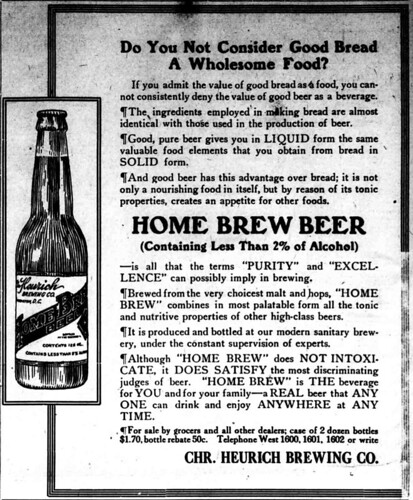
Heurich Wholesome Home Brew

An advertisement published in the Washington Herald on 7 February 1913, promoted Heurich Home Brew, a beer brewed by the Christian Heurich Brewing Company. At less than 2% alcohol-by-volume, this was pretty much a 'near beer,' and possibly a test of what the Washington, D.C., brewery might have to produce if Prohibition were ratified.

Which, regrettably, it was.

National Prohibition began on 17 January 1920, when the Eighteenth Amendment went into effect, and would continue through 5 December 1933, when it was repealed by the ratification of the Twenty-first Amendment, an interregnum that H.L. Mencken, Baltimore-based literary reporter/satirist, referred to as those "Thirteen Awful Years."

In Washington, D.C., it was even more awful.

There, local Prohibition had begun nearly three years earlier, when on 1 November 1917, Congress, under its Constitutional authority over the city, enacted the Sheppard Act, prohibiting the manufacture, distribution, and sale of intoxicating beverages within the District Of Columbia. Congress wouldn't repeal the city's Prohibition until 1 March 1934, three months after the rest of the nation.

However, although tardy, that repeal legislation would become a model for other jurisdictions in the U.S. on how to regulate, license, and control alcohol sales, as opposed to dispensing it directly.
In place of unfettered bootlegging would be alcohol licensing, regulation, taxation, and a control board. [Anti-Prohibition crusader] Rufus Lusk proposed a drinking age at eighteen, except for any alcohol with 14 per cent alcohol by volume, or higher, in which case you had to be twenty-one. It established licensing for bars, hotels, restaurants, and retail establishments to sell alcohol. ... Most states adopted similar licensing as they established Alcoholic Beverage Control (ABC) boards
Prohibition in Washington, DC: How Dry We Weren't. Garrett Peck.

How dry we were. How inchoate we remain.


-----more-----

Friday, January 17, 2020

The shameful occurrence one hundred years ago today, 17 January 1920.


One hundred years ago, today, the 18th Amendment to the United States Constitution took effect, on 17 January 1920.

Its issue, National Prohibition, would remain in effect for thirteen years. Beer, wine, and distilled spirits had become unconstitutional.

18th Amendment to the Constitution of the United States of America

Section 1. After one year from the ratification of this article the manufacture, sale, or transportation of intoxicating liquors within, the importation thereof into, or the exportation thereof from the United States and all the territory subject to the jurisdiction thereof for beverage purposes is hereby prohibited.

Section 2. The Congress and the several States shall have concurrent power to enforce this article by appropriate legislation.

Section 3.This article shall be inoperative unless it shall have been ratified as an amendment to the Constitution by the legislatures of the several States, as provided in the Constitution, within seven years from the date of the submission hereof to the States by the Congress.

Prohibition actually had passed a year earlier, on 16 January 1919, when the Nebraska legislature became the 36th state to approve the amendment, satisfying the Constitution's 2/3-of-the-states requirement. The amendment's wording mandated a year's delay until implementation. Praise be to the enlightened citizens of Connecticut and Rhode Island: their states were the only to vote nay.

To this day, the 18th Amendment remains the only amendment to the Constitution that eliminates rights. It did not, however, prohibit the drinking of "intoxicating beverages," 'merely' their manufacture, inter-state distribution, and sale. In its collective wisdom, Congress, authorized by section 2, defined an intoxicating beverage as anything containing in excess of one half of one percent alcohol by volume. That was, of course, just enough.

Prohibition would not be repealed until 5 December 1933, with the adoption of the superseding 21st Amendment.

Who or what was responsible? Distilling an answer might be reductive sociology, but four movers stand above the others: the alcohol industry itself, the Women's Christian Temperance Union, The Anti-Saloon League, and the 16th Amendment.

About the last, first. Since the Civil War, the federal government had been growing hand-in-hand with a bourgeoning population. Revenue from excise taxes and other fees had become insufficient. The 16th Amendment, ratified in 1916, constitutionalized the income tax, which up to that time, the Supreme Court had repeatedly disallowed. Its passage made excise taxes less integral. (Were that viewpoint as sanguine today!)

The temperance movement had been growing in strength for a hundred years, especially so in the early 20th-century. Its proponents laid crime, health problems, spousal abuse, and other social ills at the feet of the alcohol industry, which —with such as 'gin joints'— was far from blameless. And the beer industry, seeing beer as indeed the beverage of temperance —that is, not of prohibition but of moderation— did little, and too late, to stem the tide.

But maybe the arch-villain of the story is Wayne Wheeler, president of the Anti-Saloon League. Single-minded in his crusade against alcoholic beverages, Wheeler became, at one point, powerful enough to influence national elections. He was to alcohol as the virulently racist Harry Anslinger later was to marijuana.

The Woman's Christian Temperance Union continues today, albeit in more quiescent form. The Anti-Saloon League also survives, but now known more politely as the American Council on Alcohol Problems. And income tax? Well, you know that story.

-----more-----

Friday, December 05, 2014

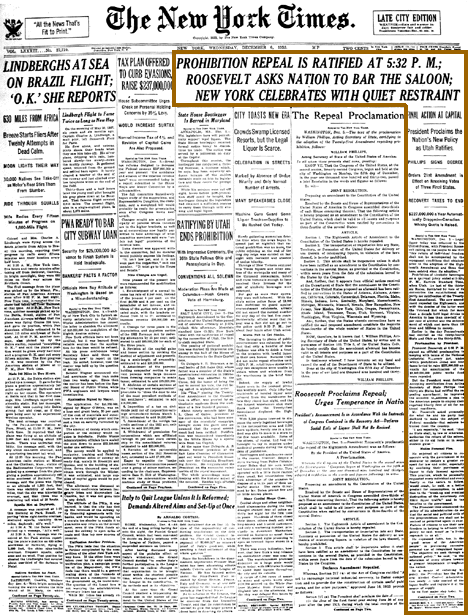
At 5:32 pm, Prohibition ended 81 years ago, today.

New York Times front page: 5 December 1933

Yesterday, eighty-one years ago, in 1933, the state of South Carolina voted against the 21st Amendment to the Constitution of the United States of America. Fortunately, it would be the only state to vote no, and to futile effect. *

The very next day, 5 December 1933, at 5:32 PM ET, the citizens of Utah would vote for ratification. Utah became the 36th State to do so, thus achieving the 3/4 majority of states' votes needed to enact the 21st Amendment, repealing the 18th Amendment and ending the nearly 14 year ignoble reign of Prohibition.

It had become legal, again, to manufacture, distribute, and sell alcoholic beverages ... if a state desired to do so. The 21st Amendment left to the states the right to control the importation, sale, and regulation of alcohol within each state's own borders. And, to this day, there remains a seemingly inchoate patchwork of state-by-state alcohol laws throughout the nation.

21st Amendment to the Constitution of the United States of America

Section 1. The eighteenth article of amendment to the Constitution of the United States is hereby repealed.

Section 2. The transportation or importation into any State, Territory, or possession of the United States for delivery or use therein of intoxicating liquors, in violation of the laws thereof, is hereby prohibited.

Section 3. This article shall be inoperative unless it shall have been ratified as an amendment to the Constitution by conventions in the several States, as provided in the Constitution, within seven years from the date of the submission hereof to the States by the Congress.

But in the capital of the United States: not so fast.

In his book, "Prohibition in Washington, D.C.: How Dry We Weren't", historian Garrett Peck observed that Congress wouldn't rescind Prohibition for Washington, D.C. until the following year, on 1 March 1934. Washington D.C.'s repeal legislation, although tardy, would become a template for other jurisdictions in the U.S. on how to regulate, license, and control alcohol sales, as opposed to dispensing it directly.

There's another unique facet to the 21st Amendment, as noted by beer historian Bob Skilnik
American voters, through state referendums, added the 21st Amendment to the Constitution of the United States. It was the first time in our history that a constitutional amendment was passed, not simply by the will of legislators, but instead through popular mandate, i.e., the power of the U.S. citizenry [and the only time].

Take a moment today to honor the sagacity of those Americans of eighty-one years ago. Hoist a beer, sip a whisky, drink a glass of wine. Legally.

-----more-----

Thursday, December 05, 2013

Eighty years of drink!

Yesterday, eighty years ago, in 1933, the state of South Carolina voted against enacting the 21st Amendment to the Constitution of the United States of America. Fortunately, South Carolina would be the only state to vote no, and to futile effect.

The very next day, 5 December 1933, at 5:32 PM ET, the state of Utah voted for ratification, becoming the 36th State to do so, and thus achieving the 3/4 majority of states' votes needed to enact the amendment.

With that vote, the nearly 14 year ignoble reign of that 18th Amendment, otherwise known as Prohibition, was ended. The 21st Amendment, in effect, repealed the 18th Amendment. As of today, eighty years ago, it had become legal, once again, to manufacture, distribute, and sell alcoholic beverages.

21st Amendment to the Constitution of the United States of America

Section 1. The eighteenth article of amendment to the Constitution of the United States is hereby repealed.

Section 2. The transportation or importation into any State, Territory, or possession of the United States for delivery or use therein of intoxicating liquors, in violation of the laws thereof, is hereby prohibited.

Section 3. This article shall be inoperative unless it shall have been ratified as an amendment to the Constitution by conventions in the several States, as provided in the Constitution, within seven years from the date of the submission hereof to the States by the Congress.

New York Times front page: 5 December 1933

Not so fast for the capital of the nation. In his book, "Prohibition in Washington, D.C.: How Dry We Weren't", historian Garrett Peck notes that Congress didn't rescind Prohibition in Washington, D.C. until 1 March 1934.

The 21st Amendment left to the states the right to control the importation, sale, and regulation of alcohol within each state's own borders. Washington D.C.'s repeal legislation, although tardy, would become a model for other jurisdictions in the U.S. on how to regulate, license, and control alcohol sales, as opposed to dispensing it directly. Despite that, to this day, there remains a seemingly inchoate patchwork of alcohol laws throughout the nation.

There's another unique facet of the 21st Amendment, noted by beer historian Bob Skilnik
American voters, through state referendums, added the 21st Amendment to the Constitution of the United States. It was the first time in our history that a constitutional amendment was passed, not simply by the will of legislators, but instead through popular mandate, i.e., the power of the U.S. citizenry [and the only time].

Take a moment today to honor the sagacity of those Americans of eighty years ago. Hoist a beer, sip a whisky, drink a glass of wine. Legally.

-----more-----

Saturday, January 16, 2016

A date in U.S. history that should live in ignominy.

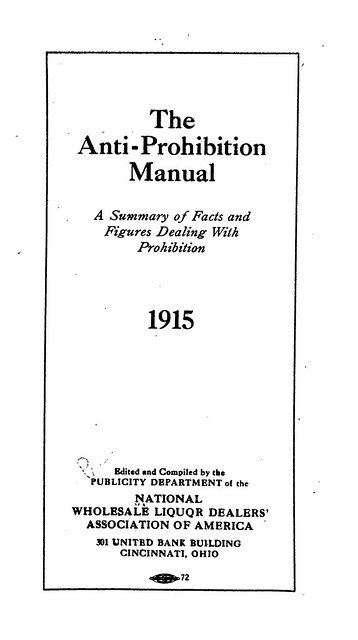
The Anti-Prohibition Manual (1915)
Our religion is based on freedom of choice. It is for us to decide choices bad or good, according to our definition of the same. Men and women cannot be legislated into Goodness nor into Salvation.

If we lose control of ourselves, the mind and body run riot. Self-control, combined with temperance in the individual, is the basis of society's moral success. Prohibition begins at the wrong end.

The Prohibitionist believes — “Law, then public sentiment”— whether or so. This is far from the idea of those who fought for us in 1776.
The National Wholesale Liquor Dealers' Association of America
Cincinnati, Ohio: 1915.

Despite their efforts, the National Wholesale Liquor Dealers' Association of America would prevail against neither "Goodness nor Salvation." National Prohibition, the 18th Amendment to the United States Constitution, was passed on 16 January 1919, and took effect a year and a day later, on 17 January 1920.


Anti-Saloon League paper, The American Issue

Decreeing alcolic beverages to be illegal nationwide*, the 18th Amendment has the ignominious distinction of being the only Constitutional amendment, among all twenty-seven approved, to deny rights rather than granting them.
Section 1. After one year from the ratification of this article the manufacture, sale, or transportation of intoxicating liquors within, the importation thereof into, or the exportation thereof from the United States and all the territory subject to the jurisdiction thereof for beverage purposes is hereby prohibited.

Section 2. The Congress and the several States shall have concurrent power to enforce this article by appropriate legislation.

Section 3. This article shall be inoperative unless it shall have been ratified as an amendment to the Constitution by the legislatures of the several States, as provided in the Constitution, within seven years from the date of the submission hereof to the States by the Congress.
Amendment XVIII
United States Constitution
National Archives

Prohibition would remain in effect for thirteen years, not repealed until 5 December 1933, with the passage of the superseding 21st Amendment.


How dry I am, how dry I am.
It's plain to see just why I am.
No alcohol in my highball
And that is why so dry I am.

Then have some Bevo.
Have a drink of Bevo.
It's the grandest imitation that we know.
If you care for beer, it's the drink you should pick.
It tastes like lager but it hasn't got the kick.

Bevo, have a drink of Bevo,
Though it hasn't got a punch up, it's sleeve-o.

How dry I am, how dry I am.
It's plain to see just why I am.
Oh, how I call for alcohol.
And that is why so dry I am.

-----more-----

Wednesday, November 03, 2010

That couldn't possibly happen again.

Ninety-four years and two days ago, 1 November 1916, the Commonwealth of Virginia went 'dry', enforcing statewide prohibition against the sale and importation of intoxicating beverages. The enabling legislation, the Mapp Act, prohibited all malt production, even of non-alcoholic beer, for sale in-state. Prohibition went national, nearly four years later, in January, 1920.

That couldn't possibly happen again, could it?

Keg boneyard


***************

Saturday, December 05, 2009

A Reason to Celebrate Today

On December 5, 1933, the State of Utah voted to approve the 21st Amendment to the Constitution of the United States of America. With that vote, the 18th Amendment —ignobly known as Prohibition— was repealed, and it had once again become legal in the United States to manufacture, distribute, and sell alcoholic beverages. That remains so today, 76 years later.

Section 1. The eighteenth article of amendment to the Constitution of the United States is hereby repealed.

Prohibition had lasted for nearly 14 years.

Utah was the 36th out of 48 states to vote in favor, achieving the constitutionally required majority of 3/4 of the states. Ten states (excluding Alaska and Hawaii, which weren't States at the time) either rejected the Amendment or failed to vote on it.

The 18th amendment is the only amendment to have eradicated constitutional rights rather than granting them. With the adoption of the 21st Amendment, the 18th also had become the only amendment to have been wholly overturned by another.

Beer historian Bob Skilnik notes that
American voters, through state referendums, added the 21st Amendment to the Constitution of the United States. It was the first time in our history that a constitutional amendment was passed, not simply by the will of legislators, but instead through popular mandate, i.e., the power of the U.S. citizenry [and the only time].

Although the 21st Amendment lifted national prohibition nationally, it left open the possibility of local prohibition. It gave to the states the right to control the importation of alcohol within each state's own borders. That's why there is such a patchwork of laws dealing with the distribution of alcohol state-by-state, and sometimes county-by-county.

Section 2. The transportation or importation into any State, Territory, or possession of the United States for delivery or use therein of intoxicating liquors, in violation of the laws thereof, is hereby prohibited.

Recent rulings of the Supreme Court have challenged the state's exclusive control over distribution, especially in regard to the so-called three-tier system.

Beer goggles

Take a moment today to remember American folly and to thank American sagacity. Then, enjoy your beer (or other preferred fermentable).

Didn't the enactment of the Cullen-Harrison bill on 7 April 1933 legalize beer? Well, yes and no. Go here.

Thursday, December 05, 2019

On this date in American history, it once again became legal to sell intoxicating beverages.

Prohibition Repealed!

A prohibitionist is the sort of man one couldn't care to drink with,
even if he drank.
— Henry Louis (H.L.) Mencken

Eighty-six years ago, today —on 5 December 1933 (at 5:32 pm ET)— the state of Utah voted to approve the 21st Amendment to the Constitution of the United States of America, its decision fulfilling the requisite number of states and thus terminating the ignoble, nearly 14-year reign, of the 18th Amendment, Prohibition.

Some might find it ironic that Utah of all states —with its widespread latter-day teetotalling— would vote to ALLOW alcohol. On closer examination, it may have been logically sagacious of that state to repudiate the 18th amendment, the ONLY amendment to eradicate constitutional rights rather than creating, affirming, or clarifying them.

After Utah's vote, two more states would vote to ratify. Six states (excluding Alaska and Hawaii, which were not states at that time) would never bother to vote on the amendment. But alone among all the states of the nation, only South Carolina, deserving of ignominy, voted against repeal.

-----more-----

Sunday, April 07, 2013

Beer be Free! (80 years ago, today)

In the 11th century, King Canute ordered the ocean's tide to retreat. It didn't.

In 1893, the Supreme Court ruled that a fruit was a vegetable. Nature stated otherwise.

And, on 7 April 1933 —80 years ago today— Congress, in its collective wisdom, decreed beer to be non-intoxicating... sort of.

The 18th Amendment to the U.S, Constitution —which was ratified on 16 January 1919— had prohibited the manufacture and sale of "intoxicating liquors ... for beverage purposes". The wording left it up to Congress to define "intoxicating". Congress did so later that year, via the Volstead Act, defining intoxicating as any beverage containing greater than 0.5% alcohol by weight (the equivalent of 0.634% by volume).


National Prohibition would go into effect the following year, in January 1920, and it would be a long, dry, thirteen years until Congress would pass the Cullen-Harrison Act on 19 March 1933. President Franklin D. Roosevelt, in keeping a campaign promise, signed the bill the next day, saying, "I think this would be a good time for a beer."

A few weeks later, on 7 April 1933, the bill went into effect, declaring, in effect, that alcoholic beverages of equal to or less than 3.2% alcohol-by-weight (4.05% by volume) were to be considered as "non-intoxicating", under the requirements of the 18th Amendment. Beer, of a weak sort, had become legal, even though Prohibition still remained in effect.

Family-owned F.X. Matt Brewing, of Utica, New York, would obtain the first brewery permit in the nation to sell beer. Another family-owned brewery Yuengling, of Pottsville, Pennsylvania, would deliver a case of beer to the President at the White House. And, throughout the nation, in celebration, 1.6 million barrels of beer would be consumed in a 24 hour period. If that had been just bottled beer - which it wasn't - the happy ruck would have consumed more than 529 million bottles of beer in one day.

Considering all that beer at the ready, a question begs to be asked. Since it had been illegal to brew beer before the stroke of midnight 7 April 1933, where had all that beer suddenly come from? Regardless, the day indeed was quite the national party, and contrary to the dire predictions of the 'drys,' relatively crime-free.

To be precise, it wouldn't be until nearly eight months later, on 5 December 1933, that the 21st Amendment would be ratified, repealing the 18th Amendment, and thus Prohibition. From that date on, beers of any strength, and wines and spirits, were allowed to be produced and sold, but only at the discretion of each state within its own borders.

Anchor Cue


Today, celebrate, yet be mindful of a milestone of U.S. beer history. Enjoy a beer brewed by an independent American brewery. You won't have to limit yourself to 3.2%.

-----more-----

Thursday, December 29, 2011

Cool Yule #5(b)! Beer Books for 2011: Brewing in Baltimore

Cool Yule! #5

Cool Yule! 12 Beer Books for 2011

Not a list of the dozen best-of-the-best books about beer of 2011, but, rather, my list of 12, some personal delights, others of unique or deserved merit. Some of the books have been published this year, while others are worthy chestnuts. I was planning to reveal my selections between 20 November and the Winter Solstice New Year's Eve. Now, I'll be posting my final choices in the new year. Delayed, but still valid.


So ... cue Five Go-old Rings.


Cool Yule Beer Book for 2011
#5(b)

Brewing in Baltimore

Brewing in Baltimore
(Images of America)
Maureen O'Prey
Paperback: 128 pages
Arcadia Publishing, 2011
ISBN-13: 978-0738588131

For Cool Yule beer book suggestion #5 (a), I reached out for fellow Virginia beer blogger Eric Delia, who reviewed the book, Richmond Beers. Staying regional, Brewing in Baltimore is a bookend to that.

***************

I recently read a review of George F. Kennan: An American Life, a biography of the creator of the U.S. Cold War containment of the Soviet Union strategy, by Yale historian John Lewis Gaddis. That does not have much to do with the book Brewing in Baltimore, except for this quote from the book concerning Kennan:
He saw what others saw but in different colors. . . . He had a historian’s consciousness of the past, which gave him a visionary’s perspective on the future.” That is as good as any description of an historian.

Author of Brewing in Baltimore, Maureen O'Prey is indeed an historian. She holds a Masters in Historical Studies from the University of Maryland, and is a professor of history at Baltimore City Community College, Maryland. And, she loves a good beer.

Author of "Brewing in Baltimore"

Ms. O'Prey began her research with Brewing in Maryland, a self-published book in the mid-1960s by William J. Kelley, a local beer aficionado and amateur historian. Then, serendipitously, Catherine Scott, the archivist of the Baltimore Museum of Industry alerted her to a treasure trove: original documents dating from the late 19th century of Baltimore Gas & Electric, then known as Consolidated Gas & Electric. Why would this be crucial? Because the breweries were among the first industries to switch from producing their own electricity with coal-fired generators to purchasing power. And Consolidated kept detailed records. Addresses, names, brewers, officers, equipment, production, energy requirements, photographs, etc.

From there, she found leather-bound ledgers for early 20th century breweries and one mini-conglomerate in Maryland. The latter failed, in part, because of local consumer antipathy. After repeal in the early 1930s, there were 75 breweries in Maryland; by the late 1980s only one, and that one just outside of Baltimore City. Support for local breweries had become severely diminished.

O'Prey lists the names and tells the stories in the roll of the departed Baltimore breweries: such as Maryland Brewing Company, Gottlieb, Free State, Bauerenschmidt, Globe, Arrow, American, and, of course, National (Natty Boh, hon!). She tells us that the company which almost single-handedly invented bottle enclosures as we know them today —Crown, Cork, and Seal— was a Baltimore company.

Ms. O'Prey has discovered another truly fascinating resource. As Prohibition would loom in the 1910s, the United States Brewers Association published several Anti-Prohibition Manuals. These snapshots into society at the time compared, for example, the relative lesser crime rate in a 'wet' state such as Maryland versus a dry state such as Kansas. Prohibition-backers, such as the Anti-Saloon League, would constantly tout the nirvana that would be achieved if alcohol were banned. These published statistics showed otherwise. Not enough folk listened: a cautionary tale in the face of today's neo-Prohibitionism?

There are no brewery recipes in the book. Ms. O'Prey laments that these may be permanently missing, or may require greater sleuthing to be unearthed. In the UK, brewing historians such as Ron Pattinson and Martyn Cornell have done yeoman work in doing just that. Like a zymurgic Jurassic Park, the recipes they are uncovering literally can be used to bring the efforts of those long-lost breweries back to life.

The publisher of Brewing in Baltimore is Arcadia, South Carolina-based. Its series Images of America consists of pictorial books of American history. The books re all exactly 128 pages, the areas they cover must only be cities or small regions or jurisdictions, and oddly enough, no footnotes or endnotes are permitted. Thus, Ms. O'Prey was limited to only Baltimore, and to a pre-determined format.

Despite the marvelous photographs on almost every page of Brewing in Baltimore, the life of the breweries is sometimes subsumed by the litany of names. Arcadia limits documentation to a bibliography. The format also denies room for more analysis into the reasons for success and ultimate failure. That WWII soldiers —who had been supplied weaker beers made possible by improving technologies such as canning— may have desired those less flavorful beers when they returned from the war-font is insufficient to hang a theory of the demise of smaller breweries making more flavorful beer.

Brewing in Baltimore concludes with a brief look at the brewing renaissance in Baltimore, the almost 25-year old microbrewery scene. (One of the pioneers of that movement, Hugh Sisson —the owner of Heavy Seas Brewing of Baltimore— wrote the forward to the book.)

Brewing in Baltimore is an entertaining and visually fascinating introduction to the rise, and crash, and re-birth of brewing in the city. It's a valuable lesson on what happened there (and elsewhere) and what could happen again, whether via neo-Prohibition or through neglect of local community support in the battle against larger, outside concerns.
The colorful history of brewing in Baltimore serves as both a reminder of the city's strong heritage and a testament to the craft brewing industry's ability to persevere with local support [emphasis mine], despite the odds.

Ms. O'Prey has plans to write a much more exhaustive history of brewing, not just of Baltimore, but of the entire state of Maryland: the full story of Maryland's breweries and brewers, their beers and recipes, and their economic and societal impact and legacy. With a historian's pride, she grins: "There'll be extensive footnotes!"

***************

Cool Yule for 2011, so far:
  • #5(a):Richmond Beers
  • #6: Under The Influence
  • #7: Designing Great Beers
  • #8: The Best of American Beer & Food
  • #9: Beer & Philosophy
  • #10: Evaluating Beer
  • #11: Windows on The World
  • #12: The Story of Brewing in Burton on Trent

***************
  • Maureen O'Prey will be signing copies of Brewing in Baltimore at Heavy Seas Brewing Company on Saturday, 17 January, between 11am and 5pm. Hugh Sisson will also be present for signing. Registration is required: here.
  • Follow more about the book on Twitter: @BrewBalt.
  • For on-line purchasing, I link to the Brewers Association book store, or to the marvelous resource, BeerBooks.com. When not available there, or if published as an ebook, I link to Amazon.com.
  • The 12 Books for Christmas 2009: here.

Monday, March 09, 2015

Session Beer Day returns 7 April 2015.

On 7 April 2015, celebrate Session Beer Day!

Some history, first.

7 April is the day, in 1933, that beer became legal again in the United States after thirteen years of Prohibition. Well, sort of.

On that day, the Beer and Wine Revenue Act went into effect, declaring, in effect, that alcoholic beverages of equal to or less than 3.2% alcohol-by-weight (4.05% by volume) were to be considered as "non-intoxicating" under the requirements of the 18th Amendment. Even though Prohibition still remained in effect, beer, of a 'session' sort, had become legal. (The passage of the 21st Amendment would finally repeal national Prohibition, a few months later, on 5 December 1933.)

Some more recent history.

In 2009, beer writer Lew Bryson 'formalized' his campaign to bring back American session beers —that is, well-flavored beers of less than 4.5% alcohol-by-volume— with his Session Beer Project blog.

Since then, he has asked brewers, pub owners, and good-beer drinkers to work toward the return of session beer to America. And, now, in 2015, he asks us to celebrate its return.

Session Beer Day_2015

Session Beer Day 2015 is on for April 7!

After several years of being on the cusp, of thinking 'okay, this is the year session beer goes mainstream!', we're here.

Almost every beer bar I walk into these days -- hell, here in Philly, almost any new bar I walk into -- has at least one session beer on tap. Every major brewer has a session beer in their portfolio (or comes grudgingly close). There are session beer events regularly, there are brewers who make only session beers, session beer has been recognized as one of the major trends in craft brewing.

We can do Session Beer Day right this year.


What is a session beer?

How to define a session beer is open to debate.

The Encyclopedia of Beer (1995) defines it as a beer a person can drink throughout the evening withot becoming inebriated.

Mr. Bryson pegs it as ...
... beers that are under 4.5% ABV, that are flavorful -- sorry, no mainstream light lagers need apply, that's just how it is. [...] It's a common taunt: "People who drink light beer don't really like beer; they just like to pee a lot." Well...if you're going out to drink beer, why get hammered on two or three huge beers? If you really like to drink beer, why not find a good, flavorful session beer and have five? I mean...if you like drinking beer, and the conviviality and social fun that goes with it, why not have a beer that lets you keep doing that longer?

I've read descriptions of 8% alcohol beers as 'sessionable.' Ha! To paraphrase former Supreme Court Justice Potter Stewart: "I know a session beer when I see it, and an 8% alcohol-by-volume beer is not that."

And, it's better not to ignore the vocal subset that disputes Mr. Byson's upper limit of 4.5% alcohol-by-volume (3.6% by weight), calling instead for one of 4.0% or less (3.2% by weight). Theirs is an argument historically accurate in terms of what happened in the U.S. in 1933 (and of beer history in 20th century Great Britain), but one that can be rendered moot by calling for a modern American session beer.
But insist on 4.5% or less. If it ain't significantly less, it ain't significant. We've watched "IPA" become an increasingly meaningless marketing term; even "craft beer" is being hollowed out by arguments over what is and what isn't. I welcome the discussion of whether session beer should be under 4.0%, but I dismiss the idea that it is under 5.0%. There's just not enough difference to be different there. If you want more on why, I've written plenty: have a look.

Even only a few years ago, Mr Bryson (and many of us session guerillas) would often be told that session beers would never work: 'craft' beer drinkers wanted bang for their bucks. My response has been: if alcohol is the goal, beer is a poor delivery system. Try Everclear, instead.

But shouldn't brewers be charging less for lower alcohol beers? No, says Mr. Bryson!
But we've had that discussion, and the truth is, lower alcohol beers don't really cost that much less to make or sell. Materials -- hops, malt, spices -- are only part of a beer's cost; there's energy, labor, transport, taxes, promotion, facility costs, debt service... If a pint of 4.5% pilsner is a good pint, a good-tasting beer, why should it be cheaper than a 6.5% IPA? Because it cost a nickel less to make? Or because it has less alcohol? I thought craft beer was all about flavor. If it's about the alcohol, well...why are you drinking it, again? Maybe you ought to think about that. In any case, I'd certainly encourage any brewpub operator or bar manager to think about dropping pints a buck just to encourage the multiple sales sessions are about, but it's not about session being a somehow "lesser" beer. We don't buy that, no matter what the price.


How to celebrate Session Beer Day

So let's do this.
  • Brewers, get your little beers ready.

  • Bars, get your little beers on. If you're a bar manager: please consider putting at least three beers on tap that are 4.5% or under. If you really want to support things, don't make them all "session IPA" choices; the Session Beer Project has always been about expanding choices. Lead, don't follow. Find something different, and reward it. If you have equipment for cask ale, by all means put the session beers on if possible; that's where they shine.

  • And the rest of us? Start asking if YOUR local is doing anything for Session Beer Day.
Start planning what you're going to do; get creative! If you've got good stuff, let me know! Tweet it up: #SessionBeerDay.

Get ready for OUR DAY. Session Beer Day. April 7. Dream Big for Small Beer!

So, what is Session Beer? Why, it's the one beer to have when you're having more than one! And, it's the one with Goldilocksian character: not flavor-hyped, but definitely not flavor-wanting. Just right.

Miller Lite fails the character test; Mild Ale, by contrast, doesn't.


-----more-----

Friday, January 15, 2010

Appreciate your tipple

2009.11_Pint of Rye at Sweetwater

Enjoy an 'adult' beverage tonight, and do so with poignant gusto. Remember that, on this day in 1920, it would be the last occasion for 13+ years before a US citizen could again legally enjoy an alcoholic beverage.

Prohibition —the 18th Amendment to the US Constitution— took effect on 16 January 1920. It would not be until 5 December 1933 that Prohibition would be repealed, by the 21st Amendment.

More posts here on Prohibition.

Saturday, April 24, 2010

Birthday in Beer: Bob Skilnik

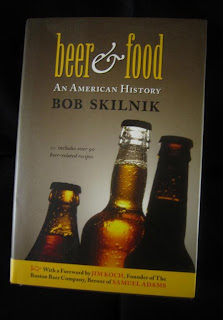
Today's Birthday in Beer belongs to Bob Skilnik, the author of Beer & Food: An American History. He's written a well-researched story of beer in America from Colonial days to the present, in which he places beer in context, connecting it with the nation's food and cuisine. The book is one part history, one part beer-as-ingredient cookbook, and one part beer myth exposé.

Beer & Food

Bob is definitely a beer curmudgeon; he delights in deflating beer myths. For example, from his blog, Beer (and more) in Food, you'll learn:
  • what Ben Franklin did NOT say about beer
  • the true history of Pilgrims and beer and the first Thanksgiving
  • how beer came to be available on the very day the manufacturing of 3.2% alcohol-by-weight beer became legal in 1933. 
The beer now available had been brewed under the old Prohibition formula for near beer. <...> This would explain how the brewers had hundreds of thousands of cases of beer ready for sale in such a short period of time. After all, old-time local brewers had been stating for decades that their beer required two months for lagering purposes. Despite the loud protests of local brewers, Chicagoans were getting a weakened version of the kind of beer they had drunk before Prohibition. City brewers continued to insist that their beer was up to government standards but week-end arrests for drunkenness indicated otherwise. Police records showed only 63 persons were charged with drunkenness on Saturday night in Chicago. This was about one-third of the normal arrest figures during a typical Prohibition-era week-end.

Bob is a young 72 today. His blog is subtitled  Beer: The Condiment With An Attitude!. That's appropriate.

**********************************
  • Bob is the author of Does My Butt look Big in This Beer, which lists nutritional analyses for 2,000 beers.
  • More of my short list of Birthdays in Beer: here.
  • Follow the Brookston Beer Bulletin's much more comprehensive calendar of beer birthdays. It's a marvelous resource for learning more about the folk who brew, deliver, and write and talk about beer.

Thursday, March 24, 2016

Saving Mr. Heurich's Lager

For much of the first half of the 20th century, the largest employer and largest property owner in Washington, D.C. —not called the United States government— was ... a brewery. But few D.C.-area 'craft' beer fans, today, know about this.

That may soon change. Here's how a homebrewer, a Washington, D.C. brewery, and a museum have resurrected a long-lost beer.

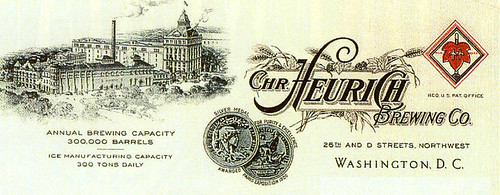
Christian Heurich Brewing Co.

Christian Heurich

In 1872, a young German immigrant named Christian Heurich arrived in Washington, D.C. He would soon purchase the Schnell Brewery and Tavern, at 20th and M streets NW, a small, struggling brewery that had opened during the Civil War in 1862, and whose brewmaster at the time was an African-American. Heurich enlarged the operations and renamed the brewery eponymously.


Fire was a constant threat at breweries before the widespread adoption of electricity and fire-retardent materials. And, indeed, a fire would devastate that facility. Heurich, undaunted, would build yet again, this time, a state-of-the-art concrete-and-steel brewery near 26th and D Streets NW, along the Potomac River, where the Kennedy Center now stands. Heurich would remain as active brewmaster until his death in 1945, at the age of 102. (Beer is good for you, anyone?)

There was one structure on the grounds, however, that was not fire-resistant: the building that housed all of the brewing records was built of wood. In 1935, it burned to the ground, destroying an entire history of brewing recipes and procedures. The rest of the brewery would continue operations until it was finally closed in 1956, with an annual capacity of over 500,000 barrels. The Christian Heurich Brewery had been the nation's capital's largest brewery, and it would be its last brewery, for decades.


The grandson

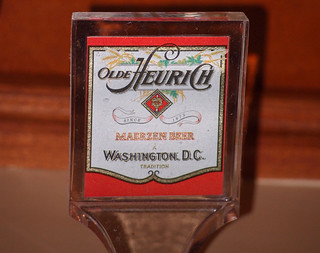
In 1986, thirty-years later, Christian Heurich's grandson, Gary Heurich, a successful Washington, D.C. real estate businessperson, revived the beers, if not using historic materials, at least designing the beers in the style of the original beer. He arranged to have the F.X. Matt Brewing Company (now popularly known as Saranac) in Utica, New York, contract brew Old Heurich beer. The Maerzen, and the later, Foggy Bottom brands, were, for a time, the de facto hometown D.C. beers.

Old Georgetown

In 2005, when professional baseball would return to Washington, D.C. after a thirty-one year hiatus, Olde Heurich had a prominent $750,000 concession on the main promenade of RFK Stadium. The venture, however, had been ahead of its time, and the following year, Gary Heurich ended its production.

Reviving Heurich


Archives and legacy

Fast forward to 2013.

Homebrewer Mike Stein, whose master's thesis involved brewing history, had been searching the National Archives for clues about the original Heurich's beers. He discovered, not recipes, but actual receipts of Heurich brewery transactions. Using those —and indeed surviving recipes of other U.S. breweries of the time— he and fellow homebrewers —Joshua H. Hubner and Pete Jones— created a recipe, and home-brewed it.

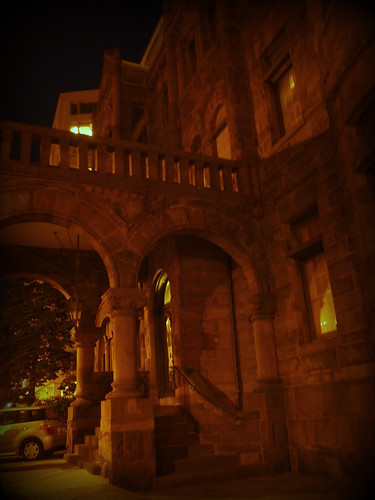
When the Christian Heurich Brewery closed, the family and operating board donated the extant Heurich family house, a Victorian-style mansion popularly known as the Brewmaster's Castle, at 22nd and M Streets NW, to the Historical Society of Washington, D.C.. Now a landmark on the National Register of Historic Places, the house was built in 1892 of poured concrete and reinforced steel, the city’s first fireproof house. In 2003, upkeep of the building was ceded to the non-profit Heurich House Museum,, which maintains it today.

Heurich House, by night

As kismet would have it, Stein was recreating Heurich's recipe, at the same time that Kim Bender, executive director of the Heurich House Museum, was looking for a brewing partner to recreate the beer of the namesake brewery. She and the Museum's board tasted his beer and enthusiastically approved. Local 'craft' brewery, DC Brau (itself the first production brewery in the city since Heurich's demise), scaled up the recipe, and brewed a small, one-off batch. Heurich's Lager debuted during DC Beer Week of that year.


Heurich's Lager returns

Thursday night, 24 March 2016, liquid history repeated itself.

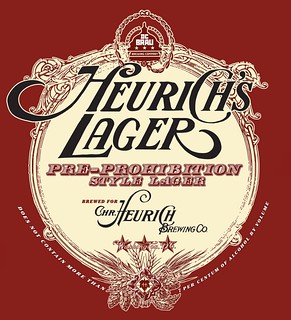
Heurich's Lager (label)

DC Brau has again brewed a small, thirty-barrel batch of Heurich's Lager. It will be released tonight at the Heurich House at a special celebration and fundraiser for the museum. After that, cans and kegs of the beer will be distributed throughout the city, while, as they say, supplies last.

What is the beer like? Jeff Hancock, DC Brau's brewmaster, filled me in on the details.

For this iteration, he turned to research by the late Professor George Fix. To a grist of Czech pilsner malted barley, Hancock added American flaked maize and rice. He infused the wort with Czech Žatec hops (known, in German, as Saaz: hops that Stein had determined to be in the original recipe) in the kettle, achieving about 40 International Bittering Units (IBUs). He fermented the result with a Bavarian-sourced yeast, and lagered —that is, stored cold— the finished beer for three weeks. (Lager is the German word "to store." Extensive lagering is an essential process for producing a traditional lager.) The beer was partially carbonated, also in the German-style, by closing the tank when fermentation was nearly concluded, trapping residual yeast-produced carbon dioxide. To get to the desired level of bubbles, he topped off the beer with additional CO2.

Hancock was enthusiastic about the results.

The alcohol level is about 7% by-volume, he told me. The beer appears light gold in color, with a crackly white head of foam. Filtered, it has a brilliant see-through clarity, just as contemporary reports had acclaimed Heurich's Lager of half-a-century-ago to appear. The flavor is medium-bodied and malt-accented, with floral and spicy hop characters, and sweet grain aromas. The corn, Hancock pointed out, added a depth of flavor, something he had anticipated from his research.


Praise the maize

For many years 'craft' beer drinkers have spurned beer made with corn, perhaps spurred on by the [U.S.] Brewers Association, which defined 'craft' beer, in part, by the absence of "adjuncts" such as corn. This amounted to blaming the ingredient rather than its misuse by macro-industrial breweries. Should Belgian beers be damned for use of brewing sugars? Should German hefeweizens be eschewed for use of wheat over barley? Many would disagree. Likewise, praise the maize: it has been a traditional ingredient in American beers, ales and lagers.

DC Brau has produced approximately 1,000 gallons of Heurich's Lager: half the run packaged in kegs, and the other half, about 150 cases, in 12-ounce aluminum cans. It'll be available at the DC Brau's tasting room, and in shops and pubs, but only in Washington, D.C. The label, based on a late 1930s design from the Heurich House archive, was created by artist Graham Jackson, who has designed other labels for DC Brau.

It's not much. Will there be another batch of Heurich's Lager? Maybe.

When the Christian Heurich Brewery ceased operations in 1956, its trademarks, through disuse, expired. Gary Heurich would trademark "Olde Heurich" and his own, "Foggy Bottom," but those rights have lapsed, as well. Today, the Heurich House has the trademarks to "Heurich's Lager," the "Christian Heurich Brewing Company," and "Senate Beer," another of the orignal brewery's brands. DC Brau paid Heurich House for one-time use of the rights to the first two, as a contribution, in kind, to the non-profit.


DC Brau expands

Part of the difficulty that small 'craft' breweries encounter when producing lagers is the lagering itself. Storing beer for weeks or months requires tank space, a precious commodity.

To that end, DC Brau is expanding. Founded five years ago (in fact, its first beers were released 15 April 2011), the brewery currently sells its beer in Washington, D.C. (of course), adjoining Virginia and Maryland, and New Jersey and Connecticut. Coming soon is a brewery expansion from 30,000 square feet to nearly 50,000, a doubling of its brew-length to sixty barrels, a new, state-of-the-art German-manufactured 4-vessel automated brewhouse, and a new canning line increasing packaging yield from the current 35 cans per minute to 250.

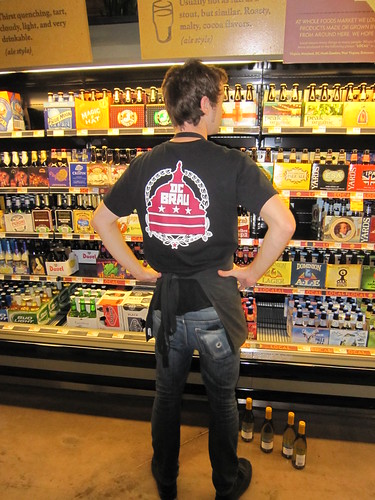
DC Brau tee

"Yes," Hancock told me. "More lagering capacity could be in the cards."


Craft Lager returns?

Prohibition came early to Washington, D.C.: it was established in the city, by Congress, in 1916, whereas, nationally, not until 1920. To his credit, Christian Heurich would survive that seventeen-year drought, and reestablish his brewery ... in his age 90s. In most other cities, Ms. Bender reminded me, a story like Heurich's would be remembered well, but in Washington, where history focuses on the federal side, there are large gaps in the narrative. The Heurich House is an intact Victorian-era house, the home of an important historical figure. The Heurich House Museum helps keep that story alive.

Are the lagers of pre and post Prohibition, returning into favor? In the end, should we think that beers like Heurich's might be the tip of an emerging 'craft' lager iceberg? As JP Williams, brewmaster of Van Trapp Brewing — a 'craft' brewery in Vermont (yes, Sound of Music Van Trapp)— was quoted, in the Winter 2016 issue of American Brewer:
A lot of people are getting over the idea that if the other person drinks an IPA, I should drink it as well. Pilsner will have a big renaissance, in my opinion.

But drinking your well-made 'craft' lager ice-cold, like a macro-lager swill? No, not so much. In his day, Brewmaster Heurich was known to warm his lager on a radiator to get it to that just right not-too-cold not-too-warm temperature. Just like a latter-day 'craft' IPA ... if not on a radiator.

Hancock told me that 'craft' beer drinkers have been calling the brewery since news of Heurich's Lager was first reported. "We thought you were the first brewery in D.C.," they've told him, confused. The history of beer in Washington, D.C., the history of 'craft' beer, the history of American beer: it's something that goes way back, and it's something we would all be well served to learn, and celebrate.

Thursday night, Heurich's Lager was re-released at the Heurich House, and, in Christian Heurich's honor, Ms. Bender promised that the Heurich House would "party like it's 1916."

-----more-----

Monday, November 08, 2010

Clamps & Gaskets: Roundup for 2010 Week 44

Clamps and Gaskets: weekly roundup
A non-comprehensive roundup of the week's news
of beer and other things.

Weeks 42/43
31 October 2010 - 6 November 2010

  • 2010.11.06
    There are 595 'citizen' beer logs (unaffiliated with a brewery or other business) in North America, according to the Beer Bloggers Conference. http://bit.ly/92C5OE
  • 2010.11.06
    Warren Buffett and Berkshire-Hathaway are in the beer and wine distribution business: http://nyti.ms/dnEBAU
  • 2010.11.06
    Magazine plagiarizes a blogger’s article; refuses to recognize copyright or give compensation. http://on.mash.to/bYCufl
  • 2010.11.05
    Keith Olbermann suspended from MSNBC for making political contributions. Twitter reacts. http://wapo.st/dwpWnc
  • 2010.11.05
    The Session: On the first Friday of each month, beer bloggers write on one topic. http://bit.ly/daClQh
  • 2010.11.05
    (Happy) Guy Fawkes Day! http://bit.ly/11CsUr
  • 2010.11.05
    Richmond (Virginia) Beer Week. http://bit.ly/dedJm5
  • 2010.11.05
    The 1st ever Beer Bloggers Conference, in Boulder, Colorado. http://bit.ly/ci2Vb1
  • 2010.11.04
    Questioning the legitimacy of 'craft' beer bloggers. http://bit.ly/dfIX2t
  • 2010.11.04
    Birthday in Beer: Alex Hall, USA cask ale maven. http://bit.ly/aWqpzp
  • 2010.11.04
    For chestnut lovers, now's the season. But why are most US chestnuts imported?http://wapo.st/8XOpkW
  • 2010.11.03
    John Hickenlooper -past owner of Wynkoop, Denver's original brewpub- is elected governor of Colorado. http://yhoo.it/d7QrkN

  • Barboursville at Shockoe Bottom
  • 2010.11.03
    Simply because a wine is locally produced is not grounds to assume it is inferior. http://wapo.st/ao0GmO
  • 2010.11.03
    (Possible) plans for northern Virginia real ale festival in April 2011. http://wapo.st/bwpfJg

  • Savor decor 2008
  • 2010.11.03
    The Brewers Association announces expansion of Savor in 2011 to two nights, June 3 & 4 at National Building Museum in Washington, D.C. Tickets on sale early March.
  • 2010.11.02
    California's measure to legalize marijuana, Prop 19, defeated. http://huff.to/9vpoTU
  • 2010.11.02
    Washington, D.C. voter uses a hand-stamp in an attempt to write in a candidate ... on a touch screen. http://bit.ly/bkd9gF
  • 2010.11.02
    Washington Post's Thomas Boswell on the San Francisco treat: Giants win first World Series since moving from New York in 1958. http://wapo.st/9KNudA

  • Alexandria VA brewery Portner's closed 31 Oct 1916
  • 2010.11.01
    Virginia went 'dry' on 1 November, 1916, enforcing statewide alcohol prohibition, nearly 4 years before National Prohibition. http://bit.ly/cr8jGf
  • 2010.11.01
    Happy World Vegan Day http://bit.ly/95NwcA ... and the first day of VeganMoFo: Vegan Month of Food blogging: http://bit.ly/co3KoG
  • 2010.10.31
    November is National Blog Posting Month http://bit.ly/dAEDY7
  • 2010.10.31
    I Am A Craft Brewer: A Parody: http://hops.me/ak

***************************
  • Clamps and Gaskets is a weekly wrap-up of stories  not posted at Yours For Good Fermentables.com. Most deal with beer (or wine, or whisky); some do not. But all are brief, and many are re-posts from my Twitter account: twitter.com/cizauskas.
  • The Clamps and Gaskets graphic was created by Mike Licht at NotionsCapital.