Showing posts with label prohibition. Show all posts

Friday, April 07, 2023

Happy National Beer Day, 2023!

Happy National Beer Day 2023!

7 April 2023: It's National Beer Day ... in the U.S., that is.

Then, again, is not every day, "beer day"? Ah, but there's more to the 90-year-old story. Read more at: YFGF.

***************

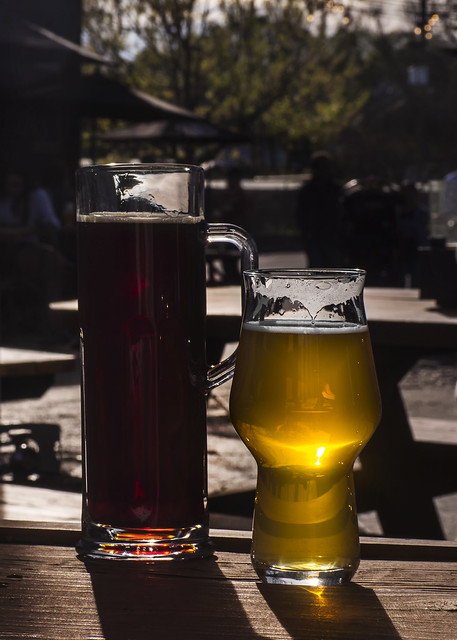
Now, as to those two lovelies...

  • Deathstill (left)
    • "German Style dopplebock." 8% alcohol-by-volume (abv).
    • In Dune —a series of science fiction novels (and films) by writer Frank Herbert and his estate— a deathstill is a "device used to extract all moisture from a living or dead human or creature. This is traditionally done to reclaim precious water from the dead, who no longer require it; but in Children of Dune the device is used as a method of execution."
  • A Night on Ponce (right)
    • "American IPA with Citra, Palisade, and Magnum hops." 7.5% alcohol-by-volume (abv).
    • Ponce de Leon Avenue is a major thoroughfare in Atlanta, named for the eponymous 16th-century Spanish conquistador, who searched for the legendary fountain of youth in Florida. Atlanta natives simply refer to the street as "Ponce."
Both beers brewed by Three Taverns Brewery, in Decatur, Georgia, USA. Both beers enjoyed, al fresco, on the brewery's beer patio, 11 March 2023.

A series of occasional reviews of beer (and wine and spirits).
No scores; only descriptions.

-----more-----

Sunday, December 05, 2021

Ignominy repealed

"Pretty good. Not bad at all!"

Happy Repeal Day!

Eight-eight years ago, today, on 5 December 1933, Utah became the 36th (of 48 states) to ratify the 21st Amendment (3/4 of all states are required by the Constitution to ratify an Amendment) thus nullifying the 18th Amendment and ending America's 13-year ignominious experiment with the Prohibition of alcohol.

Take a moment today to honor the sagacity of those Americans of eighty-eight years ago. Hoist a beer, sip a whisky, or drink a glass of wine. Legally.

Read more at YFGF: here.

-----more-----

Saturday, June 12, 2021

Pic(k) of the Week: 'Old-Fashioned' tacos

Old-Fashioned tacos

Cocktails and tacos!

Pop-up kitchen Mascogo Tacos 1 was cooking up their fare on 4 June 2021, outdoors on the 'whiskey patio,' at small Independent Distilling Company, in Decatur, Georgia, USA.

We were there; we ate; we drank. Pictured clockwise from top:
  • Old Fashioned cocktail 2
    Independent Distilling Hellbender Bourbon, demerara syrup, aromatic bitters, Regan's Orange Bitters, twists of lemon and orange.

  • Barbacoa taco
    Braised brisket cooked in smoked chilis, with spices, onions, cilantro.

  • Pollo con Chili Verde taco
    Hatch-chili-verde-stewed chicken breast, onions, cilantro, Cotija. 3

  • Los Cactus taco (partially obscured)
    marinated grilled cactus, onions, cilantro, charred tomato salsa, with/without Cotija.
"What's the cactus in the taco?" I asked Mascogo Tacos' chef, Craig L. Headspeth, "It's tasty." "There's only one edible cactus," he replied. "Prickly pear." 4 "Ah!"

I thanked him; the other half complimented him on the two meatier tacos. Thanks were also proffered to Independent's 'mixologist' Corey for the cocktail and to Michael Anderson, Independent's owner/distiller, for the Hellbender Bourbon, the first bourbon distilled in the Atlanta area since before Prohibition. That's one hundred-one years ago, in 1920(!), in case you're counting.

-----more-----

Saturday, April 24, 2021

Pic(k) of the Week: Let us pray

Let us pray

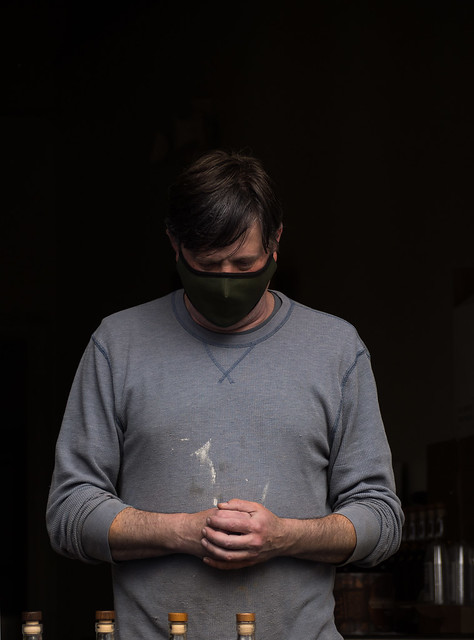
During a tour of Independent Distilling Company and a tasting of the company's spirits, owner/distiller Michael Anderson paused (as if in prayerful thanks).

Decatur (East Decatur Station), Georgia, USA. 26 March 2021.

***************

Et seq.

When Georgia repealed  Prohibition in the state in 1935, it forbade distilleries (and breweries) from selling their own products on-site. It wouldn't be until 1 September 2015 that Georgia’s distilleries (and breweries) were permitted to sell their products directly to consumer from their tasting rooms. But...

The law limited distilleries to offering only three, half-ounce samples of their spirits per person. And if a visitor wished to purchase a bottle of spirits, hey/she first had to pay for and attend a tour of the distillery (of course, equal to the retail cost of that bottle). Providing distillery guests with cocktails, however, remained strictly verboten. But...

Two years later, on 1 September 2017, Georgia removed blue law pretense. Now, distilleries can sell consumers up to three 750 ml bottles directly on its premises. Additionally, they can sell cocktails (of only their own house-produced liquor) and unlimited full-ounce samples to vistors to their facilities, without the pretense of a tour ticket. Topping it off, any distillery can sell up to five hundred 53-gallon barrels of its liquor per year on-site. That's 133,754 bottles of bourbon (or whatever the spirit may be)!

************

Ergo

In the photo above, Mr. Anderson may have been ruminating upon all that. That weekend, his small distillery was celebrating its 7th anniversary. But...

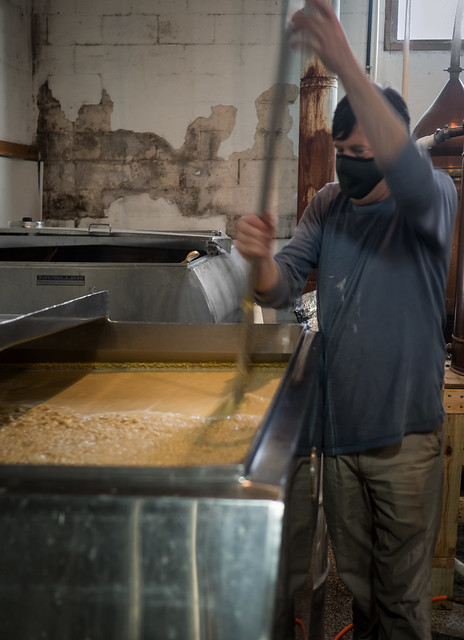
Even during a celebratory tour, his work was not done. Fermentum nunquam dormit! *

Stirring the wash


-----more-----
  • * Translated, from the Latin, as "yeast never sleeps." Amusingly, an alternate meaning of the word "fermentum" is "trouble." Thus, with poetic license, the phrase could be translated as "trouble is always brewing." Seems apt.

  • Pic(k) of the Week: one in a weekly series of images posted on Saturdays, occasionally (as is the case today) with a good fermentable as the subject.
  • Photo 17 of 52, for year 2021. See it on Flickr: here.
  • Camera: Olympus OM-D E-M10 II.
    • Lens: Olympus M.40-150mm F4.0-5.6 R
    • Settings: 123 mm | 1/250 | ISO 200 | f/5.3
  • Commercial reproduction requires explicit permission, as per Creative Commons.

  • For more from YFGF:

Saturday, December 05, 2020

Pic(k) of the Week: Delirium trashed!

Delirium trashed!

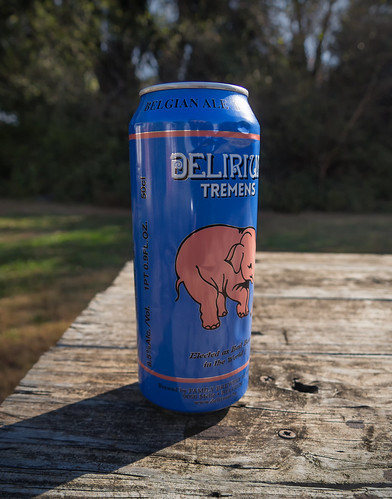
Just as Pabst Brewing continues to milk a blue ribbon it once received for its beer at a long-ago competition, the Huyge Brewery —located near Ghent, Belgium— touts its Delirium Tremens as the "best beer in the world" for one accolade it received in one competition in 2008.

The beer, named for symptoms brought on by alcohol withdrawal, is, fittingly, a strong beer, containing 9% alcohol. More importantly, how does the beer taste?

In his 2005 book, The Great Beers of Belgium, the late, great beer sage Michael Jackson described Delerium Tremens as:
Very bright [golden]. It has a dense head; a very fruity (greengage? gooseberry?) bouquet; a sweetish palate; and a lot of warming alcohol in an abrupt finish.

I didn't pose that empty beer can, by the way. It was already there, emptied of its contents, sitting on the picnic table, as I and the dog walked by on our morning constitutional. There must have been quite the beer party the day before.

-----more-----

Friday, January 17, 2020

The shameful occurrence one hundred years ago today, 17 January 1920.


One hundred years ago, today, the 18th Amendment to the United States Constitution took effect, on 17 January 1920.

Its issue, National Prohibition, would remain in effect for thirteen years. Beer, wine, and distilled spirits had become unconstitutional.

18th Amendment to the Constitution of the United States of America

Section 1. After one year from the ratification of this article the manufacture, sale, or transportation of intoxicating liquors within, the importation thereof into, or the exportation thereof from the United States and all the territory subject to the jurisdiction thereof for beverage purposes is hereby prohibited.

Section 2. The Congress and the several States shall have concurrent power to enforce this article by appropriate legislation.

Section 3.This article shall be inoperative unless it shall have been ratified as an amendment to the Constitution by the legislatures of the several States, as provided in the Constitution, within seven years from the date of the submission hereof to the States by the Congress.

Prohibition actually had passed a year earlier, on 16 January 1919, when the Nebraska legislature became the 36th state to approve the amendment, satisfying the Constitution's 2/3-of-the-states requirement. The amendment's wording mandated a year's delay until implementation. Praise be to the enlightened citizens of Connecticut and Rhode Island: their states were the only to vote nay.

To this day, the 18th Amendment remains the only amendment to the Constitution that eliminates rights. It did not, however, prohibit the drinking of "intoxicating beverages," 'merely' their manufacture, inter-state distribution, and sale. In its collective wisdom, Congress, authorized by section 2, defined an intoxicating beverage as anything containing in excess of one half of one percent alcohol by volume. That was, of course, just enough.

Prohibition would not be repealed until 5 December 1933, with the adoption of the superseding 21st Amendment.

Who or what was responsible? Distilling an answer might be reductive sociology, but four movers stand above the others: the alcohol industry itself, the Women's Christian Temperance Union, The Anti-Saloon League, and the 16th Amendment.

About the last, first. Since the Civil War, the federal government had been growing hand-in-hand with a bourgeoning population. Revenue from excise taxes and other fees had become insufficient. The 16th Amendment, ratified in 1916, constitutionalized the income tax, which up to that time, the Supreme Court had repeatedly disallowed. Its passage made excise taxes less integral. (Were that viewpoint as sanguine today!)

The temperance movement had been growing in strength for a hundred years, especially so in the early 20th-century. Its proponents laid crime, health problems, spousal abuse, and other social ills at the feet of the alcohol industry, which —with such as 'gin joints'— was far from blameless. And the beer industry, seeing beer as indeed the beverage of temperance —that is, not of prohibition but of moderation— did little, and too late, to stem the tide.

But maybe the arch-villain of the story is Wayne Wheeler, president of the Anti-Saloon League. Single-minded in his crusade against alcoholic beverages, Wheeler became, at one point, powerful enough to influence national elections. He was to alcohol as the virulently racist Harry Anslinger later was to marijuana.

The Woman's Christian Temperance Union continues today, albeit in more quiescent form. The Anti-Saloon League also survives, but now known more politely as the American Council on Alcohol Problems. And income tax? Well, you know that story.

-----more-----

Thursday, December 05, 2019

On this date in American history, it once again became legal to sell intoxicating beverages.

Prohibition Repealed!

A prohibitionist is the sort of man one couldn't care to drink with,
even if he drank.
— Henry Louis (H.L.) Mencken

Eighty-six years ago, today —on 5 December 1933 (at 5:32 pm ET)— the state of Utah voted to approve the 21st Amendment to the Constitution of the United States of America, its decision fulfilling the requisite number of states and thus terminating the ignoble, nearly 14-year reign, of the 18th Amendment, Prohibition.

Some might find it ironic that Utah of all states —with its widespread latter-day teetotalling— would vote to ALLOW alcohol. On closer examination, it may have been logically sagacious of that state to repudiate the 18th amendment, the ONLY amendment to eradicate constitutional rights rather than creating, affirming, or clarifying them.

After Utah's vote, two more states would vote to ratify. Six states (excluding Alaska and Hawaii, which were not states at that time) would never bother to vote on the amendment. But alone among all the states of the nation, only South Carolina, deserving of ignominy, voted against repeal.

-----more-----

Wednesday, November 01, 2017

Virginia bans alcohol.

101 years ago, today, on 1 November 1916, the Mapp Act became law in Virginia: alcoholic beverages were prohibite and the entire state went dry. For the rest of the country, National Prohibition —under the 18th Amendment to the Constitution— would not take effect until 17 January 1920.

Although Virginia established statewide prohibition through a popular referendum, it nonetheless faced several challenges in enforcing the new law. Its long coastline made it difficult to prevent smuggling, i.e. rum-running. It bordered on a wet state, Maryland, which made barely an effort to enforce national dry laws from 1920-1933. Virginia contained several cities which were reluctantly dry, most notably Alexandria, Richmond, and Norfolk. In addition, Virginia had a long-established moonshining tradition in the mountainous western part of the state. As a result, Virginia struggled to live up to the dry ideal it set for itself in 1916.

[...] The referendum on state-wide prohibition [with two simple choices, “For State-Wide Prohibition” and “Against State-Wide Prohibition”] passed, on 2 September 1914 by a vote of 94,251 in favor and 63,886 opposed. Of Virginia’s 100 counties, 71 voted in favor of prohibition. Eight of the ten congressional districts went dry, and one of the remaining two was wet by only ten votes. Surprisingly, sixteen of the state’s twenty cities also voted in favor of going dry. Traditionally cities were strongholds of wet votes. However, only Arlington, Norfolk, Williamsburg, and Richmond stayed wet.Accordingly, following the referendum, the Virginia legislature quickly passed a prohibition law, called the Mapp Law after state Senator Walter Mapp of Accomack County, making the entire state dry as of midnight, the morning of November 1, 1916. [...]The Mapp law defined “ardent spirits” as “alcohol, brandy, whiskey, rum, gin, wine, porter, ale, beer, all malt liquors, absinthe, and all compounds or mixtures of any of them.” The phrase “all malt liquors” was worded to include both intoxicating and non-intoxicating drinks made of malt.

The new dry law closed numerous distillers, six breweries, as well as several hundred saloons, in addition to taking away business from bottling companies and distributors. Breweries and distillers were allowed to stay in business so long as they sold their product out of state. Five of the six Virginia breweries stayed open until 1918. Only Robert Portner’s in Alexandria closed immediately.

[...] Virginia shares the Chesapeake Bay with Maryland, and the bay seemed as if it were designed for smuggling with its many small islands, coves and inlets. Norfolk had been wet during the referendum and remained a popular spot for smugglers to import alcohol. Finally, Virginia had a long-standing tradition of moonshining, especially in the western mountains, an area which traditionally resented Richmond’s control. Moonshiners found that prohibition furnished an even larger market for their product.
—Mark Benbow of RustyCans.org, as published in the winter 2010-2011 issue of Brewery History

Seventeen years later, on 3 October 1933, Virginia voters would vote to end statewide prohibition. A few weeks later, on 25 October, a state convention would ratify the 21st amendment to the U.S. Constitution, repealing Prohibition, making Virginia the 32d state to do so. The amendment would take effect less than two months later, on 5 December. A few months after that, on 7 March 1934, Virginia's Department of Alcoholic Beverage Control would be established.

And so it goes.

-----more-----

Wednesday, December 07, 2016

Did American brewers really become gangsters during Prohibition?


Earlier this week, America noted the 83rd anniversary of the repeal of Prohibition. Craft Beer & Brewing Magazine marked the occasion with a short, well-intentioned piece on "Industries That Breweries Turned to During Prohibition."

The story began promisingly, if somewhat overwrought:
While the craft-beer industry is full of talented up-and-comers, there are a handful of breweries who survived one of the darkest—and supposedly driest—eras in the American brewing industry: Prohibition. The Temperance Movement sought to crack down on all the booze-guzzling heathens, and while pointing at the alcohol industry with one hand and clutching their pearls in the other, they shut the industry down. [...] But with a little ingenuity—and a whole lot of luck—some breweries survived. Many of them are thriving today, and so are some of their Prohibition side projects.

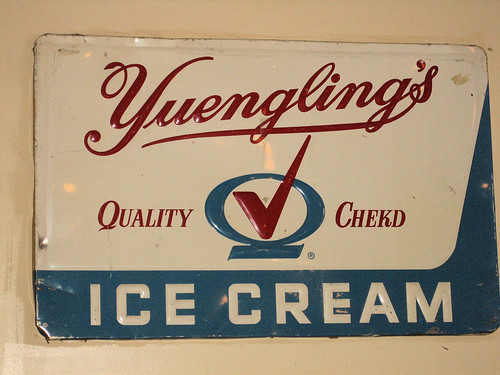
For example, Coors kilned high-tech ceramics; Yuengling churned ice cream.

Yuengling tin

But then the author, Libby Murphy, made this startling claim:
Unemployment soared after the breweries closed their doors. To make ends meet, many unemployed brewery employees turned to organized crime to keep food on the table, which, unsurprisingly, kept the underground liquor industry going stronger than ever.

Indeed, the record shows that bootlegging was rampant during Prohibition, but what is the source for Murphy's claim about law-breaking brewers? By "many," did she mean a plurality or a majority of brewers? Or did she merely assume that SOME brewery workers MIGHT have turned to organized crime? The word "many" certainly does not mean a few. This is so vague. She doesn't clarify.

As historian Maureen Ogle —author of Ambitious Brew: The Story of American Beer— told me:
Most breweries were long since out of business before Jan. 1, 1920. And companies that stayed open worked hard to keep employees in business (thus the efforts to diversify by, e.g., Yuengling, AB, Miller, etc. Did some [unemployed brewery employees turn to organized crime]? No doubt. Many? Doubtful.

Murphy's unemployment claim also seems suspect.

In 1919, when Prohibition was ratified, the unemployment rate sat at 2.3%. In 1921, a year after Prohibition had taken effect nationally, the rate did indeed jump dramatically, to 11.9%. But soon thereafter, it fell just as dramatically. In 1922, it was 7.6%; in 1926, 1.9%. The rate rose again, slightly, just before the Crash in late 1929, to 3.2%.

I found these data, with only a cursory web search, at the website for the National Bureau of Economic Research. Granted, the methodology and metrics of that era were most probably different than those of today. But the data do not support Murphy's claims.


Murphy has written a story of historical brewery interest, a feel-good story of American brewers, industrious under duress. When, in an offhand manner, she then placed those brewers' lawfulness in doubt, she should have provided proof. She didn't.

In the title to this post, I asked: Did American brewers really become gangsters during Prohibition? The answer: NOT PROVEN. Ms. Murphy has published an unfounded allegation.

-----more-----

Thursday, April 07, 2016

7 April: today and in history.

Session Beer Day: 7 April!
  • Today, today:
    Happy Session Beer Day!
    Beer writer Lew Bryson's campaign to bring back 'session' beer, because a beer doesn't have to be big to be bold.
  • Today, in history:
    Happy National Beer Day!
    And, no! Prohibition did not end on this day in 1933.

  • Today, in greatness:
    Happy birthday, Lady Day!
    Musical genius, the beautiful, incomparable Billie Holiday (April 7, 1915 - July 17, 1959) would have been 101 today.
    Billie Holiday (”Lady Day”) is considered by many to be the greatest of all jazz singers. In a tragically abbreviated singing career that lasted less than three decades, her evocative phrasing and poignant delivery profoundly influenced vocalists who followed her. Although her warm, feathery voice inhabited a limited range, she used it like an accomplished jazz instrumentalist, stretching and condensing phrases in an ever-shifting dialogue with accompanying musicians. Famous for delivering lyrics a bit behind the beat, she alternately endowed them with sadness, sensuality, languor, and irony.


-----more-----

Saturday, January 16, 2016

A date in U.S. history that should live in ignominy.

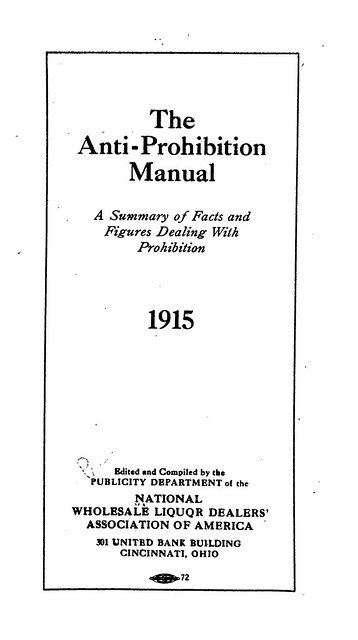
The Anti-Prohibition Manual (1915)
Our religion is based on freedom of choice. It is for us to decide choices bad or good, according to our definition of the same. Men and women cannot be legislated into Goodness nor into Salvation.

If we lose control of ourselves, the mind and body run riot. Self-control, combined with temperance in the individual, is the basis of society's moral success. Prohibition begins at the wrong end.

The Prohibitionist believes — “Law, then public sentiment”— whether or so. This is far from the idea of those who fought for us in 1776.
The National Wholesale Liquor Dealers' Association of America
Cincinnati, Ohio: 1915.

Despite their efforts, the National Wholesale Liquor Dealers' Association of America would prevail against neither "Goodness nor Salvation." National Prohibition, the 18th Amendment to the United States Constitution, was passed on 16 January 1919, and took effect a year and a day later, on 17 January 1920.


Anti-Saloon League paper, The American Issue

Decreeing alcolic beverages to be illegal nationwide*, the 18th Amendment has the ignominious distinction of being the only Constitutional amendment, among all twenty-seven approved, to deny rights rather than granting them.
Section 1. After one year from the ratification of this article the manufacture, sale, or transportation of intoxicating liquors within, the importation thereof into, or the exportation thereof from the United States and all the territory subject to the jurisdiction thereof for beverage purposes is hereby prohibited.

Section 2. The Congress and the several States shall have concurrent power to enforce this article by appropriate legislation.

Section 3. This article shall be inoperative unless it shall have been ratified as an amendment to the Constitution by the legislatures of the several States, as provided in the Constitution, within seven years from the date of the submission hereof to the States by the Congress.
Amendment XVIII
United States Constitution
National Archives

Prohibition would remain in effect for thirteen years, not repealed until 5 December 1933, with the passage of the superseding 21st Amendment.


How dry I am, how dry I am.
It's plain to see just why I am.
No alcohol in my highball
And that is why so dry I am.

Then have some Bevo.
Have a drink of Bevo.
It's the grandest imitation that we know.
If you care for beer, it's the drink you should pick.
It tastes like lager but it hasn't got the kick.

Bevo, have a drink of Bevo,
Though it hasn't got a punch up, it's sleeve-o.

How dry I am, how dry I am.
It's plain to see just why I am.
Oh, how I call for alcohol.
And that is why so dry I am.

-----more-----

Wednesday, October 14, 2015

What will President Jimmy Carter be remembered for?

It was an important day for 'craft' beer on 14 October 1978. Back then 'craft' beer wasn't known as 'craft' beer. In fact, it only barely existed. America was awash in American 'light' lagers.

That 'craft' beer exists -- and thrives-- today, you should first thank President Jimmy Carter for what he did on that day.

When Prohibition was repealed in 1933, lawmakers decided to again permit citizens to produce small amounts of wine and beer at home. However, due to a stenographer's error, the 1933 law failed to include beer, and, for the next forty-four years, the insalubrious omission stood as law. No congressperson believed it politically expedient to demand the right of his or her constituents to brew beer at home. As late as the 1970s, the federal penalty for home brewing was as much as five years in prison or a $10,000 fine.

That is, until January 1977, when Barber Conable, a House of Representatives Republican from New York, would introduce bill HR 2028. Alan Cranston, a Democrat from California, introduced a similar bill in the Senate, along with Senate co-sponsors former NASA astronaut Senator Harrison Schmitt (R) of New Mexico (R), Senator Dale Bumpers (D) of Arkansas, and Senator Mike Gravel (D) of Alaska.

The next year, 1978, these bills would become House Resolution 1337 and Senate Amendment 3534. And, on 14 October 1978, President Jimmy Carter would sign the combined bill into law, putting beer-making at home on the same legal footing as wine-making at home.


The law took effect a few months later, on 1 February 1979, but even so, it did not actually legalize homebrewing. Rather, it revoked the federal excise tax on homebrew, for up to one-hundred gallons per adult per year and a total of two-hundred gallons per household per year. (Two-hundred gallons is the approximate equivalent of eighty-nine cases of beer.) Actual legalization —the right to brew at home without fear of the police knocking at your door— would require state-by-state approval, as provided under the 21st Amendment to the Constitution.

Several states acted quickly; several did not. It would take until May 2013, for homebrewing to be legal in all fifty states, when Alabama (and Mississippi just preceding it) approved.

In the 1970s and 80s, there was a strong correlation between homebrewing and 'craft' brewing, with former homebrewers (some possibly benignly illicit, others, later and legal) going on to become brewers and owners at the few, new, microbreweries —what 'craft' breweries were then called. 1. In fact, in 1978, when Carter lifted the homebrewing restrictions, there was only one microbrewery in the U.S., New Albion Brewing, in California. (Or two. 2) There, Jack McAuliffe would brew an ale with a hop that had been released only five years earlier, Cascades, whose 'grapefruity' flavor quickly became the hallmark of the American Pale Ale style. In 1981, two homebrewers, Paul Camusi and Ken Grossman, opened their microbrewery, the Sierra Nevada Brewing Company, and the microbrewery movement had begun in earnest.

Nearly four decades later, homebrewing and 'craft' beer again seem to be dancing partners. As the number of breweries in the U.S has surpassed 4,000, homebrewers are the driving force behind many of those small and very-small breweries opening at the rate of almost two per day.

Here's the late, great 'Beer Hunter', beer writer Michael Jackson, as recorded in 2004, reminiscing, with wry wit, on that important legal change, and the significance of homebrewing in America.


Enjoying that 'craft' beer you're drinking today? Thank a homebrewer; and thank President Jimmy Carter.

-----more-----

Tuesday, April 07, 2015

Happy Days are Here Again!

"Pretty good. Not bad at all!"

Based upon an event that occured in the United States in 1933, many now celebrate 7 April as National Beer Day.

That day, after more than thirteen dry years of national Prohibition, the manufacturing, distribution, importation, and sale of beer again became legal in the United States.

Well, sort, of. There was a 'small' beer catch. Prohibition, per se, remained in effect.

The 18th Amendment to the Constitution never explicitly outlawed beer, wine, or liquor. Rather, it prohibited the "the manufacture, sale, or transportation of intoxicating liquors" [emphasis mine]. To define what that meant, Congress passed additional 'enabling' legislation, the principal bill of which was the National Prohibition Act (commonly known as the Volstead Act, after the Congressman who wrote it). In it, Congress defined "intoxicating liquors" as ANY beverages containing 0.5% alcohol-by-weight or more. All such beverages became illegal on 20 January 1920, the day the 18th Amendment took effect. 1

Thirteen-plus dry years later, Congress didn't actually legalize beer but, prodded by President Franklin D. Roosevelt, simply altered beer's parameters upward. (Roosevelt's campaign planks had included a promise to Repeal Prohibition.) The legislation it passed, the Cullen–Harrison Act, declared, in effect, that alcoholic beverages of up to 3.2% alcohol-by-weight (abw) —which is the equivalent of 4.05% alcohol-by-volume (abv)2— were now to be considered as "non-intoxicating"! On 22 March 1933, the president signed the bill into law, noting that "I think this would be a good time for a beer." The bill took effect two weeks later, on 7 April.

Unfortunately, stronger beers and alcoholic beverages remained prohibited. It wouldn't be until eight months later, on 5 December 1933, that a majority of states would approve the 21st Amendment, finally revoking federal Prohibition of most alcholic beverages.


So, it may have been 'small' beer poured and drunk across the nation on 7 April, but it was an all-day party that started (or at least legally started) at midnight. It's estimated that one and a half million barrels of beer were consumed that day.

Anheuser-Busch rushed a dray of its new team of Clydesdale horses to Washington, D.C. to deliver a just-bottled case of 4.05% Budweiser to President FDR at the White House. To their dismay, the drivers found that other breweries —including the Abner-Drury Brewing Company of Washington, D.C. and the Yuengling Brewery of Pottstown, Pennsylvania— had already been there, done that. A delicious defeat, especially considering future brewing history.

Shortly after midnight, a few miles to the north, Baltimore, Maryland's curmudgeonly scribe, H.L. Mencken, took his first legal sip of beer in thirteen years and un-petulantly declared it, "pretty good —not bad at all." And radio stations across the nation gleefully spun the hit song, Happy Days are Here Again.


So long sad times, so long bad times,
We are rid of you at last.
Howdy gay times! Cloudy gray times,
You are now a thing of the past.

Happy days are here again,
The skies above are clear again.
Let us sing a song of cheer again,
Happy days are here again.

All together, shout it now. There's no one
Who can doubt it now.
So let's tell the world about it now,
Happy days are here again.

Your cares and troubles are gone.
There'll be no more from now on.

Happy days are here again,
The skies above are clear again.
Let us sing a song of cheer again.
Happy days are here again!

Happy Days are Here Again
Milton Ager (music); Jack Yellen (lyrics). 1929.

-----more-----

Monday, March 09, 2015

Session Beer Day returns 7 April 2015.

On 7 April 2015, celebrate Session Beer Day!

Some history, first.

7 April is the day, in 1933, that beer became legal again in the United States after thirteen years of Prohibition. Well, sort of.

On that day, the Beer and Wine Revenue Act went into effect, declaring, in effect, that alcoholic beverages of equal to or less than 3.2% alcohol-by-weight (4.05% by volume) were to be considered as "non-intoxicating" under the requirements of the 18th Amendment. Even though Prohibition still remained in effect, beer, of a 'session' sort, had become legal. (The passage of the 21st Amendment would finally repeal national Prohibition, a few months later, on 5 December 1933.)

Some more recent history.

In 2009, beer writer Lew Bryson 'formalized' his campaign to bring back American session beers —that is, well-flavored beers of less than 4.5% alcohol-by-volume— with his Session Beer Project blog.

Since then, he has asked brewers, pub owners, and good-beer drinkers to work toward the return of session beer to America. And, now, in 2015, he asks us to celebrate its return.

Session Beer Day_2015

Session Beer Day 2015 is on for April 7!

After several years of being on the cusp, of thinking 'okay, this is the year session beer goes mainstream!', we're here.

Almost every beer bar I walk into these days -- hell, here in Philly, almost any new bar I walk into -- has at least one session beer on tap. Every major brewer has a session beer in their portfolio (or comes grudgingly close). There are session beer events regularly, there are brewers who make only session beers, session beer has been recognized as one of the major trends in craft brewing.

We can do Session Beer Day right this year.


What is a session beer?

How to define a session beer is open to debate.

The Encyclopedia of Beer (1995) defines it as a beer a person can drink throughout the evening withot becoming inebriated.

Mr. Bryson pegs it as ...
... beers that are under 4.5% ABV, that are flavorful -- sorry, no mainstream light lagers need apply, that's just how it is. [...] It's a common taunt: "People who drink light beer don't really like beer; they just like to pee a lot." Well...if you're going out to drink beer, why get hammered on two or three huge beers? If you really like to drink beer, why not find a good, flavorful session beer and have five? I mean...if you like drinking beer, and the conviviality and social fun that goes with it, why not have a beer that lets you keep doing that longer?

I've read descriptions of 8% alcohol beers as 'sessionable.' Ha! To paraphrase former Supreme Court Justice Potter Stewart: "I know a session beer when I see it, and an 8% alcohol-by-volume beer is not that."

And, it's better not to ignore the vocal subset that disputes Mr. Byson's upper limit of 4.5% alcohol-by-volume (3.6% by weight), calling instead for one of 4.0% or less (3.2% by weight). Theirs is an argument historically accurate in terms of what happened in the U.S. in 1933 (and of beer history in 20th century Great Britain), but one that can be rendered moot by calling for a modern American session beer.
But insist on 4.5% or less. If it ain't significantly less, it ain't significant. We've watched "IPA" become an increasingly meaningless marketing term; even "craft beer" is being hollowed out by arguments over what is and what isn't. I welcome the discussion of whether session beer should be under 4.0%, but I dismiss the idea that it is under 5.0%. There's just not enough difference to be different there. If you want more on why, I've written plenty: have a look.

Even only a few years ago, Mr Bryson (and many of us session guerillas) would often be told that session beers would never work: 'craft' beer drinkers wanted bang for their bucks. My response has been: if alcohol is the goal, beer is a poor delivery system. Try Everclear, instead.

But shouldn't brewers be charging less for lower alcohol beers? No, says Mr. Bryson!
But we've had that discussion, and the truth is, lower alcohol beers don't really cost that much less to make or sell. Materials -- hops, malt, spices -- are only part of a beer's cost; there's energy, labor, transport, taxes, promotion, facility costs, debt service... If a pint of 4.5% pilsner is a good pint, a good-tasting beer, why should it be cheaper than a 6.5% IPA? Because it cost a nickel less to make? Or because it has less alcohol? I thought craft beer was all about flavor. If it's about the alcohol, well...why are you drinking it, again? Maybe you ought to think about that. In any case, I'd certainly encourage any brewpub operator or bar manager to think about dropping pints a buck just to encourage the multiple sales sessions are about, but it's not about session being a somehow "lesser" beer. We don't buy that, no matter what the price.


How to celebrate Session Beer Day

So let's do this.
  • Brewers, get your little beers ready.

  • Bars, get your little beers on. If you're a bar manager: please consider putting at least three beers on tap that are 4.5% or under. If you really want to support things, don't make them all "session IPA" choices; the Session Beer Project has always been about expanding choices. Lead, don't follow. Find something different, and reward it. If you have equipment for cask ale, by all means put the session beers on if possible; that's where they shine.

  • And the rest of us? Start asking if YOUR local is doing anything for Session Beer Day.
Start planning what you're going to do; get creative! If you've got good stuff, let me know! Tweet it up: #SessionBeerDay.

Get ready for OUR DAY. Session Beer Day. April 7. Dream Big for Small Beer!

So, what is Session Beer? Why, it's the one beer to have when you're having more than one! And, it's the one with Goldilocksian character: not flavor-hyped, but definitely not flavor-wanting. Just right.

Miller Lite fails the character test; Mild Ale, by contrast, doesn't.


-----more-----

Friday, December 05, 2014

At 5:32 pm, Prohibition ended 81 years ago, today.

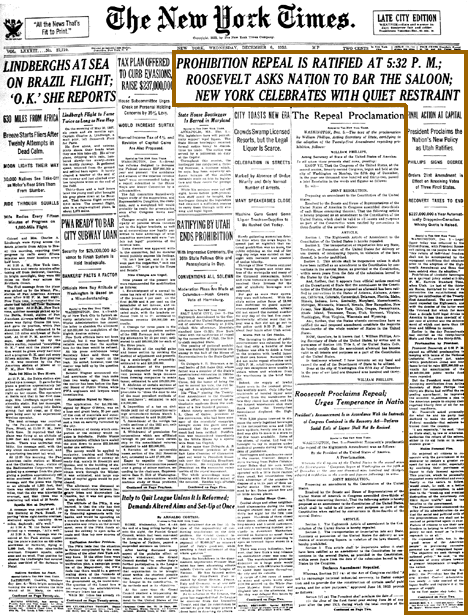
New York Times front page: 5 December 1933

Yesterday, eighty-one years ago, in 1933, the state of South Carolina voted against the 21st Amendment to the Constitution of the United States of America. Fortunately, it would be the only state to vote no, and to futile effect. *

The very next day, 5 December 1933, at 5:32 PM ET, the citizens of Utah would vote for ratification. Utah became the 36th State to do so, thus achieving the 3/4 majority of states' votes needed to enact the 21st Amendment, repealing the 18th Amendment and ending the nearly 14 year ignoble reign of Prohibition.

It had become legal, again, to manufacture, distribute, and sell alcoholic beverages ... if a state desired to do so. The 21st Amendment left to the states the right to control the importation, sale, and regulation of alcohol within each state's own borders. And, to this day, there remains a seemingly inchoate patchwork of state-by-state alcohol laws throughout the nation.

21st Amendment to the Constitution of the United States of America

Section 1. The eighteenth article of amendment to the Constitution of the United States is hereby repealed.

Section 2. The transportation or importation into any State, Territory, or possession of the United States for delivery or use therein of intoxicating liquors, in violation of the laws thereof, is hereby prohibited.

Section 3. This article shall be inoperative unless it shall have been ratified as an amendment to the Constitution by conventions in the several States, as provided in the Constitution, within seven years from the date of the submission hereof to the States by the Congress.

But in the capital of the United States: not so fast.

In his book, "Prohibition in Washington, D.C.: How Dry We Weren't", historian Garrett Peck observed that Congress wouldn't rescind Prohibition for Washington, D.C. until the following year, on 1 March 1934. Washington D.C.'s repeal legislation, although tardy, would become a template for other jurisdictions in the U.S. on how to regulate, license, and control alcohol sales, as opposed to dispensing it directly.

There's another unique facet to the 21st Amendment, as noted by beer historian Bob Skilnik
American voters, through state referendums, added the 21st Amendment to the Constitution of the United States. It was the first time in our history that a constitutional amendment was passed, not simply by the will of legislators, but instead through popular mandate, i.e., the power of the U.S. citizenry [and the only time].

Take a moment today to honor the sagacity of those Americans of eighty-one years ago. Hoist a beer, sip a whisky, drink a glass of wine. Legally.

-----more-----

Thursday, December 05, 2013

Eighty years of drink!

Yesterday, eighty years ago, in 1933, the state of South Carolina voted against enacting the 21st Amendment to the Constitution of the United States of America. Fortunately, South Carolina would be the only state to vote no, and to futile effect.

The very next day, 5 December 1933, at 5:32 PM ET, the state of Utah voted for ratification, becoming the 36th State to do so, and thus achieving the 3/4 majority of states' votes needed to enact the amendment.

With that vote, the nearly 14 year ignoble reign of that 18th Amendment, otherwise known as Prohibition, was ended. The 21st Amendment, in effect, repealed the 18th Amendment. As of today, eighty years ago, it had become legal, once again, to manufacture, distribute, and sell alcoholic beverages.

21st Amendment to the Constitution of the United States of America

Section 1. The eighteenth article of amendment to the Constitution of the United States is hereby repealed.

Section 2. The transportation or importation into any State, Territory, or possession of the United States for delivery or use therein of intoxicating liquors, in violation of the laws thereof, is hereby prohibited.

Section 3. This article shall be inoperative unless it shall have been ratified as an amendment to the Constitution by conventions in the several States, as provided in the Constitution, within seven years from the date of the submission hereof to the States by the Congress.

New York Times front page: 5 December 1933

Not so fast for the capital of the nation. In his book, "Prohibition in Washington, D.C.: How Dry We Weren't", historian Garrett Peck notes that Congress didn't rescind Prohibition in Washington, D.C. until 1 March 1934.

The 21st Amendment left to the states the right to control the importation, sale, and regulation of alcohol within each state's own borders. Washington D.C.'s repeal legislation, although tardy, would become a model for other jurisdictions in the U.S. on how to regulate, license, and control alcohol sales, as opposed to dispensing it directly. Despite that, to this day, there remains a seemingly inchoate patchwork of alcohol laws throughout the nation.

There's another unique facet of the 21st Amendment, noted by beer historian Bob Skilnik
American voters, through state referendums, added the 21st Amendment to the Constitution of the United States. It was the first time in our history that a constitutional amendment was passed, not simply by the will of legislators, but instead through popular mandate, i.e., the power of the U.S. citizenry [and the only time].

Take a moment today to honor the sagacity of those Americans of eighty years ago. Hoist a beer, sip a whisky, drink a glass of wine. Legally.

-----more-----
Sunday, April 07, 2013

Beer be Free! (80 years ago, today)

In the 11th century, King Canute ordered the ocean's tide to retreat. It didn't.

In 1893, the Supreme Court ruled that a fruit was a vegetable. Nature stated otherwise.

And, on 7 April 1933 —80 years ago today— Congress, in its collective wisdom, decreed beer to be non-intoxicating... sort of.

The 18th Amendment to the U.S, Constitution —which was ratified on 16 January 1919— had prohibited the manufacture and sale of "intoxicating liquors ... for beverage purposes". The wording left it up to Congress to define "intoxicating". Congress did so later that year, via the Volstead Act, defining intoxicating as any beverage containing greater than 0.5% alcohol by weight (the equivalent of 0.634% by volume).


National Prohibition would go into effect the following year, in January 1920, and it would be a long, dry, thirteen years until Congress would pass the Cullen-Harrison Act on 19 March 1933. President Franklin D. Roosevelt, in keeping a campaign promise, signed the bill the next day, saying, "I think this would be a good time for a beer."

A few weeks later, on 7 April 1933, the bill went into effect, declaring, in effect, that alcoholic beverages of equal to or less than 3.2% alcohol-by-weight (4.05% by volume) were to be considered as "non-intoxicating", under the requirements of the 18th Amendment. Beer, of a weak sort, had become legal, even though Prohibition still remained in effect.

Family-owned F.X. Matt Brewing, of Utica, New York, would obtain the first brewery permit in the nation to sell beer. Another family-owned brewery Yuengling, of Pottsville, Pennsylvania, would deliver a case of beer to the President at the White House. And, throughout the nation, in celebration, 1.6 million barrels of beer would be consumed in a 24 hour period. If that had been just bottled beer - which it wasn't - the happy ruck would have consumed more than 529 million bottles of beer in one day.

Considering all that beer at the ready, a question begs to be asked. Since it had been illegal to brew beer before the stroke of midnight 7 April 1933, where had all that beer suddenly come from? Regardless, the day indeed was quite the national party, and contrary to the dire predictions of the 'drys,' relatively crime-free.

To be precise, it wouldn't be until nearly eight months later, on 5 December 1933, that the 21st Amendment would be ratified, repealing the 18th Amendment, and thus Prohibition. From that date on, beers of any strength, and wines and spirits, were allowed to be produced and sold, but only at the discretion of each state within its own borders.

Anchor Cue


Today, celebrate, yet be mindful of a milestone of U.S. beer history. Enjoy a beer brewed by an independent American brewery. You won't have to limit yourself to 3.2%.

-----more-----

Wednesday, March 06, 2013

Washington D.C. Prohibition repealed!

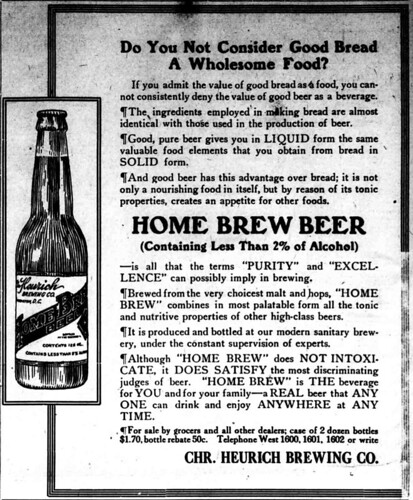
Heurich Wholesome Home Brew

An advertisement published in the Washington Herald on 7 February 1913, promoted Heurich Home Brew, a beer brewed by the Christian Heurich Brewing Company. At less than 2% alcohol-by-volume, this was pretty much a 'near beer,' and possibly a test of what the Washington, D.C., brewery might have to produce if Prohibition were ratified.

Which, regrettably, it was.

National Prohibition began on 17 January 1920, when the Eighteenth Amendment went into effect, and would continue through 5 December 1933, when it was repealed by the ratification of the Twenty-first Amendment, an interregnum that H.L. Mencken, Baltimore-based literary reporter/satirist, referred to as those "Thirteen Awful Years."

In Washington, D.C., it was even more awful.

There, local Prohibition had begun nearly three years earlier, when on 1 November 1917, Congress, under its Constitutional authority over the city, enacted the Sheppard Act, prohibiting the manufacture, distribution, and sale of intoxicating beverages within the District Of Columbia. Congress wouldn't repeal the city's Prohibition until 1 March 1934, three months after the rest of the nation.

However, although tardy, that repeal legislation would become a model for other jurisdictions in the U.S. on how to regulate, license, and control alcohol sales, as opposed to dispensing it directly.
In place of unfettered bootlegging would be alcohol licensing, regulation, taxation, and a control board. [Anti-Prohibition crusader] Rufus Lusk proposed a drinking age at eighteen, except for any alcohol with 14 per cent alcohol by volume, or higher, in which case you had to be twenty-one. It established licensing for bars, hotels, restaurants, and retail establishments to sell alcohol. ... Most states adopted similar licensing as they established Alcoholic Beverage Control (ABC) boards
Prohibition in Washington, DC: How Dry We Weren't. Garrett Peck.

How dry we were. How inchoate we remain.


-----more-----

Friday, October 14, 2011

Thank a homebrewer today!

An important milestone was reached on this day, 14 October, thirty-three years ago, 1978.

When Prohibition was repealed in 1933, lawmakers decided to again permit citizens to produce small amounts of wine and beer at home. However, due to a stenographer's error, the 1933 law failed to mention beer. Thus, even though it became legal to ferment wine at home, homebrewing remained illegal. For the next 44 years, no congressman would find it politically expedient to demand the right of homebrewing for his or her constituents.

That is until January 1977, when Barber Conable, a House of Representatives Republican from New York, would introduce bill HR 2028. Alan Cranston, a Democrat from California, introduced a similar bill in the Senate, along with Senate co-sponsors former NASA astronaut Senator Harrison Schmitt (R) of New Mexico (R), Senator Dale Bumpers (D) of Arkansas, and Senator Mike Gravel (D) of Alaska.

The next year, 1978, these bills would become House Resolution 1337 and Senate Amendment 3534. On 14 October 1978, President Jimmy Carter signed the bill into law.

The law did not actually legalize homebrewing. Rather, it revoked the federal excise tax on homebrew, for up to 100 gallons per adult per year for a total of 200 gallons per household per year. (200 gallons is the approximate equivalent of 89 cases of beer.) Actual legalization would require state-by-state approval, as provided under the 21st Amendment to the Constitution. Only Alabama Aand Mississippi still explicitly forbid the practice. [UPDATE: As of May 2013, homebrewing is now legal in all 50 states.]

Homebrew and 'craft brew' had a strong correlation in those days. In 1978, there was only one 'craft' brewery. In 1981, Sierra Nevada Brewing Company began its operations - founded by two homebrewers - and the craft beer revival had begun in earnest.

Buy a homebrewer a beer today, or better yet, drink one of hers. And, then ... thank her!

Wednesday, November 03, 2010

That couldn't possibly happen again.

Ninety-four years and two days ago, 1 November 1916, the Commonwealth of Virginia went 'dry', enforcing statewide prohibition against the sale and importation of intoxicating beverages. The enabling legislation, the Mapp Act, prohibited all malt production, even of non-alcoholic beer, for sale in-state. Prohibition went national, nearly four years later, in January, 1920.

That couldn't possibly happen again, could it?

Keg boneyard


***************